
Coinbase released its second-quarter earnings on July 30, 2026, reporting total revenue of $1.22 billion, down 14% from the previous quarter and 19% from a year earlier. Trading revenue was $599 million, subscription and services revenue was $555 million, and the company posted a net loss of $359 million.
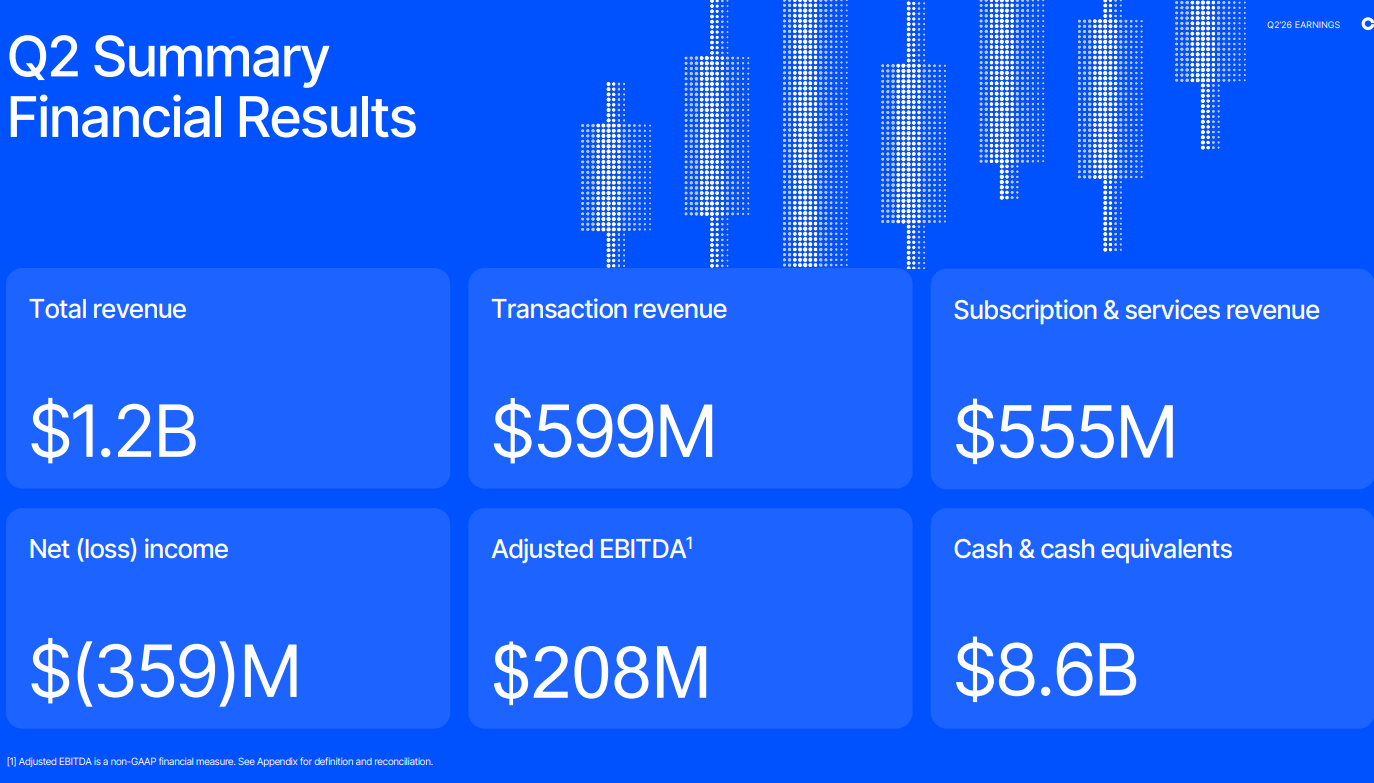
Cash and cash equivalents stood at $8.6 billion at quarter end, including $2.96 billion in payment stablecoins, $3.09 billion in money market funds and short-term Treasuries, and $2.47 billion in bank cash. Shares of COIN were at $163.58, down 5.12% in after-hours trading.
Business mix keeps shifting
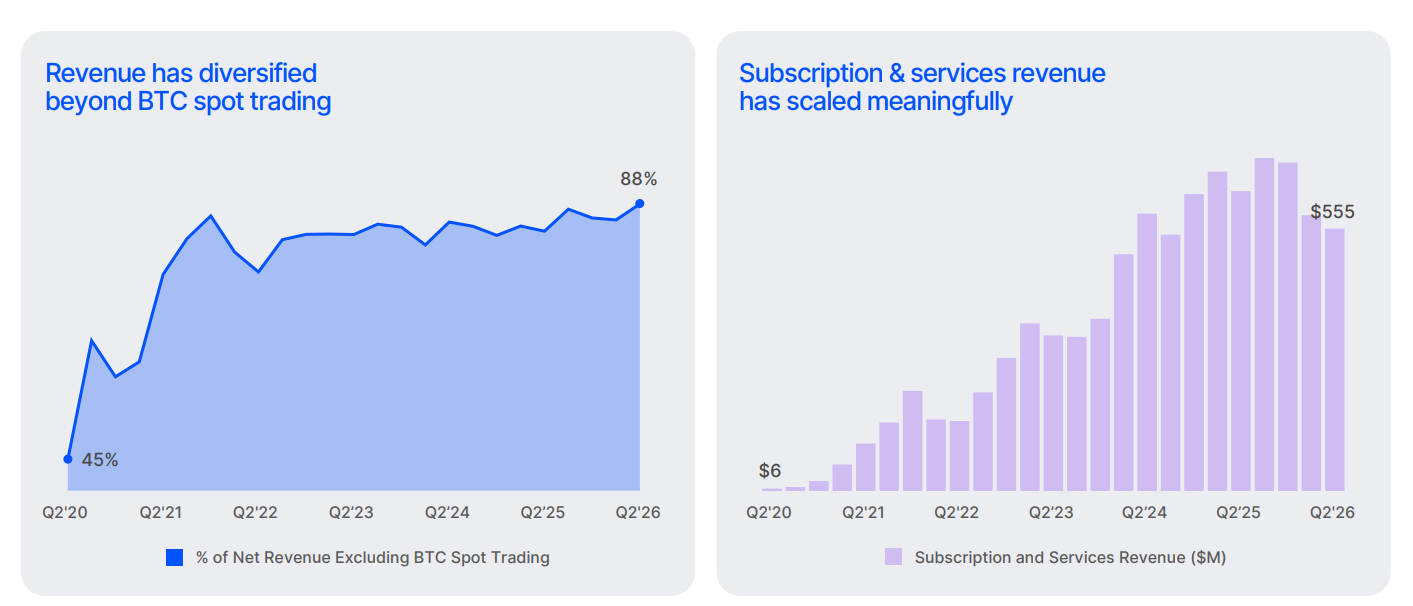
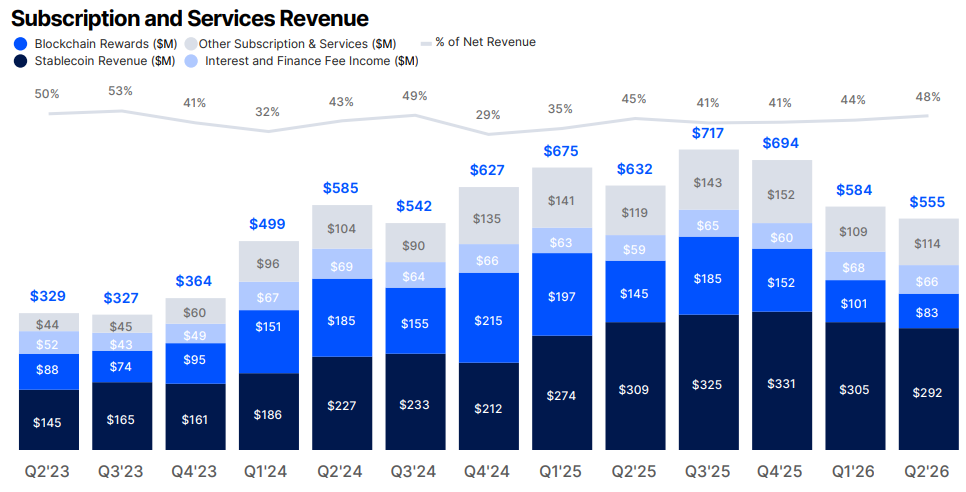
The earnings report showed a continued change in Coinbase’s revenue mix. Net revenue excluding Bitcoin spot trading rose from 45% in the second quarter of 2020 to 88% this quarter. Subscription and services revenue increased from $6 million in that earlier period to $555 million this quarter, equal to 48% of net revenue.
Stablecoin revenue contributed $292 million, driven mainly by record USDC holdings of $20 billion. Blockchain rewards brought in $83 million, while interest and finance fee revenue totaled $66 million. The figures show that transaction fees are no longer the company’s only major earnings pillar.
Prediction markets and new products added to revenue
Coinbase said its so-called Everything Exchange has started to make a measurable contribution. Driven by sports markets tied to the NBA playoffs and the World Cup, prediction market contracts and revenue rose 106% quarter over quarter, and annualized revenue has now exceeded $100 million.
The newly launched Crypto Binaries product also posted sharp growth during the quarter. Average daily traders increased threefold, and average daily revenue increased fourfold.
Derivatives trading volume was broadly flat from the previous quarter, while the broader derivatives market fell by a double-digit percentage. Spot share gains were concentrated in fiat-to-crypto channels, and derivatives benefited from the continued penetration of perpetual futures.
Market share rose even as industry volumes fell
Coinbase’s share of crypto trading volume reached 10.3% in the quarter, up from 9.1% in the first quarter and the highest level on record. That marked a third straight quarter of market share growth.
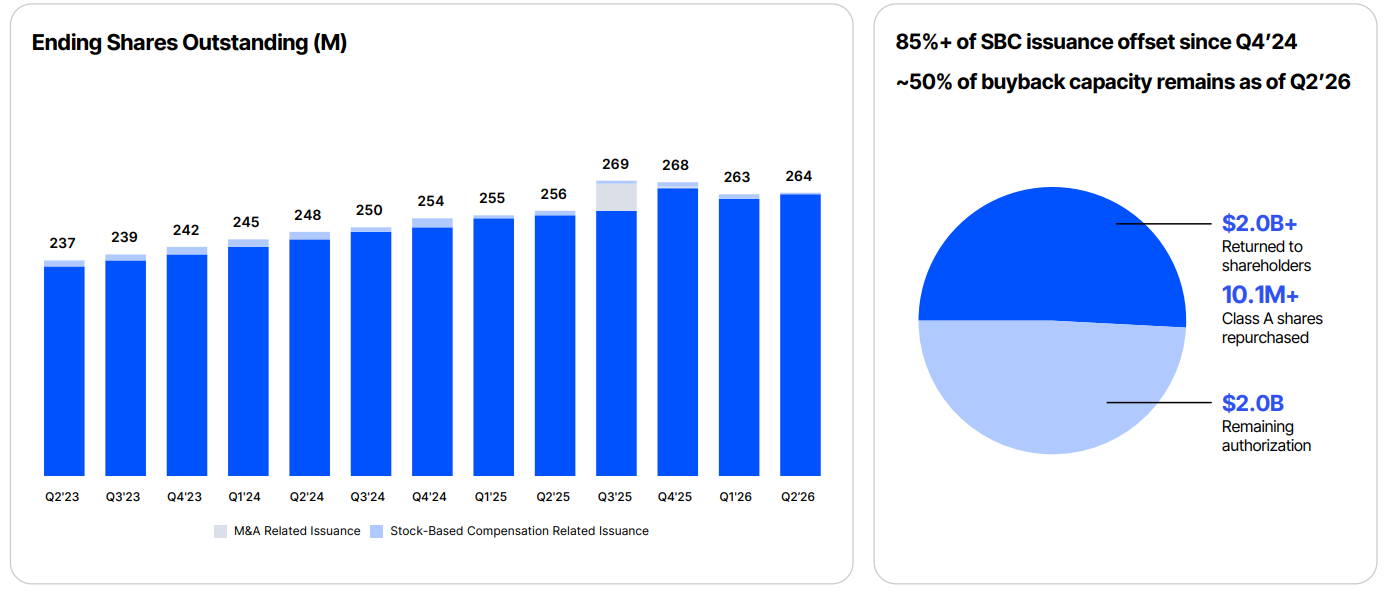
The company disclosed that since the fourth quarter of 2024, it has repurchased more than 10.10 million Class A shares and returned more than $2 billion to shareholders. Coinbase said it still has $2 billion remaining under its current repurchase authorization.
Base and USDC remained central to the on-chain push
Stablecoins and on-chain activity took up a large part of the quarter’s discussion. Coinbase said average USDC holdings reached $20 billion, up 44% year over year and representing more than 30% of circulating supply. Over the past year, the company captured about 50% of the economics tied to USDC.
The report said the conditions for automatic renewal of Coinbase’s partnership with Circle had been met and the agreement will renew on the same terms. Coinbase also said it is advancing a multi-stablecoin strategy and has become an initial member of the Open Standard Consortium.
Base stablecoin transfer volume increased sevenfold from a year earlier. In Agentic Finance, more than 99% of on-chain agentic commercial activity used USDC, more than 90% of agentic stablecoin volume took place on Base, and more than 97% of on-chain agentic transactions used the x402 protocol.
Average borrowing balances on Base reached $1.491 billion, up by more than $1 billion year over year. Coinbase’s native wrapped assets, including cbBTC and cbETH, exceeded $5 billion in assets. The company also said Base became the leading chain by Bitcoin DEX spot trading volume.
Macro conditions still weighed on trading revenue
Coinbase also laid out the pressure coming from the broader market backdrop. Industry-wide spot trading volume fell sharply in the second quarter, prices declined, and volatility compressed, all of which weighed directly on transaction revenue. Platform assets fell to $246 billion, equal to 11.2% of global crypto market capitalization.
Institutional transaction revenue dropped 26% quarter over quarter, broadly in line with market conditions. Other transaction revenue also saw weaker contribution from Base-related activity.
Subscription and services revenue now accounts for close to half of the business, but it still did not fully offset the volatility in trading revenue. Headcount fell from 4,988 at the end of the first quarter to 4,321, and the company narrowed its full-year adjusted expense guidance.
The report’s central tension was clear in the quarter’s numbers: Base has established a measurable lead in stablecoin settlement and agentic use cases, but the pace of revenue growth from on-chain and newer businesses was still not enough to fully close the gap left by shrinking trading fees during a weak-volume quarter. Coinbase remains exposed to changes in crypto prices, volatility, and overall risk appetite, all of which feed quickly into trading revenue and asset balances.