
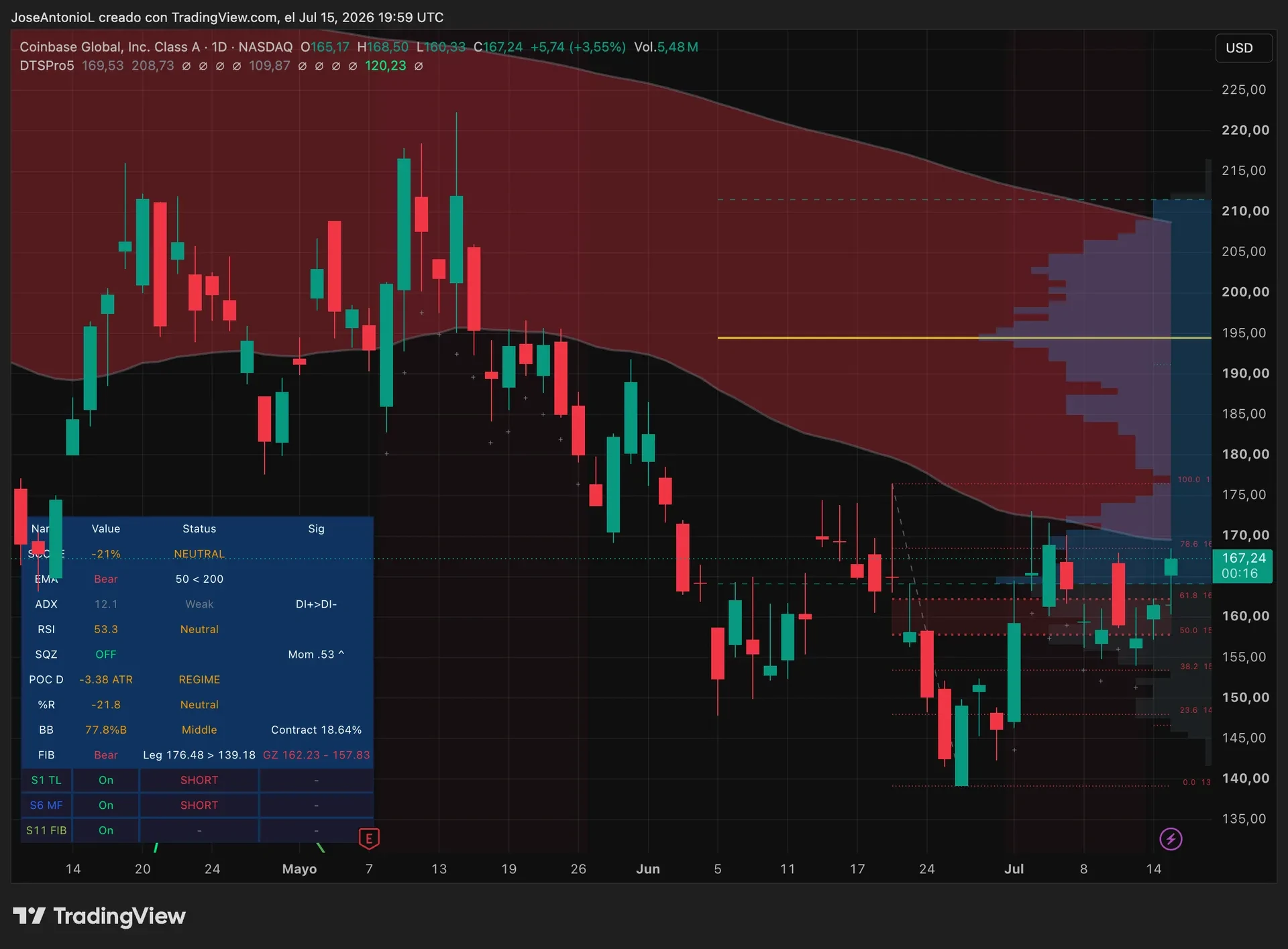
Coinbase shares have fallen nearly 30% this year, but a new Wall Street note argues the stock may be close to a bottom. William Blair lowered its revenue and earnings expectations for Coinbase while keeping an outperform rating, and the market reaction was positive: Coinbase (COIN) and Circle (CRCL) both rose about 3% to 4% on the day.
The Chicago-based investment bank’s central view is straightforward. Most of the negative news, it said, is already priced in, and investors should continue to hold Coinbase.
William Blair cuts forecasts but keeps its outperform rating
William Blair reduced its 2026 revenue forecast for Coinbase by 12% and its 2027 revenue forecast by 13%. It also cut adjusted EBITDA estimates for both years by 34%.
Analysts Andrew Jeffrey and Adib Choudhury said Coinbase’s earnings should bottom in the second half of 2026 and improve in 2027. They said investors should keep holding the stock as spot crypto trading volumes and Bitcoin approach a bottom together.
The firm expects Coinbase’s total trading volume to decline about 44% this year to $669 billion. In 2027, it sees trading volume rebounding by more than 32%.
William Blair said this cycle differs structurally from 2022. Its report pointed to several conditions that were not in place four years ago: the arrival of spot Bitcoin ETFs, continued institutional inflows into the sector, and a regulatory framework that is becoming more established.
Base, derivatives, and prediction markets are part of the bullish case
The report also highlighted Base, Coinbase’s Ethereum layer-2 network, as a potential core profit driver. William Blair said derivatives and prediction markets are broadening the company’s revenue base, making the business less dependent on spot trading alone.
Retail derivatives by themselves generated more than $200 million in annualized revenue in the first quarter, according to the report.
That said, not every firm is optimistic on COIN in the short term. Piper Sandler analyst Patrick Moley cut his price target on the stock to $155 from $170 and maintained a neutral rating.
Moley said the key themes for the second quarter are prediction markets and perpetual futures. He added that World Cup events have driven a sharp jump in prediction-market activity, while the third quarter is likely to bring closer scrutiny of the competitive pressure tied to perpetual contracts.
COIN, Bitcoin, and Circle have all pulled back this year
COIN is down nearly 30% year to date, compared with about 26% for Bitcoin over the same period. Circle, which listed on the New York Stock Exchange in June 2025 at $31 a share, has fallen 20% since the start of this year.
The valuation debate around Coinbase is closely tied to a broader market question: whether Bitcoin’s spot market is actually close to a durable bottom. The article pairs the Wall Street view with technical and on-chain signals that are being watched for confirmation.
John Bollinger says Bitcoin is forming a “W” bottom on the daily chart
On the technical side, veteran analyst John Bollinger, the creator of Bollinger Bands, has been signaling since early July that Bitcoin is building a key bottoming pattern on the daily timeframe.
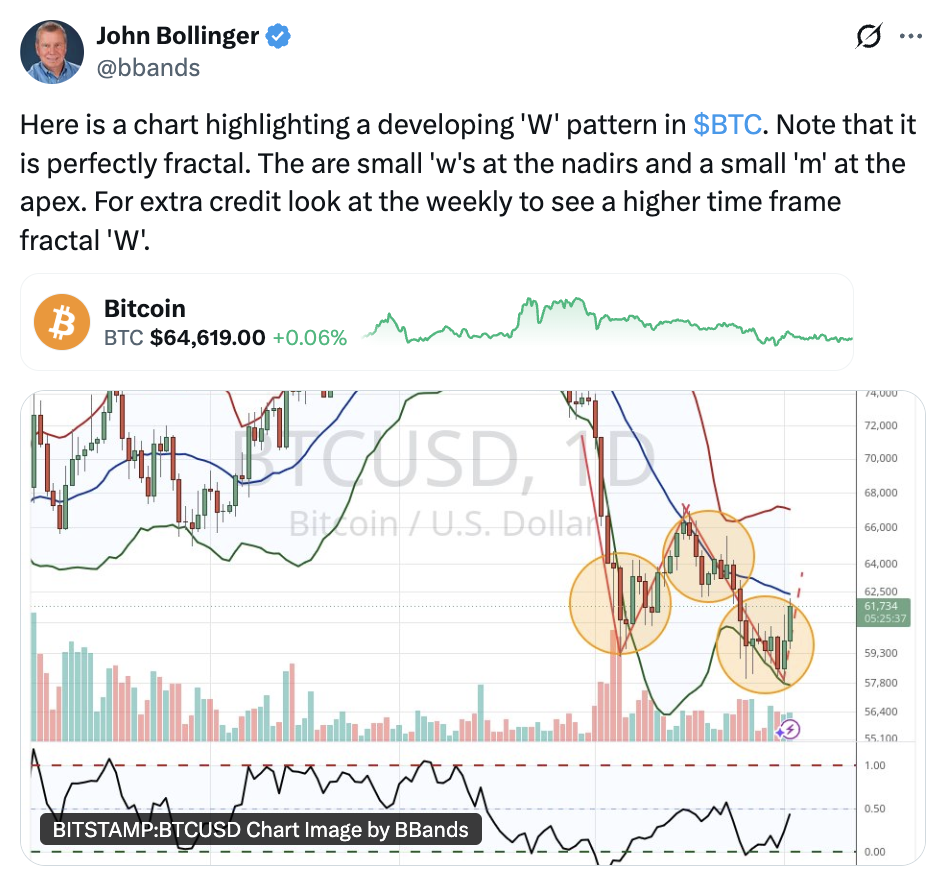
In a post on X on July 2, Bollinger said price action had formed a “W” double-bottom reversal structure. In his description, the pattern consists of two lows with a rebound in between, and a bullish trend would be confirmed if price breaks above the resistance level between those two lows.
He said the current setup is a standard fractal structure, with smaller W formations nested inside a larger one, and that the same pattern can also be seen on the weekly chart. He also noted the uncertainty. During this bear market, similar bullish formations have appeared before and were later broken by selling pressure.
In his latest comments, Bollinger said that if the current W bottom is completed, he would treat it as a clear trend-reversal signal. He described it as his clearest bullish call so far, one that would suggest the move is more than a short-term bounce.
Earlier this year, Bollinger disclosed that his investment vehicle held a long Bitcoin position. He said his view was aligned with that position. Even so, the broader technical trend for Bitcoin has not fully turned, though downside momentum has continued to fade.
Glassnode says long-term-holder selling pressure peaked two weeks ago
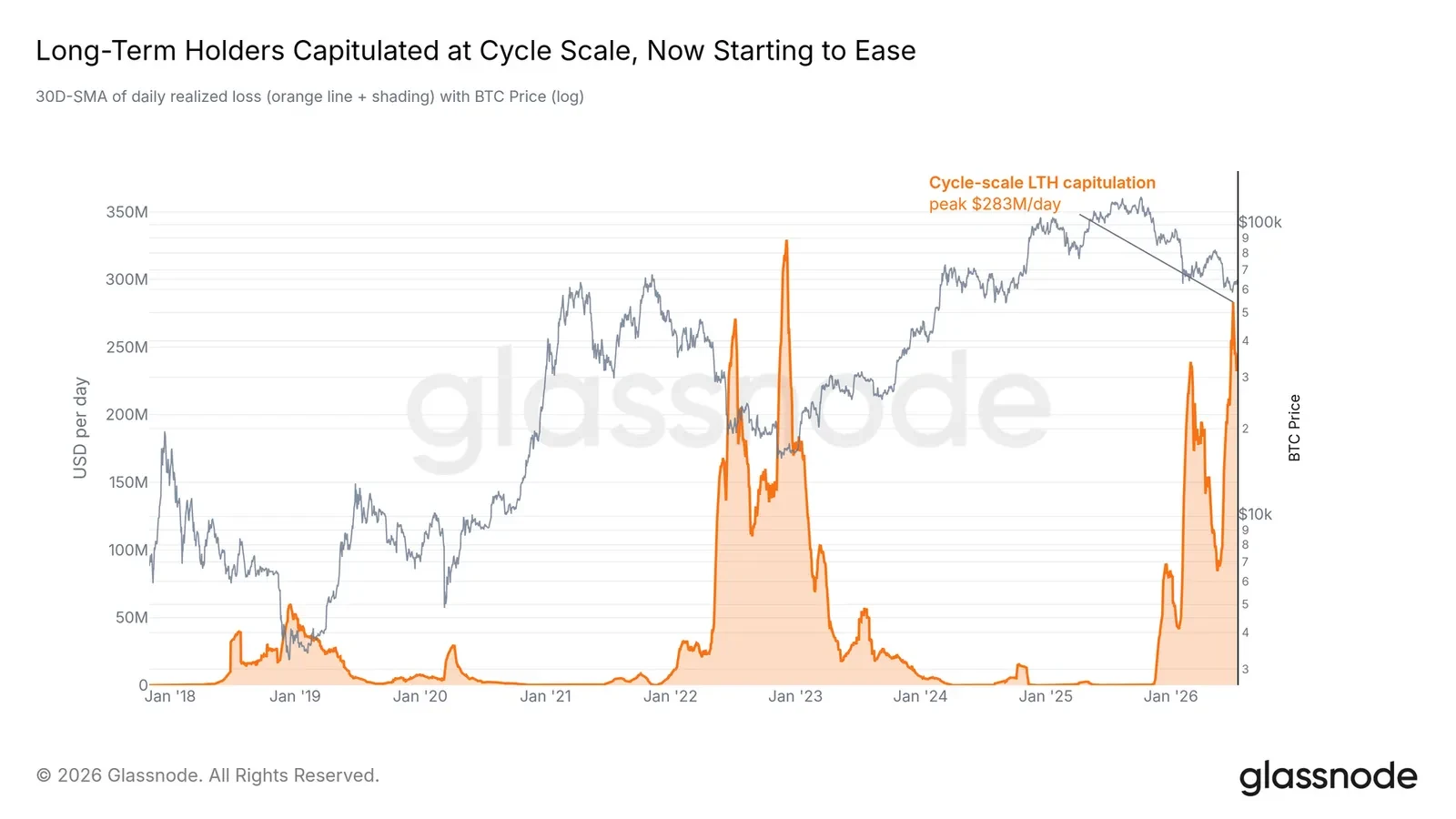
Glassnode said in its latest weekly report that the market’s main source of selling pressure this year — panic selling by long-term holders — peaked two weeks ago and has since started to ease. The firm said the metric filters out intra-chain transfer noise and tracks actual selling by long-term holders, marking the first downward inflection point of this cycle.
According to the report, the price lows seen in June attracted heavy buying. Glassnode said wallets of different sizes were accumulating Bitcoin during the dip. It also said Bitcoin’s negative correlation with the U.S. dollar index has deepened, while its correlation with U.S. equities has continued to weaken. As one example, the article noted that after Tuesday’s inflation data came in below expectations, Bitcoin outperformed the major U.S. stock indexes.
Still, both on-chain analysts and Wall Street firms are focused on the same unresolved issue: the Bitcoin spot market has not yet shown sustained buying demand strong enough to confirm a reversal.
Derivative positions continue to be closed, long-term-holder selling pressure is gradually easing, and panic premium in the options market is narrowing. But fresh capital has not entered at scale. William Blair’s view is that the real turning point comes in 2027, after Coinbase trading volume drops 44% this year and then rebounds 32% next year.