
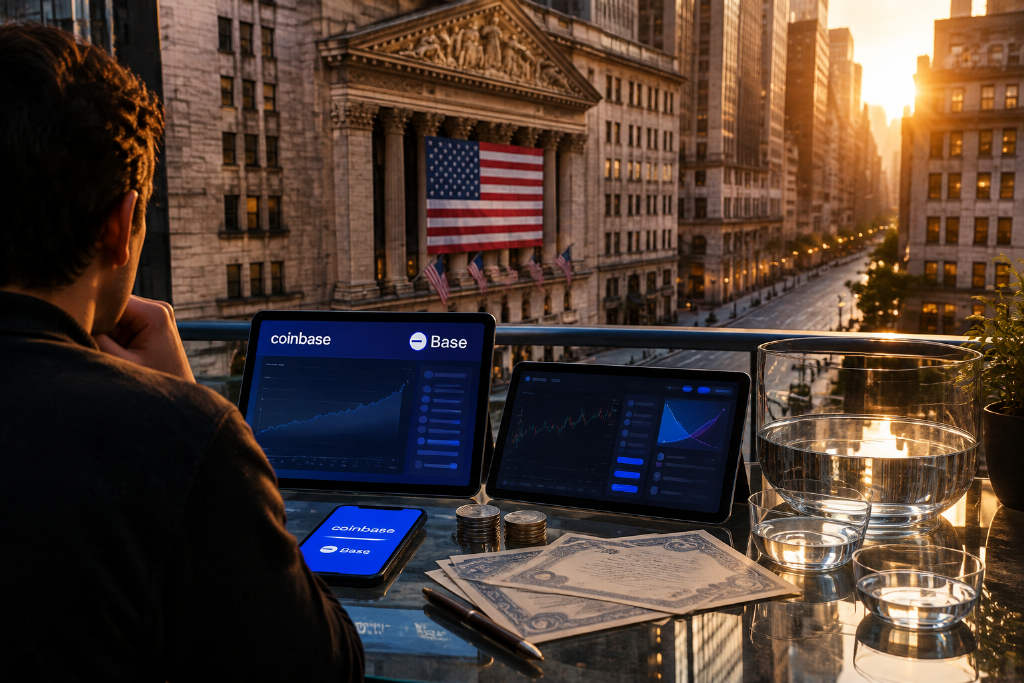
Coinbase stock tokens on Base have logged more than $1 billion in cumulative volume, but that headline figure does not answer the question holders care about most: how much selling the market can actually absorb, and at what price, when U.S. stock markets are closed.
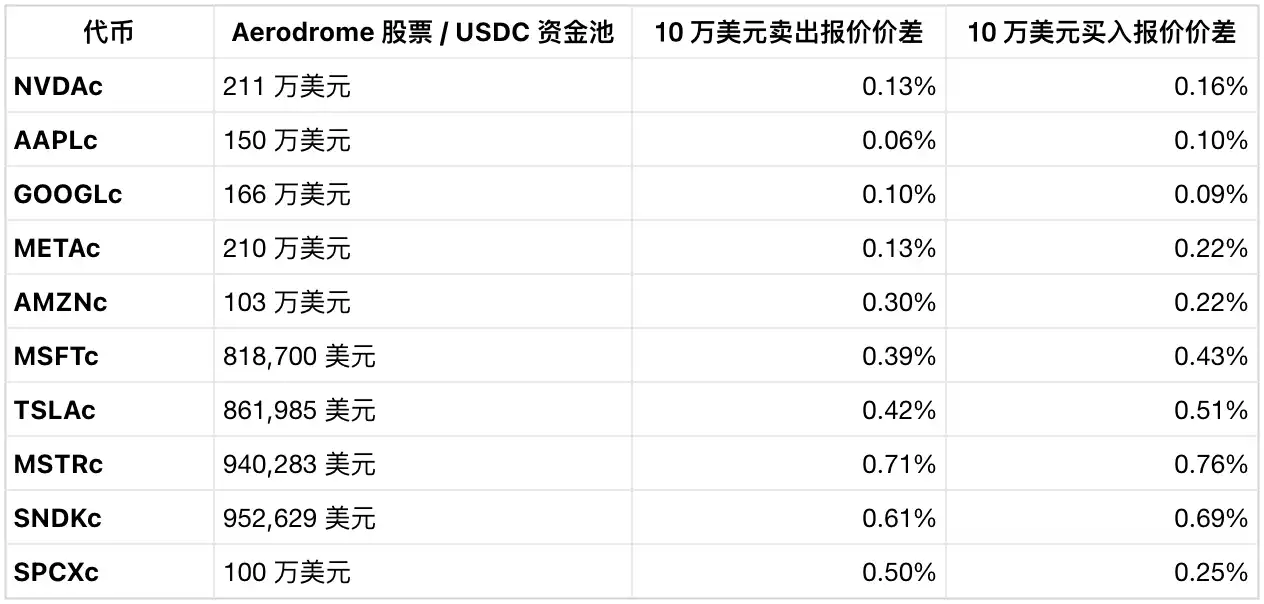
A pre-market test on Sept. 23 showed that all 10 Coinbase-issued stock tokens on Base had simulated quote paths for buy and sell orders of roughly $100,000 each. Estimated sale proceeds came in 0.06% to 0.71% below token valuations shown by KyberSwap. Those figures reflect point-in-time, single-order routing estimates. They do not show how the market would handle several concentrated sell orders hitting at once.
$1 billion in cumulative volume is not the same as standing buy-side depth
Data from Dromos Kitchen’s stock-token dashboard showed cumulative trading volume of about $1.02 billion and total market capitalization of $19.82 million as of Sept. 23. The community-built dashboard also carries a note saying the data may be incomplete.
That distinction matters. Volume is an accumulation of past trading activity, not a live measure of how much capital is waiting to take the other side of a large sell order at any given moment.
During the review, the 10 core Aerodrome stock-token/USDC pools showed a combined on-paper balance of about $12.97 million. Individual pools ranged from roughly $818,700 for MSFTc to about $2.11 million for NVDAc. Those balances include both stock tokens and USDC, so the number alone does not reveal how much buying power is available within any specific price band to absorb sales.
What the $100,000 quote test did and did not show
The exercise paired Aerodrome pool balances with KyberSwap route estimates for token swaps. The quoted spread represented the degree to which the route-estimated dollar output fell below the input valuation. It did not compare token prices directly with the underlying U.S. stocks, and it did not represent completed trades.
The methodology was specific. Pool data came from 10 Aerodrome Slipstream 3 stock-token/USDC records at 08:00 UTC. KyberSwap routing data was pulled from 08:02:01 to 08:02:42 UTC. Based on displayed token prices, each sale size was roughly equal to $100,000, though KyberSwap’s own input valuation had small deviations. Values were rounded, gas costs were calculated separately, no live trades were sent, and any API call would still require transaction construction afterward.
At around $10,000 per token trade, quoted sell-side slippage was only 0.01% to 0.12%. Once order size rose to $100,000, spreads generally widened. Some routes aggregated liquidity from Aerodrome and other sources, so the estimate could reflect more than one pool. That extra liquidity can change quickly if market makers or liquidity providers adjust quotes.
Aerodrome liquidity depends in part on incentives
Part of the liquidity shown in those pools is supported by incentives designed to retain liquidity providers. Under Aerodrome’s pool-governance rules, liquidity providers that stake positions to receive AERO token emissions give up direct trading fees. Those fees go instead to users who vote on where emissions are directed. Fee income and AERO rewards are separate economic streams.
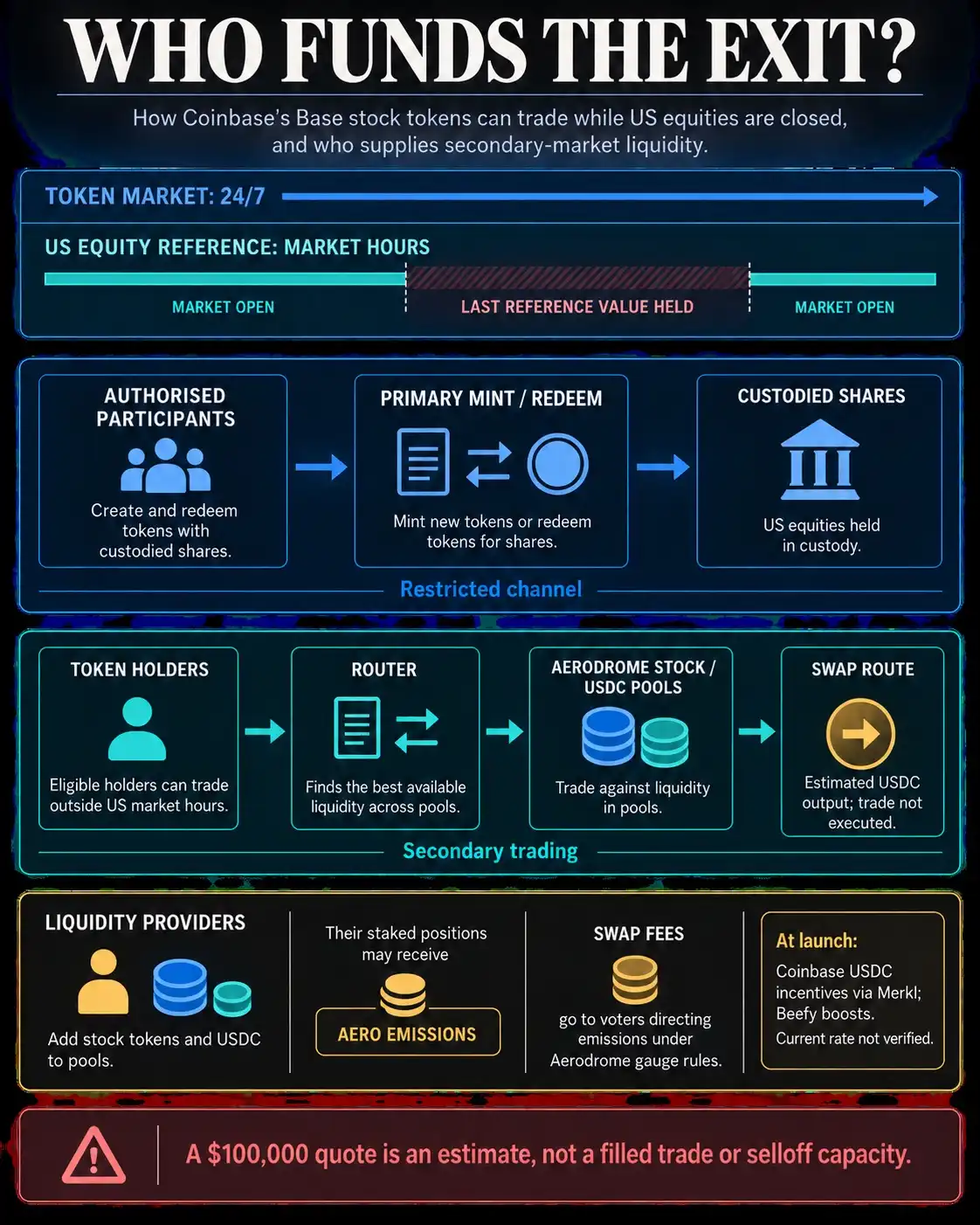
During the August launch phase, Beefy said Coinbase was providing USDC incentives every two weeks through Merkl, while Beefy layered on Aerodrome token emissions as additional rewards. That described the early-stage liquidity program. It did not establish that every pool now has a verifiable, stable source of yield.
Regardless of historical volume, liquidity providers can withdraw capital if incentives fade or governance votes move emissions toward other assets. That matters more when the tokens keep trading after the underlying stock market has closed.
After hours, secondary-market liquidity has more control over execution
Coinbase stock tokens continue trading 24/7 even when U.S. equities are closed, with Aerodrome pools serving as the main secondary-market liquidity venue. The quotes available on-chain are still estimates. They do not guarantee that holders can exit large positions at those levels.
Base documentation says the tokens are backed by underlying shares held in regulated custody accounts and are available only to eligible users outside the United States. Developer documentation also says secondary-market trading is permissionless but subject to address risk controls, while primary minting and redemption of the underlying stock exposure is limited to authorized participants.
That structure leaves ordinary holders dependent on the secondary market when stocks are not trading. Base also says Chainlink equity oracles keep the prior trading day’s price during non-market hours, while on-chain token trading continues uninterrupted. If holders sell after the close, the oracle remains at the old price and the immediate execution price is set by secondary-market liquidity providers, not by a redemption channel open to the public.
The Sept. 23 test showed quotes exist, not that depth is durable
The Sept. 23 routing test showed that even with modest pool sizes, a single order of about $100,000 could still receive a simulated quote. That is a useful data point, but it falls short of proving stable depth for larger or clustered exits.
When oracle prices are frozen outside market hours, quote quality can change sharply if AERO governance votes shift, liquidity is withdrawn, or company-specific news breaks after the bell. More than $1 billion in cumulative volume may look impressive. It does not replace a direct assessment of live liquidity structure.
For holders of Coinbase stock tokens, the practical issue is not the size of past turnover. It is what price the secondary market will still offer when U.S. equities are shut, primary redemption is unavailable to ordinary users, and selling pressure arrives anyway.