
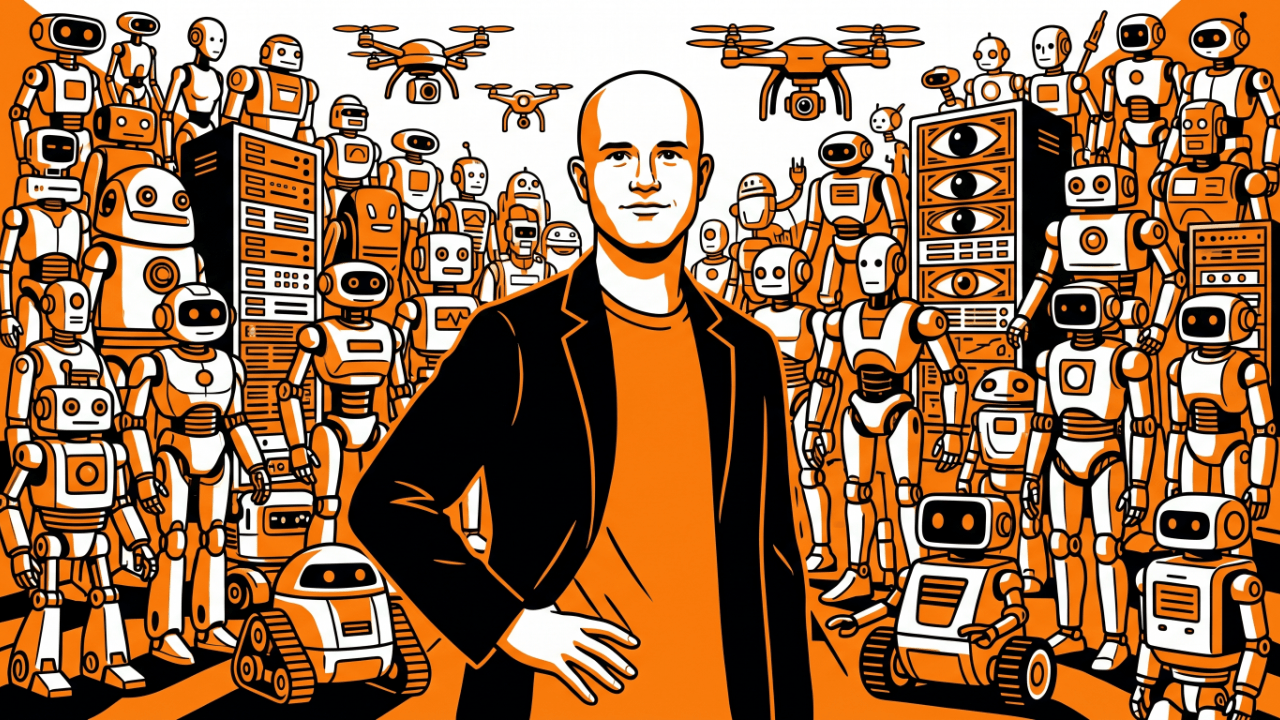
Coinbase is testing AI agents that appear inside Slack and email as part of its workplace setup, according to co-founder and CEO Brian Armstrong. The first two agents are modeled on former Coinbase figures Fred Ehrsam, the company’s co-founder, and Balaji Srinivasan, its former CTO.
Armstrong said the agents are designed to show up at work like human teammates. He described the initial release of two agents as a good start and said the program is expected to expand. His stated next step is to let any employee launch agents modeled after other employees, though he also argued these systems should eventually have names of their own rather than be framed as someone else’s “digital twin.”
First rollout draws from early Coinbase leadership
Ehrsam helped found Coinbase, while Srinivasan later served as CTO and authored “The Network State: How to Start a New Country.” Coinbase engineer Travis Bloom said he discussed a new idea with the Srinivasan agent and that the exchange helped “crystallize” his vision.
The test moves AI beyond a background productivity tool. Instead of staying limited to text generation or back-office automation, these agents are being placed directly into company communication channels and daily workflows. That changes the role they occupy inside the firm.
Workplace use case expands as accountability questions remain
Based on Armstrong’s comments, Coinbase is treating AI agents as a possible new layer within internal operations. If the experiment expands, the model could be watched closely by other crypto firms and by technology companies outside the sector.
The rollout has also raised concerns. Critics cited a basic issue: accountability for decisions or actions taken by these agents may be difficult to assign, especially because the systems do not directly represent a human employee even when they appear in workplace environments as if they were one. Coinbase’s public comments so far focus on the test itself and the direction of the project, not on any detailed accountability framework.