
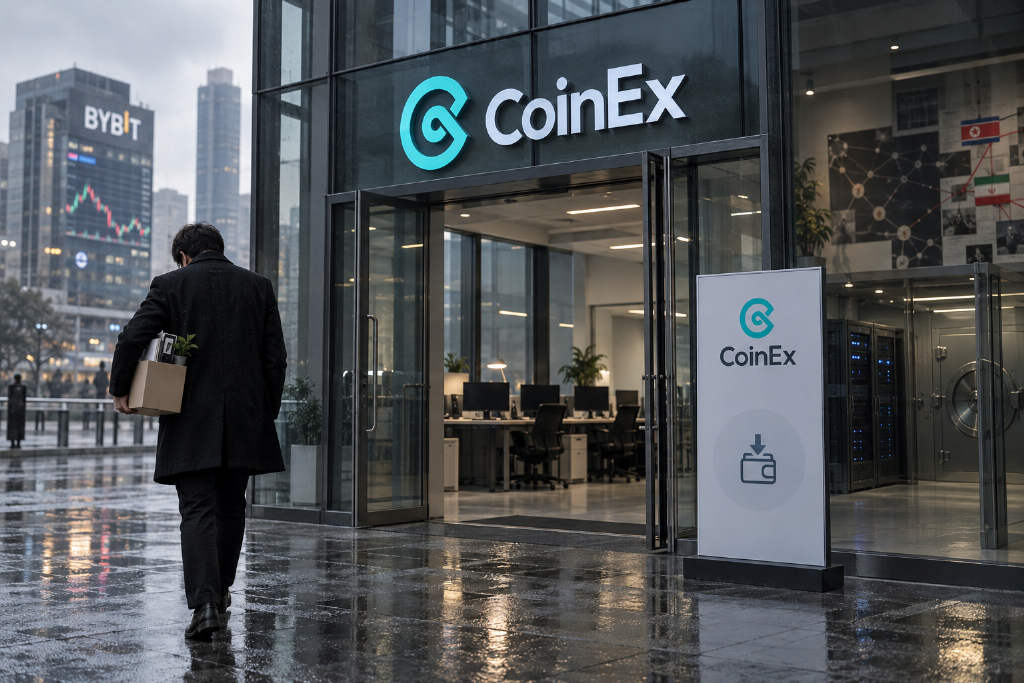
CoinEx will shut down, founder Yang Haipo said on Sept. 15, framing the decision in blunt terms: "Taking unlimited risk for limited income is no longer a rational choice." He said he turned down offers to sell the exchange and chose an orderly closure instead. User assets remain 100% withdrawable, reserves are above 100%, and withdrawals will stay open until Dec. 22.
The article’s central point is that CoinEx’s manner of exit is only part of the story. The deeper issue is what pushed the exchange there.
An on-chain chain reaction
According to the article, the market has circulated a cause-and-effect sequence that sounds improbable at first, but each link has on-chain evidence behind it.
In February 2025, North Korea’s Lazarus Group stole $1.5 billion from Bybit, described in the piece as the largest single theft in crypto history. Bybit did not collapse. Ben Zhou covered the hole with bridge financing, and withdrawals continued. But the stolen funds then began moving through the ecosystem.
The ETH was routed through THORChain and a range of DeFi protocols in a multilayer laundering process. The article says related swap volume on THORChain during that period approached $3 billion. After the laundering phase, TRM Labs traced the funds to two wallets belonging to Iran’s central bank. In the article’s telling, money stolen from Bybit ended up flowing into Iran’s treasury. It also cites analysis saying the funds may have been used to buy oil and support other sanction-evasion trade activity.
That money then needed a route into the broader crypto market. Nobitex, described as Iran’s largest crypto exchange, served as that gateway. From 2024 onward, the article says, CoinEx replaced Binance as Nobitex’s largest offshore trading counterparty. In 2025 alone, fund flows between Nobitex and CoinEx exceeded $763 million.
TRM Labs said in a report published on June 25, 2026, and covered the same day by The Wall Street Journal, that Iran-linked wallets had processed $3.84 billion through CoinEx since 2019. Of that amount, about $67 million was directly traceable to accounts tied to Iran’s central bank and had on-chain links to the stolen Bybit funds.
Not sanctioned, but drawn into scrutiny
Three weeks before that report, on June 2, 2026, the U.S. Treasury’s Office of Foreign Assets Control sanctioned four Iranian exchanges — Nobitex, Bitpin, Wallex, and Ramzinex — under an operation called Economic Fury. The article says observable crypto trading volume in Iran fell 78% after those sanctions.
CoinEx was not placed on the sanctions list, but it was named. Yang responded by saying CoinEx did have Iranian users, but no ties to the Iranian government, and had already begun blocking new sign-ups from Iranian IP addresses. The Wall Street Journal report also did not say CoinEx had intentionally facilitated illicit transfers.
Even so, the article says the damage was already done. For a mid-sized exchange, the pressure of possible scrutiny from the U.S. Treasury and OFAC can be costly on its own. Legal fees, sanctions compliance audits, and geopolitical risk reviews all add up. In that context, Yang’s phrase about unlimited risk and limited income carried a clear message.
The piece summarizes the chain this way: Lazarus first stole CoinEx’s money directly in 2023, then stole Bybit’s funds in 2025, and after those Bybit funds circulated through laundering channels and Iran-linked wallets, they reappeared in flows tied to CoinEx in 2025 and 2026, bringing regulatory and legal pressure with them.
CoinEx is closing while still able to repay users in full
The article highlights several details from Yang’s announcement.
- Reserves above 100%: CoinEx said it chose to close while still able to meet all user claims in full, rather than after becoming insolvent.
- No sale of the exchange: Yang said he had received acquisition offers but rejected them. He said closing the platform while ensuring full withdrawals was the only way to live up to user trust. Selling the exchange, in his view, would have handed user assets and data to an unknown new owner.
- CET buyback: CoinEx said it would repurchase all remaining CET at 0.005 USDT. The market price before the announcement was about 0.00466 USDT, so the offer stood slightly above market. Any CET not withdrawn after Sept. 29 will be automatically converted to USDT at that price.
- ViaBTC and CoinEx Wallet continue independently: The mining pool and wallet businesses will keep operating and are not affected by the exchange shutdown.
- A three-month withdrawal window: Users can withdraw assets from Sept. 15 to Dec. 22. After Dec. 22, any unclaimed USDT will move to independent custody and incur a 5% monthly custody fee, though users can still claim those funds until Aug. 22, 2028.
A contrast with Bitmart
The article places CoinEx’s exit beside Bitmart’s and argues the difference is stark.
Bitmart said on July 26, 2026 that it would carry out an orderly shutdown and that withdrawals would remain available. Two weeks later, users said their withdrawal requests had been frozen. One user claimed that $10.1 million in assets could not be withdrawn at all. Another said Bitmart released just $5 from a $24,000 withdrawal request.
On-chain monitoring group Lookonchain reported that in the first 24 hours after Bitmart’s shutdown announcement, only 58 wallets successfully withdrew a combined roughly $805,000, and for eight of those hours, no withdrawals were processed at all.
After two weeks of silence, founder Sheldon Xia denied that he had fled and said the company was reviewing funds and considering court proceedings and a third-party audit. He then went quiet again. By late August, Bitmart had hired White & Case as restructuring counsel and softened its earlier wording, saying a full shutdown was only one option and hinting at a possible creditor distribution process.
The article also points back to Bitmart’s 2021 hack, when $196 million was stolen and the company promised full compensation. It says many users still claim they were never repaid. In that comparison, CoinEx and Bitmart both moved toward closure in 2026, but in very different ways: CoinEx announced its exit while still able to repay users in full and gave them a three-month withdrawal period, while Bitmart said withdrawals were normal even as users reported that funds were effectively frozen.
Pressure on mid-sized exchanges
The article ends by arguing that CoinEx is unlikely to be an isolated case.
In its view, the Bybit hack accelerated tighter oversight and reinforced the concentration of liquidity at the largest venues. Compliance costs are rising, while trading volume keeps concentrating at Binance, Coinbase, OKX, and other major platforms. That leaves less room for smaller and mid-sized exchanges to operate.
Yang chose to shut CoinEx while the platform still had the funds to make users whole. The article leaves open whether the next exchange founder to make the same decision will have the same room to do it.


