

Most affluent investors across seven major economies already hold digital assets and many plan to add more, according to a new survey from CoinShares. The study said crypto accounts for about 10% of their portfolios on average.
Majority ownership across seven countries
The survey covered 2,230 investors in the United States, United Kingdom, France, Germany, Italy, Sweden and Switzerland. Each respondent had at least $500,000 in investable assets.
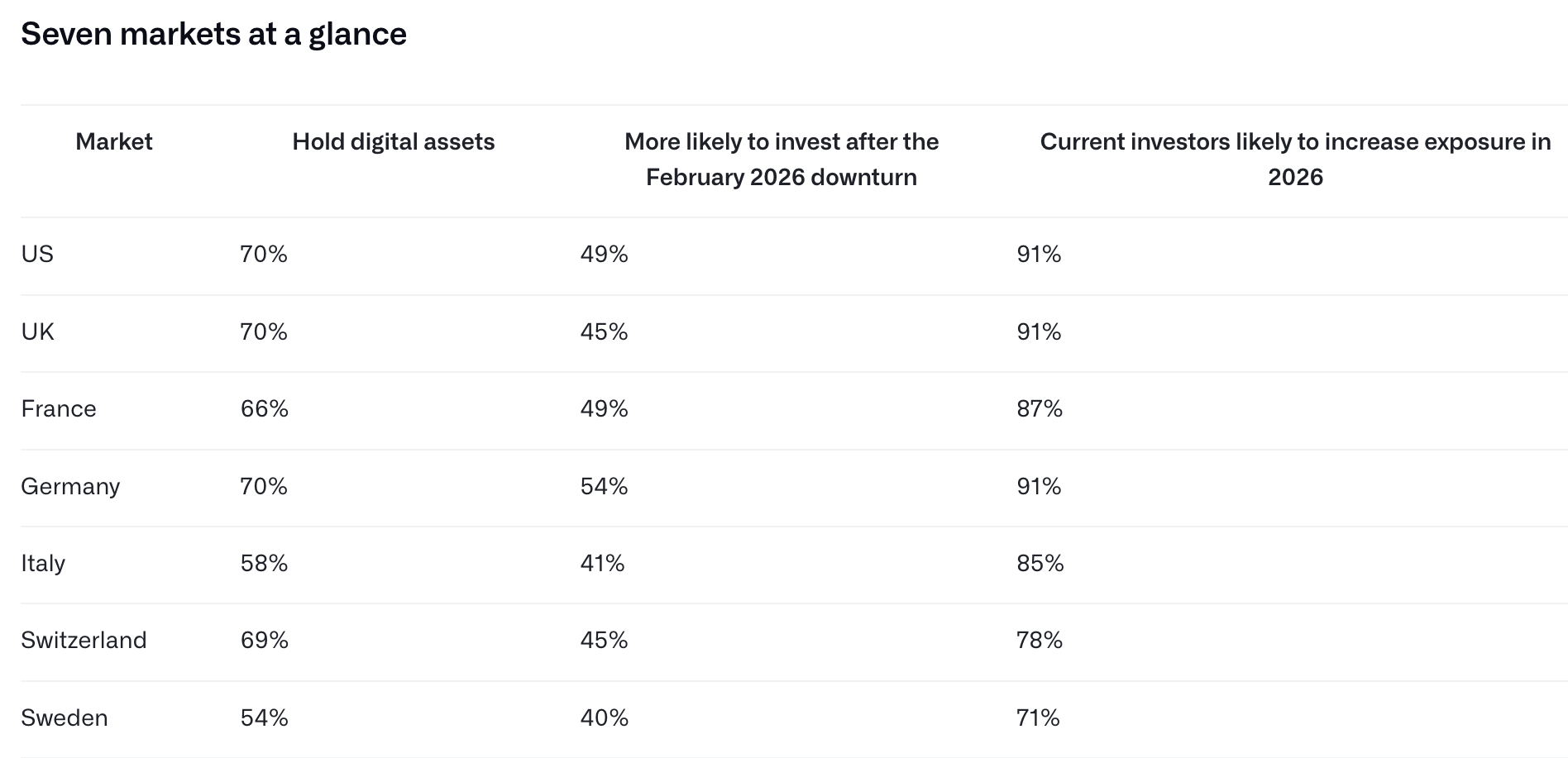
CoinShares found that a majority of affluent investors in all seven countries hold digital assets. Ownership ranged from 54% in Sweden to about 70% in the US, UK, Germany and Switzerland.
In five of the seven countries, at least 85% of current digital asset investors said they planned to increase exposure in 2026. The figure reached 91% in the US, UK and Germany.
The February 2026 crypto market downturn did not materially weaken that appetite. In all seven countries, more respondents said the sell-off made them more likely to invest in digital assets than less likely.
Long-term appreciation and diversification lead the case
The findings pointed to a long-term view of the asset class. Long-term appreciation and diversification were the top reasons respondents gave for investing in crypto, while speculation ranked last. Only 6% said they primarily identified as short-term traders.
Bitcoin remained the most widely held digital asset, owned by 80% of digital asset investors on average. At the same time, 89% of BTC investors also held other digital assets.
On bitcoin’s place in the broader financial system, 77% of respondents said BTC would play a significant role in the future global financial system. Another 79% said they supported increased regulation of digital asset markets.
Younger investors stood out in the data. Across all seven countries, they allocated more to digital assets than older investors, and in four countries their allocations were roughly double those of older cohorts.
Advisers trail investor demand
The survey also showed a gap between affluent investors and their financial advisers. In Switzerland, France, the US and Germany, roughly four in 10 respondents who worked with an adviser said that adviser was overly cautious about digital assets.
Ric Edelman, founder of the Digital Assets Council of Financial Professionals and Edelman Financial Engines, echoed that view in comments to Cointelegraph. He said financial advisers remain slow adopters of digital assets, and that many lack either the knowledge or the incentive to learn about the asset class.
Edelman also said some firms prohibit advisers from discussing crypto or offering crypto-related investments to clients. In his view, that means advisers may not know which clients already own crypto and may be missing opportunities to provide tax, estate-planning and philanthropic services tied to those holdings.
Debate over the right allocation size
Edelman challenged CoinShares’ conclusion that affluent investors allocate about 10% of their portfolios to crypto on average. Based on his own research, he said allocations of 2% to 5% are far more common.
Even so, his recommended allocations are higher than that range. He said investors could allocate 10% to 40% depending on risk tolerance: 10% for conservative portfolios, 25% for moderate portfolios and 40% for aggressive portfolios.
"As the asset class matures, 10% allocations or higher will become the norm," Edelman said. "The sooner people do that, the better off they will be."
Retirement-plan skepticism remains
Edelman’s allocation guidance differs sharply from broader public caution around using crypto in retirement savings. An August survey from the National Institute on Retirement Security found that 77% of Americans viewed cryptocurrency in workplace retirement plans as risky. Within that group, 46% said it was very risky.
The CoinShares survey focused on ownership, allocation plans, motivations and adviser relationships among affluent investors. Its results suggest that, across these seven countries, digital assets are already part of many high-net-worth portfolios rather than a marginal holding.