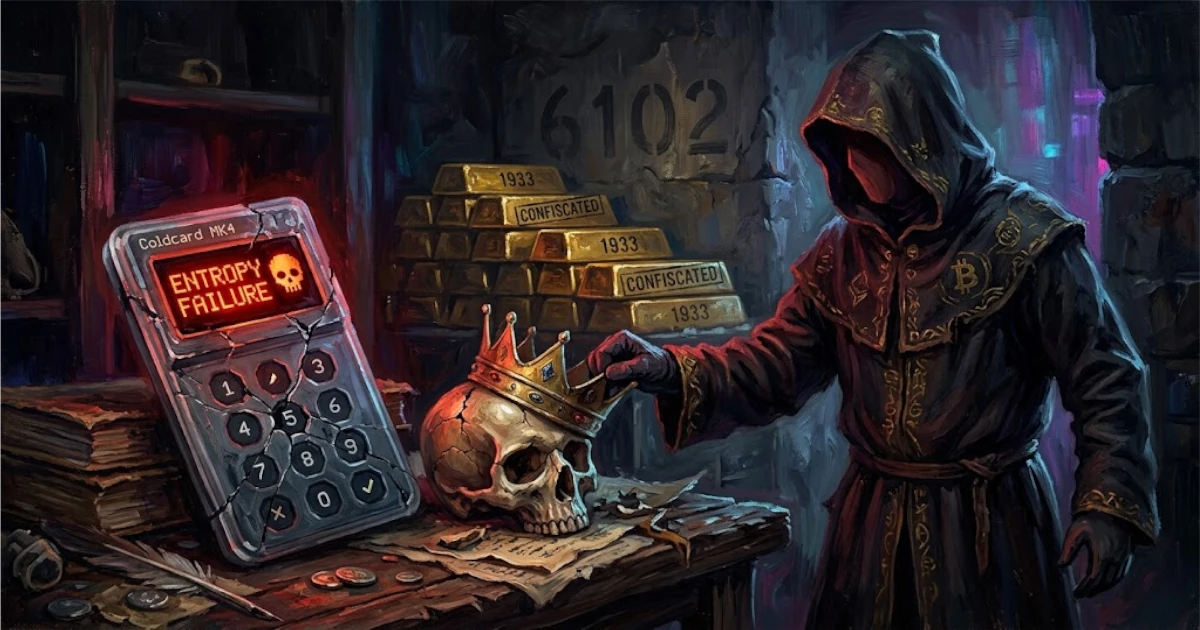
Bitcoin Magazine says last week’s Coldcard breach dealt a sharp blow to a part of the Bitcoin industry that has long treated self-custody as a non-negotiable principle. The article says the fallout has triggered a grim reassessment of how retail users secure bitcoin and of several assumptions that have guided hardware wallet design for years.
According to the piece, the full consequences may take months to show up. The immediate reaction is already visible. Some people are saying self-custody is dead, and some reports estimated that more than 11,000 BTC moved to custodial exchanges last week as users fled one of the most widely used hardware wallets in the Bitcoin market.
The theft itself is described as ongoing, with users still able to protect themselves. The article says more than 1,300 BTC have been stolen so far, while some estimates place the number as high as 2,000 BTC.
The flaw hit the part of Coldcard that should have been untouchable
The article focuses on Coinkite and, in particular, its outspoken founder NVK. It notes that the company built its reputation on hardline views about what is required to protect Bitcoin private keys from attackers, and that Coldcard became known for design choices intended to reduce exposure at every step.
Its wallets were air-gapped so malware could not exfiltrate data through USB cables. They used low-resolution LED screens to avoid the complexity of touch screens. Coinkite also developed protocols such as BBQR and added NFC so information could move between a device and a computer without direct contact and without shared SD cards. The author writes that the list of paranoid design choices behind Coldcard’s reputation is long.
Yet the attackers who stole bitcoin from Coldcard users last week did not rely on anything out of a spy film. In the article’s telling, they exploited the one feature that should have been fully locked down: the generation of keys with enough randomness, or entropy. Put plainly, the secrets protecting funds were supposed to be mathematically hard to guess.
The piece says the devices were meant to use high-quality entropy sources, but a firmware bug prevented that from happening. The result, it argues, was Bitcoin private keys that became easier to guess. The bug went unnoticed for years while the product kept gaining popularity, until the issue surfaced last week.
Why the article rejects the “just buy the ETF” answer
The article frames the loss as a wound to a group of Bitcoiners who were among the most committed to holding their own keys. Even so, it argues that Bitcoin cannot give up on self-custody and still preserve its integrity. The author says many people in the industry hold that view.
The reasoning starts with Bitcoin’s origin. The piece says Satoshi Nakamoto’s white paper was clearly meant as an answer to trusted third parties and financial intermediaries. It presents the white paper as a critique of financial hierarchies, then points to the 2008 financial crisis as evidence of the systemic risks and failures embedded in legacy finance.
To reinforce that point, the article quotes El Salvador President Nayib Bukele, who wrote on July 29, 2026: “This may be unpopular, but we never escaped the 2008 financial crisis. We just shifted the pain.” The quote is used to support the author’s view that the crisis never truly ended and that its costs were merely displaced.
The essay reaches back to the 1933 U.S. gold seizure order
From there, the argument broadens into a critique of centralized custody by revisiting the birth and spread of modern banking and fiat money. The article says Executive Order 6102, signed by President Franklin D. Roosevelt in 1933, led to the persecution and confiscation of gold from both centralized trusted third parties and citizens.
It states that $300,000,000 in gold was returned after the order threatened owners with heavy fines and jail time if they failed to sell bullion to banks at $20.67 per ounce. More than 14 million troy ounces were turned in as a result, the article says. It also cites an estimate that another 200 million troy ounces were being held in the American banking system at the time.
The piece notes that the banking system of that era, not only in the U.S. but around the world, was built on top of the gold standard. The U.S. was the world’s largest economy and had the biggest concentration of gold within its borders. In the author’s view, the country’s abandonment of the gold standard was a death blow to gold as a free-market pricing mechanism for goods and services.

The article then argues that governments, once freed from the restraints of sound money, quickly benefited from what it calls the hidden tax of inflation. At the time of the executive order, gold was fixed at $20.67 per ounce. Less than a year later, after the Gold Reserve Act of 1934, the price was reset to $35 per ounce, which the piece describes as a 69% devaluation of the dollar.
The author characterizes the shift as the delivery of the fiat standard to governments around the world by an alliance between the banking system and politicians. In that framing, central banks were granted the legal right to counterfeit money and print it at will. The article says World War Two followed and was funded by fiat currency, with tens of millions of people sacrificed at the altar of state power.
Fast-forward about a century, the article continues, and U.S. government debt now requires nearly $1 trillion a year in interest payments alone. Total debt is said to be close to $40 trillion, with debt to GDP at 123%. The author presents those figures as predictable consequences of the collapse of the gold standard.
The piece also says the dollar’s purchasing power has collapsed over the past century even as technology has posted dramatic gains in efficiency. In the author’s view, that combination is only possible when money has been losing value for decades. It adds that the dollar remains the best of the fiat currencies anyway.
Bitcoin, in this argument, is gold redesigned to survive a new 6102
The article contends that confiscation of gold by a rising power like the United States killed the gold standard, but says the process might have been harder if civilian custody had been broader and more distributed. It notes that many of the people who returned millions in gold after Executive Order 6102 had just withdrawn it from their accounts during a bank run. Their names were known, and the quantities they held had been counted.
The author goes further. If gold had been easier to move in large quantities, if private ownership totals had been more ambiguous, and if the state could not have interrupted its free flow simply by knocking on bankers’ doors and pointing a gun, then perhaps the world’s economies would not have so easily sustained a war as vast and destructive as World War Two over the following decade.
That historical comparison sets up the article’s central claim: Bitcoin is presented as an alternative to gold that was designed after learning from gold’s weaknesses. The piece says Bitcoin has better properties for resisting and surviving confiscation of that kind. It describes a future imagined by Bitcoiners in which Bitcoin becomes a global monetary standard and a large minority, or even a small majority, of the global economy uses it as the primary store of value. In that future, Bitcoin would replace gold and restore sound money to what the author calls the capitalist order.
To become a global reserve currency and defend that position, the article argues, Bitcoin must be better than gold, and it can be better because it is digital. Control over private keys may look more daunting in the shadow of the Coldcard breach, but the author says that control can still be more powerful than any physical vault.
The essay points in particular to multisignature scripts, which allow Bitcoin private keys to be stored in distributed form so that a threshold number of approvals is required before coins can move. That opens the door, the article says, to multinational, multi-jurisdictional vault structures that can evade or resist the reach of a large state attempting a modern version of a 6102-style seizure.
Bitcoin’s digital nature also makes it easier to move large amounts of value, the article argues, without sending a navy to retrieve gold and without building a trusted hierarchy of banking custodians to transfer it. The author adds that civilians, using tools available today and tools still to come, may be able to conceal Bitcoin ownership in the way the article says has already happened in war-torn countries such as Ukraine, escaping a state’s grip over public wealth.
The conclusion targets a manufacturer failure, not self-custody itself
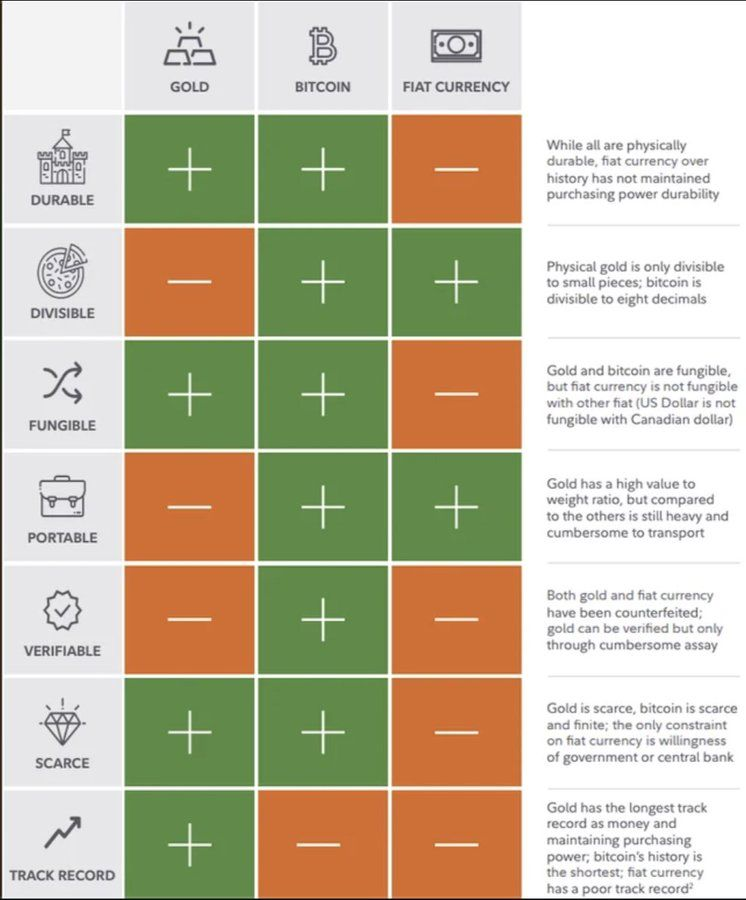
The article closes by saying a major hardware wallet maker failed the Bitcoin industry. Still, it argues that the fundamental qualities of money have not changed and that, among the forms of money discussed by Aristotle and others, Bitcoin remains king.
It ends with a quote attributed to @BITCOINARCHIVE: “Bitcoin vs gold vs fiat One is not like the others.” The post first appeared on Bitcoin Magazine and was written by Juan Galt.