
Bitcoin Magazine says Coinkite’s Coldcard entropy bug has become a turning point in the Bitcoin self-custody debate, pushing advocates and security-focused users toward a new baseline: multi-vendor multisignature wallets. The idea is straightforward. If key material is created across hardware from different manufacturers, users reduce their dependence on any single wallet vendor and lower the damage a single implementation failure can cause.

The article describes the Coldcard flaw as a catastrophic entropy bug that had gone undiscovered since at least 2021. For many Bitcoin users, the lesson was blunt: even a wallet provider with a strong reputation and broad trust can still ship a major failure. That has triggered fresh scrutiny of old assumptions, including long-standing support for single-signature self-custody, where one wallet alone generates and controls the private key pair. Some participants have gone as far as declaring the “death of single sig.”
The starting point is a personal threat model
The report frames self-custody as an advanced Bitcoin practice. It notes that advocates have long promoted it as protection against exchange misconduct, citing FTX and MtGox as examples. Recent events, however, have led many holders to reassess custody choices. Some moved coins back to exchanges, at least temporarily. Others upgraded or rebuilt their setups entirely.
Nick Neuman, CEO of Casa, said 233k bitcoins moved to safety in response to the Coldcard hack, according to the article. That reaction, in the report’s telling, reflects a larger question: when does self-custody make sense, and for whom?
The answer begins with threat modeling. The article defines a threat model as a deliberate review of the risks facing a specific person, followed by the design of security practices and structures in advance. A simple version starts with a list: everything that worries you about self-custody, plus the risks veteran advocates routinely warn about. After that, users sort the list by what is most likely to happen to them personally and what is most common in general. The final step is severity. If a given risk becomes real, how catastrophic would it be, and could the current setup survive it?
According to the piece, two of the most common paths to losses in Bitcoin self-custody are user mistakes tied to backups or forgotten passwords, and theft. Some coins widely believed to be lost were linked to poor early private-key backups that disappeared when a computer failed. In other cases, users chose passwords that were too hard to brute force and then forgot them, locking their private keys away permanently.
On the theft side, the report places bad-entropy attacks among the most effective attacks seen so far in self-custody. It groups Coldcard with other wallets that have suffered similar failures, intentional or not, including Trust Wallet and a range of lesser-known, possibly malicious mobile wallets. It also points to fake wallet apps, such as iOS apps impersonating Sparrow Wallet, that allegedly kept copies of user-generated private keys and swept funds after deposits arrived.
In those cases, the article argues, the defense starts before any deposit is made: users have to be far more careful about trusting unknown software with life savings. Once users have a clear threat model and enough understanding of the tools they are using, building a security setup becomes less guesswork and more method. While personal circumstances vary, the piece says some structures have proved more resilient than others. A carefully designed multisig setup is one of them, and it is gaining favor among long-term self-custody Bitcoin holders.
Why multi-vendor multisig is getting so much attention
The term “multi-vendor multisig” is relatively new, the article says, but “multisig” itself spread rapidly in 2026 after the Coldcard hack, which it says led to more than $100 million in bitcoin losses, mostly from single-seed wallets.
Most single-seed Coldcard users, according to the report, appear to have generated their private keys on the device without adding an extra passphrase and without adding extra dice rolls, both of which can contribute extra custom entropy. Because the firmware’s entropy was weak, and because users had little reason to doubt a company with such a strong brand, the resulting private keys became easier to guess with customized work. Hackers eventually figured that out.
That is why the surge of interest in multisig makes sense, the article argues. A multisig Bitcoin wallet lets users create an address that can only be spent from when multiple private keys, and therefore multiple devices, sign a transaction. The mechanism rests on Bitcoin script.
Bitcoin scripts, as described in the piece, function like contracts that define spending conditions. In that sense, every Bitcoin wallet relies on some kind of script. The simplest and most common version allows anyone who can produce a valid signature to spend some or all of the funds. Multisig scripts replace that with a threshold requirement: a withdrawal is only valid if enough signatures from different keypairs are present. Bitcoin consensus rules enforce those conditions.
Multi-vendor multisig takes that one step further. The theory is that every keypair used in the multisig setup should come from a different wallet vendor. The article offers one likely example: one key from a Trezor Safe 7 hardware wallet, a second key from a Ledger Nano, and a third key supplied by a multisig wallet provider as a recovery key. In that structure, any 2 of the 3 possible signatures would be enough to authorize a spend.
Using two different hardware wallet providers cuts trust in any one of them, the report says, and helps protect users if one vendor suffers an entropy failure like Coldcard’s. Other multisig structures use more keys. A 3-of-5 threshold is also common, and the article says it is a standard offering from a multisig-focused provider such as Casa.
Where wallet software ends and signers begin
At this point, the article argues, common terminology starts to lose precision. Products such as Casa are software interfaces that allow users to combine partially signed transactions from different private key pairs. In that model, calling devices like Trezor or Ledger simply “hardware wallets” misses part of the picture. The piece suggests “key signers” is a better term, because no single keypair in the set contains enough key material to spend all the bitcoin held by the multisig script address.
Under that framing, Casa is a multisig wallet that lets users secure and send bitcoin through a threshold of hardware signers. At a more fundamental level, services like it make Bitcoin script easier to use and help users build transactions that satisfy consensus rules.
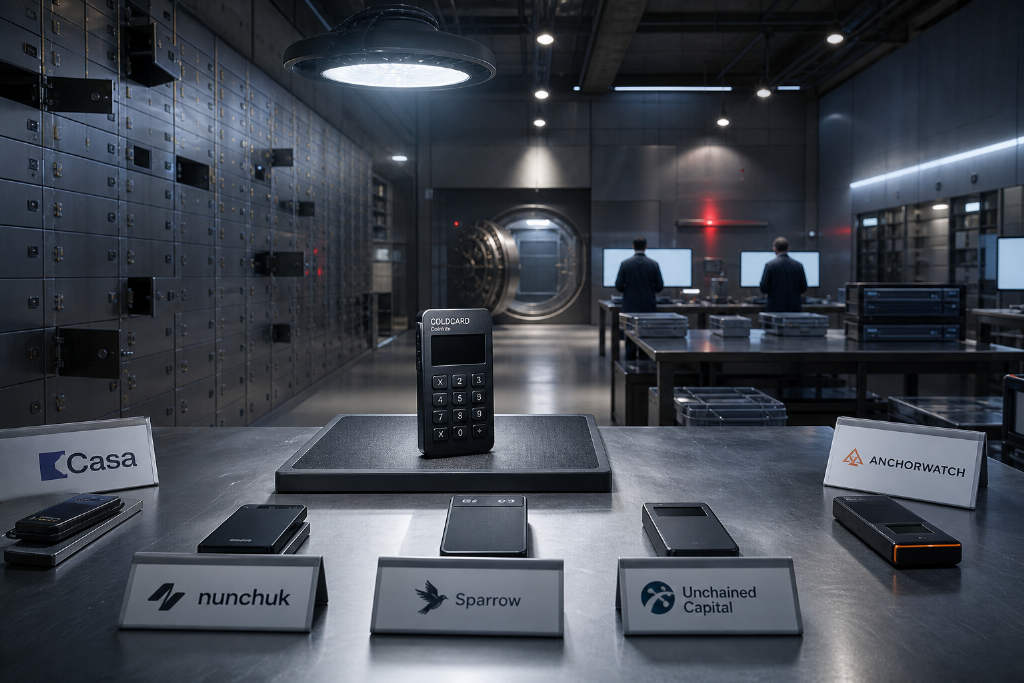
The article names other multisig wallet providers as well, including Nunchuck, Sparrow desktop wallet and Unchained Capital. In the case of Casa and Unchained, the provider gives users a recovery key controlled by the company, something some users see as a useful feature. Nunchuck and Sparrow, by contrast, are designed around fuller user autonomy in that area, though the piece notes that Nunchuck also offers a premium plan tied to recovery-key services.
The case for multisig goes beyond vendor diversification
Another major benefit, according to the article, is resistance to so-called wrench attacks. It points to countries such as France, where tax filings can make Bitcoin and crypto ownership part of the public record, turning those markets into focal points for theft and kidnapping tied to crypto holdings.
Whether funds sit in self-custody or with a custodian, the risk rises when a victim can move the full balance quickly, either from a phone-accessible exchange account or from a self-custody setup that can be spent immediately. More advanced forms of multisig can make that much harder.
The piece gives two examples. One is multi-jurisdictional multisig, where users would need to travel to reach other key signers required for a valid Bitcoin transaction, ideally through an airport. Another is time-locked multisig, where a recovery key may be configured not to sign until two weeks after the user submits the request and transaction data.
The effect, the article says, is to remove the last central point of failure in Bitcoin custody: the user’s own willingness to send bitcoin while under coercion. It adds that best practice in a wrench-attack scenario is still to avoid ending up in that situation at all. Even so, making coins hard to spend quickly can also defend against phishing and other social-engineering attacks that rely on urgency and pressure.
The report also says multisig is opening the door to new forms of Bitcoin insurance. It points to AnchorWatch as an example. The company operates as both a multisig wallet and an insurance provider, offering theft protection denominated in BTC. Those services are currently offered primarily to Americans through Lloyd s of London, according to the article.
The tradeoff: users must store more than keys
The article does not present multisig as cost-free. Its main warning is that users need more than threshold signing access. It is not enough to control the necessary key material, whether that means two hardware wallets in a 2-of-3 setup or one device plus a company-held recovery key. Users also need to preserve a copy of the multisig script or template so they can recreate the contract and recover the valid spending conditions later.
Most multisig wallets keep that information on behalf of clients, the report says, but they also send a copy to the user. The purpose is independent recovery: if the multisig wallet provider goes offline one day, the user should still be able to rebuild the setup and access funds without relying on the original service.
The article first appeared in Bitcoin Magazine and was written by Juan Galt.