
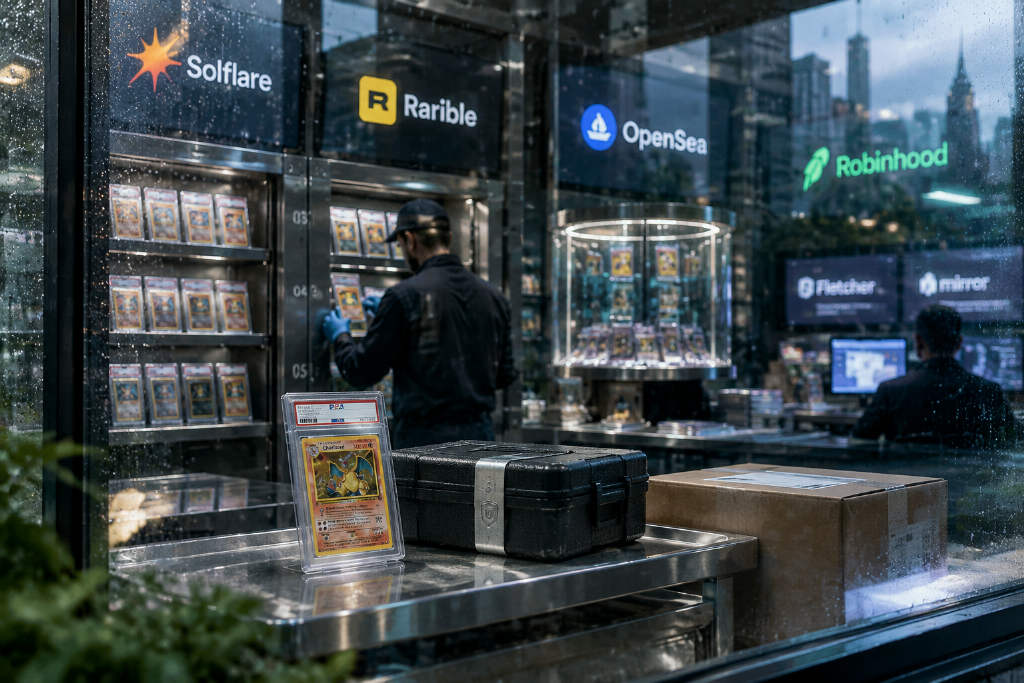
PANews said Collector Crypt is best understood not as a single NFT card marketplace, but as infrastructure for tokenizing and circulating physical collectibles. According to the article, the company handles or coordinates card sourcing, grading, warehousing, custody, inventory pools, randomized pack openings, instant buybacks and shipping, then lets wallets, NFT marketplaces and other on-chain projects plug into that stack.
The piece opens with a simple example. A graded Pokémon card can be pulled inside the Solflare wallet, opened on a Rarible page, resold on OpenSea, or turned into a Mirror NFT on Fletcher on Robinhood Chain. The holder can still burn the NFT and ask for the physical card to be shipped. Those touchpoints look like separate products on the surface, but PANews says many of the cards come from the same supplier system: Collector Crypt’s warehouse and inventory pools.
The project says cumulative scale has passed $1 billion
The article says Collector Crypt stated in May 2026 that cumulative platform transaction volume had exceeded $1 billion, then said in August that gross revenue had topped $1 billion. PANews argues that a closer look matters, because a significant part of that flow appears to come from a repeated loop in which a card is pulled from a pack, sold back to the platform, returned to inventory and drawn again later.
That is why the report frames three practical questions instead of focusing on NFT issuance alone: how a single physical card can circulate on-chain multiple times, how that system becomes infrastructure for other products, and whether fast business growth means CARDS is worth buying.
How one physical card moves through the system
PANews says users or the platform can send cards that have already been graded by PSA, BGS, CGC or SGC to a designated warehouse. After inspection and intake, Collector Crypt mints an NFT tied to that card, with metadata linked to the card number, image and attributes. Standard intake currently does not accept ungraded cards or sealed products, and intake itself carries no fee.
The NFT is not just an image. The article describes it as the on-chain claim to the physical item. A holder can keep it, sell it, swap it, or burn it to request redemption of the underlying card.
Once a card is in storage, PANews lays out five main paths:
- Pack opening: The platform bundles stored physical cards into fixed-price Gacha packs. After payment, a VRF-based process selects a card from the pool and sends the NFT to the user. PANews says VRF can verify that the draw followed the stated random process, but it does not prove fair valuation of the pool and does not mean every buyer will receive a card worth more than the pack price.
- Instant buyback: Users typically get a 72-hour window after opening a pack to sell the NFT back at a percentage of the displayed insured value. The article says common disclosed ratios on partner fronts include 85% for $25 and $50 packs, 90% for $250 packs and 93% for $1,000 packs, depending on the current pool.
- Secondary trading or swaps: Collectors who want a specific card can buy an NFT directly, place listings or make offers. They can also use a Swap function for NFTs or tokens. PANews says the point of the swap flow is that assets enter on-chain escrow first and settle simultaneously after confirmation, reducing the risk that one side delivers first and the other does not pay.
- Redemption: To receive the physical card, the holder burns the NFT on-chain and submits a shipping address. The platform ships only after the token claim is invalidated. Users pay shipping, platform service fees and other related costs. PANews cites shipping terms published in April 2026: $5.99 for the first U.S. card, or $10.99 if value exceeds $500; $20.99 for Canada; $29.99 for Europe; and $34.99 for other regions, with extra charges for additional cards. The project says packages are insured up to $5,000 by default, with higher values charged at 0.5%, while international users may also face duties.
- Inventory replenishment: Collectors with graded cards can deposit them into the platform. They can also use eBay Bidder by pre-funding USDC and setting a maximum bid, with the platform bidding on their behalf. If the auction is won, a 1% service fee is charged and the card is sent to the platform for verification, storage and NFT minting.
PANews spends time on a point it says is often misunderstood: the buyback ratio is not a guaranteed floor based on the pack price. The insured value is referenced from sources such as ALT and eBay, but it is not the same as an immediately executable market bid. If a user spends $100 on a pack, receives a card marked at $80 by the platform, and sells it back at 85%, the payout is $68.
Integrations already span wallets, marketplaces and other projects
According to the article, by September 2026 Collector Crypt supported intake, pack opening, marketplace trading, asset swaps and physical redemption. PANews says visible integration points already existed through Magic Eden, Solflare and Rarible, while projects such as Fletcher and Collectr had also shown inventory or service-layer integrations.
That is the key distinction, the piece says, between Collector Crypt and a simple card NFT collection. The company is trying to turn physical-card supply, turnover and delivery into underlying services that other teams can call.
User participation is not limited to opening packs
From the user side, PANews says the product is not just about blind draws. If the goal is a specific card, buying the NFT in the market and redeeming the physical item is usually more direct than repeatedly opening packs. If the goal is to sell an already graded card, the owner can deposit it and tap on-chain liquidity. If someone is watching a listing on eBay, the Bidder product handles auction participation and verification.
The article says Gacha should be treated more like a consumer product with a verifiable random process than as a price-discovery tool or a low-volatility yield product.
As an example, PANews cites the Riftbound $100 pool launched in September 2026. The official prize-tier odds were listed at 75%/20%/4%/1%. Third-party tracker PackAnalyst reviewed 1,574 public openings and found probabilities roughly in line with those figures, but the median marked value was about 80% of the pack price, while the average was lifted to 107.8% by a small number of high-value pulls. The article’s takeaway is direct: for most users, budget, buyback discount, valuation method and actual resale difficulty matter more than theoretical expected value.
PANews also notes incentive programs intended to boost participation. As of Sept. 22, 2026, September Gacha Games was underway. Starting Sept. 1, monthly leaderboards, streaks, weekly tasks and hidden challenges awarded Gacha Points, while openings through partner fronts and marketplace purchases did not count. The project said the event allocated 1 billion points, though point value, ranking bands and the unified redemption timeline had not been fully disclosed.
The article says a June event drew about 9,925 participants and distributed 1 billion points, worth roughly 500,000 free card packs, with CARDS holders receiving 84 million points.
APIs and white-label tools are the infrastructure layer
If the project’s own front end answers how users interact with cards, PANews says the API side answers how third parties can build products on top of the same system.
It describes the Gacha API flow as straightforward. A partner generates a purchase transaction for the user to sign on its own page. After the user signs and pays, Collector Crypt uses VRF to select a card from the relevant inventory pool and sends the NFT. During the 72-hour window, the partner can also generate the transaction that swaps the NFT back into USDC. The user stays on the partner page, and the partner does not need to source cards, maintain pools or build random-distribution logic.
The Shipping API breaks redemption into address entry, shipping quote generation, a transaction for the user to sign, NFT burn, order creation and logistics-status return. PANews says this solves the hardest part for wallets or marketplaces: the cards are not in their possession, and they do not need to build warehouse or cross-border shipping operations.
The article describes Launchpad and white-label pages as a model where the partner runs its own storefront while Collector Crypt handles back-end inventory. The partner uses its own brand, user funnel, page style and community, while Collector Crypt continues to manage inventory, pack openings, instant buybacks and fulfillment.
The project says it already has more than 20 API partners. PANews points to Solflare, which explicitly says sourcing, grading, custody, insurance, buyback and redemption are handled by Collector Crypt, with Solflare acting as the distribution front end. Fletcher brings a version of the model to Robinhood Chain, where users pay in USDG and the underlying physical cards are still processed by Collector Crypt. But PANews notes that Fletcher remains in beta, and the asset path adds a cross-chain settlement layer rather than offering a mature official bridging solution.
Seven chains are covered for holding and redemption, but not fully connected
PANews says support for a blockchain can mean at least four different things: being able to hold the NFT, redeem the physical card, move it between chains, or trade it natively on that chain. Collector Crypt’s NFT holding and physical redemption already cover Solana, Ethereum, Base, Monad, ApeChain, Arbitrum and Robinhood Chain, while bridges and secondary markets are still under development.
The article says the cross-chain rule is simple: the NFT on the source chain is burned and a new claim token is minted on the destination chain, so a single physical card does not correspond to two valid NFTs at once. For collectors, the key issue is whether redemption works. For investors, the missing pieces matter too, because native EVM markets and a two-way bridge with Solana had not yet been completed at the time described.
Revenue comes from several channels, but inventory and buybacks consume cash
The article says Collector Crypt’s revenue should not be reduced to secondary-market fees alone. PANews presents it as a business that runs card retail and trading while also operating a loop that needs inventory and buyback capital.
Money comes in through several channels:
- users buying Gacha packs;
- marketplace trading, where the default platform fee is 2% of sale price and can be configured within a 0% to 2% range, with fees going to the treasury;
- a 1% service fee on successful eBay Bidder auctions;
- shipping and possible insurance surcharges on redemption;
- potential payments or revenue sharing tied to APIs, white-label pages or launch activities.
PANews adds an important caveat: the fee model and scale for that last category have not been disclosed, so the existence of more than 20 API partners cannot be translated directly into B2B revenue.
Cash also leaves the system quickly. The platform has to buy cards, buy NFTs back from users, pay for grading and verification, warehousing, insurance, shipping, payment infrastructure and on-chain services, and cover team costs and incentives. Instant Gacha buybacks make it easier for cards to flow back to the platform and re-enter inventory, but that also means the company has to keep managing valuation and buyback liquidity.
The upside, PANews says, is faster inventory turnover. The cost is that GMV gets amplified by repeated circulation of the same underlying assets, so volume alone cannot be used to infer profit, and it should not be treated as cash on hand.
Why the $1 billion number looks more like turnover than audited revenue
PANews revisits the headline claim directly. Collector Crypt said in May 2026 that cumulative platform transaction volume had exceeded $1 billion, then said in August that gross revenue had reached the same level. Yet a Blockworks report sponsored by the project referred to a similar metric as cumulative gross volume.
Given the instant buyback mechanism, the article says the more careful phrasing is that the project claims cumulative scale above $1 billion, but the figure is closer to cumulative cash flow and card turnover than to audited operating revenue.
PANews cites Blockworks’ report for the second quarter of 2026, while also noting that it was funded by Collector Crypt, retained editorial control and underwent internal review, but was not an independent financial audit. The figures still help explain the business structure, the article says. Growth was driven more by Gacha than by peer-to-peer secondary trading, and instant buybacks worked as the liquidity and inventory-recycling engine. Users paid for pack openings, many cards returned to the platform, and those same cards could be placed into later pools again, allowing one physical card to contribute transaction value repeatedly.
For protocol revenue, DeFiLlama’s Q2 reading at the same observation point was about $32.75 million, including on-chain sales, fiat or credit-card pack sales and secondary-market activity, while deducting Gacha buybacks. That was close to the $32.20 million figure cited by Blockworks, a difference of about 1.7%.
The Blockworks report also said that by the end of Q2 the platform held 88,338 tokenized collectibles valued at roughly $37.4 million. In the same quarter, 22,805 NFTs were burned for physical redemption, corresponding to a reference value of $11.62 million. PANews says this suggests a meaningful share of users are still genuine card collectors.
User concentration is another point the article flags. Blockworks data showed that 195 wallets with more than $1 million in cumulative spending accounted for about 58% of historical spending. That implies GMV has been driven mainly by a small number of high-net-worth users, so any drop in their activity could affect pack openings, buybacks and revenue at the same time.
Competition: higher GMV, weaker natural secondary trading
PANews compares Collector Crypt with Courtyard and Phygitals, saying all three try to connect physical collectibles with on-chain ownership but show different operating profiles.
Collector Crypt has the largest GMV of the group, according to the article, but weaker secondary-market turnover, which means it relies more heavily on pack opening and buybacks to drive circulation. Courtyard has a relatively larger share of natural secondary trading.
Using an OpenSea snapshot from Sept. 22, 2026, the article says the Collector Crypt collection showed about 159,613 items, 15,636 holders and roughly $4.3 million in cumulative volume. Phygitals showed about 238,902 items, 26,130 holders and roughly $2.9 million in cumulative volume. PANews says the comparison still points to a structure where a smaller group of wealthier users supports higher GMV at Collector Crypt.
Team and funding: private fundraising is not the same as token-sale proceeds
On the team side, PANews says co-founder and CEO Tuomas “Tuom” Holmberg has a background in tech entrepreneurship, card collecting and relatively early personal crypto participation. Co-founder and CTO Dax Herrera comes more from software and digital business, while business development lead Joe Munns brings experience in finance, product work and cross-border card activity. The Blockworks report said the team had about eight members.
The article says public information does not show a record of the founders running several major DeFi or NFT protocols before Collector Crypt. For this project, PANews argues, the ability to handle sourcing, inventory, valuation, buybacks and international shipping may matter more than a polished on-chain résumé. As multichain support expands and higher-value physical assets move through the system, the article says contract security, custody arrangements, insurance and asset segregation disclosures will have to keep pace.
Funding is split into different buckets in the report:
- A 2023 seed announcement named participants including GSR, Big Brain Holdings, FunFair Ventures, Genesis Block Ventures, MasterVentures, StarLaunch and Telos, but did not disclose the amount.
- In a project anniversary review, the team said cumulative fundraising before TGE was about $1.1 million, with a little over $800,000 in pre-seed and a little over $300,000 in seed. The same post said seed investors were all users of the platform at the time. PANews treats this $1.1 million as private fundraising.
- Separately, the Metaplex Genesis Launch Pool in August 2025 brought in about $3.5 million for 100 million CARDS. The article says this should be classified as public token-sale proceeds, not venture equity funding. The project said net proceeds would be used to buy card inventory and provide CARDS liquidity.
PANews says that distinction matters because a business that continually buys cards, accepts user buybacks and pays for storage and shipping needs cash to support inventory and repurchase capacity.
CARDS: business growth does not automatically flow through to token value
The article says CARDS launched on Aug. 29, 2025, with an initial maximum supply of 2 billion tokens. The token does not represent company equity, ownership of the physical cards in storage or a fixed right to revenue sharing. Its main links to the operating business are community rewards, event points, liquidity and buyback-and-burn actions that the project can choose to execute.
On unlocks, PANews says pre-seed allocations vested monthly over 12 months from TGE and were completed in August 2026. Team, Advisors and Seed allocations were locked for 12 months first, then began monthly release over 12 months from Aug. 29, 2026. An official page updated on Sept. 4, 2026 showed 11 remaining scheduled releases of about 44.4 million tokens each month.
Using a Sept. 22, 2026 price of about $0.1822, the article estimates a monthly notional value of about $8.09 million, equal to roughly 10.3% of the official circulating figure. At the same observation point, if only 5% of one month’s unlocked amount were sold in the short term, the notional scale would be about $405,000, or roughly six times the then-current one-sided 2% depth on Raydium.
PANews also distinguishes between two kinds of supply. Monthly releases for Team, Advisors and Seed are predictable additions to circulation. Larger already-unlocked Foundation and Community reserves have no fixed timetable and are supply the project can arrange at its own discretion. According to project disclosures, Community allocations are intended for rewards such as Non-drop. The fifth round was calculated at 0.75% of total supply based on the prior quarter’s activity, and the next four rounds were proposed at 0.5% each, one per quarter.
Based on the published plan for a full future quarter, the article estimates about 133.2 million tokens from the first category. If the next two Non-drop rounds each distribute 0.5% of total supply, the second category would amount to about 10 million tokens, a 93% versus 7% split. PANews says the main predictable pressure comes from Team, Advisor and Seed releases, while the biggest uncertainty lies in when and how Foundation and Community reserves reach the market.
On buybacks and burns, the article says the project disclosed roughly $616,000 in bot-driven buybacks for about 3.4765 million CARDS, plus about $225,900 in supportive purchases. On Aug. 29, 2026, the project burned 22,485,689 CARDS and published the relevant address on its website.
PANews warns that these actions do not amount to a fixed deflation rule. The project has not published a formula specifying what portion of revenue must be used for buybacks, a minimum amount, a fixed frequency or an automatic trigger. The team has also said past actions do not constitute a future commitment. As a result, the article says buybacks and burns can be tracked as signals but cannot be inserted into a valuation model as guaranteed mechanics.
PANews’ conclusion: the project is worth following, the token still calls for caution
The article closes by saying Collector Crypt has already done something that white-paper projects struggle to replicate: it connected sourcing, verification, custody, pooled inventory, randomized pack opening, buybacks and shipping for physical cards, and has started to let wallets, marketplaces and other on-chain projects use that system. For research into on-chain TCG models, PANews says it has become a case study that cannot easily be ignored.
The value of the business, in the article’s framing, lies in the part that is hardest to replicate. Tokenizing a collectible is not the scarce capability. Keeping physical items moving reliably through supply, capital, warehousing and distribution is.
At the same time, PANews lists several concrete risks. First, the $1 billion figure looks closer to turnover than profit, and actual profitability still needs verification. Second, Gacha and instant buybacks remain the main engine, while spending is concentrated, so demand after weaker incentives or lower whale activity remains an open question. Third, public disclosure around warehouse assets, insurance beneficiaries, asset segregation and full reserve proof for stored inventory is still limited. Fourth, CARDS has no clear revenue right or fixed buyback mechanism, while Team, Advisor and Seed unlocks are now underway on a monthly basis.
The article’s final stance is split into three parts. As a project, Collector Crypt is worth sustained tracking, especially to see whether API channels begin contributing measurable non-subsidized users and revenue. As a collecting and usage product, participation should depend on the user’s goal: direct purchase, trading or redemption is more suitable for someone who wants a specific card, while pack opening should be treated as entertainment spending rather than as a protected return because a buyback option or points campaign exists. As an investment in CARDS, PANews says the right stance for now is cautious observation rather than chasing the token on business growth alone.
The article says more convincing conditions would include actual market absorption of monthly unlocks, a verifiable and durable buyback-and-burn framework, disclosure of third-party channel revenue, and materially better transparency around custody and finance. The key question going forward, it says, is whether Collector Crypt can turn inventory infrastructure into stable business income, broaden its user base and revenue mix, and keep extending support back to CARDS.