
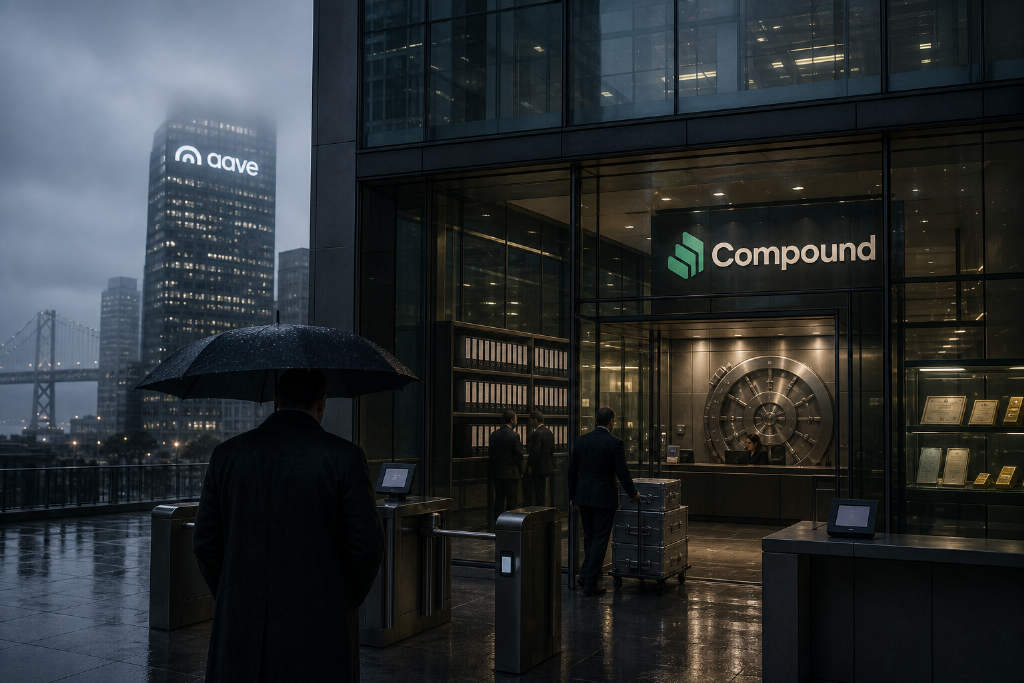
Compound Finance’s DAO approved a $52 million budget on Aug. 17, the largest in the protocol’s history, while replacing its management team and shifting strategy from retail lending toward real-world assets, institutional credit, and compliance integrations.
The decision follows a sharp decline in the protocol’s scale. Compound’s total value locked, or TVL, has fallen from roughly $12 billion at its 2021 peak to about $1.2 billion now, a 90% drop. Over the same stretch, Aave’s TVL stood at about $14.8 billion, leaving it more than ten times larger than Compound. A protocol once identified with the early DeFi lending boom is now far behind a rival that expanded faster.
Liquidity mining helped drive growth, then lost its pull
Compound introduced liquidity mining in the summer of 2020, rewarding deposit and borrowing activity with COMP tokens. The mechanism became one of the defining features of DeFi Summer. Within weeks, it pushed the protocol’s TVL up by dozens of times and influenced incentive design across much of decentralized finance.
That model also carried its own weakness. Liquidity mining drew capital seeking yield rather than committed users. When token rewards declined or token prices fell, funds could move quickly to wherever returns looked higher. COMP has dropped from around $900 at its 2021 high to less than $50 now, leaving token-based incentives with little of their earlier appeal.
Aave moved faster across chains and products
During the same period, Aave expanded across multiple chains more quickly, including Arbitrum, Optimism, Polygon, and Avalanche. It also launched the GHO stablecoin as a new revenue source and used its Horizon protocol to target institutional RWA-backed lending, allowing tokenized money market funds to be used as collateral to borrow USDC and GHO.
Compound, by comparison, was described as being at least two years slower to respond. The report said the protocol lagged in multichain expansion, stalled on product innovation, and drew criticism for governance efficiency. In September 2025, the DAO rejected a proposal to recall 300,000 COMP tokens that had previously been allocated to special delegates, with 70% of participants voting against it. Governance deadlock and strategic drift kept weakening Compound’s position in DeFi lending.
The $52 million budget is aimed at institutional infrastructure
According to CoinDesk, Compound plans to use the capital to build compliance infrastructure for institutional clients. That includes whitelist mechanisms, links to legal entities, risk management frameworks, and KYC/AML integration. The intended users are traditional financial institutions that want to lend and borrow onchain but face compliance requirements.
The new management team was described as having deep institutional experience. Himanshu Sahay, co-founder and CTO of crypto lending company Arch Lending, said that $52 million combined with a team that has institutional credentials 「is a serious move and should improve execution」. He also added a warning: institutions 「underwrite the structure, not the team」.
The report said Compound’s transition will not be easy. Institutions look for more than a capable team and battle-tested smart contracts. They also want legal opinions, insurance coverage, audit reports, clear custody arrangements, and a predictable regulatory path. Each of those pieces takes time and money, and none is mainly a coding problem.
Gal Stern, chief business development officer at deBridge, offered a more constructive view. He said this is a good time to put real capital into structural buildout and bring in people who can explain DeFi to risk committees in terms those committees already understand.
Compound is part of a broader DeFi shift
Compound is not the only DeFi protocol turning toward institutions. Aave’s Horizon protocol is still awaiting DAO approval. It uses a hybrid structure: the liquidity pool remains permissionless, while collateral is limited to approved RWA tokens. Its revenue-sharing design starts with 50% going to the Aave DAO in the first year and declines to 10% by the fourth year. The target is a tokenized asset market that Standard Chartered has forecast at $16 trillion.
MakerDAO, now known as Sky, made the turn earlier. It has allocated a large portion of assets to U.S. Treasuries and onchain RWA, and the backing behind DAI and USDS has shifted from purely onchain assets to a mixed pool led by Treasuries.
The broader DeFi market has also been under pressure. Total TVL across the sector has fallen by more than one-third since the start of the year to about $70 billion, hit by a wider crypto market pullback, tighter yields, and security incidents at protocols, including the $292 million KelpDAO theft in April.
Permissionless design now runs into institutional demands
Compound’s core proposition has long been permissionless lending. Users can deposit assets to earn interest and borrow against collateral without credit checks, KYC, or approval flows. That has been one of DeFi’s clearest distinctions from traditional finance.
Institutional clients usually want the opposite. They look for whitelist controls so they deal only with verified counterparties. They want legal structures so responsibility is clear if something goes wrong. They also need compliance interfaces that satisfy regulatory reporting obligations. Those demands cut directly against the permissionless model.
Aave’s answer so far has been to keep a permissionless base layer and add a permissioned layer on top through Horizon. It is still unclear whether Compound will take the same route, as public details remain limited. What does appear clear from the report is that if most of the $52 million is spent on building institutional business, the protocol’s center of gravity will move away from retail and toward institutions.
For COMP holders, the benchmark for this budget was framed in simple terms: 18 months from now, has Compound signed real institutional clients, has it generated sustainable protocol revenue from institutional lending, and has TVL stabilized and started to recover. If all three answers are no, the $52 million will stand as one of the costliest strategic bets in DeFi governance.
At the industry level, the shift sends a broader signal. When the protocol that helped pioneer liquidity mining stops relying on token incentives to pull in retail users and starts using legal structure and compliance architecture to court institutions, one phase of DeFi has clearly changed. Whether the next phase arrives will depend on whether institutional risk committees are willing to sign off on an audited smart contract-based lending model.