
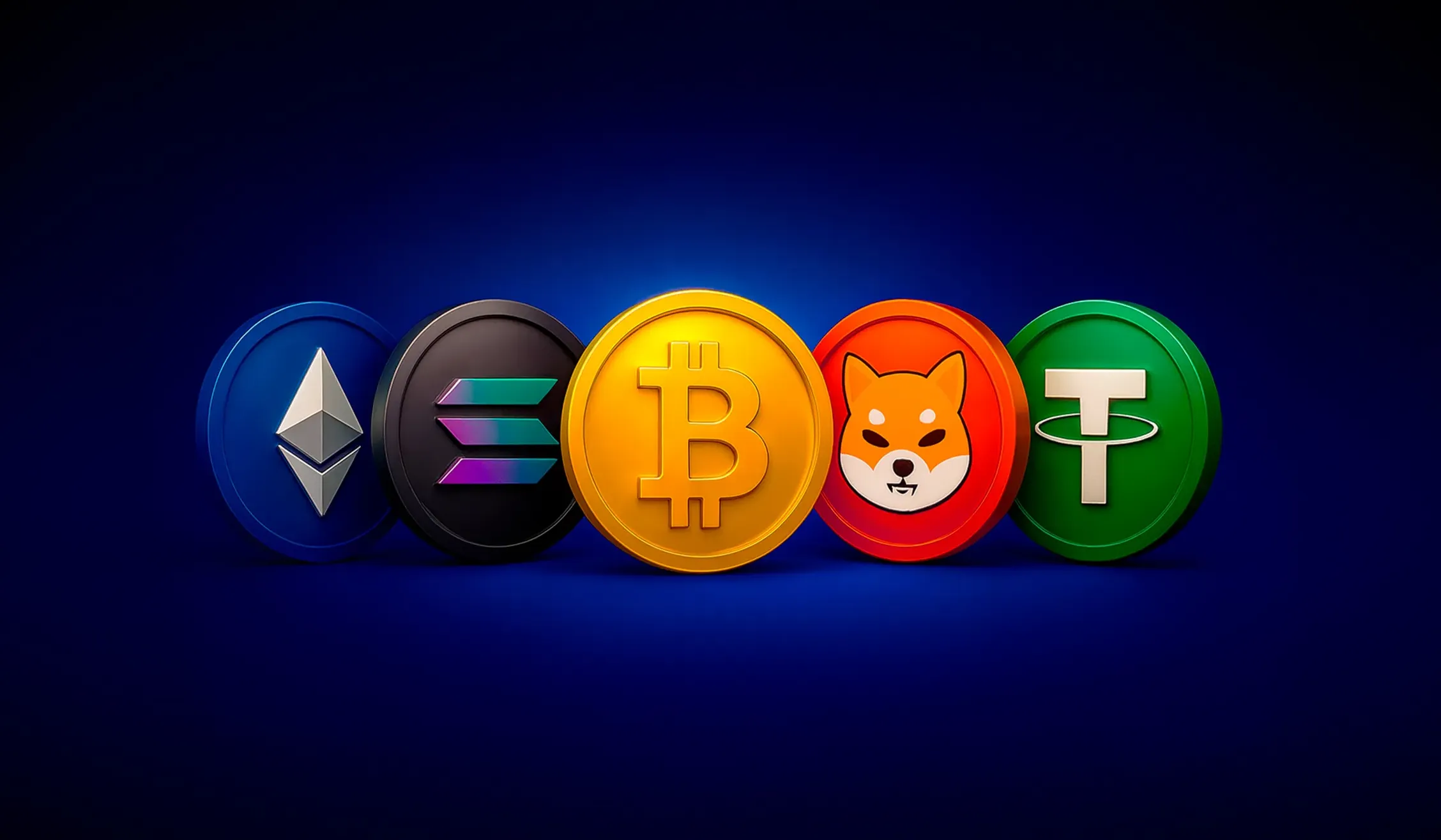
Types of cryptocurrencies explained
With over 20,000 digital assets in circulation, each possessing distinct features and purposes, the first step to understanding this vast ecosystem is recognizing the fundamental difference between coins and tokens.
- Coins operate on their own independent blockchains. Bitcoin runs on the Bitcoin network, Ethereum on its own chain, and Litecoin has its dedicated infrastructure. These native assets power their respective ecosystems and serve as the primary medium of exchange within their networks.
- Tokens are built on existing blockchain platforms, predominantly Ethereum or Solana. They leverage the infrastructure of the underlying chain while fulfilling specific roles inside decentralized applications (dApps) or representing particular assets.
Two main frameworks help categorize the thousands of crypto assets:
- Functional classification groups cryptocurrencies by their use case – payment currencies (Bitcoin, Litecoin), smart contract platforms (Ethereum, Cardano), privacy coins (Monero, Zcash), stablecoins (USDC, Tether), and utility tokens that grant access to specific services.
- Technical-layer classification organizes them by their infrastructure role. Layer-1 protocols form the base blockchain network, Layer-2 solutions improve scalability and transaction speed, and application-layer tokens serve precise functions inside dApps.
This framework helps investors quickly determine whether a digital asset functions as foundational infrastructure, a scaling tool, or a specialized application token.
Top 16 types of cryptocurrency
The cryptocurrency ecosystem covers thousands of digital assets, each serving specific functions from payments and smart contracts to governance and entertainment:
- Bitcoin (BTC)
- Ethereum (ETH)
- Altcoins
- Stablecoins
- Memecoins
- Payment cryptocurrencies
- Privacy coins
- Store-of-value cryptocurrencies
- Infrastructure cryptocurrencies
- Financial/DeFi cryptocurrencies
- Service cryptocurrencies
- Media and entertainment tokens
- Non-fungible tokens (NFTs)
- Security tokens
- Central bank digital currencies (CBDCs)
- Governance tokens
1. Bitcoin (BTC)
Bitcoin, the world’s first cryptocurrency, was introduced in 2009 by the pseudonymous Satoshi Nakamoto. It runs on a Proof-of-Work (PoW) consensus mechanism and functions as a decentralized store of value independent of traditional financial systems. Its blockchain validates transactions through energy-intensive mining, creating an immutable ledger. Bitcoin’s main strengths are its massive network effect as the most recognized cryptocurrency, heightened security derived from enormous computational power, and proven resilience over 16 years. Its drawbacks include high energy consumption, limited transaction throughput, and price volatility that undermines everyday use. Primary use cases center on its perception as “digital gold” and cross-border payments, especially in regions with unstable currencies or banking restrictions. Institutional adoption has grown notably, with companies like Tesla and MicroStrategy adding BTC to their treasuries. Price is largely driven by the fixed supply cap of 21 million coins creating long-term scarcity, institutional adoption, regulatory developments, and broader macroeconomic trends. The four-yearly halving that cuts new supply issuance also significantly influences market value.
2. Ethereum (ETH)
Ethereum revolutionized blockchain technology with smart contracts — programmable agreements that execute automatically when predefined conditions are met. In 2022, Ethereum transitioned from energy-intensive PoW to the more efficient Proof-of-Stake (PoS), cutting energy use by over 99%. The network still charges gas fees for transactions and smart contract execution. Ethereum’s strengths include robust support for dApps, dominance in DeFi with billions in total value locked, and leadership in the NFT space. It hosts thousands of projects, from lending protocols to digital art marketplaces. Challenges remain, including high fees during congestion and competition from faster, cheaper alternatives like Solana. ETH’s primary role is serving as the infrastructure for a decentralized web, hosting finance protocols, social networks, and gaming platforms. Its native currency also acts as gas for network operations and collateral in many DeFi applications. Key price drivers include network usage (transaction volumes and fees), major protocol upgrades, growth of DeFi and NFT sectors built on Ethereum, staking rewards, and competitive pressure from other smart contract platforms.
3. Altcoins
Altcoins encompass all cryptocurrencies other than Bitcoin and Ethereum, representing thousands of alternative digital assets. They were created to address perceived limitations in Bitcoin’s design or to serve entirely different market needs. Popular examples include Litecoin (LTC) offering faster transaction times, and Cardano (ADA) emphasizing academic research and sustainability. Advantages include specialized features for specific use cases, lower transaction costs than Bitcoin, and potential for higher returns during bull markets. Many implement innovative consensus mechanisms and governance structures. However, they face significant disadvantages: lower liquidity and adoption, higher volatility, risk of project failure, and fierce competition in crowded segments. Use cases vary: Litecoin focuses on faster payments, Chainlink provides oracle services, and Polygon offers Ethereum scaling solutions. Price drivers include technological milestones, partnership announcements, adoption metrics, and overall market sentiment.
4. Stablecoins
Stablecoins are designed to maintain a stable value by pegging to external assets like fiat currencies, commodities, or through algorithmic mechanisms. They bridge traditional finance and crypto markets by offering price stability while retaining blockchain advantages like 24/7 trading and programmability. There are four main subtypes: fiat-collateralized (e.g., USDT, USDC backed by traditional currency reserves); crypto-backed (e.g., DAI, overcollateralized with cryptocurrency assets); commodity-pegged (tied to gold or other physical materials); and algorithmic stablecoins that use smart contracts to adjust supply and maintain stability. Leading stablecoins include Tether (USDT), despite transparency concerns; USD Coin (USDC) with regular audits and compliance; and MakerDAO’s DAI providing decentralized stability through crypto collateral. Advantages include reduced volatility enabling practical use as a medium of exchange, seamless DeFi integration, and faster settlement than traditional banking. Disadvantages include counterparty risk with centralized issuers, regulatory uncertainty, and potential depegging under market stress. Common use cases include trading pairs, cross-border payments, DeFi lending and borrowing, and as a safe haven during volatility. Prices are driven by the ability to maintain the peg through reserve management, market confidence in backing, regulatory actions, and demand from trading and DeFi.
5. Memecoins
Memecoins are cryptocurrencies inspired by internet memes, jokes, or cultural phenomena. They usually lack serious utility, with value driven by community enthusiasm and social media buzz. Dogecoin (DOGE), originally created as a Bitcoin parody around the Shiba Inu meme, gained mainstream attention via celebrity endorsements. Shiba Inu (SHIB) emerged as a “Dogecoin killer,” and numerous dog-themed tokens have since flooded the market. Advantages include potential for explosive returns during viral moments, strong community engagement, a low entry barrier for newcomers, and an entertainment factor that attracts broader audiences. The very significant disadvantages are extreme price volatility, a total lack of underlying utility or technology, high risk of pump-and-dump schemes, and susceptibility to celebrity influence and social media manipulation. The core use cases are speculation, community building, and cultural expression. Prices depend on social media trends, celebrity endorsements, viral content, community growth, and overall risk appetite in crypto markets. Memecoins often experience massive swings driven by tweets, memes, or cultural events with little fundamental grounding.
6. Payment cryptocurrencies
Payment cryptocurrencies are designed for peer-to-peer transactions, emphasizing speed, low costs, and ease of use. Key examples include Litecoin (LTC) with faster block times and lower fees, Bitcoin Cash (BCH) created to improve Bitcoin’s transaction capacity, Ripple (XRP) focusing on cross-border banking settlements, and Stellar (XLM) targeting remittances. Advantages include faster processing than traditional banks, significantly lower fees for international transfers, 24/7 availability, and financial inclusion for the unbanked. Their cross-border features eliminate intermediary banks and currency conversions. Drawbacks include price volatility, limited merchant acceptance compared to traditional methods, regulatory uncertainty, and network effects that favor established players. Use cases center on remittances, cross-border commerce, micropayments, and peer-to-peer transfers. XRP targets banking partnerships, while XLM focuses on developing‑market access. Price movements are influenced by transaction volumes, merchant integration, regulatory developments, competition from CBDCs, and partnership announcements with financial institutions.
7. Privacy coins
Privacy coins prioritize transaction anonymity through advanced cryptographic techniques that obscure sender, receiver, and amount. Monero (XMR) uses ring signatures and stealth addresses to hide details by default; Zcash (ZEC) offers optional privacy via zero‑knowledge proofs (zk-SNARKs); Dash uses CoinJoin mixing services. Advantages include strong financial privacy protection, censorship resistance, fungibility (all coins are equal regardless of history), and appeal for users in authoritarian regimes. Significant disadvantages are regulatory scrutiny and potential bans tied to illicit activity, exchange delistings, higher technical complexity, and slow mainstream adoption. Many governments view privacy coins as threats to financial oversight and taxation. Legitimate use cases include protection from corporate surveillance, personal security in high‑risk regions, business confidentiality, and preservation of financial privacy rights, though they are also exploited for darknet markets and money laundering. Their popularity hinges on regulatory developments, exchange policies, and the broader debate between privacy as a right and compliance pressures.
8. Store-of-value cryptocurrencies
Store-of-value cryptocurrencies are designed to preserve wealth over time, akin to precious metals. Bitcoin dominates this category as perceived “digital gold” due to its fixed supply, network security, and first-mover advantage. Other examples include tokenized gold projects like PAX Gold (PAXG) and Tether Gold (XAUT) that represent ownership of physical gold. Some view Ethereum as evolving into a store of value through its deflationary mechanisms post-Merge. Key advantages include acting as a hedge against inflation and currency debasement, providing portfolio diversification beyond traditional assets, offering 24/7 market access, and independence from centralized financial systems. However, sharp short-term volatility can undermine immediate value preservation, regulatory uncertainty may affect long-term viability, and technological risks such as network attacks or protocol failures make them less suitable for some investors than traditional stores of value. Use cases include wealth preservation during economic uncertainty, portfolio diversification, cross-border value transfers, and protection against currency devaluation in unstable economies. Price drivers include inflation rates, monetary policy, institutional adoption trends, network security, and overall sentiment toward risk assets versus traditional haven assets during turbulence.
9. Infrastructure cryptocurrencies
Infrastructure cryptocurrencies power blockchain networks that support dApps, smart contracts, and other services, forming the backbone of Web3. Layer‑1 examples include Ethereum (ETH) hosting thousands of dApps, Solana (SOL) offering high‑speed transactions, BNB Smart Chain (BNB) providing low‑cost alternatives, Cardano (ADA) emphasizing research, and Polkadot (DOT) enabling interoperability. Layer‑2 solutions build upon existing chains to improve scalability and reduce costs: Polygon (MATIC) through sidechains, Optimism and Arbitrum with optimistic rollups, and the Lightning Network for faster Bitcoin payments. Advantages include essential utility for ecosystem growth, potential for significant returns as adoption increases, first‑mover advantages in emerging sectors, and strong network effects. Disadvantages include intense platform competition, technological risks from bugs or attacks, high development complexity, and dependence on broader crypto adoption. Many projects struggle to deliver promised scalability improvements. Use cases focus on providing computational resources, securing networks through staking, paying fees, and enabling cross‑chain communication. Price drivers include network activity, developer adoption, technological milestones, partnership announcements, and competitive positioning against alternative platforms.
10. Financial/DeFi cryptocurrencies
DeFi tokens power protocols that recreate traditional financial services without intermediaries, using smart contracts for lending, trading, insurance, and more. Notable examples include Aave (AAVE) governing a leading lending protocol, Uniswap (UNI) powering the largest decentralized exchange, Compound (COMP) enabling algorithmic interest rates, and MakerDAO (MKR) backing the DAI stablecoin system. Core advantages are governance rights allowing holders to influence protocol development, potential revenue sharing from fees, exposure to the rapidly growing DeFi sector, and utility benefits like reduced trading fees or enhanced yield opportunities. Disadvantages include smart contract risks such as bugs and exploits, regulatory uncertainty, high competition among similar projects, and dependence on broader DeFi adoption. Many tokens face selling pressure from team unlocks and liquidity mining rewards. Primary use cases encompass protocol governance, fee discounts, collateral for borrowing, liquidity incentives, and speculation on DeFi growth. Some tokens also provide insurance against protocol risks. Prices are driven by Total Value Locked (TVL) in protocols, trading volumes and fee generation, governance proposals and upgrades, regulatory developments, and token economic emission schedules.
11. Service cryptocurrencies
Service cryptocurrencies are the native tokens of platforms providing specific services — exchanges, payment processors, and financial service providers. They typically offer utility benefits, fee discounts, or governance rights within their platforms. Key examples include CRO, which powers a comprehensive crypto ecosystem including exchange, debit cards, and DeFi services, and Uniswap (UNI) governing the leading decentralized exchange protocol. Advantages include direct utility within popular platforms creating consistent demand, fee reductions for active users, potential revenue sharing, and strong user bases that reinforce network effects. Disadvantages are platform‑specific risks (e.g., regulatory issues or business failures as demonstrated by FTX’s collapse), intense competition, dependence on platform adoption and user growth, and potential regulatory challenges for centralized platforms. Use cases focus on trading fee reductions, governance participation, staking rewards, payment for services, and access to premium features. Price drivers include platform user growth and trading volumes, regulatory developments, competitive positioning, new product launches, token burn mechanisms, and overall crypto market activity that drives heightened platform usage.
12. Media and entertainment tokens
Media and entertainment tokens power block‑based gaming, virtual worlds, and digital content platforms. Leading examples are Axie Infinity (AXS) governing a popular play‑to‑earn gaming ecosystem, The Sandbox (SAND) powering a voxel‑based virtual world, Decentraland (MANA) enabling virtual real estate ownership, and Enjin (ENJ) facilitating NFT creation and gaming asset management. Advantages include exposure to the rapidly growing gaming and metaverse sectors, utility in increasingly popular virtual experiences, strong network effects as platforms gain users, and appeal to younger demographics driving crypto adoption. Disadvantages encompass dependence on entertainment trends and user engagement, high competition in gaming markets, technological challenges in creating compelling experiences, and volatility related to platform success or failure. Many gaming projects struggle with sustainability and long‑term player retention. Use cases range from purchasing virtual assets and NFTs to accessing premium game features, governance voting, staking for rewards, and trading virtual goods. Prices move on user engagement metrics (daily active users, time spent in‑platform), new game releases and content updates, partnership announcements with gaming companies, and broader metaverse and NFT market sentiment.
13. Non-fungible tokens (NFTs)
Non‑fungible tokens are unique digital assets that cannot be replicated, each possessing distinct characteristics and ownership records stored on a blockchain. NFTs span digital art, collectibles, gaming items, virtual real estate, music, and utility tokens for exclusive access. Landmark examples include CryptoPunks, one of the first successful collections; Bored Ape Yacht Club, blending art with membership benefits; and NBA Top Shot featuring officially licensed basketball highlights. Advantages include verifiable digital ownership, programmable royalties that benefit creators from secondary sales, potential for significant appreciation, and utility beyond speculation — such as community access, games, or experiences. Disadvantages are extreme price volatility and speculative bubbles, environmental concerns from blockchain energy use, copyright and IP complications, market manipulation risks, and questions about long‑term value. Use cases span digital art collection, gaming asset ownership, virtual property, membership tokens, music collectibles, and identity verification. NFT prices are driven by rarity and artistic quality, creator reputation and celebrity involvement, utility and community benefits, broader market sentiment, technological advancements enhancing functionality, and cultural trends influencing digital collectible demand. Floor prices of successful collections often establish value benchmarks for similar projects.
14. Security tokens
Security tokens represent digital securities that derive value from external tradable assets, providing blockchain‑based ownership of real‑world investments like stocks, bonds, real estate, or commodities. They must comply with securities regulations, offering regulatory clarity but requiring extensive legal frameworks. Examples include RealT for fractional property ownership, equity tokens representing company shares, bond tokens for fixed‑income exposure, and commodity tokens backed by physical assets. Advantages include fractional ownership that makes expensive assets accessible, 24/7 trading, programmable compliance that reduces administrative costs, global investor access, and transparent blockchain records. Disadvantages involve complex, jurisdiction‑specific regulatory requirements, limited liquidity compared to traditional securities, high compliance costs for issuers, technological risks from smart contract bugs, and ongoing regulatory uncertainty as frameworks evolve. Primary use cases are democratizing investment access, programmable dividend distributions, creating liquid markets for traditionally illiquid assets like real estate, and reducing settlement times and costs. Price drivers include underlying asset performance, regulatory developments affecting security token legality, platform adoption by institutional issuers, advances in compliance automation, and broader acceptance of tokenized securities by traditional finance.
15. Central bank digital currencies (CBDCs)
CBDCs are government‑issued digital versions of national currencies, blending blockchain benefits with central bank oversight and monetary policy control. Emerging examples include China’s Digital Yuan (e‑CNY) in advanced pilots, the ECB’s planned Digital Euro, the Federal Reserve’s ongoing research, and smaller nations like the Bahamas with the Sand Dollar already in circulation. Advantages include improved payment system efficiency and financial inclusion for the unbanked, better monetary policy transmission, reduced cash handling costs, programmable money for automatic tax collection or stimulus distribution, and maintenance of sovereign monetary control against private cryptocurrency competition. The big problems are privacy concerns from government transaction monitoring, potential elimination of cash reducing financial privacy, cybersecurity risks, disruption to commercial banks, and massive infrastructure implementation challenges. Use cases focus on domestic payments, cross‑border transfers, government benefit distribution, tax automation, and financial inclusion. Price drivers for investible CBDC‑related tokens (where they exist) include regulatory announcements and pilot results, technological milestones, international cooperation agreements, competitive pressure from private cryptocurrencies, and broader CBDC adoption trends. Most CBDCs themselves maintain a stable value pegged to the respective national currency.
16. Governance tokens
Governance tokens give holders voting rights in decentralized protocols, enabling community‑driven decision‑making on parameters, upgrades, treasury management, and strategy. Major examples are MakerDAO (MKR) governing the DAI stablecoin system with votes on collateral types and stability fees, Curve (CRV) for liquidity mining rewards and protocol parameters, Compound (COMP) for lending protocol interest rates, and Aave (AAVE) for lending protocol risk parameters. Advantages include direct influence over protocol development, potential revenue sharing from protocol success, alignment between token holders and protocol health, community‑driven innovation, and democratic alternatives to centralized control. However, low voter participation can reduce governance effectiveness, and there is potential for whale manipulation where large holders control decisions. Complex governance processes also require significant technical knowledge. Primary use cases are voting on upgrades, setting fee structures and interest rates, managing treasuries, selecting grant recipients, and determining tokenomics parameters like inflation rates or reward distributions. Governance tokens are moved by proposal outcomes, voter participation rates, protocol revenue and TVL growth, regulatory developments around their classification, and competitive positioning relative to alternative protocols.
How to invest in crypto with us
- Sign up to Crypto.com.
- Check live prices and filter by category on Crypto.com Price.
- Trade any of these cryptos easily on the Crypto.com App.
FAQs on types of cryptocurrencies
What are the main types of cryptocurrencies?
Coins (like Bitcoin), tokens (utility, governance, security), stablecoins, privacy coins, and DeFi tokens.
What are the biggest cryptocurrencies by market cap?
Bitcoin (BTC), Ethereum (ETH), and Tether (USDT) are often the largest three.
How many types of cryptocurrencies exist?
Over 20,000 cryptocurrencies, though only a few hundred enjoy significant adoption and liquidity.
What’s the difference between coins and tokens?
Coins run on their own blockchain while tokens are built on top of another blockchain.
What are stablecoins used for?
By maintaining a stable value, they enable trading, payments, and hedging against volatility.
What is a privacy coin?
A cryptocurrency that hides transaction details, valued for financial privacy but often scrutinized by regulators.
What are DeFi tokens and how do they make money?
Tokens powering DeFi apps. Holders earn through staking, lending, liquidity provision, or governance rewards.
Important information: This is informational content sponsored by Crypto.com and should not be considered as an investment recommendation. Trading cryptocurrencies carries risks, such as price volatility and market risks. Before deciding to trade cryptocurrencies, consider your risk appetite. Although the term “stablecoin” is commonly used, there is no guarantee that the asset will maintain a stable value in relation to the value of the reference asset when traded on secondary markets or that the reserve of assets, if there is one, will be adequate to satisfy all redemptions.