
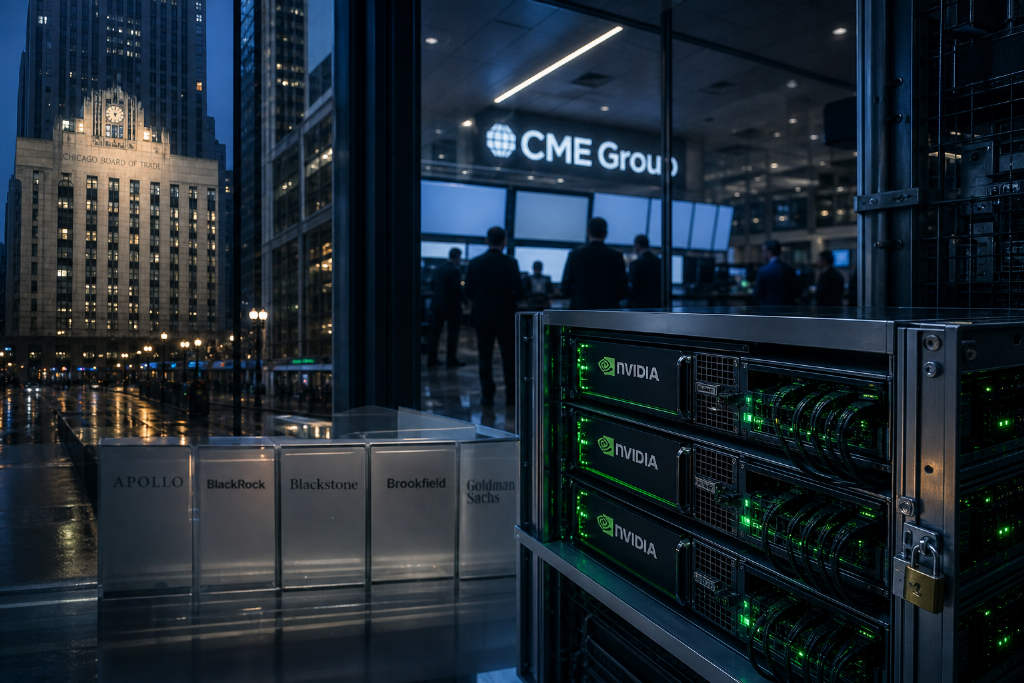
Compute is being pushed into the language of finance. Nvidia has framed GPUs as collateralizable infrastructure assets, CME Group and Intercontinental Exchange are building futures around compute pricing, and a wider chain of OTC swaps, on-chain block trades, and prediction-market forward curves has already started to form around the same idea.

On Aug. 10, 2026, Nvidia said it had signed memorandums of understanding with Apollo, BlackRock, Blackstone, Brookfield, Goldman Sachs, and KKR. The goal is to mobilize more than $500 billion in third-party capital and position GPUs as infrastructure assets that can be financed and invested in. One day later, on Aug. 11, 2026, CME Group said it would launch the world’s first futures contracts tied to GPU compute rental prices on Oct. 5.
Before those announcements, Shanghai had already moved in its own way. A government document published on June 2 called for research preparations for compute futures, while spot trading on the Shanghai compute trading platform has been running since 2023.
Placed side by side, these developments point to the same shift: compute is moving from leased IT capacity to an asset that can be priced, traded, hedged, and pledged in open markets. Forwards have already traded, futures are lining up for launch, pricing indexes are on Bloomberg terminals, and Chinese policy documents now explicitly use the term compute futures.
How Nvidia is trying to turn GPUs into collateral
A reclassification of the GPU
To understand why compute derivatives accelerated in 2026, it helps to start with Nvidia’s attempt to redefine what a GPU is.
According to Nvidia’s Aug. 10, 2026 news release, the company signed memorandums of understanding with Apollo Global Management, BlackRock, Blackstone, Brookfield, Goldman Sachs, and KKR to build an independent compute financing platform. The stated aim is to mobilize more than $500 billion in third-party capital to support AI data centers, chip factories, and related power infrastructure.
The financing number is only part of the story. The bigger change is the taxonomy Nvidia is trying to establish: GPUs should no longer be treated simply as rapidly depreciating technology hardware, but as investable infrastructure assets.
In that framework, GPUs are presented as assets with long-duration and relatively predictable cash flow, closer in spirit to commercial real estate or toll roads. Jensen Huang’s argument is that Nvidia compute assets are widely adopted across cloud providers, can move between customers, and can continue to gain performance through the CUDA software ecosystem, extending their useful life.
On Aug. 10, 2026, Huang said, 「This really is the first time that technology chips have become an investable asset class.」
The central question is whether the economic life of a GPU can match the time horizon lenders usually require for collateral-backed financing.
Traditional collateral such as commercial real estate or cargo vessels is accepted by banks in part because those assets sit on top of decades-old secondary markets and price moves are relatively gradual. GPUs behave differently. Their value curve is driven less by physical wear and more by the cadence of chip upgrades.
Data cited from industry research firm Silicon Data and GPU trading platform GPUSmith showed that an H100 priced at about $40,000 at the end of 2023 had fallen to a secondary-market transaction range of $12,000 to $22,000 by mid-2026. Some auction prices were as low as $8,200. That kind of abrupt, non-linear reset is the hardest technical problem in the GPU financialization experiment.

Residual value support is still being tested
To address creditor concerns, Nvidia proposed a key term: for some financing transactions, it would provide residual value support of up to 25%. If actual chip resale value at maturity falls below expectations, Nvidia would absorb up to 25% of the shortfall, with the exact level assessed case by case.
There is an important wrinkle. Financial analysis platform Electron Economics said that after checking the original Aug. 10 release line by line, it found no mention of residual value or backstop in the text itself. The release said only that Nvidia was working with the six institutions to build large-scale pools of dedicated financing at attractive rates, and it stated that any cooperation remained subject to final agreements. The more specific language around support of up to 25% residual value appeared in Huang’s follow-up interviews and articles the next day.
That sequence matters, especially when set against the credit market reaction.
- According to ICE Data Services, Nvidia’s five-year credit default swap spread widened in July amid reports around circular trading. On July 27, it jumped 14 basis points in a single day and briefly hit 82 basis points before pulling back. That was the biggest intraday one-day rise since the contract began trading actively in November 2025.
- Investing.com said the spread moved up to about 77.5 basis points on Aug. 10, the day the financing plan was announced, suggesting the support language did not materially cool the market response.
In practice, the credit market may be offering the clearer signal. The mechanism is still being tested and has not settled into a fully accepted structure.
Why exchanges are stepping in
Collateral needs a benchmark
For an asset to become acceptable collateral on a bank balance sheet, three conditions usually matter: relative price stability, a functioning secondary market, and a trusted benchmark. A single physical GPU struggles to meet all three. That is where CME and ICE come in.
On May 12, 2026, CME Group and GPU market data firm Silicon Data said they planned to launch the first compute futures contracts later in the year. On Aug. 11, the two sides said more specifically that they would list two contracts on Oct. 5: Silicon Data H100 Rental Index Futures and Silicon Data B200 Rental Index Futures. The contracts track hourly rental indexes for the H100 and the next-generation Blackwell B200 chip, and, if launched as planned, would trade on NYMEX.
Pete Keavey, CME’s global head of energy and environmental products, compared the move to crude oil futures. He said, 「Compute has become the currency of the AI era. Just as oil powered the 20th-century economy and evolved from spot trade into a global derivatives market, our futures contracts will turn compute into a standardized, tradable commodity.」
Just one week later, on May 19, 2026, ICE said it would work with compute data firm Ornn on GPU compute futures based on the Ornn Compute Price Index, or OCPI. The coverage runs from enterprise-grade H100 and H200 chips to consumer GPUs such as the RTX 5090.
The timing was hard to miss. Two large exchanges moved almost in parallel, which suggests the competition over compute price discovery is developing faster than many expected.
Two design paths are emerging
Contract design in compute futures is splitting into two broad approaches.
- One route is rental-based. It uses GPU hourly rental indexes as the underlying reference and prices compute from the supply side, at the hardware layer.
- The other route is token-based. It ties pricing to the demand side by linking value to the number of tokens consumed by large models, which is closer to the actual cost experience of downstream AI developers and end users.
CME and ICE are following the first path. Financial media reports have said that the compute futures design being explored by the Shanghai Futures Exchange follows the second, focused on AI Token futures.

That also means the phrase first compute futures needs a qualifier. CME may be the first to bring compute futures into a regulated mainstream exchange framework, but it is not the first compute derivative in absolute terms. Before any exchange listing, the OTC and prediction-market segments had already logged several live transactions.
The derivatives chain was already forming outside exchanges
No index, no derivative
Every product in this market, from FalconX’s OTC swap to Polymarket’s on-chain block trade to the planned CME and ICE futures, depends on the same base layer: a credible pricing index.
Without an index, there is no benchmark. Without a benchmark, there is no room for standardized derivatives.
Two index tracks are running in parallel.
- The Ornn Compute Price Index, or OCPI, is published by Ornn and is described as the first compute index built only from real transaction records rather than quotes or advertised prices. In April 2026, OCPI went live on Bloomberg terminals. It covers H100, H200, A100, B200, RTX 5090 and other models, and it serves as the settlement benchmark for ICE’s compute futures.
- Silicon Data’s index suite provides the benchmark for CME’s contracts and tracks daily GPU rental pricing. CME currently plans separate H100 Rental Index Futures and B200 Rental Index Futures. Each is priced off the hourly rental rate of the corresponding chip model, without converting different models into one standardized compute unit.
Only after indexes like these exist does compute start to look more like a commodity class with recognizable benchmarks, the way WTI and Brent work in oil.
FalconX records the first OTC compute forward price swap
On May 27, 2026, digital asset broker FalconX said it had completed the world’s first OTC compute forward price swap. The counterparty was Robert Leshner, founder of digital asset platform Superstate. The trade referenced the forward price of H100 compute in Ornn’s OCPI, with FalconX acting as dealer.
Ornn CEO Kush Bavaria described it as a step toward turning a volatile and unpredictable market into one that can be measured, traded, and hedged as a commodity.
The trade was not large in size, but it mattered because it showed that institutional investors were already trying to manage compute price risk through OTC structures while exchange-traded futures were still awaiting approval.
Polymarket adds on-chain block execution
A few days later, on June 2, 2026, prediction market platform Polymarket said it had completed its first institutional on-chain block trade.
The counterparties were FalconX and AI risk clearinghouse startup AneraLabs. The trade settled against Ornn’s OCPI, was worth a six-figure dollar amount, and was recorded on the Polygon blockchain.
The risk trade itself was packaged as a prediction market position on Polymarket, which also provided the execution venue and on-chain settlement mechanism.

CNBC said it was the first institutional block trade in the prediction-market sector explicitly tied to compute prices through the H100 OCPI index. One month earlier, Kalshi had completed its own first institutional block trade, though that contract tracked California carbon allowance auction prices. Taken together, the two deals show that prediction-market venues are building institutional trading capacity, and compute has become one of the categories entering that process.
Compared with a conventional OTC swap, the Polymarket transaction added an on-chain execution and settlement layer. After FalconX and AneraLabs negotiated bilaterally, the trade was executed on Polymarket’s international platform and ultimately recorded on Polygon rather than relying entirely on the back-end clearing systems of traditional finance.
There is also a jurisdictional distinction that matters. Polymarket operates two separate platforms:
- the international venue used for this compute trade, built on Polygon, settled in USDC, requiring no identity verification, and geo-blocked for U.S. users;
- Polymarket US, launched at the end of 2025 and operated through the acquired QCX entity, regulated by the CFTC, settled in dollars, and requiring full identity verification.
The GPU compute trade took place on the first platform, outside the CFTC framework.
Kalshi builds a forward curve from prediction markets
On July 14, 2026, CFTC-regulated prediction market platform Kalshi launched an AI compute forward curve.
According to Kalshi’s news release, the curve currently covers Nvidia B200, H200, and A100 chips. More broadly, compute-related contracts on Kalshi also cover H100 and RTX 5090.
Kalshi’s chief risk officer, who previously spent about 16 years at CME Group, told Bloomberg that the platform is using prediction markets to build a GPU compute forward curve and sees it as a foundation for future products such as futures and options. He also said hyperscaler capital expenditure commitments in 2026 alone had already reached roughly $500 billion to $600 billion.
Kalshi also made clear that the forward curve itself is not a tradable asset. It is a reference price intended for OTC swaps and structured products. The tradable instruments are the underlying prediction market contracts listed on Kalshi’s exchange.
The curve is not fully independent from the Ornn system either. Some of Kalshi’s compute contracts also settle using real-time pricing data from Ornn. So while the compute derivatives chain already involves many names, pricing data at the base layer is still highly concentrated between Ornn and Silicon Data.
Different products, different roles
These transactions all sit under the compute derivatives label, but they do different jobs.
FalconX’s OTC swap and Polymarket’s on-chain block trade both use negotiated institutional execution, though the structures differ. In the FalconX deal, FalconX acted as dealer opposite Robert Leshner and effectively made a hedge available to him. In the Polymarket deal, FalconX and AneraLabs were counterparties to each other, while Polymarket supplied execution infrastructure and settlement on Polygon.

Kalshi’s forward curve is something else again. It is not a contract. It is a reference curve reverse-engineered from many small prediction-market trades on the platform. The tradable instruments are those underlying contracts, not the curve itself.
CME and ICE are closest to the traditional commodity futures model: standardized terms, exchange listing, and centralized clearing, structurally similar to crude futures.
Viewed together, the division of labor is becoming clear. OTC forwards absorb hedging demand during the regulatory gap before exchange approvals. Prediction markets use frequent small trades to surface a market reference price. Exchange futures then standardize that price into contracts anyone can trade.
China’s market is early in spot infrastructure and cautious in futures
Shanghai moved from platform testing to policy language
China’s buildout in spot compute trading infrastructure began earlier than the current wave of U.S. futures activity, and it developed across several layers at once.
At the platform level, Shanghai moved first. The Shanghai compute trading platform began trial operations in April 2023, released its 2.0 version in December that year, and was upgraded in May 2025 into the China Compute Platform (Shanghai). That platform is only one local node, however. At the national level, the China Compute Platform led by the China Academy of Information and Communications Technology had achieved full connectivity by the August 2025 China Compute Conference, with branch platforms in Shanxi, Liaoning, Shanghai, Jiangsu, Zhejiang, Shandong, Henan, Qinghai, Ningxia, and Xinjiang connected.
On the benchmark side, CSI Commodity Index Company on Dec. 24, 2025 released the CSI Intelligent Compute Supply Index series, a set of 16 indexes covering one composite index, seven regional indexes, and eight national compute hub node indexes.
The policy turn came later and in two steps. In April 2026, China’s Ministry of Industry and Information Technology first said it would explore new business models such as compute banks and compute supermarkets. The clearer breakthrough came at the end of May. On May 28, 2026, the General Office of the Shanghai Municipal People’s Government issued the Opinions on Deepening the Development of Shanghai as a Global Asset Management Center, and the document was publicly released on June 2. It explicitly called for research preparations for electricity futures and compute futures.
That appears to be the first formal use of the phrase compute futures in a public document issued by a provincial-level Chinese government. The text said: 「做好电力期货、算力期货研发准备,研发更多代表新质生产力发展方向的新型期货品种。」
The wording matters. It speaks about research preparations, not an imminent listing. That is a different tempo from CME’s concrete Oct. 5 launch date. The same Shanghai document also set a broader target: by 2030, Shanghai aims for 55 trillion yuan in assets under management, accounting for one-third of the national total.
A different technical route from the U.S.
According to an exclusive Reuters report, the Shanghai Futures Exchange is designing a futures framework linked to AI Tokens, the smallest units used by large models to process information and price AI services. That is very different from the GPU hourly rental model used by CME and ICE.
Reuters said the work remains at an early stage. It did not disclose whether pricing would be based on token quantities or per-token prices, and it said there was no regulatory approval timeline yet.

Even so, the divergence is visible from the design stage. The U.S. approach is anchored to hardware rental cost on the supply side. China’s exploratory route is tied to token consumption on the demand side.
The logic is straightforward. CME and ICE largely serve data center operators and cloud providers that care about hourly card rental economics. Token-based pricing is closer to the cost perspective of downstream AI application developers, who care more about how many tokens a task consumes and how much it costs to run.
There is no settled verdict on which route is better. If China can make token futures work, the addressable market would point more directly to the downstream application layer, which is larger than short-term card leasing. The same path could offer more room in areas such as transferability and convenience, but standardization would be much harder.
The idea of a “compute dollar” is still only a proposal
Where the idea comes from
Once compute starts to look more like oil in the sense that it can be priced, traded, and pledged, another question follows naturally: if oil’s dollar-denominated trade helped produce the petrodollar system, could compute follow a similar path?
The analogy did not originate here. Over the past six months, several institutional research pieces have advanced versions of it. One of the more widely cited examples is a Dec. 8, 2025 commentary article by Navin Girishankar, head of economic security and technology at the Center for Strategic and International Studies, titled Turning the AI Revolution into Dollar Dominance.
The basic argument is that the U.S. is exporting advanced AI chips to allies and partners, helping them build compute infrastructure. That infrastructure could then generate AI services for export to the rest of the world. Whichever currency captures settlement of that export income could gain a position analogous to the dollar’s role in oil.
The input text is careful on the point that this is a personal commentary article. CSIS states that its research is nonpartisan, does not represent institutional positions, and is not established U.S. government policy.
The biggest weakness in the thesis
The central gap in the “compute dollar” thesis is one the author himself acknowledges: the chip export deals in question do not require recipient countries to settle their AI service export earnings in dollars.
His framing is that a country may spend a one-time $10 billion building data center infrastructure, but the chips could later generate $50 billion to $100 billion a year in AI service export income. The key long-duration revenue stream is not bound to any currency arrangement. The petrodollar rested on settlement conventions. A compute-dollar system has not even reached that stage.
To close that gap, he proposed three policy steps:
- tie chip export licenses to commitments to settle in dollars or dollar-backed stablecoins;
- use dollar stablecoins as settlement tools through the GENIUS Act, which was signed into law in July 2025;
- offer an economic security umbrella as a contemporary version of the Cold War-era defense umbrella.
On the facts available here, “compute dollar” is better understood as a policy proposal in a think tank commentary, not an operating monetary system.

A historical reference point: bandwidth tried this before
The path from new asset narrative to verified market structure usually takes a full cycle. The source text uses two bubbles around 2000 as reference points: the better-known internet equity bubble, and the telecom equipment bubble, which is structurally closer to today’s compute story.
At that time, equipment makers such as Cisco, Lucent, and Nortel extended large amounts of vendor financing to cash-strapped telecom carriers and internet service providers. Loans supported equipment purchases, purchases helped push share prices higher, and the cycle fed on itself.
Before the collapse, the sector expanded to more than $1.5 trillion, accumulated roughly $1 trillion in debt, and spent more than $500 billion laying fiber and related infrastructure. Nortel alone completed a $19.7 billion acquisition in 2000 using almost entirely stock.
There is also a more direct parallel. People tried to turn bandwidth itself into a tradable commodity, and that effort failed. In December 1999, Enron completed its first bandwidth trade, a monthly DS-3 incremental contract on Global Crossing’s network between New York and Los Angeles. Enron explicitly said it wanted that contract to become a benchmark and laid out further expansion plans. The method is strikingly similar to what Ornn and Silicon Data are doing with indexes and what CME is trying to do with standardized contracts.
The market did not survive long enough to build deep liquidity. After Enron collapsed in 2001, Williams, Dynegy, and El Paso shut their bandwidth trading operations, while independent platforms such as RateXchange exited outright.
That history does not prove that demand was imaginary. Internet traffic kept growing, and overbuilt fiber later helped reduce the cost of broadband, video, and cloud computing. What the crash punished was leverage and pricing that ran ahead of realized demand, not the direction of travel itself.
AI compute demand today is also strong in the signals available so far, though whether that becomes durable profitability remains unknown. The source text notes another difference as well: many regulatory reforms last time arrived after the bubble burst, whereas agencies such as the CFTC and the Bank of England are already watching developments in advance.
The direction is clearer than the destination
The compute trading stack is moving quickly, but speed is not the same thing as completion. Forwards have traded, indexes are live, and futures are lining up for launch. That can make compute financialization look settled. It is not.
The unresolved issues are the ones that matter most: whether demand can support the leverage built around it, whether regulation can keep pace with product innovation, and whether these different design paths can converge into a market standard.
Open questions remain around GPU residual value assumptions, whether a “compute dollar” can ever be written into actual agreements, and whether China’s token-linked route and the U.S. rental-hour route will eventually point to one framework or stay separate.
What is already visible is the direction. Compute is being remade into a financial asset. Who ends up setting the price, which currency settles the trade, and what standard governs the market are still unanswered.