
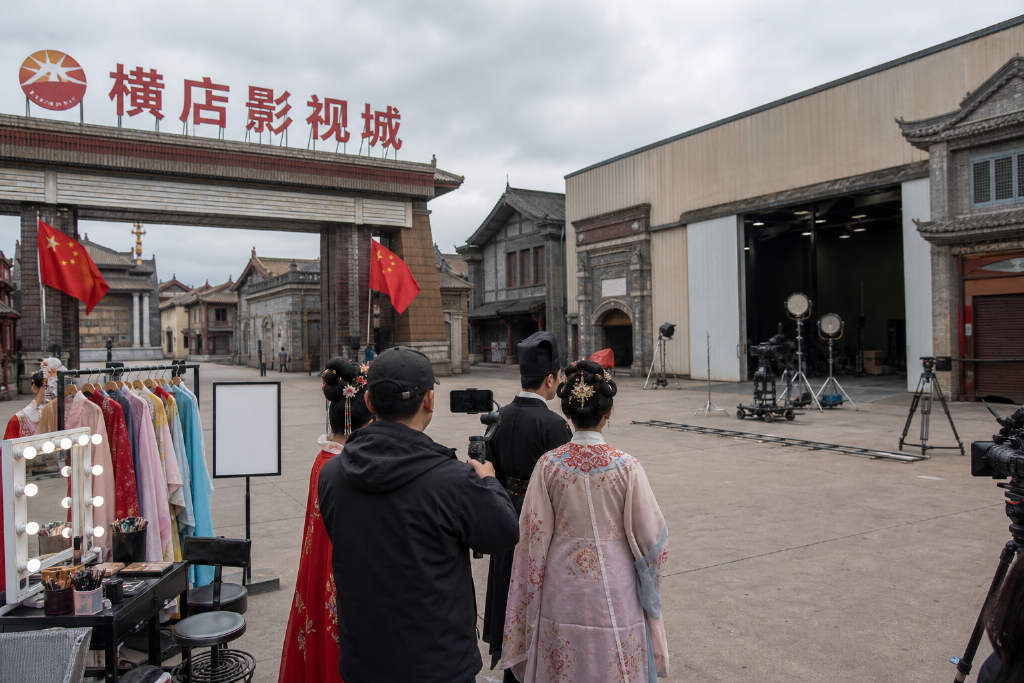
Hengdian in China is turning part of its studio business into a tourist-facing short drama experience as AI short-form production takes over more of the market. For about 300 yuan, visitors can put on costumes, hear a director call action, and receive a personalized short drama in as little as an hour.
Tourist shoots are now sold as a standardized product
The report says Hengdian has packaged filming itself as a consumer product. Pricing starts at 218 yuan for a single-person vertical short drama without makeup and styling. A 388 yuan package includes full styling, while group mini-film packages range from 3,800 yuan to 12,000 yuan.
The script catalog has expanded from more than 20 options to 30 or 40, covering palace intrigue, wuxia, spy stories, Republican-era settings, and domineering CEO storylines. Visitors do not need acting experience. Directors guide blocking and lines on site.
The process has been compressed into a production line: choosing a script, changing costumes, makeup, a launch ceremony, and filming. Faster packages can deliver a finished 1- to 2-minute video in under an hour, while the full process usually takes two to three hours.
One operator said more than 2,000 people joined the experience in August alone. Some directors can shoot about 20 short dramas in a single day. Foreign tourists and corporate team-building groups have also joined. A wardrobe inventory of more than 1,000 outfits helps keep the workflow moving.
What Hengdian is selling, in effect, is a stripped-down version of the film industry process: sets, costumes, lighting, and live direction, turned into an experience product that can be consumed in a short block of time.
AI short dramas are displacing live-action production
The business did not emerge in a vacuum. It reflects pressure from AI short dramas that are rapidly replacing live-action output. According to an August visit by Sina Entertainment cited in the report, AI short dramas accounted for more than 95% of overall short drama production in the first quarter of 2026, and studio vacancy rates were close to 80%.
A field report from 36Kr described the contraction in more concrete terms. At the 2025 peak, as many as 40 to 50 crews were shooting on a single day. By April 2026, only one crew remained in a seven-story influencer studio complex. By mid-May, the entire park had just 33 short drama crews and 26 long-form drama crews still operating. Short drama launches were down by three-quarters year over year, and filings for live-action short dramas had fallen 63%.
Cost and delivery time are driving the shift
The gap between live-action and AI production is centered on cost and turnaround.
A 50-episode live-action short drama costs at least 300,000 to 500,000 yuan and takes around half a month to one month to shoot. An AI-produced version costs 80,000 to 200,000 yuan and can be delivered in 1 to 5 days.
Using the figures cited in the report, AI production is close to two-thirds cheaper for the same output, with delivery measured in days instead of weeks. That pricing and speed gap is pushing producers to move orders away from live-action crews.
Financial results and labor figures show the pressure
The impact has also appeared in Hengdian Film’s financials. The company reported first-quarter 2026 revenue of 582 million yuan, down 50.36% year over year, and net profit of 40.1224 million yuan, down 88.30%.
Hengdian is also home to about 140,000 so-called hengpiao, long-term background actors and temporary performers. The report says effective daily casting calls have fallen to around 800, which works out to roughly 175 people competing for each role.
Under those conditions, opening a new revenue stream from studio tourism has become one of the few ways left to use part of the city’s production capacity.
The tourism model does not solve the scale problem
The report argues that turning sets into a theme-park-like business only addresses the problem on the surface.
An average ticket of about 300 yuan is not comparable to the production budget of a full mini-film, which can run into the tens of thousands of yuan. The tourist product is also closer to a one-time experience than a repeatable content business, which limits its ability to provide stable cash flow.
The larger problem is scale. Around 140,000 hengpiao need work, but a full day of tourist experiences can only absorb service demand for dozens of people. Those are not comparable numbers.
Even if being the lead actor becomes a normalized tourism business, the jobs it can sustain may be limited to a small number of service roles such as guides or costume assistants. The broader employment question for actors remains unresolved.
Hengdian’s move from producing for audiences to selling the experience to tourists amounts to a recognition that live-action film capacity has become excessive, and AI has exposed that shift faster than many expected.