
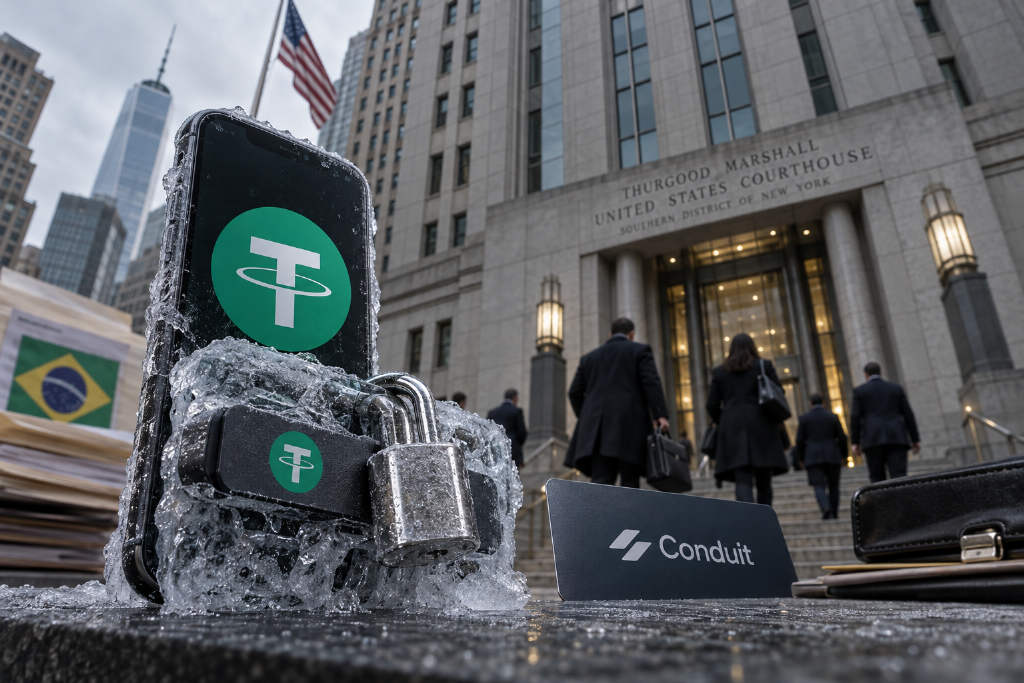
Cross-border payments company Conduit has sued Tether in the U.S. District Court for the Southern District of New York, alleging that the stablecoin issuer froze $2.76 million of its operating funds without legal justification and refused to release them for more than a year.
According to the complaint filed Monday, Tether froze Conduit’s treasury wallet on Sept. 24, 2025. Conduit describes that wallet as the digital equivalent of its operating bank account. The filing says the funds have remained locked ever since, while Tether continued to profit from the reserves backing those tokens.
The lawsuit brings claims including conversion, unjust enrichment, breach of fiduciary duty, and computer fraud, and seeks the return of the frozen funds.
The dispute centers on a Brazil investigation
Conduit says the freeze was tied to a Brazilian investigation that had nothing to do with the company. According to the complaint, Brazil’s federal police were investigating entities linked to a company called Onix, which had previously used Conduit’s platform.
Conduit says the frozen treasury wallet was created in May 2025, almost one month after Onix completed its last transaction on the platform. The company also says that wallet never held any funds connected to Onix.
In the complaint, Conduit says Brazil’s federal police confirmed they never flagged the wallet and did not know the basis on which Tether froze it. Conduit argues the decision came from Tether’s own T3 Financial Crime Unit rather than from a direct designation by Brazilian law enforcement.
Conduit says the freeze damaged its business
Conduit argues the freeze devastated its business. Before the wallet was locked, it had processed more than $1.1 billion in volume over roughly four months, according to the filing. The company says the resulting liquidity shock forced layoffs and office closures.
The complaint also says Tether kept collecting interest from the U.S. Treasuries backing the frozen tokens during that period. Conduit contends that Tether was able to generate financial returns from the freeze without bearing any additional cost.
Tether’s freeze powers face renewed scrutiny
The case puts Tether’s authority to freeze USDT back under the spotlight. It is not the first challenge this year involving the company’s handling of frozen assets.
Tether has also been sued this year over another freeze involving $42.4 million, and the company has frozen hundreds of millions of tokens flagged as linked to illicit activity. More recently, Tether and Circle froze funds tied to the Bitget hack.
At the same time, Tether is facing pressure from the opposite direction. Senator Richard Blumenthal recently described USDT as a "highway" for sanctions evasion and pointed to its use in Iran. That leaves the company facing criticism on both fronts: lawsuits over freezing assets and political pressure that it has not frozen enough.