
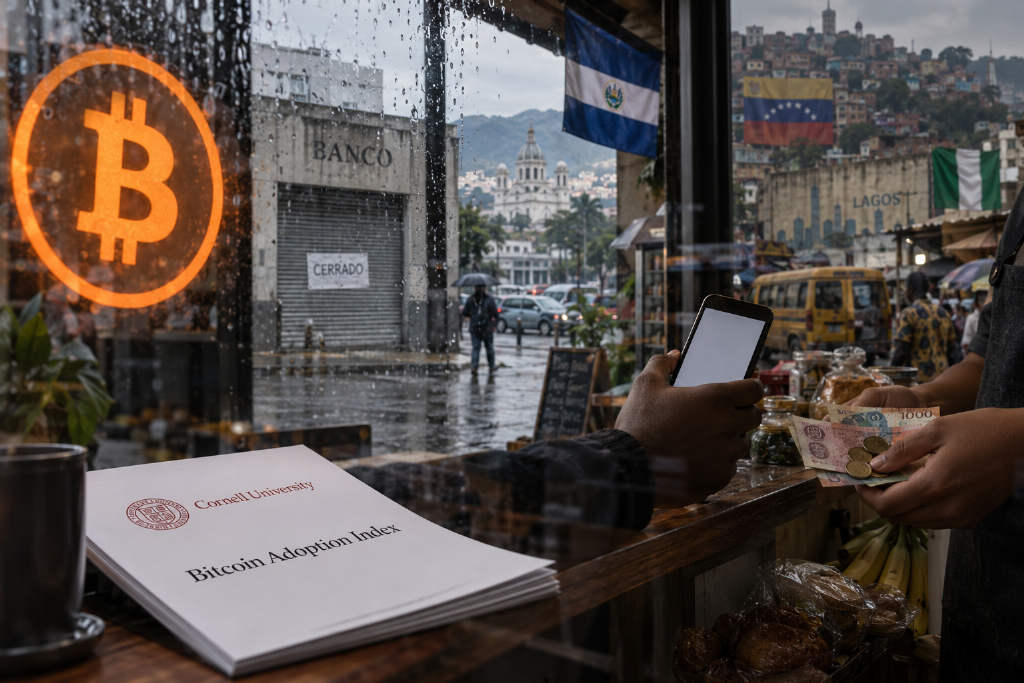
Cornell University’s new Bitcoin Adoption Index says bitcoin ownership is highest in places where banking access is weaker and local currencies have been less stable.
The report, based on a survey of nearly 26,000 people worldwide, found that El Salvador, Venezuela, and Nigeria had the highest share of respondents who said they had ever owned bitcoin.
Top-ranked countries were not wealthy financial centers
According to the report, the countries at the top were not rich financial hubs. They were economies where the national currency had been unstable and where everyday access to dollars or reliable banking had been difficult.
The report said that in those settings, bitcoin functioned “less as a speculative bet and more as a practical workaround.”
Knowledge of Bitcoin fundamentals remained limited
Cornell also found that many respondents, including bitcoin holders, struggled to explain basic elements of the protocol. That included the question of how many bitcoins will ever exist.
Among those surveyed, 58% said they did not know that bitcoin’s supply is capped at 21 million coins.
Interview responses focused on practical use
Even with that gap in technical understanding, the report said bitcoin had still been useful for people who wanted to use it.
One unnamed respondent in Venezuela told interviewers that bitcoin was “faster, cleaner, and much less risky” than other ways of getting dollars in the country.
An interviewee from El Salvador was quoted as saying, “When nobody controls [bitcoin], it means we all have control of it.”
A respondent from Nigeria told Cornell researchers: “I’ve been to six African countries and whenever I go there, I don’t fear it because I know I can spend my bitcoin.”
Country-specific context in Venezuela, El Salvador, and Nigeria
The article said bitcoin adoption in Venezuela began rising years before many other countries, as hyperinflation damaged the economy and strict government currency controls made dollars harder to obtain.
El Salvador made bitcoin legal tender alongside the U.S. dollar in 2021. The country’s leader has acknowledged that getting citizens to use the cryptocurrency was difficult, though the Central American country still says it buys bitcoin for government reserves.
In Nigeria, described as one of the countries with some of the highest transaction volumes in the world, some people have used bitcoin savings to get around the collapse of the naira.
Survey scope and participating organizations
Cornell’s research was fielded by Morning Consult in partnership with the Tech Policy Institute at Cornell University’s Jeb E. Brooks School of Public Policy, the Cornell Bitcoin Club, the Human Rights Foundation, and the Reynolds Foundation.
Researchers interviewed 25,880 people in 25 countries between Dec. 16, 2024 and March 10, 2025, asking 125 individual questions.
The article first appeared in Bitcoin Magazine and was written by Mathew Di Salvo.