
ChangXin’s debut turned an old investment into a missed windfall
ChangXin Technology opened trading on Shanghai’s STAR Market at 9:30 a.m. on July 27, 2026. Its IPO price was RMB 8.66 per share, and the stock opened at RMB 49.50, up 471.59%.
Based on 66.881 billion shares after the offering, the company’s market capitalization reached RMB 3.31 trillion at the open, topping Industrial and Commercial Bank of China and making ChangXin the largest A-share company by market value. By midday, the stock had touched RMB 54.65, pushing its valuation close to RMB 3.66 trillion. Turnover for the day reached RMB 141.187 billion, setting a new A-share single-stock daily trading record.
Reports said 9.4288 million accounts took part in the online subscription, with a winning rate of 0.4714%. Each allotment was 500 shares. Investors who sold at the opening price would have made about RMB 20,000. At its initial issuance size, ChangXin raised RMB 57.919 billion, the largest IPO on the STAR Market since the board launched.
As soon as the bell rang, the market began calculating the paper wealth of legacy shareholders, including Hefei state-owned investors, Alibaba and employee shareholding platforms. One former name was missing from the list: Country Garden.
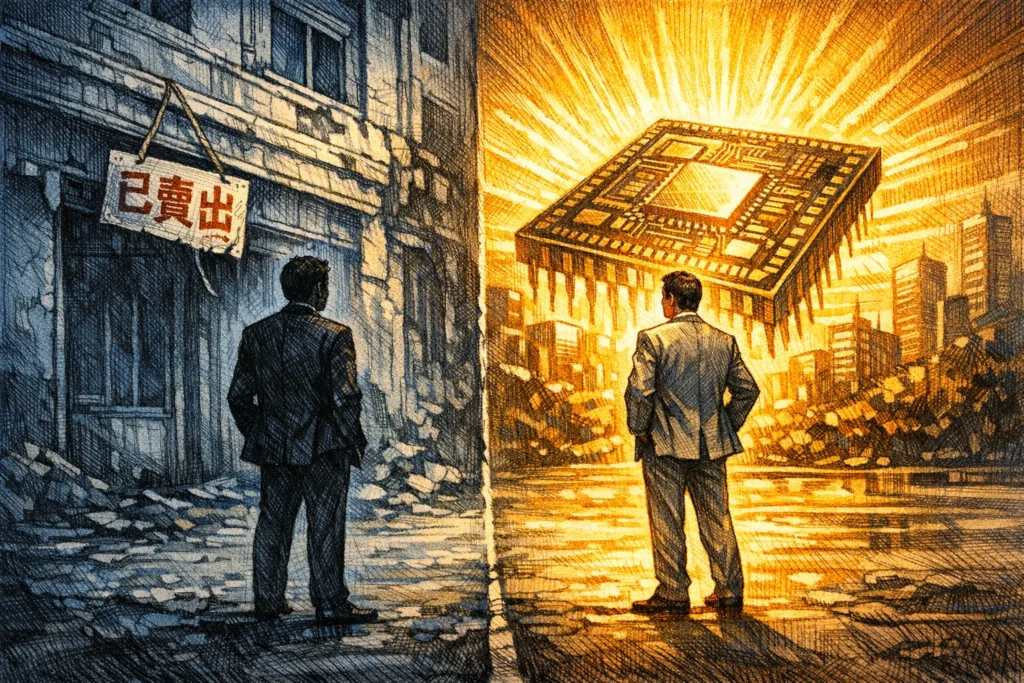
In 2021, Country Garden put RMB 2 billion into ChangXin and acquired about 2.24% of the company. After several later capital increases, that stake was diluted to 1.56%. In December 2024, Country Garden sold the entire holding to Hefei state-owned capital and got back RMB 2 billion. By the time ChangXin opened on the market, the stake it once held was worth about RMB 50 billion.
In simple terms, the developer got the call right years earlier and then had to give up the position about 19 months before the IPO.
How Country Garden came to back ChangXin
Country Garden Venture Capital was established in 2019. A year earlier, the group had proposed a shift toward becoming a “high-tech comprehensive enterprise.” At that point, property development was still generating substantial internal capital, and the company’s brand gave its new investment arm access to projects that smaller investors often could not reach. The group was not short of money then, but it did need a path beyond real estate.
One of its first high-profile hard-tech deals was in commercial space. In 2019, the team spent nearly half a year interviewing domestic space companies to understand where the bottleneck was across remote sensing, communications and navigation. It concluded that launch capacity was the constraint and chose LandSpace, which was focused on medium- to large-sized liquid rockets. In December that year, Country Garden invested RMB 500 million as the sole investor in LandSpace’s Series C round. It later led two more rounds, during which LandSpace’s valuation climbed from about RMB 3 billion to above RMB 10 billion.
The approach says a lot about how the firm learned to invest. It brought a property developer’s supply-chain logic into venture capital. Real-estate development already depended on breaking down a long chain and identifying the most critical nodes. In investing, Country Garden gave two names to that framework: the core company in an industrial chain was the “chain leader,” while the bottleneck was the “chain blocker.” The team required a full industry study before entering a new sector, and in principle a project could not go to the investment committee without that research.
Its first semiconductor investment was Unisoc, which fit the “chain leader” label. Moving deeper into manufacturing, ChangXin was treated as the kind of “chain blocker” that could not be bypassed.
Its capital structure also differed from that of a standard RMB fund. Most domestic funds have fixed terms and must eventually exit, often after seven or 10 years. Country Garden Venture Capital mainly used the group’s own balance-sheet capital. Managing partner Niu Ruolei described it at the time as “perpetual capital,” at least in theory without a hard time limit. The strategy was a barbell: one side targeted very early technical projects, while the other targeted near-IPO super unicorns where a single ticket could exceed RMB 1 billion. It spent much less time in the crowded middle-growth stage.
By early 2022, Country Garden Venture Capital had independently completed more than 90 investments, producing 26 unicorns and 10 listed companies. A total of 52% of invested capital went into hard-tech sectors including advanced manufacturing, semiconductors and carbon neutrality. The portfolio included ChangXin, LandSpace, Unisoc, Biren Technology, BYD Semiconductor, SJ Semiconductor, SVOLT Energy and Dreame Technology.
ChangXin makes DRAM, the memory used by computers, smartphones and servers while they are running. The product may be small, but the business behind it is not. A DRAM producer has to keep buying equipment, refining process technology, retaining engineering talent and living through sharp cycles in memory pricing.
By the end of 2024, ChangXin had accumulated losses of about RMB 38.52 billion. Before its listing, it already operated three 12-inch wafer fabs and employed nearly 20,000 people, including more than 6,000 in research and development.
The 2021 bet: RMB 2 billion on the DRAM manufacturing bottleneck
As of 2025, Samsung, SK Hynix and Micron still controlled more than 90% of the global DRAM market combined. Unlike some corners of semiconductors where a smart small team can get started, DRAM requires design capability, manufacturing process, yield, equipment and large amounts of capital all at once.
ChangXin was founded in 2016. On Sept. 20, 2019, it announced that its self-developed manufacturing project had entered production and unveiled its 8Gb DDR4 product for the first time. That marked a threshold moment: a mainland Chinese company had crossed from “can it be made at all” to scalable DRAM manufacturing.
That is why Country Garden’s 2021 entry came at a specific point in the risk curve. The earliest technology risk had started to ease, but the most expensive phase of expansion, iteration and market competition still lay ahead. That fit the large-ticket end of Country Garden’s barbell strategy.
On July 5, 2021, Haikou Country Garden Venture Capital signed a Series B capital increase agreement with ChangXin and other shareholders. The round used a uniform price of RMB 2.219 for each RMB 1 of registered capital, with an initial fundraising cap of RMB 26 billion. Country Garden invested RMB 2 billion, subscribed to about RMB 901.3 million in registered capital and ended up with 2.24% on a post-money basis.
Other investors in the same round included the second phase of the National Integrated Circuit Industry Investment Fund, Anhui investment entities, the China State-owned Enterprise Structural Adjustment Fund, CMB-related capital, Xiaomi and Midea. In December that year, the funding cap for the round was lifted to RMB 36 billion.
From Unisoc in chip design, to ChangXin in wafer manufacturing, to SJ Semiconductor in packaging, Country Garden Venture Capital was trying to fill out the semiconductor chain one segment at a time. The case for ChangXin rested on one idea: manufacturing was a bottleneck that China’s chip industry could not avoid.
China was already one of the world’s main DRAM demand markets, while large-scale supply on the mainland was close to zero. If ChangXin stayed alive, capacity expansion alone could make it much bigger.
That call later proved accurate. By the fourth quarter of 2025, ChangXin’s global share by sales had risen to 7.67%, making it No. 1 in China and No. 4 worldwide. In the first quarter of 2026, the company posted revenue of RMB 50.8 billion and net profit attributable to shareholders of RMB 24.762 billion. It had spent years moving from “can make” to “can sell,” and then benefited from a fresh jump in memory demand tied to AI servers.
Property downturn changed the holding period
In 2021, the year of ChangXin’s Series B financing, China’s property market also hit its high point. Nationwide commercial housing sales reached 1.794 billion square meters, with sales value at RMB 18.19 trillion. By 2025, new-home sales area had fallen to 881 million square meters, nearly halving in four years. China’s population stood at 1.4126 billion at the end of 2021 and started declining the following year.
Country Garden was hit directly. In 2021, 68% of its sales came from lower-tier cities. Those cities had once given the developer its broadest market, but they also made adjustment harder once demand shrank.
At its peak, Country Garden reported RMB 558 billion in attributable contracted sales, RMB 502.2 billion in cash collection and RMB 181.3 billion in available cash. Three years later, attributable contracted sales had dropped to RMB 47.2 billion, the company posted a RMB 32.8 billion loss attributable to shareholders, and total borrowings stood at RMB 253.5 billion. At year-end, total cash was RMB 29.9 billion, but RMB 23.5 billion of that was restricted. Cash and cash equivalents came to only RMB 6.362 billion.
In 2021, RMB 2 billion on Country Garden’s balance sheet was an industrial investment it could have held for a decade. In 2024, the same sum was close to one-third of its year-end unrestricted cash.
For developers, advance payments collected in sales offices are not truly free cash. Every presale is tied to an undelivered apartment, and the money eventually has to turn into steel, concrete, elevators and keys.
From 2022 to November 2025, Country Garden delivered about 1.8 million homes in total. To get those projects completed, it sold equity stakes, hotels, bulk assets and even official vehicles starting in 2022, bringing in more than RMB 65 billion. The RMB 2 billion from ChangXin was part of that larger effort.
How the exit happened
On May 31, 2024, Bloomberg reported that Country Garden Venture Capital was seeking buyers for its ChangXin stake at an asking price of about RMB 2 billion. At the time, the transaction was still under review and might not have been completed. Country Garden later said it was evaluating its asset portfolio and potential disposal opportunities to optimize its balance-sheet structure.
In June 2024, ChangXin completed a new capital increase in which 12 investors subscribed RMB 10.8 billion at RMB 2.61 per share. At that price, Country Garden’s holding was already worth more than RMB 2.3 billion.
But on Dec. 27, seller Huibi No. 5, buyer Hefei Jianchang and ChangXin Technology signed a share transfer agreement at a final price still set at RMB 2 billion, or about RMB 2.22 per share.
Hefei Jianchang is 87.45% directly owned by Hefei Construction Investment Holding Group, and its ultimate beneficial owner is the Hefei State-owned Assets Supervision and Administration Commission. The buyer that took over Country Garden’s ChangXin shares was state-owned capital from the same city where ChangXin is based.
This was no longer a calm investor choosing the best exit window. As described in the source article, both sides knew the seller needed cash, and Country Garden’s remaining point of dignity was getting its principal back intact.
The payment terms reflected that pressure. ChangXin had to provide a stamped updated shareholder register on the 10th working day. After receiving the register and a payment notice, Hefei Jianchang was required to pay the full amount in one installment. Hefei Construction Investment provided joint liability assurance for 99.985% of the consideration, with a maximum guarantee of RMB 1.9997 billion. If the transfer could not be completed within 180 days, the non-breaching party could terminate the deal. Other existing shareholders expressly or implicitly waived their right of first refusal.
From an industrial stake to project-delivery cash
Country Garden said in its disclosure that the RMB 2 billion would be used as general working capital, mainly for project construction tied to home delivery. In effect, the ChangXin stake was converted into payments for construction sites.
According to shareholding changes disclosed in ChangXin’s prospectus during the reporting period, Country Garden was also the only early external investor that fully exited and did not wait for the listing. Some investors made small transfers, and some moved shares to affiliated platforms. Country Garden was the only one that actually sold out completely.
An asset handoff across economic cycles
The source article places the transaction in a longer industrial and financial shift. At the end of 1958, a large number of cadres, workers and equipment from Shenyang’s Factory 111 moved southwest. Some people sold homes and furniture, took trains and boats with their families, and traveled thousands of kilometers to Chengdu. In January 1959, Factory 420 was formally established. It later became an important aircraft-engine plant in southwest China, with workshops, dormitories, schools and cafeterias forming an entire community around the machines.
Half a century later, as Chengdu adjusted its industrial layout in the eastern suburbs, the old Factory 420 site was handed over for property development and turned into the residential project “24 City.” After hearing that a state-owned factory with tens of thousands of people would become housing within a year, filmmaker Jia Zhangke made 24 City. In the film, people sit in front of old workshops and talk about production lines, dormitories and a vanished way of life.
Country Garden, for its part, rang the bell in Hong Kong on April 20, 2007. Its IPO price was HK$5.38 and the stock closed its first trading day at HK$7.27. The public offering was subscribed 255.7 times, freezing about HK$330 billion. Yang Huiyan, then not yet 30 years old, held 58.19% of the company, and real estate created a new richest person in China that morning.
The remaking of Factory 420 into 24 City and Country Garden’s rise as a capital-market star happened in the same era. In that period, old factories were treated as the past and commercial housing as the future. Land under production lines was cleared for residential projects and revalued through development.
Country Garden grew up in exactly that direction. It linked land, population flows and presale funding into a large machine and expanded from Shunde into more than 200 cities. In 2019, it also tried to channel privately accumulated property capital into rockets, chips and new energy.
The closing thought in the source article is straightforward: money earned in old industries often does end up funding younger industries that are not yet mature. In this case, the old cycle retreated faster than the new one paid off. When the bell rang again on July 27, 2026, the company on stage was a wafer manufacturer.