
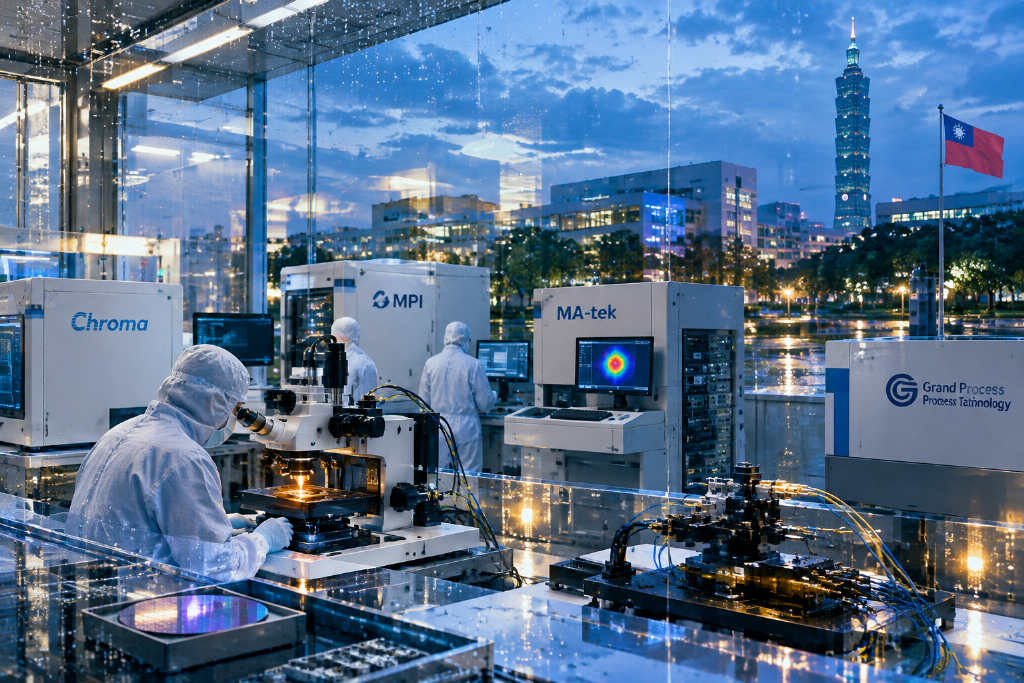
Whether Co-Packaged Optics (CPO) can scale this year while lifting yields may depend on one thing: whether the supply chain can manage the cross-domain interaction of optics, electronics, heat, and mechanical systems at the same time. ABMedia reported that institutional investors have identified Chroma ATE, WinWay, Integrated Service Technology, and MA-tek among testing and measurement suppliers that could benefit first.
AI demand is lifting the outlook for testing equipment
The report, citing Economic Daily News and SEMI forecasts, said global semiconductor equipment sales are expected to rise from $135 billion in 2025 to nearly $230 billion in 2028. Testing equipment stands out within that total. Sales in that segment are projected to surge 31% in 2026 to $15.3 billion, then increase further to $20.8 billion in 2028. Taiwan is showing a similar growth pattern, according to the report.
ABMedia said the value of testing and measurement in the AI supply chain is being reassessed, and that shift is already visible in market growth projections.
Chroma ATE and WinWay point to SLT and CPO socket demand
The report said investors expect Chroma ATE to maintain strong momentum. It linked that view to system-level testing, or SLT, demand tied to AI, high-performance computing (HPC), and application-specific integrated circuits (ASICs), along with optoelectronic testing demand from optical communications and CPO. Its semiconductor business in the second half of the year is expected to outperform the first half.
WinWay shared its industry view during SEMICON Taiwan. Executive Vice President Chen Shao-kun said the company was among the earliest to present views on CPO-related opportunities. He said 10 CPO socket projects are currently underway and that the company is expanding capacity to meet demand.
Chen also said this year’s semiconductor exhibition was the largest on record, which he said highlights Taiwan’s importance in the AI supply chain. As companies compete for advanced packaging opportunities, he said there is no so-called 「AI bubble」. He added that capital spending by wafer foundries will continue over the next three years, while backend packaging, testing, and equipment makers are also sharply increasing capital expenditures, and that this is only the beginning.
Integrated Service Technology focuses on wafer-stage screening
Integrated Service Technology said silicon photonics differs from traditional semiconductors because it requires simultaneous handling of the interaction among optics, electronics, heat, and mechanics. If defective units are not screened out at the wafer stage, discovering problems only after entering the high-cost CPO packaging stage would lead to significant waste in materials and cost.
The report said optical alignment tolerance is typically below 50 nanometers. Manual methods or geometric scanning take too long and are difficult to use in mass production. Integrated Service Technology has launched a silicon photonics measurement system that allows R&D and process teams to complete automatic light finding and highly repeatable alignment within milliseconds.
MA-tek says MSS HG has entered customer validation
MA-tek is also pushing ahead with its own silicon photonics equipment strategy. Its self-developed MSS HG system has entered customer trial and validation, according to the report. The company plans to hold a live equipment testing event in Zhubei on Nov. 5 to show the system’s measurement and light-leak localization capabilities, giving customers a more concrete view of its use in silicon photonics component development, issue localization, and follow-up failure analysis.
ABMedia said MA-tek is also continuing joint development efforts with international equipment makers, gradually expanding its business footprint in silicon photonics measurement and analysis. As CPO moves toward mass production, the ability of testing and measurement systems to provide stable quality control under combined optical, electrical, thermal, and mechanical integration will be a key gauge of supply-chain competitiveness.



