

Cregis has partnered with Remi Technology to provide core security and infrastructure support for Remi’s digital asset network serving regulated financial institutions, according to the announcement. The companies said the setup is intended to help licensed institutions such as banks, payment service providers, and foreign exchange firms conduct cross-border digital asset business in a more efficient and compliant manner.
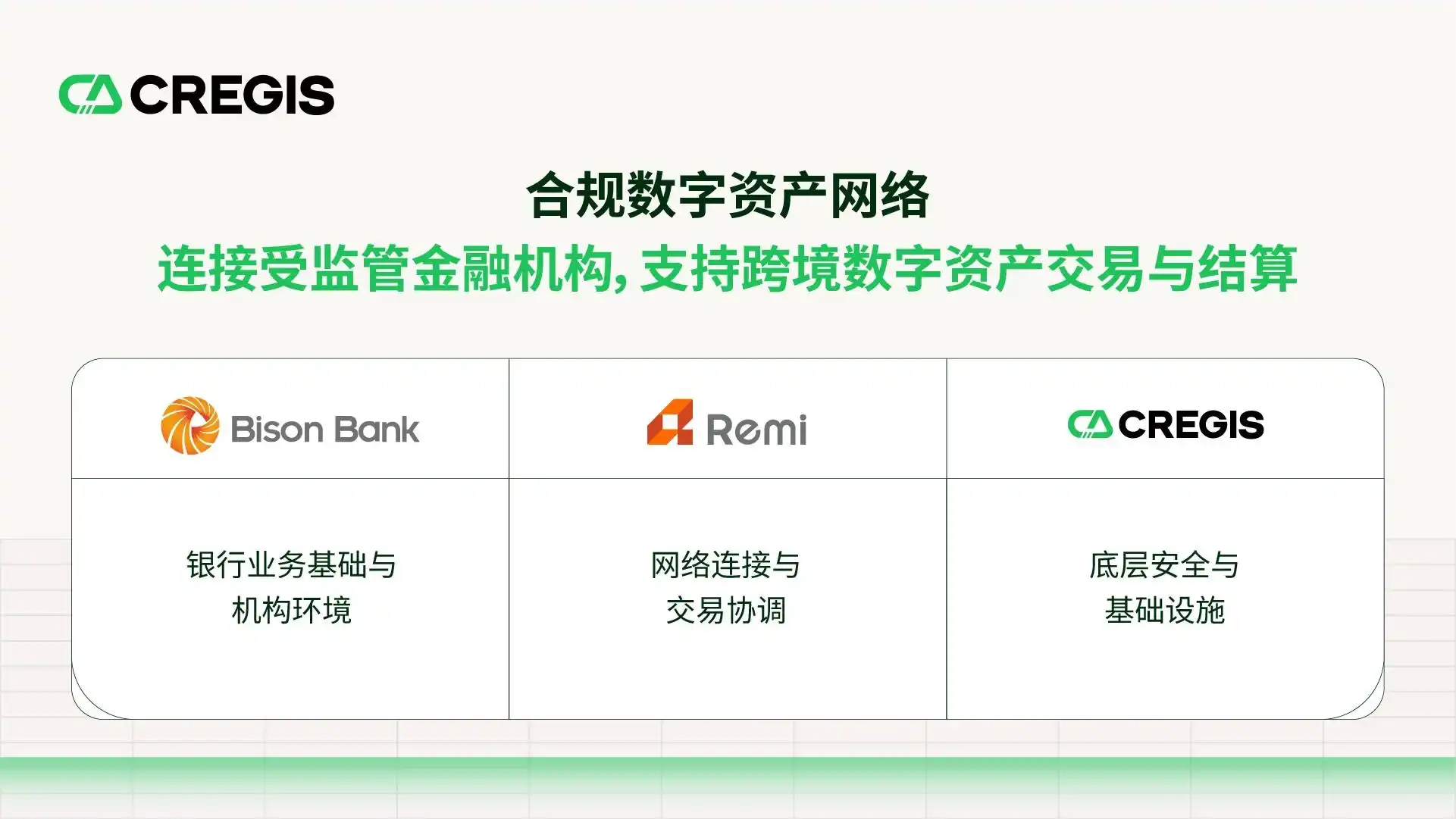
Three-party structure combines banking access, network coordination, and asset security
Remi Technology, a fintech infrastructure provider headquartered in Singapore, has formed a strategic partnership with Portugal-licensed Bison Bank and is building a digital asset network that connects regulated financial institutions. The network supports structured data exchange, transaction information delivery, status tracking, reconciliation, and compliance coordination among participating institutions.
Within that framework, Bison Bank provides the regulated banking environment and institutional base. Remi is responsible for network connectivity and settlement coordination between participating institutions. Cregis supplies the underlying digital asset security and management capabilities that support those institutions in running related services.
Cregis says institutional requirements go beyond safekeeping and transfers
Cregis CEO Shawn Yan said, 「After digital assets enter regulated financial markets, the challenge institutions face is no longer limited to how to hold and transfer assets securely. It also includes how to bring those operations into existing permission management, risk control, and governance systems. Our cooperation with Remi is meant to make digital asset infrastructure better fit the real operating requirements of financial institutions.」
Bison Bank launched EUB and USB in May 2026
The announcement said Bison Bank has continued to expand its digital asset business in recent years. In May 2026, it launched EUB and USB, e-money tokens linked to the euro and the U.S. dollar, to provide approved institutional clients with digital asset transfer and settlement services.
According to the article, that gives digital assets a practical use case inside regulated banking activity and also forms part of the cooperation structure between Remi and Bison Bank.
Remi CEO Sam Su said, 「Cross-border digital asset settlement requires not only reliable technical connectivity, but also banking infrastructure and sound security management. Our strategic cooperation with Bison Bank provides the banking and institutional foundation, while Cregis provides participating institutions with underlying digital asset security capabilities. The collaboration among the three parties will help drive a more interconnected and compliant institutional digital asset ecosystem.」
Stablecoin payment volumes highlight demand for institutional infrastructure
As financial institutions continue to explore blockchain applications in payments, transaction processing, and asset management, infrastructure connecting different institutions is drawing more attention. Estimates from McKinsey and Artemis put actual stablecoin payment volume at about $390 billion in 2025, including about $226 billion in B2B payments.
As digital assets move into real financial operations, institutions are asking for more from custody, security, compliance, and data exchange systems. The article said related infrastructure needs to connect more effectively with the existing financial system.
What Remi and Cregis each bring to the network
Remi’s network supports structured data interaction, know-your-customer and anti-money laundering functions, transaction screening, Travel Rule requirements, and compliance monitoring. Cregis, for its part, uses technologies including multi-party computation, hardware security modules, and trusted execution environments to provide digital asset infrastructure covering wallets, payments, fund flow management, and institutional custody.
Over the past nine years, Cregis said it has supported more than 4,000 enterprises across over 50 countries and regions in building and operating digital asset businesses. In 2025, the company launched its Trust Vault solution to expand institutional custody and asset governance capabilities. The product supports secure storage, management, and payments for digital assets including stablecoins, while helping enterprises improve internal permission controls, risk management, and compliance governance.
Shawn Yan added, 「For digital assets to achieve broader use in the financial system, progress by a single institution or a single technology is not enough. Infrastructure that can support long-term collaboration among different institutions is also needed. Cregis will continue building around security, asset management, and institutional operating capabilities, and will work with partners such as Remi to support the development of regulated digital asset business.」
Company profiles included in the announcement
About Remi Technology
Remi Technology is a global fintech company headquartered in Singapore. It has developed a blockchain-native cross-border payment and settlement system positioned against SWIFT and focuses on providing end-to-end compliant cross-border payment infrastructure solutions for licensed banks and compliant financial institutions worldwide.
About Bison Bank
Bison Bank serves individual and institutional clients with private banking, custody banking, corporate advisory, and integrated digital asset services. The article said it operates with strategic links between Europe and global markets and uses its European footprint and global partner network to expand internationally.
About Cregis
Cregis is a digital asset infrastructure platform that provides enterprises with technology for digital asset collections, payments, and treasury operations. The company said it helps businesses run digital asset operations in a secure, compliant, and efficient way. Founded in 2017, Cregis serves financial institutions, payment service providers, foreign exchange brokers, fintech companies, and Web3 firms. Its business covers markets including Asia, the Middle East, and Latin America, and it currently serves more than 4,000 enterprise clients across over 50 countries and regions.



