
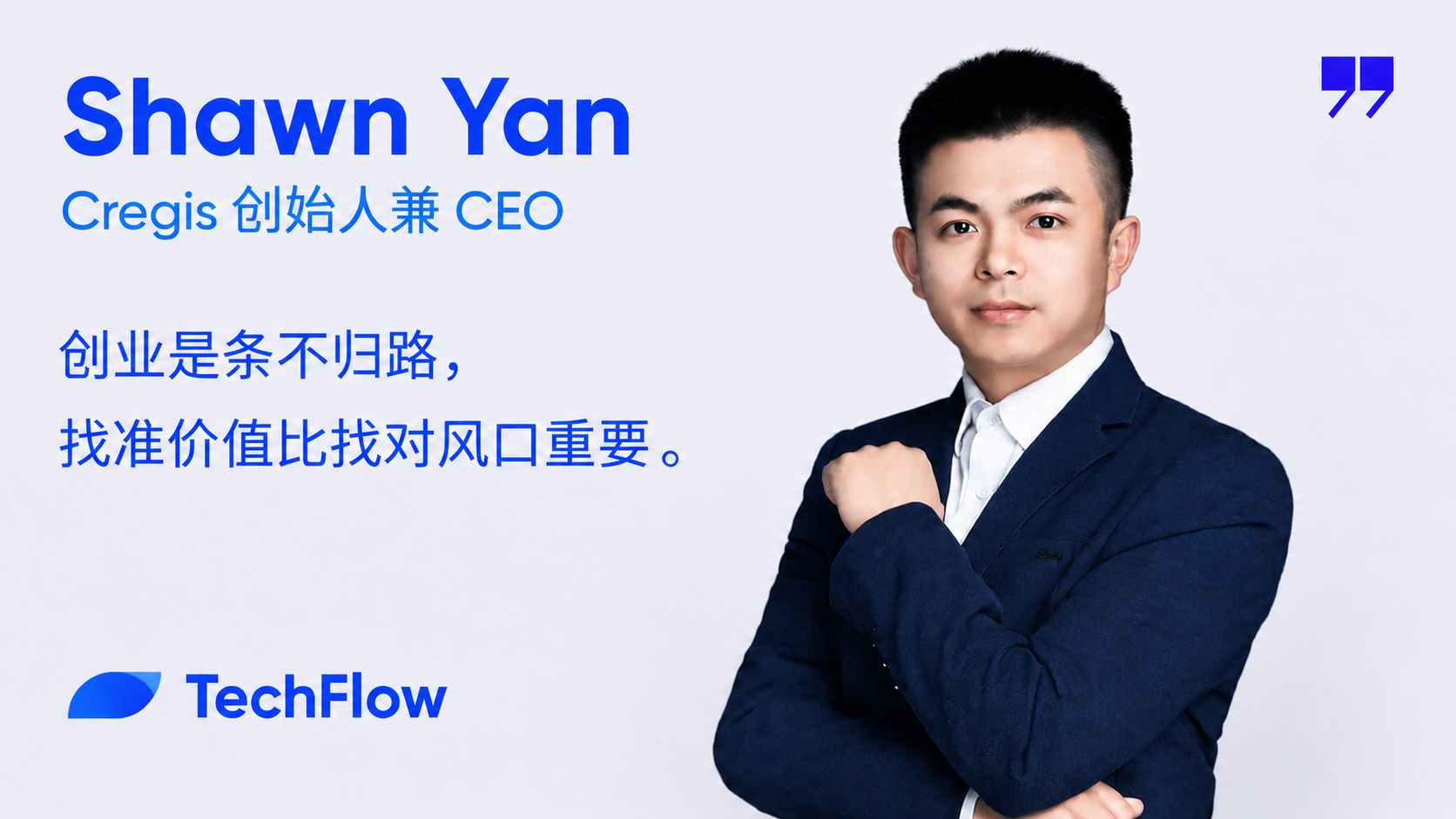
“Creating long-term value matters more than chasing every hot cycle.” That was the core message from Cregis founder and CEO Shawn Yan in an interview with TechFlow, where he reflected on more than a decade of building companies across SaaS, FinTech and enterprise digital asset infrastructure.

Yan said he graduated from college in 2012 and started his first business in 2013. His early work focused on SaaS tools for WeChat merchants, later shifted toward FinTech, and eventually moved into enterprise-facing digital asset infrastructure. Over that stretch, he said, he experienced an early business that turned profitable in its first year, painful transitions when the company tried to pivot, the 2017 market phase in which projects could raise funds “without a white paper,” and repeated chances to go after what he described as “making 100 million in a short period of time.”
Across those years, the industry moved from a rough early market to one where compliance became central. Product forms changed as well. Yan said one view never changed for him: long-term value creation matters more than running after each new narrative. He now leads Cregis at a point he described as delicate. Institutional adoption of crypto, especially stablecoins, is growing, while some industry participants have lost faith and left. At the same time, firms handling client assets at very large scale face tighter expectations around compliance, and AI is raising the bar for both customer understanding and service efficiency.
From SaaS to enterprise digital asset infrastructure
Yan said he heard a line early in his career: entrepreneurship is a one-way road. He came to agree with it. Once someone fully commits, the work stops being only about a product idea. It becomes tied to a team, customers and long-term responsibility to the industry a company serves. Decisions connect to each other, and the learning does not stop.
Asked about his first startup in 2013, he said it “wasn’t a failure.” The team built the product, won customers and became profitable in the first year. That did not last in the same form. The SaaS segment they were in was highly competitive, technical barriers were low and the product could be copied easily, so profit strength weakened sharply in the second year. The team then decided to try moving toward financial SaaS.
That transition proved much harder than expected. Yan said a pivot of that kind needed sustained investment, while the company at the time was not fully prepared at the level of strategy, team setup or talent reserves. For him personally, it was one of the first major setbacks of his entrepreneurial life. Looking back, he said the deeper lesson was that change itself is the only constant. What founders need to learn is not how to freeze things in place, but how to adapt and keep moving upward through volatility.
Why he passed on fast money during the ICO boom
TechFlow put a direct comparison to Yan: one path would have been making money quickly through ICOs, the other would be spending 10 years building infrastructure and making the same amount over a much longer period. Yan replied that he is not someone who spends much time trading tokens. He said he believes more in long-term thinking than in short-term price swings.
In his telling, the 2017 ICO wave was defined by intense FOMO. People approached his team for cooperation, and he said their technical accumulation at the time was enough for them to participate and possibly earn very high returns in a short period. They chose not to take that route.
Instead, he said, the company kept building around one broad direction: transaction systems in the early stage, enterprise wallets, capital operation systems, and later a more complete enterprise financial infrastructure stack that links into broader business scenarios. For Yan, all of those products addressed real base-layer problems that appeared as the industry developed. Because the market was still small at the time, technical services were hard to scale quickly. From the outside, he said, they may have looked slow or even foolish because the money did not come as fast.
His argument was that the business already had enough profit strength to survive bull and bear cycles. It was not built on market mood or a single asset cycle. It was tied to demand that was actually growing. He put it bluntly: money without value was not something the company felt comfortable earning. The business was healthy enough that it did not have to chase short-term gains, and if an opportunity did not carry real value, he said, the team could not persuade itself to stay committed to it over time.
Yan tied that stance to the nature of enterprise wallet work. When a company is effectively guarding a mountain of money, he said, the hardest challenge is not only technical. It is resisting temptation, staying within boundaries and not touching client funds. That, in his view, tests a management team’s values over a long period. If a person is under heavy financial stress or is used to pursuing returns through high-risk, high-leverage methods, he said the odds of making different choices under temptation rise.
He recalled one client who looked closely at a wallet provider’s attitude toward risk and assets when choosing a partner. In that client’s view, a management team focused on short-term returns and high-risk opportunities might not be the right one to take on long-term asset management responsibility. For Yan, the right outcome is when a founder finds a fit between psychological comfort, technical comfort and market comfort.
His view on Bitcoin: a product of globalization rather than an accident
Yan said his first contact with Bitcoin came in college. He studied computer science, and a teacher mentioned Bitcoin and mining in class. Because he was interested in new technologies and in how systems worked underneath, he looked up more information after class and even ran mining programs on his own computer. At the time, he said, there were websites that would give away Bitcoin for free.
In those early days, he mostly saw Bitcoin as an interesting new technology rather than immediately grasping its deeper financial meaning. He added that building around Bitcoin was not easy then because the ecosystem was still tiny. Infrastructure was thin, use cases had not matured and the commercial space available to entrepreneurs was limited.
For him, 2017 marked a real breakout point. As public blockchains, smart contracts and related infrastructure matured, the industry moved from a single-asset story to a wider set of application scenarios. That opened the door to new startups. It was also during this broader shift that his team moved from SaaS into FinTech and began to hear more from enterprise clients and financial institutions. Once those clients started asking for digital-asset-related capabilities, Yan said the team realized this was not just a request for one more feature. It pointed to a new financial infrastructure direction taking shape. That set them on the path that eventually became Cregis.
Yan framed Bitcoin in a much longer historical arc. Human exchange media, he said, have always evolved, from shells and precious metals to modern fiat systems and now digital assets. At each stage, society looks for a more efficient way to transfer value that fits current economic conditions. As the global economy becomes more tightly connected, he said, it is natural to need a tool that can move value across regions and across different financial systems with higher efficiency.

That is why he does not see Bitcoin as an accidental invention. In his view, it is a natural product of economic globalization reaching a certain stage. Even if Bitcoin had not appeared, he said, something with similar characteristics would have emerged. Whether one specific form becomes dominant over the long term is still something the market has to test.
Bitcoin, tokenized gold and stablecoins point to different paths
When TechFlow asked which of three settlement tools could become more mainstream in the future — Bitcoin, on-chain gold or stablecoins — Yan said they represent different directions rather than one simple race.
He argued that on-chain gold has been discussed for years, yet circulation has remained limited. The reason, in his view, is that gold is still a physical asset at its core, and the logic of its trading and circulation still follows the traditional system. He grouped past attempts to put assets such as tea or collectibles on-chain into the same category. Many of those efforts did not produce meaningful adoption, he said, because the assets were not natively on-chain. Simple digitization did not create new liquidity by itself.
Stablecoins look different to him. He said they fit native on-chain logic much better. Beyond being pegged to the US dollar, nearly all of their movement happens on-chain, without a complicated set of middle layers, which makes payment and settlement much smoother. That is why he sees stablecoins as developing well at the moment.
Bitcoin, by contrast, is hard to use as an everyday payment tool today because of price volatility and transaction efficiency. Yan said he sees it less as a daily payment rail and more as a value anchor, or as a global carrier of value and even a kind of spiritual symbol.
Cregis as WAAS, Rails and Custody
Asked to describe Cregis in one sentence, Yan called it an integrated digital asset service platform for enterprise clients. He broke the business into three main parts.
- WAAS, or Wallet as a Service: enterprise wallet services that let companies integrate and deploy crypto wallet functions quickly without building the full wallet infrastructure stack from scratch. He said this fits exchanges, banks and financial service providers, OTC desks and other firms that need digital asset wallet capability inside their products.
- Rails: a fund-flow orchestration and payment infrastructure service focused on inflows, routing, settlement and outflow orchestration. Yan said it is aimed at efficient lifecycle management of funds and is suitable for cross-border payments, stablecoin settlement, treasury management for foreign exchange brokers, and merchant and ecommerce collection scenarios.
- Custody: enterprise asset custody services designed for institutional custody and compliance needs, with stronger control, audit and regulatory support. He said those services are suited to banks, asset managers, exchanges, hedge funds, sovereign wealth funds and other regulated entities.
Yan said his team believes digital assets will become a very large asset class. Bitcoin, Ether, stablecoins, future digitized assets and even NFTs all sit within that broad category in his view. As the asset class grows, the way companies trade, manage and store these assets becomes more important. Cregis wants to build what he described as a digital asset financial operating system for enterprises so firms can use assets more simply and more safely.
Among the three layers, he still sees WAAS as the core. It is the foundational capability, he said, and also the broadest business category. In his view, both Custody and Rails could eventually be absorbed into a larger WAAS system.
Yan said the core technical strength inside WAAS is its MPC security architecture. By splitting private keys into multiple shards and storing them in a distributed way, the system removes a single point of failure. At the same time, Cregis itself cannot access a complete private key, which he described as true self-custody. He added that WAAS includes standardized APIs and multilingual SDKs that make integration easier for developers. Its broader business suite also includes role-based access control, multi-signature approval workflows, intelligent risk controls, real-time monitoring and alerts, and team collaboration tools.
More of Cregis’ customers now come from traditional finance, he said, and some of them know little or nothing about crypto at the start. Those customers are not mainly concerned with the underlying technical modules. They want to know whether a product solves a business problem. In that setting, WAAS serves as a practical option because companies can begin multi-chain asset operations quickly, keep full control of their assets and avoid large development costs and long learning cycles.
Rails is about more than payments
Yan said many people hear the word “Rails” and immediately think about payments, but he thinks the problem set is larger than that. Cregis Rails is meant to orchestrate fund flows across collection, treasury management, wallet transfers and later settlement, so the full lifecycle of funds becomes more automated and requires less manual work.
Payments are still one important use case, and in his account they grew directly out of customer demand. In the beginning, Cregis mainly offered wallet services so enterprises could manage digital assets. In actual operations, though, many clients still had to connect on their own to third-party payment gateways for merchant acquiring. That created breaks in the flow of funds and made it easier for companies to lose control over parts of the process, introducing security risks. As more clients raised similar requests, the team decided to go deeper into the payment scenario. The goal, Yan said, is that enterprises should not need to worry about the complexity in the middle. They should care about whether money arrived, whether funds are safe and whether the business is running normally. He said this is one reason payment institutions have become important partners for Cregis Rails.
For a concrete example, he pointed to global ecommerce. A company selling into global markets does not primarily care which asset a user pays with. It cares whether payment is smooth and what funds it ultimately receives. In crypto, that becomes complicated quickly. Users may pay with stablecoins on different chains, or with BTC or ETH, while the merchant then has to manage multi-chain wallets, gas fees, fund collection and settlement.
With Cregis Rails, he said, the merchant can simply define the type of funds it wants to receive in the end. Once a user pays, wallet selection, route conversion, fund aggregation and later processing can all happen through the system. The company does not need to handle the underlying infrastructure itself. It only needs to track how much money came in, what the costs were and whether operations are running correctly.
He gave foreign exchange brokers as a second example. Their businesses involve multiple accounts, channels and partners, and the traditional way of managing this often depends on manual coordination. Through Cregis Rails, brokers can route, transfer and settle funds automatically under pre-set business rules, making flows more transparent and traceable while lowering operating costs.
Yan stressed that Cregis Rails is not meant to replace a company’s existing systems. It is designed to serve as underlying infrastructure in payment-related scenarios, connecting fragmented fund processes so digital assets can fit more naturally into everyday corporate operations.

Self-custody, compliance and years of execution
When asked what sets Cregis apart, Yan said he does not like defining other platforms as “competitors” in a simplistic way. Different companies operate at different stages, with different business models and under different regulatory environments. There is no single setup that suits every client. What matters more, he said, is which infrastructure best fits a customer’s current stage.
In the Asia-Pacific market today, he sees self-custody as Cregis’ biggest advantage. Self-custody is naturally suited to payment infrastructure, he said, because payment businesses do not mainly need long-term asset warehousing. They need high-frequency, high-volume collection and disbursement, lower costs, more flexible orchestration of funds and risk control systems that are closer to operational workflows. On that front, self-custody wallets are friendly to payment users, and many of Cregis’ payment clients have responded positively to that model.
He also outlined four core strengths behind the business: strong product and engineering execution backed by sustained investment, nine years of industry accumulation and trust from more than 4,000 clients, operating capability across multiple jurisdictions, and compliance capability. These four strengths may not always carry the same weight, he said, but none of them can be missing if the company wants to build for the long term.
On licensing, Yan said Cregis already holds relevant licenses in Hong Kong and that its Dubai license is close to approval. Beyond those markets, the company is paying close attention to North America and Latin America and will decide whether to seek additional licenses based on business needs.
He was careful to add that the company’s main business today is self-custodied WAAS, which is closer to a technical service provider and does not necessarily require a financial license under current policy conditions. Cregis is taking a more proactive approach because it expects customer needs to change. In the future, he said, enterprises may not only want self-custody. Some may also want platform custody and broader service combinations. Building the groundwork now gives clients more options later. A license also matters as part of market trust, since customers tend to feel more comfortable when they see formal compliance qualifications.
Still, Yan does not see licenses themselves as moats. He called them more of a ticket to entry. No single license works worldwide, he said, and no single license automatically wins the trust of global customers.
He described the broader turn toward compliance in crypto as a positive development. In the early Web3 period, hype was common and many businesses could not answer a basic question: do they actually create value and generate stable income? If they do not, he said, they will never really make it to the compliance stage. The companies that remain tend to have clear value anchors such as infrastructure, enterprise services, security or audit. Compliance, in his view, helps protect businesses that are actually creating value instead of letting bad actors push out good ones.
Yan also pointed to changes in how corporate payment collection works. Many enterprises no longer accept the old model of simply providing an on-chain address. They now ask for full payment vouchers, invoices and financial proof. He called this “compliant collection.” Companies can no longer rely on a personal wallet to receive funds. They need a process that meets accounting and audit standards, including formal receiving addresses, invoice documentation, confirmation files after payment, complete fund flow records and logs that can be audited. He said that is a major part of the service value Cregis provides.
Where demand is coming from
Cregis now has more than 4,000 enterprise customers, according to Yan, and institutional customers still make up the largest share. The company first served exchanges, then expanded into payment firms, banks, securities firms, insurers and trading-oriented businesses in areas such as foreign exchange and gold.
The biggest change, he said, is that three to five years ago many institutions were still cautious about digital assets. Today, users of those institutions are already asking for crypto-related services, and that has pushed the institutions themselves to adapt. Traditional financial institutions are no longer debating whether they should enter Web3, he said. They are already using digital assets in a much deeper way, especially stablecoins.
Even so, he believes adoption by institutions is still far from saturation. In the future, he expects tens of thousands of traditional companies to join this market. He said consulting firms and traditional businesses are already coming forward with a practical question: if our customers want to pay in digital currency, what should we do? Once that wave of companies starts moving in earnest, he said, the total market size will enter another growth phase.
How the product roadmap took shape
Yan said Cregis did not arrive at its current direction by sitting in an office and mapping out a fixed plan. The path came from watching long-term industry changes and seeing recurring problems appear in customers’ real businesses.
The company started with wallet infrastructure because secure asset management is the foundation for enterprises entering digital assets. As the industry evolved, Cregis saw the challenge shifting from “how to manage assets” to “how to manage fund flows,” which led to Cregis Rails. As more institutions entered the market, compliant infrastructure and asset custody started becoming part of the same operating system, which gave rise to Cregis Custody.
Yan said Cregis has been building a full set of solutions around business demands raised by clients. At the same time, he pushed back on the idea that the company simply follows customers blindly. If the same type of demand appears repeatedly within the same period, across different markets and business scenarios, he said that often signals a missing layer of infrastructure. Those repeated pain points are where the company looks for long-term product opportunities.
He summarized the company’s path in three broad stages: solve asset security first, then solve fund operations, and eventually move toward a fuller enterprise financial infrastructure stack. As for future growth, he said that once a company places funds in a bank, it does not stop there. It then needs foreign exchange, wealth management, cross-border remittance and many other financial services. Cregis is trying to build toward that broader range of functions as well.
He specifically mentioned products and directions the company has launched or is building, including Marketplace, Swap, compliant wealth management products developed with third parties, and some global remittance functions. Yan said these areas will become important parts of Cregis’ long-term growth.

On product decisions, he said the company will not build a new feature or product simply because one client asks for it. In B2B software, understanding demand means understanding the customer’s business itself. That is why the team stays in frequent communication with many clients over long periods. Even then, clients often start with incomplete or immature ideas.
Yan used a simple analogy. A client may say they want a “chicken,” but what they really mean is that they are hungry. The job is to solve the hunger problem, not mechanically deliver a chicken. That is why the company tries to identify the common issue behind a request and decide whether it deserves long-term investment.
He also said AI is improving the speed at which the team can validate demand. In the past, a request might take a month or several months to move from research and design to a demo. Now a prototype can often be built in days. Many customers cannot clearly express what they want, but once they see an interactive demo they can usually say yes or no very clearly. In that environment, Yan argued, demand understanding becomes more scarce, not less. AI can increasingly help with implementation, but people still have to judge which problem is worth solving.
What he would say to hesitant firms and to people leaving crypto
For traditional companies still unsure about whether to adopt Web3, Yan said the hesitation often comes down to bias toward new things. Many people ask why they should use Web3. He prefers to ask the reverse: why not? To him, those are two very different mindsets. If a company evaluates the cost and finds that trying the new system does not require much sacrifice while likely improving efficiency and lowering cost, then it makes sense to test it.
He said crypto at this stage is not sustained only by the belief of a small group. It is also supported by the efficiency gains the technology delivers and by real demand.
His message to people preparing to leave crypto was equally direct: if they want to leave, then leave. But he said that choice should come after a serious assessment. Do you have long-term confidence in the industry? What is the underlying logic you believe in? Is the work you are doing actually creating value? If your value creation does not belong here, he said, then another field may suit you better.
Every sector has an early period where momentum and attention can drive rapid growth, in his view, but all of them eventually return to the basic question of real value creation. He added that some businesses are built specifically around chasing trends. That is a business model too, and not inherently right or wrong. The hard part is staying on the winning trend continuously.
What comes next for Cregis
Yan said the company’s most important goal over the next few years is still to make Cregis stronger and more solid. The company is headquartered in Hong Kong and began in the Asia-Pacific market, which served as the testing ground for its product and business model. From there, the business has expanded into the Middle East, Europe, Latin America, Africa and the United States.
He said Cregis now has offices in Kuala Lumpur, Singapore, Dubai and São Paulo, and has been building localized teams and service capabilities in those markets. In the Middle East alone, after two years of development, the company has more than 200 long-term paying stable customers. Over the past year, it has continued to push into Latin America, Africa, Europe and the US as key regions.
Globalization is not just a matter of copying the same product into new places, Yan said. It means understanding the needs of local enterprises in each market and building long-term service capability around those needs.
He added that there are many strong peers in the industry, which he sees as healthy. He pointed to AI as an example of how multiple companies exploring at once can push technology, products and services to mature, with users and the wider ecosystem benefiting in the end. He said he hopes digital asset infrastructure develops in the same way.
The meaning of “Aegis” after nearly 10 years
The interview closed with the company’s name. Cregis combines “Crypto” and “Aegis,” the latter meaning a shield. After nearly a decade of operating the company, Yan was asked what that shield protects today compared with the first day of the startup.
He said the company now has more products, more capabilities and more application scenarios, but its original intention has not changed: help customers manage digital assets more safely and more efficiently so they are willing to place trust in Cregis.
For Yan, a client deciding to entrust a company with assets is already a major act of trust. He said the team approaches that responsibility with caution and wants to do each part of the job seriously. Cregis now serves thousands of enterprise customers, and behind them stand many more end users. As the company grows, the shield is no longer only about protecting one customer’s assets. It is also about protecting the trust foundation of the broader digital asset infrastructure ecosystem.
That matters because when an infrastructure provider suffers a failure at the base layer, the damage extends beyond one client. It can also weaken confidence in digital asset use across the industry. As for how trust is built, Yan said two things matter most. First, the product must actually solve customer problems. Second, time matters. Trust is not built through marketing, he said. It is accumulated through long-term practice. In this industry, the ability to stand the test of time is itself the highest barrier.