


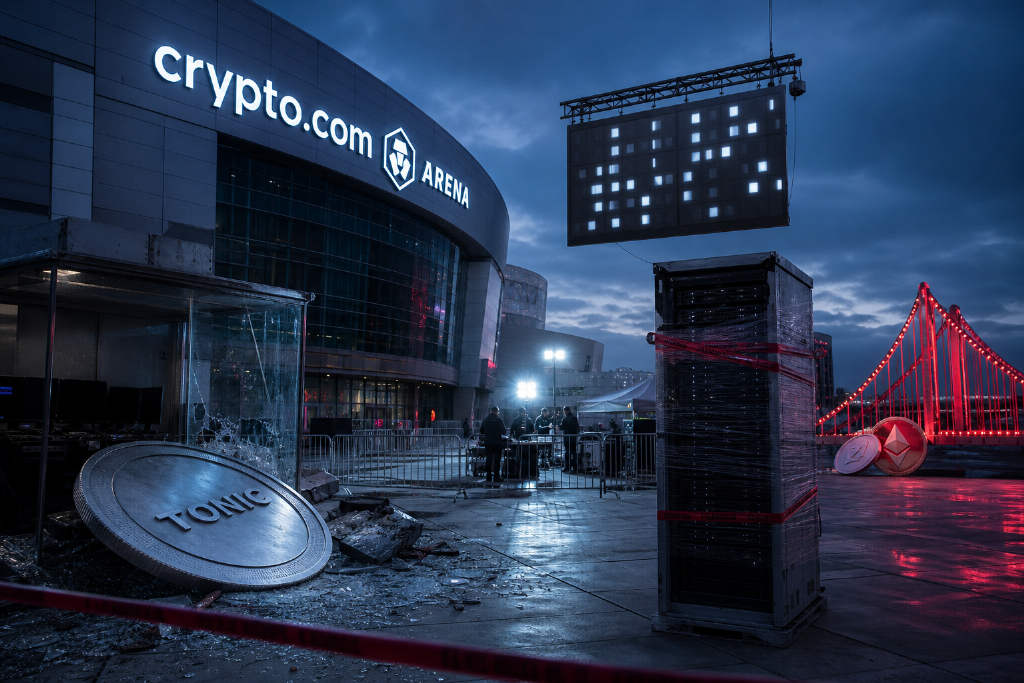
Cronos moved to roll back its chain after a hack struck Tectonic, the largest lending protocol in the Crypto.com-affiliated ecosystem, on Aug. 30. The attacker spent about 20 minutes driving up the price of TONIC, Tectonic’s low-liquidity governance token, by roughly 100x, then used the inflated tokens as collateral to borrow other assets from the protocol.
The total amount involved was about $75 million. Before Cronos halted the network, around $6 million had already been bridged to Ethereum.
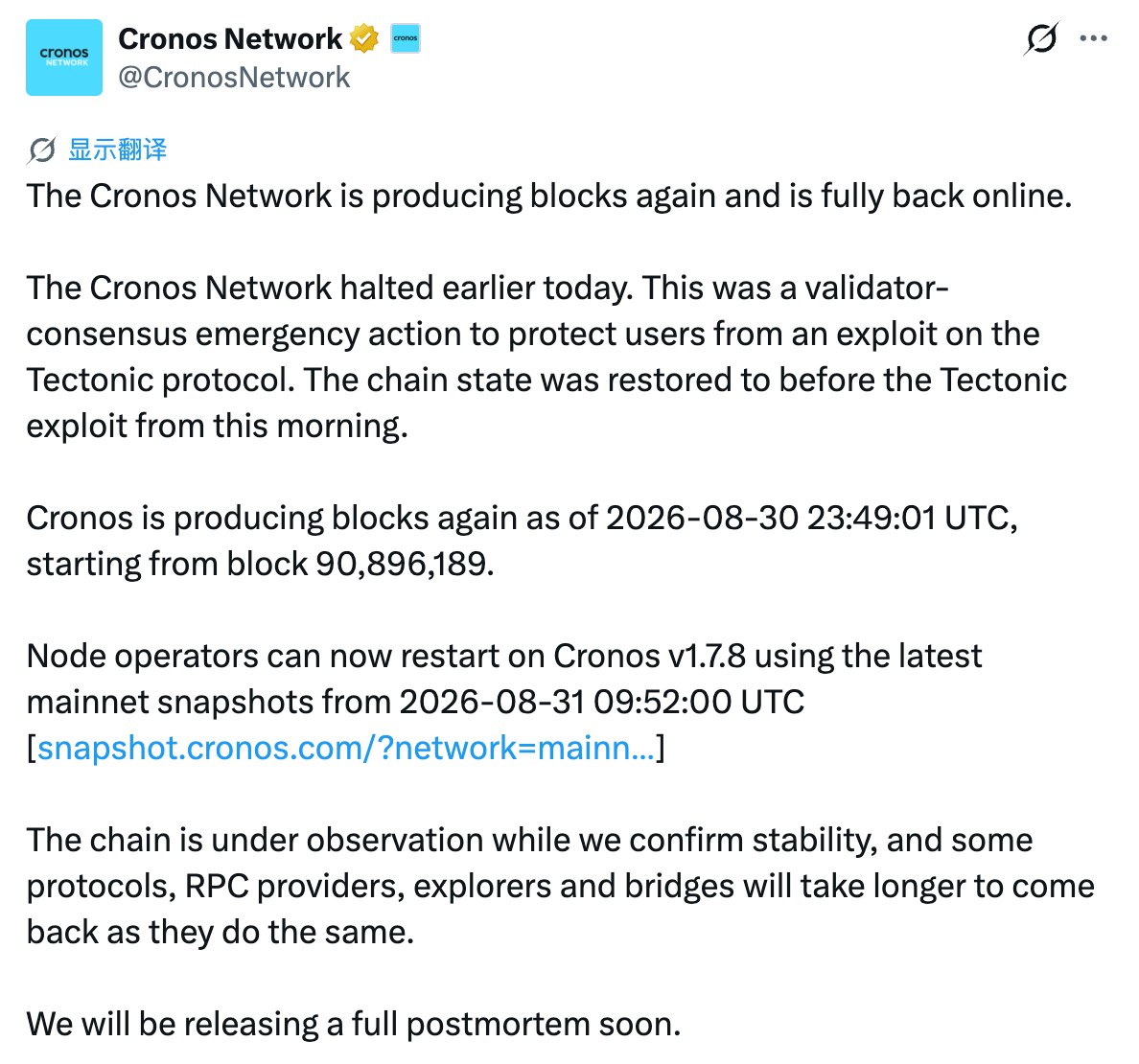
Cronos then took the more unusual step. On the evening of Aug. 30, it paused the network to stop further outflows. On Aug. 31, it released a restart plan and said the chain would resume from block height 90896189, reverting the network state to a point before the Tectonic exploit.
Cronos chose the fastest fix, but the trade-off is clear
A blockchain rollback, in simple terms, restores the network to an earlier state. Transactions, transfers and smart contract actions that took place after that point are removed from the new chain history.
That is the path Cronos took here. Judging only by the immediate outcome, it may also be the most effective one. Roughly $75 million was affected during the exploit, but only about $6 million had successfully left Cronos via cross-chain transfer before the halt. Most of the assets were still on Cronos. If the funds had not fully escaped, deleting the post-exploit chain history could, in theory, erase most of the losses as well.
From the standpoint of user fund protection, the decision is easy to understand. Without a rollback, the alternative may have been to watch the attacker move funds layer by layer while security teams tried to trace, freeze or negotiate recoveries, with no certainty on the final result.
Still, the cost is obvious. The attacker’s transactions do not disappear alone. Ordinary user transfers, trades and liquidations from the same period disappear too. In this case, Cronos restarted from block 90896189, while the network had reached block 90907150 before the halt. The gap was 10,961 blocks. Every normal transaction inside those blocks was canceled.
An extreme example shows the problem. If one user had paid another on Cronos during that window in exchange for goods or services, the rollback could erase the payment transaction even if the goods had already been delivered.
Finality is now at the center of the debate
The bigger issue is transaction finality. One reason blockchains are used for value settlement is that once a transaction receives enough confirmations, participants treat it as irreversible. Funds received are assumed to be real and durable. Payments made are not expected to vanish a few hours later.
Cronos’ response cuts into that assumption. A transaction that had already reached final confirmation could still be reversed if an event was considered serious enough. For users and counterparties on the chain, that weakens the idea that final means final.
Rollback in an extreme security event is not without precedent. Public blockchains have, in past cases, coordinated around changes to chain state after major incidents. But once that door is opened, the boundary becomes hard to define. If $75 million is enough to justify a rollback, what about $50 million or $10 million? And beyond hacks, what other events could prompt validators to restore the chain again?
That is the core of the current dispute. The rollback may solve an immediate crisis, but it also tells participants that immutability is not an absolute rule on Cronos.
Cronos has faced a similar "history rewrite" argument before
This is not the first time Cronos has been drawn into a dispute over changing a settled outcome.
In 2021, Crypto.com announced the burn of 70 billion CRO, cutting total supply from 100 billion to roughly 30 billion. At the time, the move was described as one of the largest token burns in crypto history.
Then, in 2025, Cronos put forward a plan to mint back the 70 billion CRO that had already been burned and allocate the tokens to a strategic reserve, restoring total CRO supply to 100 billion. The official reason given at the time was that rebuilding Cronos’ “golden era” would require significant capital to support the Cronos roadmap, including expansion in the U.S. market, ecosystem support, institutional progress and a potential CRO ETF.
The proposal triggered sharp controversy. The issue was straightforward: the earlier burn had been presented as permanent, yet the same tokens were later proposed for re-minting.
The governance process added another layer. Although the community strongly opposed the proposal, voting shifted near the end after concentrated participation from large holders, and the measure eventually passed.
Odaily referenced a prior report titled “CRO’s most absurd governance farce: 70 billion tokens minted back out of thin air.”
From token supply to chain state, the same governance style is under scrutiny
Viewed together, the two episodes highlight a pattern in Cronos’ approach. One changed token supply. The other changed chain state. In one case, tokens described as permanently burned were brought back. In the other, transactions that had already occurred — and in some cases had already been finalized — were removed from chain history.
Cronos has offered reasons each time. Re-minting 70 billion CRO was framed as support for long-term ecosystem development. Rolling back the chain was framed as a way to recover user assets as much as possible. Taken separately, neither decision is impossible to understand.
But after both events, it becomes harder to treat immutability as a fixed principle on Cronos. At least in exceptional cases, token supply, network rules and even historical records appear open to revision.
That leaves Cronos facing a wider argument than a single security incident. The question now is how it draws the line between decentralization, governance authority and operational efficiency in a market that usually treats decentralization as a core standard.