
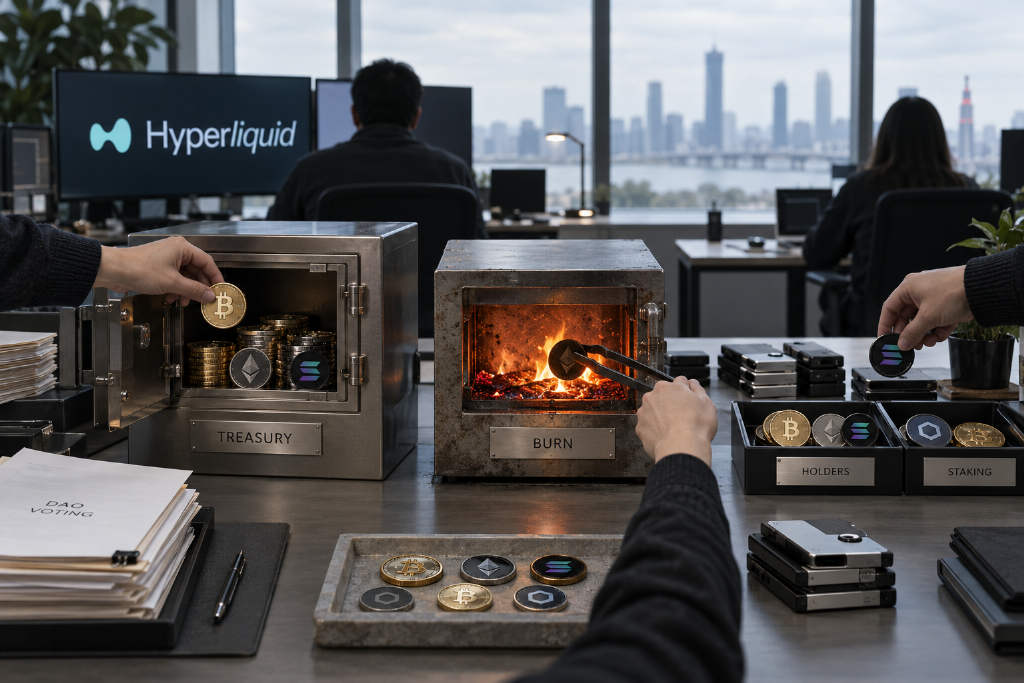
A clear trend has emerged in crypto: more projects are buying back their own tokens.
In the past, protocol income often stayed in the treasury, while tokens were used mainly for governance and incentives. That is changing. More teams are now running buybacks, burns, staking-based distributions, or direct payouts tied to protocol income.
Still, the label can be misleading. One project may buy back and permanently burn tokens. Another may simply move them into treasury reserves. Some systems run automatically. Others depend on a team or DAO decision and can be changed at any time.
This review looks at 15 projects and compares how they make money, how that money is allocated, and how much value the token actually captures.
Hyperliquid
Hyperliquid generates income mainly from spot and perpetual trading fees. The article says annualized fees of more than $1 billion are used for programmatic HYPE buybacks.
A portion of the fees that flow into the Assistance Fund is automatically converted into HYPE. The repurchased HYPE is then permanently burned and removed from both circulating supply and total supply.
- Buyback ratio: 99% of trading fees
- Execution: automatic
- Burn: yes
- Distributed to holders: no
- Token value capture: buyback + burn
PUMP
On PumpSwap, each trade currently carries a fee of about 1.25%. Part of that goes to LPs and creators, while the rest becomes platform income. Pump.fun also earns from products such as Bonding Curve and Terminal.
The platform currently uses 50% of revenue to buy back PUMP, and the repurchased tokens are permanently burned.
- Buyback ratio: 50% of revenue
- Execution: programmatic
- Burn: yes
- Distributed to holders: no
- Token value capture: buyback + burn
UNI
The article says Uniswap formally turned on protocol fees by the end of 2025. Part of trading fees flows into TokenJar and is then used through the Firepit mechanism to acquire UNI with protocol-held assets and permanently burn it.
Using V2 as the clearest example, each swap charges 0.30%. After protocol fees are enabled, 0.05% goes to the protocol and 0.25% goes to LPs. In V3, fee collection depends on each pool's fee tier, and protocol fees vary with pool configuration.
- Buyback ratio: depends on protocol fee settings across versions and pools
- Execution: permissionless, carried out by market arbitrage
- Burn: yes
- Distributed to holders: no
- Token value capture: protocol fees to UNI burn
SKY
Sky earns from USDS-related credit, collateralized lending, capital usage through Sky Agent, treasury strategies, and the Peg Stability Module.
At present, about 55% of protocol surplus goes to SKY buybacks and 45% goes to staking rewards. The treasury can also burn part of SKY based on governance decisions.
- Buyback ratio: currently 55%
- Execution: programmatic, with governance-adjustable parameters
- Burn: partial
- Distributed to holders: yes, to stakers
- Token value capture: buyback + burn + staking rewards
AAVE
Borrowers pay interest to liquidity providers, and part of that interest is retained by the protocol through each asset's reserve factor. Aave can also collect protocol fees from liquidation bonuses.
AAVE buybacks are handled through a DAO budget system. The current annual budget is about $50 million, and weekly purchases are around $250,000 to $1.75 million depending on market conditions.
The repurchased AAVE goes into the DAO Ecosystem Reserve, where it can later be used for staking rewards, grants, and service-provider expenses.
- Buyback ratio: no fixed share of revenue, budget-based
- Execution: DAO authorization plus committee execution
- Burn: no
- Distributed to holders: no; staking rewards are handled under a separate mechanism
- Token value capture: treasury buyback + staking utility
JUP
Jupiter earns from several products, including swaps, perps, limit and recurring orders, and lending. Different products charge different trading or service fees.
About 50% of protocol revenue is currently used to buy back JUP. The repurchased tokens mainly go into the Litterbox for long-term lockup rather than automatic burning.
- Buyback ratio: 50% of protocol revenue
- Execution: programmatic
- Burn: no; the current ongoing buyback is not an automatic burn
- Distributed to holders: no
- Token value capture: buyback + lock
Ethena
Ethena's income comes mainly from ETH staking yield, perpetual funding and basis, and returns on stablecoin assets. It is not built around per-trade fees.
Its new fee switch captures 5% to 20% of gross revenue depending on USDe scale, with most of that amount directed to ENA buybacks. The mechanism only starts once the relevant USDe supply thresholds are met.
- Buyback ratio: 5% to 20% of gross revenue, triggered by tiers
- Execution: conditional and rule-based
- Burn: no unified automatic burn at present
- Distributed to holders: no; sENA distribution is discussed separately
- Token value capture: conditional buyback
MORPHO
Morpho generates income from lending and vault operations. Vaults can charge performance fees and management fees, and the protocol has reserved a protocol fee switch.
For now, that income does not flow back to MORPHO on a fixed basis. The token is still used mainly for governance and incentives.
The article notes that the core contracts already include a fee switch that governance could activate later, taking as much as 25% of borrowing interest and directing it to a specified recipient address.
- Buyback ratio: 0
- Execution: none
- Burn: no
- Distributed to holders: no
- Token value capture: governance + incentives
PONS
Pons currently charges a 1% pool fee for launch tokens. Of that amount, 70% goes to creators and 30% belongs to the protocol.
From the protocol's 30% share, 80% is used to buy back PONS and 20% goes to the team and infrastructure. The buyback is manually triggered by the team and then executed automatically through TWAP. Repurchased PONS is burned.
- Buyback ratio: 80% of protocol fees
- Execution: manual trigger plus automated TWAP
- Burn: yes
- Distributed to holders: no
- Token value capture: buyback + burn
PancakeSwap
PancakeSwap earns from spot, perps, prediction, lottery, CAKE.PAD and other products. Different business lines allocate different portions of income to CAKE burns.
Spot contributes part of trading fees, perps contributes part of profits, and CAKE.PAD sends fees directly to burns. At the same time, CAKE still has ecosystem incentive issuance, so the key question is whether burns remain larger than emissions over time.
- Buyback ratio: varies by product
- Execution: rule-based with periodic execution
- Burn: yes
- Distributed to holders: no
- Token value capture: buyback + burn + net deflation
PENDLE
Pendle makes money mainly from YT yield fees and swap fees. YT charges about a 5% fee on yield, while swap fees change with market conditions.
After LP allocations are deducted, 80% of distributable protocol fees is used to buy back PENDLE. The protocol aggregates funds every two weeks and then buys through TWAP. The purchased PENDLE is ultimately distributed to active sPENDLE holders.
- Buyback ratio: 80% of distributable protocol fees
- Execution: programmatic TWAP
- Burn: no
- Distributed to holders: yes, to sPENDLE holders
- Token value capture: buyback + distribution
Raydium
Raydium earns mainly from DEX swap fees, and fee rates vary by pool. In the traditional AMM V4 model, each trade is about 0.25%.
A fixed 12% of trading fees is used to buy back RAY. The rest mainly goes to LPs and the treasury. Buybacks run continuously through scripts, but the repurchased RAY is not burned and is instead held by a protocol address.
- Buyback ratio: 12% of trading fees
- Execution: programmatic
- Burn: no
- Distributed to holders: no
- Token value capture: treasury buyback
ETHFI
ether.fi earns from staking, vaults, withdrawals, cash products and other services. The article gives eETH Fast Withdrawal as one example, noting a withdrawal fee of about 0.3%.
ETHFI currently uses several buyback mechanisms. These include using part of protocol revenue to buy ETHFI and using withdrawal revenue to purchase ETHFI. Some of the repurchased ETHFI is distributed directly to stakers rather than burned.
- Buyback ratio: multiple mechanisms, with some set at 5% of revenue
- Execution: DAO authorization plus monthly execution
- Burn: not the core mechanism
- Distributed to holders: yes, to ETHFI stakers
- Token value capture: buyback + distribution + staking
ASTER
Aster earns mainly from perps and spot trading fees. In some perp products, maker fees are 0 and taker fees are about 0.04%.
At present, 99% of daily platform fees are used to buy back ASTER automatically through TWAP. The purchased tokens are distributed to veASTER stakers. At the same time, the reserve burns an amount of ASTER equal to the buyback amount.
- Buyback ratio: 99% of daily platform fees
- Execution: automatic TWAP
- Burn: yes, through matching reserve burns
- Distributed to holders: yes, to veASTER stakers
- Token value capture: buyback distribution + matching burn
Jupiter appears again in the list
The 15th entry in the article lists Jupiter again. It says Jupiter has expanded from a swap aggregator into perps, lending, limit and recurring orders, and mobile products, with each line contributing fee income.
That income is consolidated into Jupiter Business, and about 50% of protocol revenue is used to buy JUP. The repurchased tokens are placed into the Litterbox for long-term lockup.
- Buyback ratio: 50% of protocol revenue
- Execution: programmatic
- Burn: no
- Distributed to holders: no
- Token value capture: multi-product revenue to buyback + lock
Fees, revenue and token capture are not the same thing
The article closes with a distinction between fees and revenue. A protocol with high fees does not automatically produce high token payouts.
A protocol may generate $100 million in annual fees without actually keeping $100 million. Before revenue is counted, part of that amount may go to LPs, creators, market makers, frontend channels, or rebate users. What remains with the protocol is revenue.
The article says this is especially visible in trading applications. Using frontends such as FOMO as an example, it notes that fee volume can be large while a substantial share is still diverted through rebate systems. Large fees do not necessarily mean thick protocol profits.
There is another layer after that. Even protocol earnings do not automatically become token-holder earnings.
Some protocols use 50% of revenue for buybacks, others only 10%. Some burn what they buy. Some move it into treasury reserves. Some distribute it to stakers. On the surface, all of these are called buybacks, but the value captured by holders is very different.
The mechanism matters too. Automatic buybacks follow preset rules and offer more certainty. Manual or DAO-controlled buybacks can be adjusted, paused, or canceled.
The article also says token emissions and unlocks need to be included in the calculation. A project may buy back a large amount, but if it unlocks even more tokens at the same time, holders can still be diluted.