
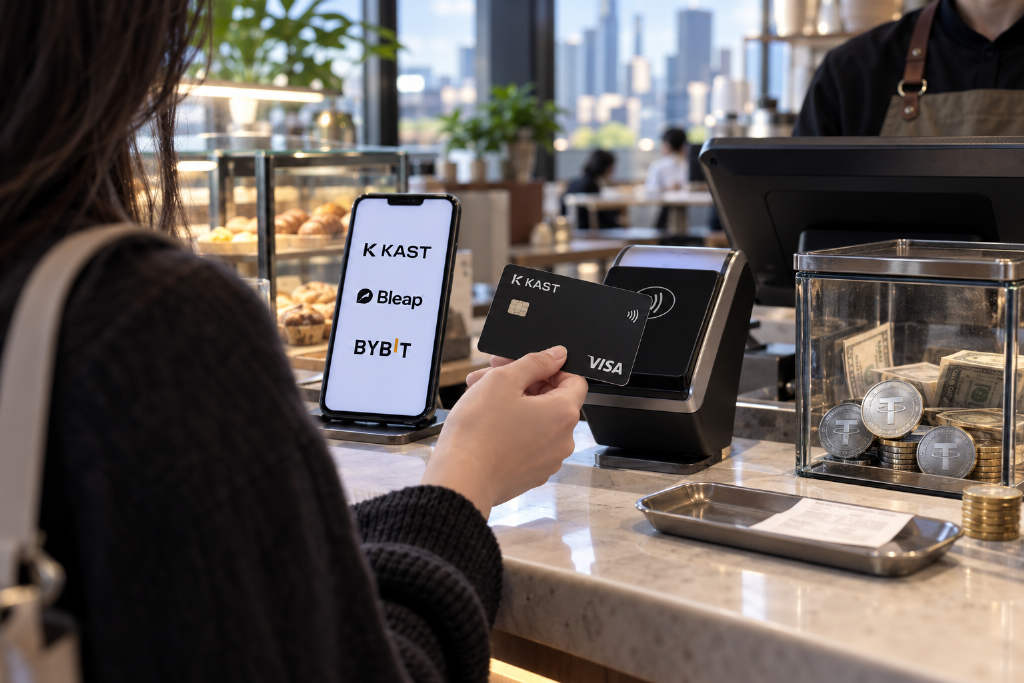
Crypto payment cards are in the middle of a rewards war that looks hard to justify on basic unit economics. KAST and Bleap have promoted offers including up to 20% cashback, balance yields above 8%, and category-specific discounts, even though the assets underneath those products generate only 3.5% to 4%. The gap is being covered by company subsidies, backed by financing, and the real test may come when those incentives are reduced.
Crypto cards have already been moving deeper into everyday spending. In the related background cited in the source article, monthly spending on crypto U cards had reached $600 million, up sixfold year over year, with USDT accounting for 62.5% and Visa taking roughly 90% of volume. Another background reference said monthly spending had exceeded $750 million across 8.8 million transactions.
KAST says growth spending pushed it from near break-even into losses
KAST, a stablecoin financial platform issuing cards on the Visa network, is one of the clearest examples of the current strategy. CEO Pathy said in an interview that the company had moved from being close to break-even to operating at a loss as it increased spending to accelerate growth.
KAST's Reserve account advertises reward rates of 8% to 12%, depending on membership tier. The assets supporting that product, however, generate only 3.5% to 4%, with KAST absorbing the difference. Pathy said Reserve had attracted tens of millions of dollars by September, making the subsidy bill meaningful, but he described the spending as a way to capture market share. 「We were almost break-even before, and now we are loss-making.」
KAST completed an $80 million funding round in March, led by QED Investors and Left Lane Capital. Pathy said the company has roughly four to five years of cash runway and that investors are not pushing it to turn profitable quickly.
He identified membership fees, enterprise services, and planned tokenized stock products as future sources of revenue from customers. He also said larger scale should help KAST negotiate better terms with infrastructure providers. Even so, the company declined to disclose the size of its subsidy bill, its latest Reserve balance, or directly answer whether it remains loss-making at present.
Bleap is also using subsidies, with a 1% default cashback rate
Bleap is following a similar playbook. The company advertises yields of up to 15% on crypto assets and cashback of up to 20%. Bleap Latvia CEO Timofejevs said in an interview that if customers simply use the card and collect rewards, they may not be profitable for the company.
Like KAST, Bleap is looking to scale and to make money from additional services, especially trading. According to its public terms, Bleap's default cashback rate is 1%, capped at €500 per transaction, or about $560, and €3,000 per month. The headline 20% cashback figure, which includes subscription-related offers, comes with separate limits depending on the benefit.
Bybit EU has already cut rewards for regular cardholders
The harder question is what happens when issuers shift from growth at all costs to profitability. In that transition, rewards are likely to shrink, and user retention becomes the key issue.
Bybit EU has already revised terms for standard cardholders. In a June announcement, it changed non-VIP cashback from 2% to 10% with monthly caps to an uncapped 1%. The new terms took effect for existing cardholders on Aug. 4. Subscription cashback also changed from a standing perk to a one-time first-month offer capped at €50. Bybit said the simpler structure makes the card useful for users outside the high-spending segment.
Bleap has also adjusted its program. Its earlier 2% cashback was changed to a 1% base rate plus boosts in selected categories, and a February update removed a previous $10 cap. Neither Bybit nor Bleap responded on how those changes affected active users, spending volume, or customer retention.
The economics are constrained by interchange fees
The reason these rewards are difficult to sustain lies in the underlying economics of payment cards. In Europe, regulated consumer debit card interchange fees are capped at 0.2%. In the United States, the picture depends on the card and issuer. Federal Reserve data show that in 2024, debit card transactions not subject to the federal cap carried an average fee of 1.21% of transaction value. Credit cards operate under a different framework, with rates that can exceed 2%.
That leaves issuers with limited revenue from each transaction while they promise rewards that can reach double digits. The shortfall has to be funded somewhere, and for now that source is external capital.
Some companies are betting card usage can become a habit
Even with rewards under pressure, there are signs that regular card use can stick. Krak, a payments app owned by Kraken and operating on the Mastercard network, said in August that users swipe their cards 8.3 times per week on average. Retail and in-store purchases account for 59.3% of those transactions. The company said it is moving toward 200,000 cardholders and wants to become customers' primary financial account.
Krak said it evaluates the economics of the full customer relationship rather than treating the card as a standalone product. Customers who both hold assets and spend through the platform still matter, even if they do not trade frequently.
OKX is taking a similar approach. In an August blog post, Europe CEO Ghoos said the company's debit card lets users spend without first moving funds from the exchange to a bank account, and that higher VIP tiers unlock richer rewards.
Cero Finance and Ether.fi are trying different reward structures
Cero Finance is testing another model. Founder Jonans said in an interview at the UN:BLOCK conference in Riga that the company combines yield and trading-related revenue to support gamified rewards, while planning to make credit and lending its main revenue source. Its planned card product is designed to build a lending relationship over time as customers spend, link accounts, and make repayments.
A newer-looking structure comes from crypto neobank Ether.fi. Its Cash credit card is tied to staking services and custodial DeFi pools. Customers can borrow against eligible yield-bearing assets held on the platform, borrowers pay interest, and collateral can be liquidated if needed.
A March report from Alea Research found that about 80% of Cash users also used the Liquid yield product. Ether.fi also uses its reward design to manage costs. Personal card rewards start at 3% and step down as monthly spending crosses thresholds, with the lower rate applying only to the portion above each threshold. ETHFI rewards already credited are not affected.
The subsidy-for-growth trade now faces a retention test
At its core, this rewards battle is a bet. Companies are paying acquisition costs with financing today in the hope that customers will spend more later on trading, lending, subscriptions, and other services. KAST has four to five years of runway, and Bleap has established a foothold in Europe, but neither company gave direct answers on the numbers that matter most: how much the subsidies have cost and how many users have stayed.
As peers begin to cut rewards on their own, the question is no longer theoretical. Bybit EU has moved to an uncapped 1% cashback structure, and Bleap has fallen back to a 1% base rate. That shift amounts to a recognition that subsidies are difficult to maintain over time, and it puts the market's focus on a simple issue: whether customers remain once the rewards become less generous.



