
Odaily’s market analysis frames 2026 as a turning point for the crypto industry. Many crypto projects, according to the article, have already been disproved by the market: some tokens fall close to zero after listing, others plunge immediately at launch, and many have come to be viewed as tools for extracting liquidity from retail participants. The broad Web3 narratives once used to justify these projects have not materialized at the expected pace. At the same time, the U.S. stock market has been moving strongly under the narrative of AI-driven advanced productivity, repeatedly setting new highs.
Against that backdrop, the article argues that crypto cannot continue to rely only on a shrinking internal market, described as “circle-internal PvP,” or on successive meme coin battles. A number of exchanges have therefore started to push U.S. stock-related products. BIT, according to the article, had already completed the route of “stablecoin funding rails + licensed brokerage framework + real U.S. stock holdings” in February 2026. From a broader industry perspective, this is described as a structural shift: crypto is moving from internal competition, where exchanges fight for users, trading volume, and narratives, toward external integration, where crypto capital enters the core asset system of traditional finance.
The Stablecoin Cash Pool Reaches $320 Billion
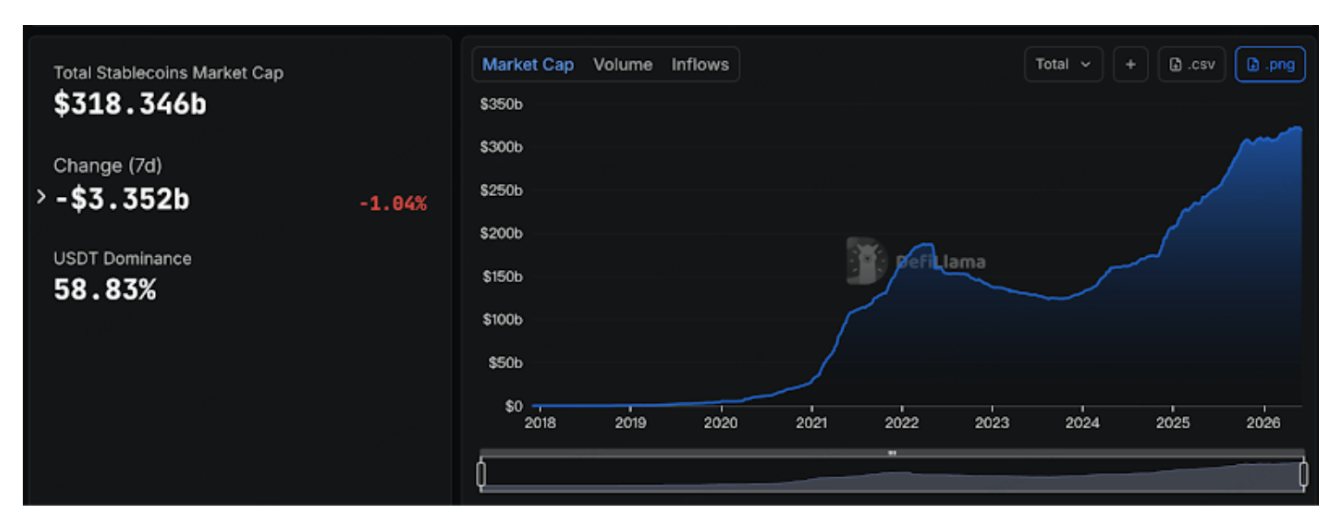
The article starts with stablecoin data. According to the latest DefiLlama figures cited in the piece, as of June 5, 2026, the total value of the stablecoin market had reached a record high of about $320 billion. Based on CoinDesk’s reporting, that figure was larger than the foreign exchange reserves of 95 countries, including the United Kingdom and Canada. Odaily describes this as crypto’s “cash pool,” arguing that the scale is now far beyond what can be called a niche market.

The irony, in the article’s view, is that such a large cash pool has historically had access to a very limited set of investable assets. Over the past few years, stablecoin holders inside crypto could mainly allocate to BTC, ETH, various altcoins, meme assets, and derivatives contracts. The article says the return profile of endogenous crypto assets has been declining visibly, which has helped push users toward assets outside the native crypto universe.
CoinGecko’s RWA Report 2026 is also cited. According to that report, RWA Perps, a tool for trading traditional finance assets, reached $524.79 billion in trading volume in the first quarter of 2026, well above the full-year 2025 figure of $313.02 billion. Tokenized gold spot trading volume reached $90.7 billion in the first quarter of 2026, also exceeding the full-year 2025 figure of $84.6 billion. Odaily uses these figures to support the argument that crypto user capital is migrating toward core TradFi assets at unprecedented speed.
From Internal PvP to U.S. Stocks, Gold, and ETFs
The article says on-chain asset innovation has gradually fallen into a loop of internal extraction. When endogenous high-risk assets cannot continue to provide healthy alpha, user risk preferences begin to split. Demand for allocation to traditional macro assets, including U.S. technology stocks and commodities such as gold, naturally rises. The reason 2026 is described as a dividing line is that this allocation demand is being met at the product level on a large scale for the first time. Many exchanges are now focused on U.S. stock access. Their routes differ, but the direction is the same: they are turning U.S. equities into an “asset exit” for crypto users.

This matters, the article argues, because it breaks a market convention that had lasted for more than a decade: crypto and traditional finance used to operate as two separate pools of capital. In the past, a user who wanted to hedge macro exposure had to buy gold or U.S. equities through a traditional brokerage account, then open contracts on a crypto exchange. The full process involved bank deposits, brokerage onboarding, cross-market settlement, and foreign exchange costs, leading to low capital efficiency.
The new trend changes that separation. Tokenized U.S. stocks or spot assets inside crypto rails are not only assets in themselves; they can also be used within portfolio allocation and hedging structures. The article says this improves capital efficiency. It also notes that, in BIT’s user research, a significant portion of stablecoin holders expressed strong interest in allocating to U.S. technology stocks or gold ETFs. These users are not described as having lost interest in crypto; rather, they are mature enough to allocate part of their holdings to lower-risk and higher-certainty assets outside high-volatility crypto positions.
BIT’s Route: Real U.S. Stock Holdings
To meet this type of demand, BIT chose what the article calls the heaviest and most difficult part of the value chain. Instead of issuing a token that tracks a stock price, BIT uses stablecoin funding rails to connect directly with U.S.-licensed broker-dealers, enabling users to buy real U.S.-listed stocks. This route requires the platform to handle the infrastructure of traditional securities markets, including custody, clearing, dividends, voting, corporate actions, and compliance frameworks.

The article explains BIT’s rationale in terms of the industry’s shift from trading prices to allocating assets. When the key need is merely price exposure, a synthetic or tokenized route can be sufficient. When the user’s capital base grows and U.S. stocks become part of a longer-term allocation plan rather than a short-term speculation tool, the questions become more fundamental: whether the user has actually purchased the stock, who the underlying broker is, and how the user’s equity interest can be verified if the platform encounters problems.
Odaily compares the dominant narratives of different periods. From 2023 to 2025, the main theme was “PvP internal war.” Exchanges competed for first listings, Launchpad activity, and user growth. Project teams competed for TVL, airdrop expectations, and KOL attention. Users competed for inside information advantages, low-buy-high-sell opportunities, and early narrative positioning. From 2026 onward, the article says the main theme is cross-market asset allocation: exchanges are connecting U.S. stocks, gold, and ETFs to crypto funding channels; project teams are building RWA protocols; and users are using U to directly allocate to NVIDIA, Tesla, SPY, QQQ, and PAXG. The article also cites Ondo Global Markets, which launched more than 100 tokenized U.S. stocks and ETFs in early 2026.

The underlying logic of this shift is described as an upgrade in crypto users’ asset allocation needs. In earlier cycles, the typical crypto user was portrayed as having a high risk appetite, seeking short-term outsized gains, and being accustomed to volatility. But when the stablecoin pool grows to $320 billion, the nature of the money changes. Part of it is institutional capital, and part of it is long-term capital from high-net-worth users. Their tolerance for a single high-volatility asset declines, while their sophistication in portfolio construction rises. The article gives a simple example: a user with 100,000 USDT may no longer put everything into one meme asset as in 2021, but instead consider 30,000 USDT in BTC, 20,000 USDT in ETH, 30,000 USDT in U.S. technology stocks, 10,000 USDT in tokenized gold, and the remaining 10,000 USDT in high-beta altcoins.
Buying NVIDIA Price Exposure Is Not the Same as Holding NVIDIA Shares
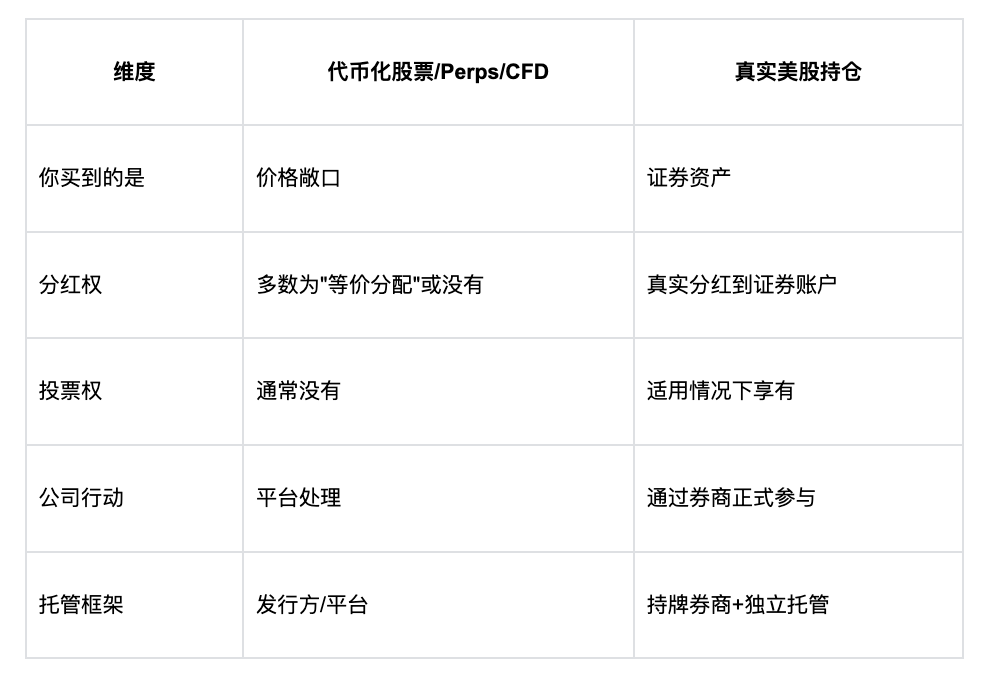
The article draws a clear distinction between buying exposure to NVIDIA’s price and holding NVIDIA stock. Crypto assets are often priced through consensus, liquidity, narrative, and on-chain mechanisms. U.S. equities, by contrast, are core securities assets in traditional finance, backed by the cash flow, profits, shareholder rights, corporate governance, and regulatory system of listed companies. Tokenized stocks are on-chain tokens designed to track the market performance of publicly traded stocks. They provide economic exposure, including price movement and, in many cases, dividend-equivalent distributions, but they do not grant direct share ownership or voting rights.
This is not presented as a criticism of tokenized stocks. Rather, the article says they solve the question of whether a user can trade the price of U.S. equities. When capital size increases and users start treating U.S. stocks as long-term allocations instead of short-term speculative instruments, the important questions change: Is the user buying an actual stock? Who is the underlying broker? If the platform fails, how are the user’s stock rights confirmed?

This distinction is the reason BIT continues to emphasize the “real U.S. stocks” route. According to the article, BIT completed the “stablecoins into real U.S. stocks” path in February 2026. The route includes 24/7 near-real-time deposits and withdrawals using USDT and USDC, direct connections to U.S.-licensed broker-dealers, support for tens of thousands of mainstream U.S. stocks and ETFs, and shareholder rights where applicable, including dividends, voting, and corporate actions. The article says BIT is not merely adding a feature that also lets users buy U.S. stocks. It is building financial infrastructure that allows digital asset capital to enter the real securities asset system in a compliant way. While other industry players compete over the number of tokenized stocks or the leverage level of stock perps, the article says BIT has been ahead of peers by at least four months in completing the real-asset route.
Three Practical Standards for Users
The article closes with three practical standards for crypto users. The first is to judge the nature of the funds before choosing an allocation strategy. If the user’s U is short-term trading capital focused on high turnover and high beta, stock perps and tokenized stocks can meet that need. If the money is medium- to long-term retained capital intended for real cross-market allocation, the user should examine products that offer a real holding path.
The second standard is to evaluate the depth of product disclosure in order to judge whether the route is real. Before buying U.S. stocks, the article suggests asking who the underlying broker is, where the assets are custodied, how clearing works, whether the licensed entity is disclosed, and whether there is a public compliance framework. With such a large stablecoin capital base behind the market, the article says user requirements for asset-route transparency will only increase.

The third standard is to treat asset allocation as portfolio management rather than a one-way bet. A crypto user in 2026, according to the article, should not only ask whether BTC will rise, but how a portfolio containing BTC, ETH, U.S. technology stocks, tokenized gold, and stablecoin yield products performs under different macro conditions. This is presented as a more mature asset allocation mindset and as a sign that the crypto industry is moving from adolescence toward maturity.
The article’s final conclusion is that the biggest trend in crypto in 2026 is not a new public chain, a new meme coin, or a specific ETF approval. It is the first large-scale and systematic entry of crypto capital into the core asset system of traditional finance. The essence of the trend is a move from a stock game in which crypto plays only with itself, toward an incremental game connected with global capital markets. BIT positions itself in this shift as an early mover in connecting stablecoins to real U.S. stock assets, aiming to provide a path into the securities system when crypto users’ capital grows, their risk preferences evolve, and their allocation needs mature.