

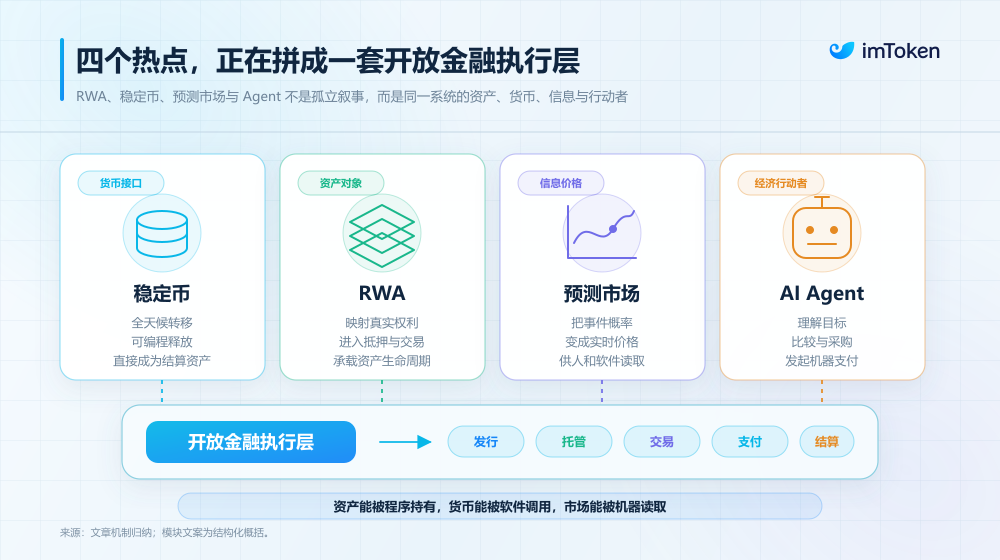
Real-world assets, stablecoins, prediction markets and agentic payments are not four disconnected crypto trends. In Foresight’s analysis, they are showing up together because the components of a new financial stack — assets, money, identity, trading and settlement — have spent years developing on separate tracks and are now starting to connect.
For much of the past few years, a large share of crypto discussion could be reduced to one recurring question: what is the next asset that goes up? From DeFi Summer to NFTs, public chains and layer 2s, restaking, memes and AI tokens, each narrative had its own technical setup and market backdrop. Even so, attention usually returned to price. Tools such as stablecoins, wallets and cross-chain bridges often drew interest mainly through the trading activity they enabled.
That framing, the article argues, is becoming too narrow in 2026. Several developments from different corners of the market are appearing in the same window. Stablecoin market capitalization has reached about $300 billion. The Depository Trust & Clearing Corporation, or DTCC, has completed its first tokenized asset conversions in a live production environment and plans to launch related services in October. Prediction markets are moving out of purely crypto-native products and into brokerages and regulated exchanges. AI agents are beginning to use stablecoins to purchase data, model access and digital services on their own.
Viewed together, those developments point to a broader shift. Over the past decade, crypto has built issuance, custody, trading, payments and settlement capabilities. Those capabilities are no longer being used only for crypto assets themselves. They are starting to open up to wider financial activity and to the machine economy.
The article’s central point is direct: crypto has not stopped being speculative, but beneath the speculative market it is building a more complete layer of infrastructure.
Why these breakthroughs are surfacing at the same time
The piece says the simultaneous rise of RWAs, stablecoins, prediction markets and AI agents is not the result of a single narrative taking over. The more useful explanation is that the components required for a new financial system have finally reached the point where they can interoperate.
Stablecoins turn money into an interface
Stablecoins are not new. What is changing is their role. Early on, they were used mainly for exchange quote currency, on-chain hedging and crypto trade settlement, with most of the funds circulating inside the crypto market. Now, more issuers, banks, payment firms and fintech companies are using stablecoins for merchant acquiring, global payroll, corporate payments, treasury sweeps and cross-border settlement.
Citing Circle’s first-quarter 2026 disclosure, the article says the network’s annualized transaction volume, based on roughly 30 days of activity at the time, reached about $8.3 billion. It also notes that partner Nium’s payment network spans more than 190 countries and territories. In this setting, stablecoins are no longer just “dollars on-chain.” They are becoming a form of money software can call directly.
They can move around the clock, be embedded in code, unlock conditionally and serve as the settlement asset once a transaction is complete. For internet applications, sending a stablecoin payment is starting to look like calling a payments API. The app does not need to understand correspondent banking, clearing schedules or cross-border account structures. It only needs the amount, the address and the execution conditions. That, in the article’s view, is the key shift that turns stablecoins from crypto trading tools into payment infrastructure.
RWAs make assets programmable
If stablecoins answer the question of what money gets used for settlement, RWAs answer what assets can be traded and settled. Earlier RWA products were concentrated in U.S. Treasurys, money market funds and private credit, with the main value proposition being access to off-chain yield for crypto users. Since last year, though, traditional financial infrastructure has become visibly more active in bringing securities registration, custody, trading and settlement on-chain.
On July 15, DTCC completed tokenized asset trading tests in a production environment with participation from more than 30 traditional financial institutions and digital asset firms, and plans to launch the service formally in October. The article stresses that DTCC’s model is not a simple token wrapper. It is designed so tokenized securities keep the ownership structure, investor protections and rights arrangements of the traditional securities they represent.
Earlier, in March, the U.S. Securities and Exchange Commission approved Nasdaq to allow eligible listed securities to trade in tokenized form. Those tokenized shares use the same CUSIP as the traditional stock, carry the same substantive rights and continue to trade under the existing market system and securities rules.
That is materially different from issuing a token that merely tracks a stock. It suggests that on-chain assets are beginning to link to real ownership, custody relationships, corporate actions and legal claims, and to carry part of the lifecycle of traditional assets. In that sense, blockchains are not only creating new asset classes. They are beginning to host part of the operating process for older ones.
Prediction markets convert future information into price
Prediction markets add the information and price-discovery layer. Stocks reflect expected future cash flows. Bonds price credit and interest rates. Prediction markets price the probability of an event happening. Elections, rate decisions, sports outcomes, company events and product launch dates can all be compressed into a market price that moves continuously.
Robinhood disclosed that more than 1 million users participated in its prediction market business in its first year, trading roughly 9 billion contracts in total. It has also acquired a CFTC-regulated exchange and clearing infrastructure. From the infrastructure angle, the article argues, prediction markets offer something traditional finance has struggled to deliver at scale: the ability to aggregate dispersed information into a probability that can be read in real time.
AI agents begin to act as economic participants
Stablecoins and RWAs address money and assets. AI agents change who initiates economic activity. Traditional software usually follows a predefined workflow. An agent can interpret a goal, search for services, compare prices and make decisions within a set of permissions. Once an agent can buy APIs on its own, it stops being only an information tool and starts becoming an economic actor.
The challenge is that many of those payments are tiny, sometimes only a few cents or less. Fixed card fees, settlement delays and identity checks in traditional payment systems are not a natural fit for high-frequency, low-value, automated machine payments. That is where low-cost blockchains and stablecoins become useful.
Coinbase has integrated x402 and stablecoin wallets into AWS Bedrock AgentCore, allowing enterprises to set budgets and governance rules for agents. Google’s Agent Payments Protocol records what a user allows an agent to buy, how much it can spend and who initiated the action, using cryptographically signed authorization credentials.
What the next-generation financial stack already has
The article says these lines are surfacing together because they are parts of the same system. Stablecoins make money programmable. RWAs make assets programmable. Prediction markets turn future information into price. AI agents let software take part in asset exchange directly.
Whether crypto is becoming infrastructure does not hinge on whether speculation still exists. Stocks, foreign exchange and commodities all carry heavy speculative activity. The more important test is whether outside companies and users are beginning to rely on a technology stack to do things that were previously too difficult, too expensive or too inefficient.
By that measure, the piece says crypto and Web3 have already formed a preliminary multi-layer capability set.
Layer 1: asset issuance and representation
It is no longer only native tokens that can live on-chain. Stablecoins, Treasurys, money market funds, private credit, gold, fund shares and equities have all appeared in different on-chain forms. The point of putting assets on-chain is not simply to drop a certificate into a wallet.
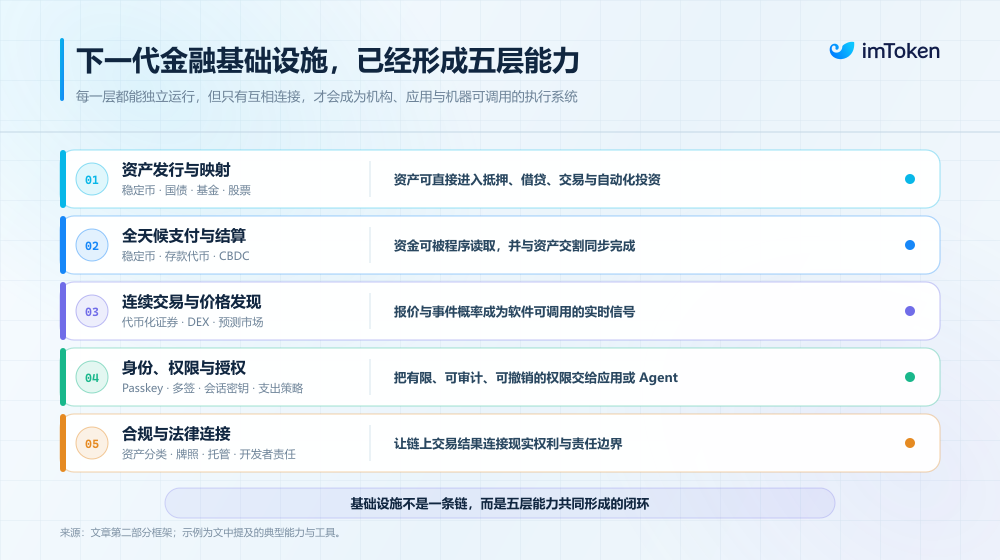
Once an asset can be recognized by a smart contract, it can move straight into collateral, lending, trading, treasury management and automated investment flows. Operations that were previously split among registrars, custodians, brokers and clearing systems can begin to compress into a more unified execution environment.
Layer 2: always-on payments and settlement
Cross-border payments in traditional finance often pass through several correspondent banks and remain constrained by business hours, account structures and regional networks. Stablecoins can move value nearly in real time on a common asset standard, around the clock.
J.P. Morgan said Kinexys has processed more than $4 trillion since launch, with average daily volume above $7 billion. It has also expanded blockchain deposit accounts into multiple currencies, including the U.S. dollar, euro, pound sterling, Japanese yen, Hong Kong dollar, Singapore dollar and renminbi.
The article adds that on-chain settlement does not require every dollar to become a publicly issued stablecoin. A future system may include tokenized bank deposits, regulated stablecoins, central bank digital currencies and on-chain commercial bank money at the same time. What they share is that funds can be read and routed by software, and settled in sync with asset delivery.
Layer 3: continuous trading and price discovery
Crypto has already shown that markets can run continuously and that liquidity can be matched and managed by smart contracts. That capability is now moving into more asset classes. Tokenized securities can reduce the time gap between trading and settlement. Prediction markets can assign probabilities to events that traditional finance does not easily price.
The article sketches several examples. A company might hold an on-chain money market fund and then adjust its cash position automatically based on changes in an interest-rate prediction market. An AI agent might read asset prices, event probabilities and liquidity conditions at the same time before deciding whether to trade. In that setting, markets stop being just screens for humans to watch. They become streams of signals software can act on directly.
Layer 4: identity, permissions and authorization
Financial activity is not only about moving assets. It also requires answers to who initiated a transaction, who has authority, how long that authority lasts, what the spending limit is and who is responsible when something goes wrong. Early crypto answered those questions mainly through private keys. Whoever held the key controlled the account.
That model is too blunt for institutions, enterprises and AI agents. Google AP2 uses verifiable authorization to record user intent. Visa is building agent identity directories, credentials and scoring mechanisms. Mastercard’s Agent Pay for Machines is aimed at giving machines identity verification, permission controls, transaction functions and settlement capabilities.
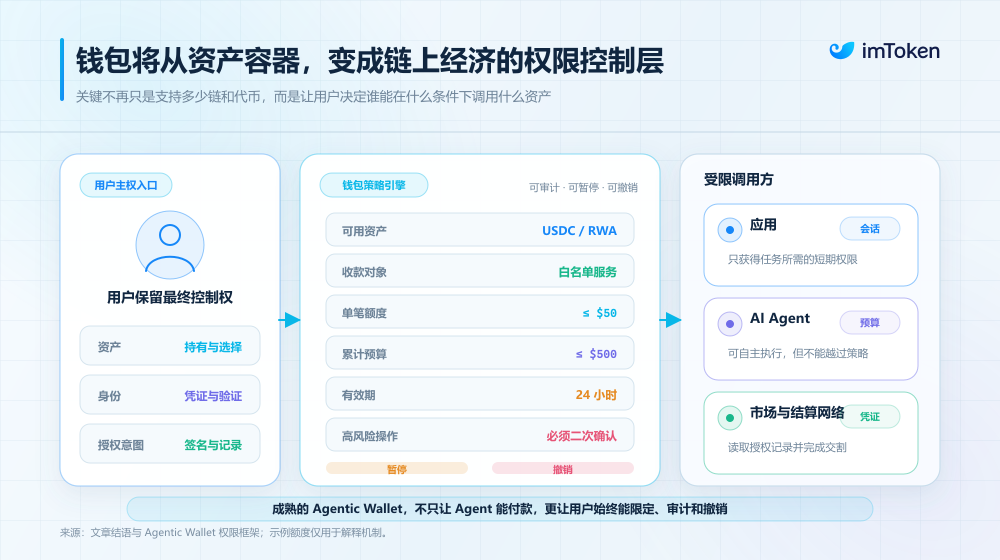
Account abstraction, passkeys, multisig wallets, session keys and spending policies also allow users to delegate limited permissions to an application or an agent without handing over full account control. In the article’s reading, that shifts the role of the wallet. A wallet may need to manage user identity, institutional credentials, agent permissions, spending budgets and authorization records, not just assets and keys.
Layer 5: links to law and regulation
A financial system does not become infrastructure just because the technology works. The legal system has to recognize the outcome of transactions as well.
In January 2026, the SEC issued guidance on tokenized securities that distinguishes among securities issued directly in tokenized form by the issuer, tokenized interests backed by assets held through third-party custody, and on-chain products that only provide synthetic price exposure. The article argues that this distinction matters because several products can look like “on-chain stocks” while giving holders very different legal rights.
The CLARITY Act is also described as an attempt to define the regulatory boundaries between the SEC and the CFTC and to create clearer rules around digital asset issuance, trading platforms, software developers, DeFi and investor protection. The legislation remains contested and has not been completed, but the article says the direction of debate has already shifted. The question is moving away from whether crypto should exist at all and toward who may issue, who is responsible for custody and which rules apply to which assets.
That change, by itself, is an infrastructure signal. Only when banks, brokerages, asset managers and payment firms can roughly assess their legal exposure will they commit long-term resources instead of running isolated pilots.
The road from speculative market to infrastructure
On the question of whether crypto is moving from a speculative market toward infrastructure, the article’s answer is yes, and it calls the shift irreversible. It is not an either-or replacement, though. Growth in stablecoin payments and RWAs will not strip crypto of its speculative character. What is happening, instead, is that a shared execution system is being built under the existing trading market for use by real-world assets, traditional institutions and intelligent software.
One sign is the expansion of revenue sources. In the past, much protocol income came from leveraged trading, asset issuance, liquidations and circular on-chain capital flows. Now a second category of cash flow is appearing from outside economic activity: businesses use stablecoins for cross-border settlement, funds distribute and manage assets through on-chain rails, software buys APIs per use, and agents pay for data and model services automatically.
The participant base is changing too. The old archetypal crypto user was a human trader sitting at a screen and clicking confirm or sign. In the next phase, many on-chain interactions may be initiated by enterprise systems, payment programs and AI agents. Humans set goals, boundaries and permissions. Software handles execution.
Regulatory debate is changing in parallel. The earlier fight centered on whether crypto should fit into the existing financial system. The newer questions are how to draw regulatory boundaries, protect investors, constrain intermediaries and still preserve room for self-custody and open software.
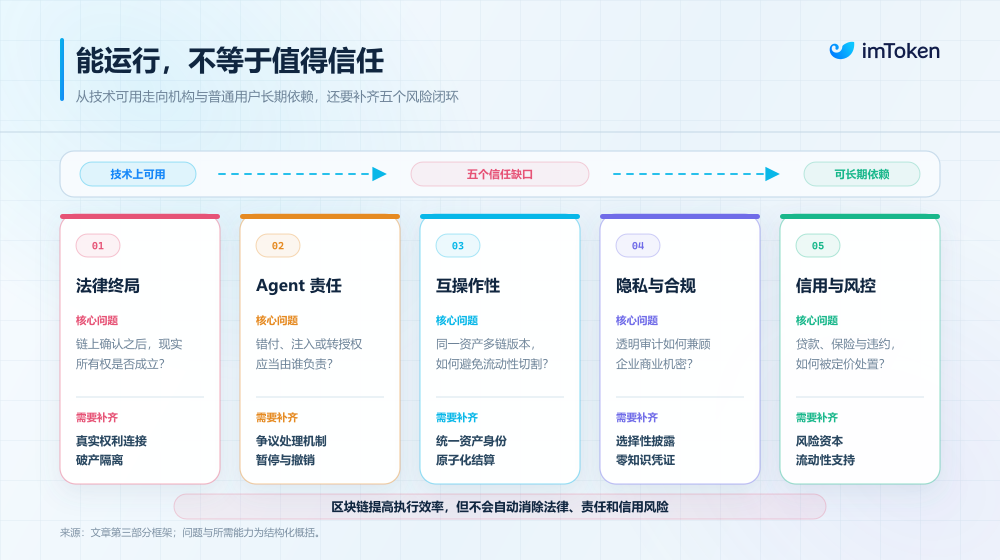
Even so, the article says there is still a long distance between “it runs” and “it can be relied on for the long term.” Several unresolved problems remain.
- On-chain confirmation is not the same as legal finality. Custody of the underlying asset, the treatment of investors if an issuer goes bankrupt, recognition of on-chain title transfer across jurisdictions, and the rights attached to token ownership — dividend rights, voting rights or only price exposure — cannot be settled by smart contracts alone.
- Agentic payments raise hard questions about liability. If an AI agent executes a wrong transaction because of bad information, prompt injection or model hallucination, responsibility is still unclear among the user, model provider, wallet and merchant. Wallets will need to do more than enable payment. They will need to define what assets an agent can use, who it can pay, how much it can spend and how permissions can be paused or revoked after an incident.
- More assets and more networks can intensify liquidity fragmentation. The same stablecoin, fund or security may exist across public blockchains, bank ledgers and permissioned networks without being freely interchangeable. The next phase may depend less on issuing still more assets and more on common asset standards, cross-network communication and secure settlement.
- Privacy remains essential for institutional adoption. Public blockchains are useful for verification and audit, but companies will not want to expose all customers, suppliers, payroll records and cash flows. The article says the practical use of zero-knowledge proofs, selective disclosure and on-chain credentials will have a direct impact on how far on-chain finance can go.
- Most fundamentally, blockchains can improve trading and settlement efficiency, but they do not create credit by themselves. Credit lending, insurance, accounts receivable, default resolution and liquidity support in the real financial system still require complex risk controls, legal frameworks and clear responsibility. Prediction markets, in the same way, do not solve insider information, weak liquidity or event adjudication simply because they publish a price.
That leaves crypto in an in-between state. The article says the basic frame for assets, money, trading and settlement has been built, but credit, privacy, accountability and legal finality have not closed into a full loop. Crypto is becoming infrastructure, but it is still far from being infrastructure that everyone can trust without conditions.
Crypto’s role is changing, even if speculation stays
Looking back at 2026, the article says the most important development is not the sudden breakout of a single sector. It is that several pieces that once evolved separately are beginning to fit together in the same period. Assets now have on-chain forms. Money has programmable carriers. Markets are producing always-on pricing. Software is gaining payment and trading permissions. Regulation is moving from gray zones toward more specific boundaries.
That is not enough to prove that a fully new financial system has already been built. It is enough, the article argues, to show that crypto’s role is changing. It has not exited the speculative market. It is constructing an execution layer beneath that market — one that can be used by real assets, traditional institutions and intelligent software.
After 15 years of evolution, the piece concludes, crypto has reached a key stage in its move from a social experiment around digital gold, through a high-frequency speculative arena, toward a frictionless global financial infrastructure.