

A company that put its website online in 2017 needed nine years to release its first mobile app. That company is Aave, the decentralized finance lending platform.
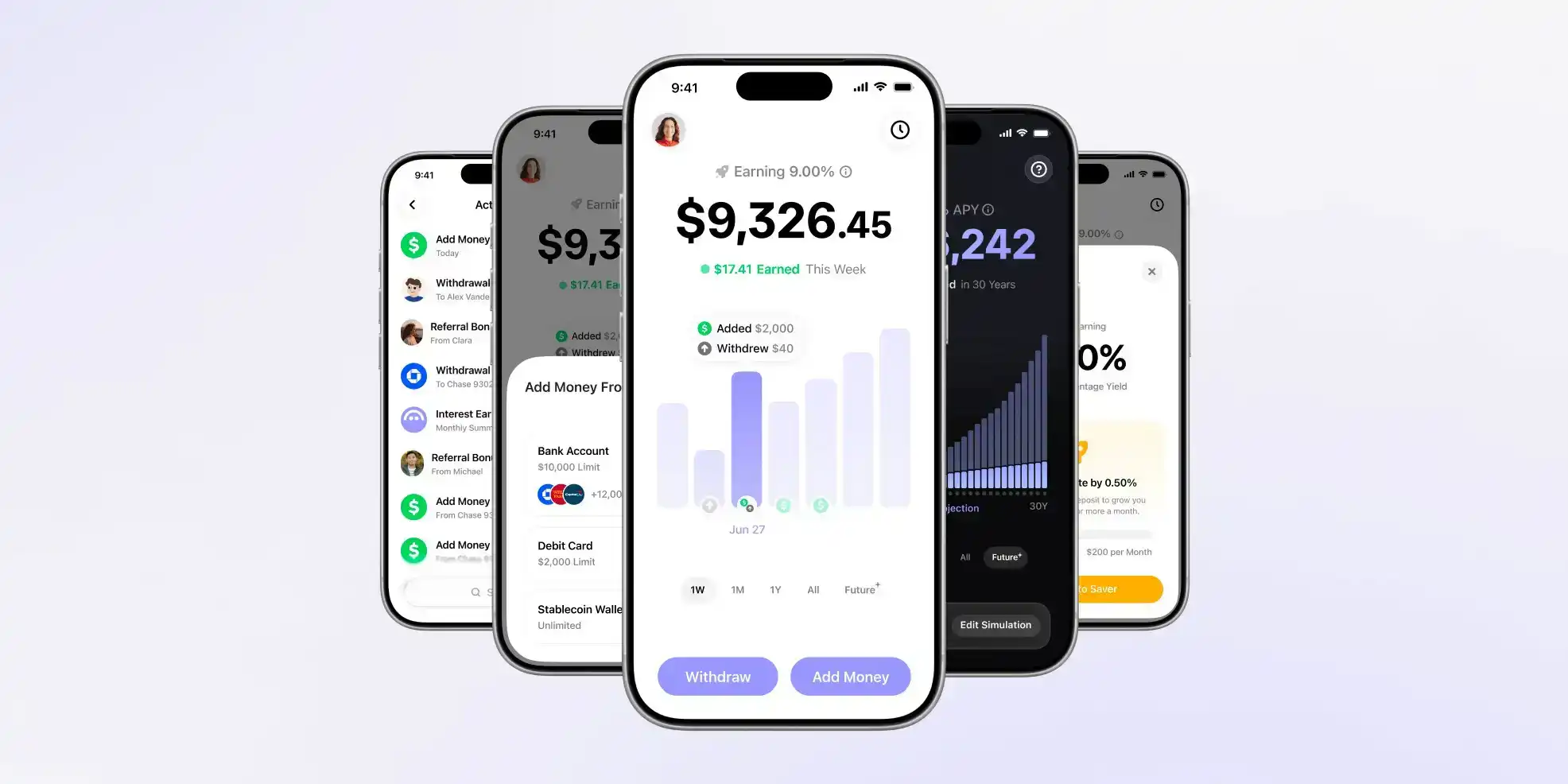
By February 2026, Aave had originated more than $1 trillion in loans. After processing that scale of business, it began building a mobile entry point. Aave’s app opened to its first iPhone users in August 2026.
The same shift is appearing outside DeFi. In May 2025, three former dYdX employees launched Fomo, a mobile app for meme-coin trading. In July 2026, Fomo’s revenue exceeded that of established terminal GMGN for seven days, making it the highest-revenue trading app across the on-chain market during that period.
Two months later, PepeBoost said it would shut down its XXYY website and stop trading there from December 1. The company said its previously incubated mobile app, GigaX, would continue operating. The website was going away; the phone app would remain.
On November 18, PancakeSwap, the largest decentralized exchange on BNB Chain, announced that it would change its name to Pancake and launch a mobile app within several weeks.
Mobile apps arrive after the gold rush
The app push comes during a difficult period for crypto. Bitcoin has been moving between $64,000 and $65,000, roughly half of its previous high of $126,000 reached more than a year earlier. It was also down about 20% from a month before.
Capital and talent are moving toward artificial intelligence. In the first quarter of 2026, about 81% of global venture capital went to AI companies. Across 2025, AI attracted $211 billion, compared with $19.7 billion for crypto. At the start of the year, several familiar crypto figures announced moves into AI.
Projects have also been disappearing. One tally showed that more than 100 crypto projects had shut down, gone bankrupt or fallen silent by August 2026. In October, Blast, an Ethereum layer-2 network that had once taken in more than $2 billion in deposits, announced that it would close. One researcher said she had never seen a shutdown wave like it.
The industry has entered a harder second half. Mobile apps are arriving in force anyway.
Hyperliquid turns a button into a business
The change is easiest to understand through Hyperliquid. In 2026, the largest on-chain perpetuals exchange quietly became the trading engine behind a large number of apps.
Any app can send its users’ orders to Hyperliquid for execution. The app can add a small fee to each trade and keep the difference. The industry calls these apps builders.
For a wallet, the model requires little infrastructure. Hyperliquid handles matching, liquidation and counterparties. The wallet adds a button.
Phantom was among the first major wallets to benefit. It added the button on July 8, 2025. Phantom, the largest wallet on Solana, had about 15 million monthly active users at the time. Roughly 18,000 people clicked the feature during its first two weeks. By the time of the source article, more than 210,000 users had clicked it, generating $29.17 million for Phantom, or an average of $137 per user.
The futures experience inside a wallet is not as polished as the experience offered by an app such as Binance. Many of these users are not professional traders. They keep a small amount of crypto in their wallets for transfers or simply hold it. Statistics cited in the source put the typical balance on several major apps at $30 to $60.
For many, this is their first exposure to perpetuals. The button is already in the wallet. Opening a position takes one tap, so comparing chart interfaces is not necessarily part of the decision.
MetaMask followed and generated $14.5 million. Trust Wallet did not connect until late April 2026, yet brought in $5.6 million in a little over six months. The three wallets had effectively opened futures venues inside existing products without building the full exchange stack, splitting nearly $50 million in revenue.
Based, an app built specifically around Hyperliquid, produced another surprise. It had more than 45,000 users and little recognition outside crypto, but still generated $15.5 million.
By March 2026, trades coming through third-party apps represented about 10% of Hyperliquid’s total volume, with most of that activity coming from mobile.
The Hyperliquid partner revenue rankings already listed 3,248 names. Adding a trading button has become a standard feature for crypto apps, and new trading products continue to appear.
Fomo chose convenience over milliseconds
Meme coins are tokens that can take off around a joke, an image or a celebrity post. Over the past two years, meme trading has become one of the most competitive businesses on-chain.
The contest has largely been about speed. Buying a new token in its first few seconds rather than several minutes later can mean a tenfold gain or a total loss. Telegram bots and web terminals such as GMGN compete for milliseconds, and traders can pay higher fees to move their orders ahead of others.
Fomo did not try to win that race.
Paul Erlanger and Se Yong Park worked together at Deutsche Bank before joining dYdX together. Erlanger once said: “One of the biggest problems in crypto is that the people building apps and tools do not trade themselves.”
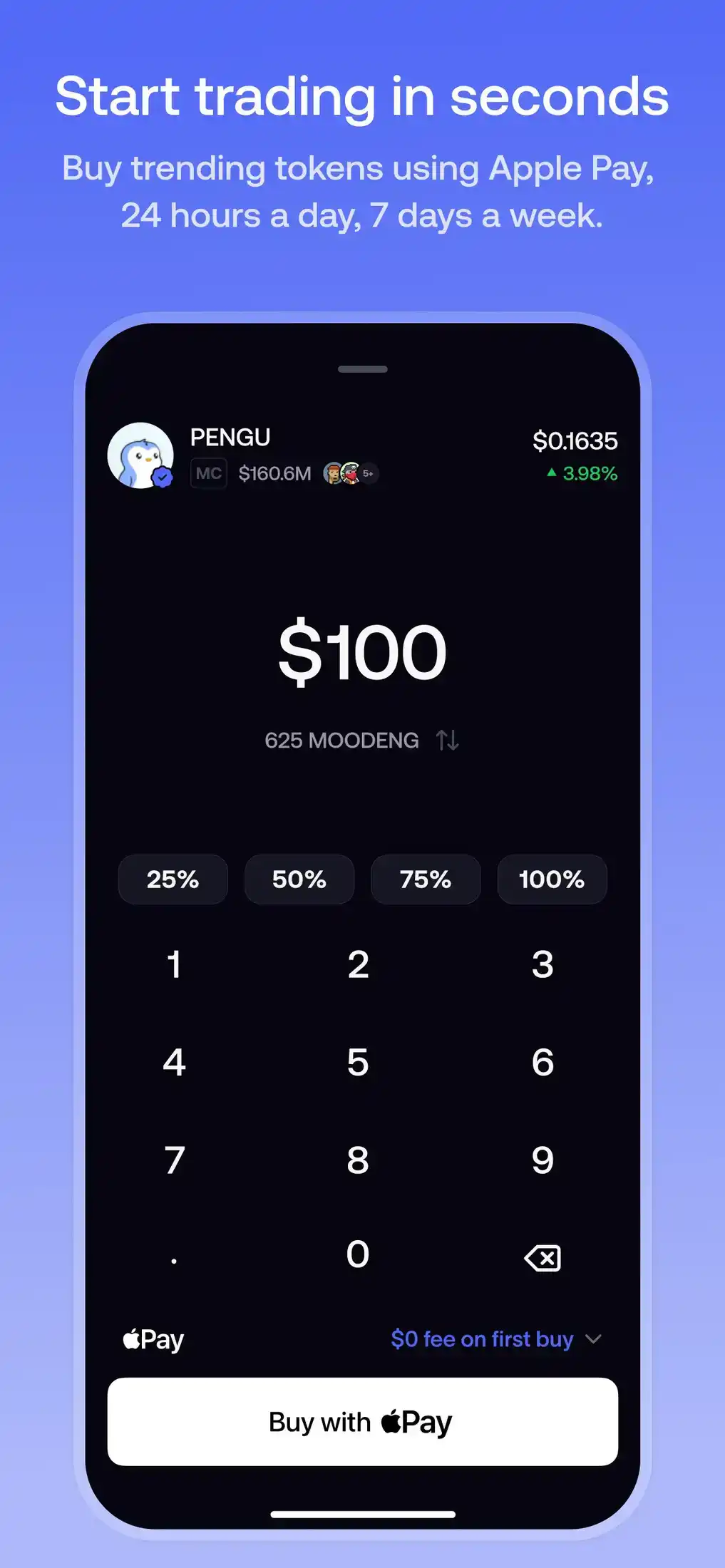
Fomo launched in May 2025. A month later, it added Apple Pay.
Users could download the app, link a card and complete a face scan, then start buying tokens within minutes. They did not need to buy USDT on an exchange first, identify the chain hosting a token or manage network fees. Fomo paid those fees and charged 0.5% on each trade. Erlanger later told TechCrunch that users and revenue surged after Apple Pay was added.
In June 2026, Fomo raised $75 million at a $550 million valuation. The company had 17 employees and was adding 3,500 users a day. A month later, the app that did not compete on speed generated more revenue than GMGN for a week.
GMGN’s iPhone app subsequently added deposit buttons for Apple Pay, PayPal and Venmo.
The most decisive retreat came from PepeBoost’s XXYY. When the web terminal launched in December 2024, its pitch was “zero-latency charts” and “industry-leading sniping and trading speed.” Less than two years later, the website was gone and only the mobile app GigaX remained. GigaX describes itself on X as “the easiest way to enter meme.”
Two years ago, the product promise was fastest. Now it is easiest.
Speed is expensive. GMGN’s web terminal has to monitor new tokens across more than a dozen chains, check contracts for traps and track the movements of many smart-money wallets in real time. More chains and more tokens mean more data for servers to process. This infrastructure is built for experienced traders who believe a few seconds can determine the outcome.
New users on phones often want a one-tap purchase. XXYY was not the only web terminal to close in 2026; BullX and Zap also went offline. Weak market conditions were one reason. The cost of maintaining the systems was another.
Erlanger told Fortune that Fomo’s goal was “not to have people think of it as a crypto app.”
The $30-user problem
A tally published in October 2026 examined wallets that used six major apps, including Phantom, MetaMask, Trust Wallet and Fomo, to trade Hyperliquid perpetuals. The group included nearly 400,000 wallets and had lost a combined $280 million.
Two other figures stand out. About half of monthly active traders were placing an order for the first time. Only around one in seven of those new traders was still trading three months later.
The model relies on a steady stream of new wallets. A person taps the button, deposits $30 or $50, makes a few bets, loses and leaves. The next month, someone else has to take that place.
The supply of wallet users is limited. Phantom has 15 million monthly active users, but more than a year after the feature launched, only 210,000 had clicked the futures button. The people willing to try had started trying, and most who tried had left. The existing crypto holders in those wallets would eventually be cycled through.
The industry learned that new users are on mobile, but mobile alone is not enough. Fomo’s critical feature was not the app’s appearance. It was the Apple Pay button, which reached people who held fiat money but had never touched crypto.
A wallet can sell what a user already holds. Apple Pay can reach the money in a bank account. The company that can pull that money into crypto has access to the next user base.
From a home computer to a mobile account
Aave founder Stani Kulechov had thought about those users for years.
In Finland in 1997, a father who worked in logistics saved for about six months to buy the family its first computer. His wife was a nurse. Years later, their son described the household as “very blue-collar and very hardworking.”
The son was Kulechov. At nine, he learned to build web pages on that computer. He later played hockey for 10 years, wearing number 31, and eventually created Aave.
Aave formally launched in January 2020. In an interview that month, Kulechov said: “People are earning almost nothing in their bank accounts.” He said those people needed to be brought into DeFi.
They never arrived in meaningful numbers. Before 2025, using DeFi generally required a computer, a browser wallet and a 12-word phrase. A single copying mistake could make funds unrecoverable. The people who cleared those hurdles were mostly crypto veterans.
In 2024, Kulechov spoke at an Ethereum conference while playing Jenga with the host. He said his parents were now using Aave, then added that DeFi was still too difficult for them.
His target users were people like his parents. The national average rate on a U.S. savings account was 0.38%; $10,000 would earn $38 in a year.
But how can people without wallets bring their money into DeFi?
Email, bank accounts and stablecoins
On November 17, 2025, Aave’s development company announced plans to list an app in Apple’s App Store. Kulechov told Fortune: “The next step for DeFi is to make it directly usable by everyday consumers.”
On its launch page, Aave placed its rate alongside two other figures: the 0.38% average U.S. savings rate and the 3.25% savings rate offered by Cash App. Aave had spent years comparing its rates with other crypto products. This time, the comparison was with banks and a payments app.
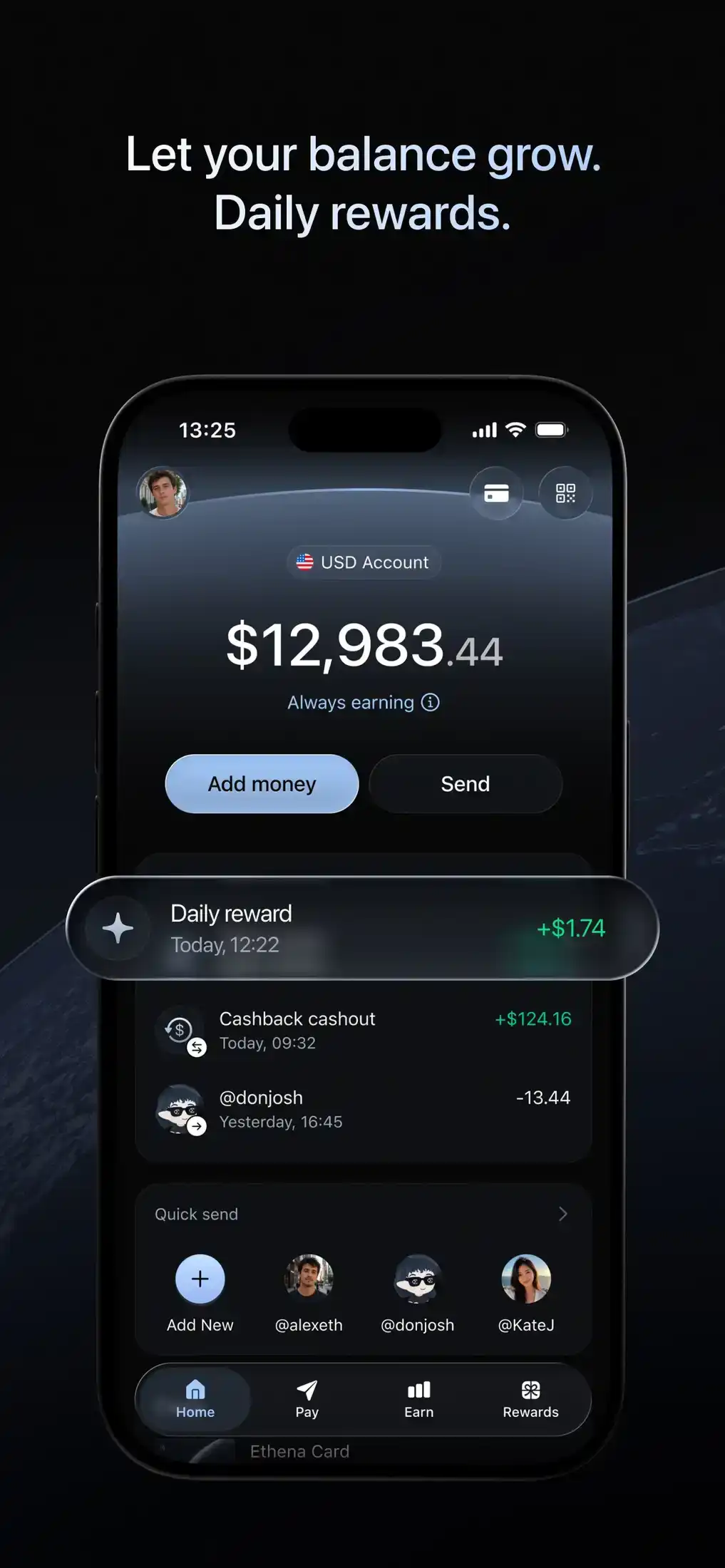
The app has no “connect wallet” prompt, no unfamiliar “health factor” and no chain selection. Users sign in with an email address or phone number. Money can move directly from accounts at more than 12,000 U.S. banks, or arrive through a debit card. The app automatically converts deposits into stablecoins, or on-chain dollars linked one-to-one with the U.S. dollar. It handles the chain and transfers in the background.
The user sees one number: a $100 deposit, with the balance increasing a little each second.
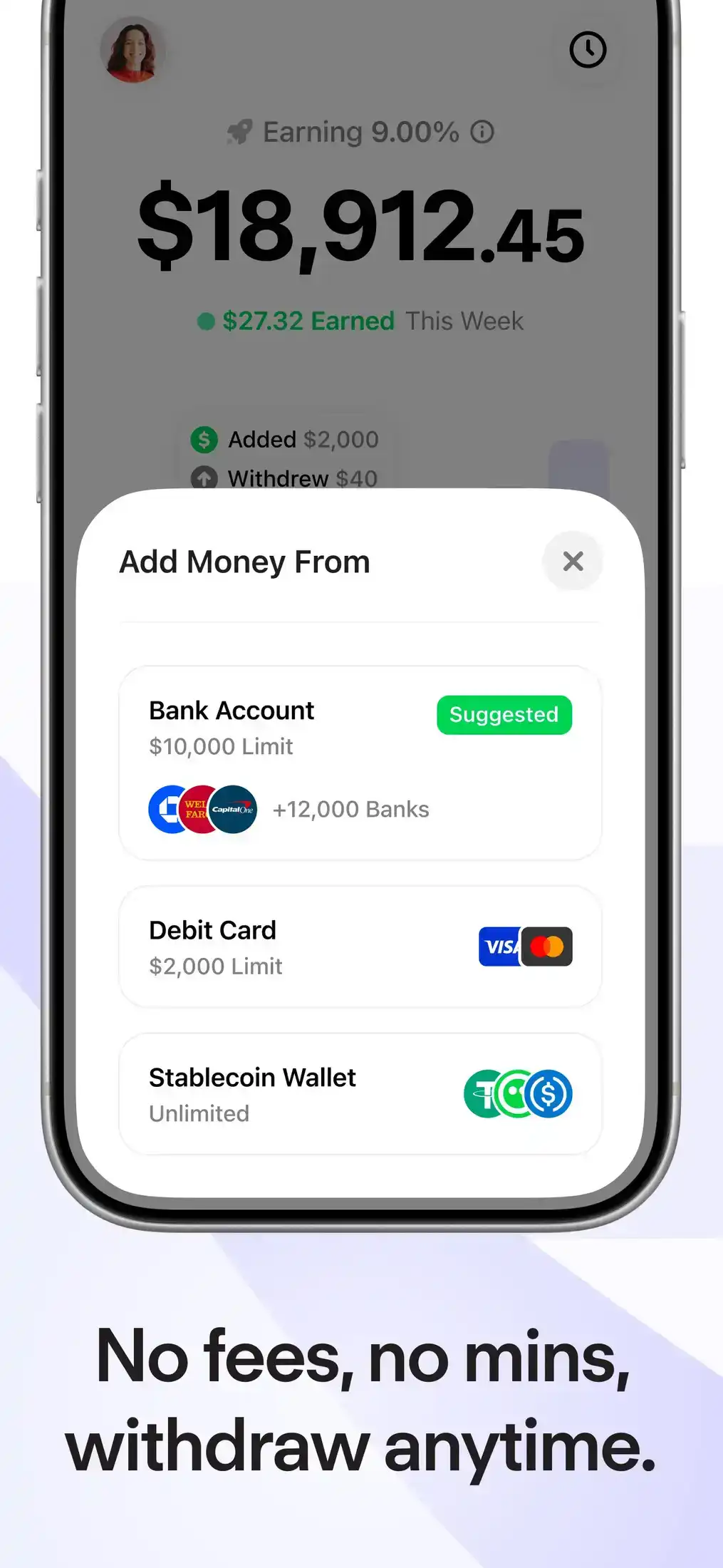
Fomo’s Apple Pay solves the first step by moving money from a bank card into a crypto product. Aave’s model is designed to keep the money there. The product shifts from “buy crypto” to “open an account.”
In October 2026, ether.fi said it would hand its entire deposit pipeline to payments company MoonPay. Each user would receive a virtual account with an account number and routing number. The routing number identifies the bank in the U.S. banking system. A user can enter both numbers into a payroll system and receive a salary in the same way as through a conventional bank account.
Rok Kopp, ether.fi’s head of growth, put the comparison bluntly: “ether.fi is not benchmarking against other crypto products. It is benchmarking against the bank app users open every morning.”
Ethena gives users a virtual European bank account that can accept euros, yen and Brazilian reais at no charge. Its blog says users “will never need to know what a chain is, what a wallet is or what a bridge is.”
Money that arrives through a token purchase is often speculative money. Money that arrives through an account can be wages and savings.
Three ways to monetize one account
A web platform may earn only a share of lending interest. An account can produce three revenue streams.
The first is yield on reserves. Each stablecoin held by a user is backed by real reserves, and those reserves generate interest. The issuer receives that interest. Aave, Ethena and ether.fi each issue their own tokens.
The second is card interchange. Each time a user swipes a card, the merchant pays a small fee to the card issuer. ether.fi CEO Mike Silagadze has said that this is the main source of revenue for its card business.
The third is the spread between deposits and loans. If a platform pays 6% on deposits and charges 9% to borrowers, the three percentage points in between are the margin. Those figures are examples used for explanation, not rates published by a specific company.
Reserve interest, card fees and lending spreads are broadly the same sources of revenue associated with banks.
Ethena’s dollar token is USDe. When it launched Ethena Pay in September 2026, Ethena acknowledged in an announcement: “To date, every USDe that has been issued has reached its holder through someone else’s product.”
That is why it wanted its own interface. “The economics of the interface belong to the people who build the interface,” the announcement said.
The Hyperliquid button monetizes a few leveraged trades. An account business seeks a different kind of money: a salary deposited every month.
Opening an account, receiving wages, issuing a card, paying interest and lending money are the daily functions of a bank. The apps being built by Aave and its peers are trying to place that bank counter inside a phone.
Crypto companies seek the banking label
If apps were only about customer acquisition and a mobile counter, companies that already had apps and tens of millions of users would have no obvious need to join the race. They are applying for licenses anyway.
On November 9, 2026, Coinbase, the largest U.S. crypto exchange, received final approval from the Office of the Comptroller of the Currency to establish Coinbase National Trust Bank.
A trust bank has a narrower mandate than a conventional bank. It primarily safeguards customer money and assets rather than taking deposits and making loans at scale. Coinbase applied in October 2025, received conditional approval in April 2026 and received final approval seven months later. In its application, Coinbase specifically said it did not intend to become a bank even if approved. The proposed institution’s name still contains the word “bank.”
Kraken’s parent company plans to establish Payward National Trust Bank. Crypto.com received conditional approval. Block, the parent company of Cash App, filed an application. Stablecoin issuers Circle and Ripple also received the license. More than 12 crypto companies have filed this kind of application.
The license has a practical attraction. Money-transmission rules in most U.S. states do not apply to trust companies. A national license could allow a company to avoid applying for money-transmitter licenses state by state.
Aave is also filling a regulatory gap. In May 2026, two U.K. subsidiaries of Aave’s development company completed crypto-asset registration with the Financial Conduct Authority and obtained an EU crypto license covering Europe, allowing euro-to-stablecoin conversion with no fees and no spread.
The two groups are moving toward the same counter from opposite directions. DeFi platforms have yield products but lack accounts, so they build apps. Exchanges have apps and users but lack a recognized role for holding customer money, so they pursue licenses. One group is moving from products toward licenses; the other is adding products to its licenses. Both are seeking to hold ordinary users’ dollars and earn from that money.
U.S. banking groups have challenged the move. The Independent Community Bankers of America sued the OCC, saying the approvals create a side door for crypto companies. Senator Warren said the approvals were unlawful. The American Bankers Association called for licenses to wait until the rules implementing the U.S. stablecoin law were in place.
The lawsuits are continuing, and the licenses are still being issued.
The small print below the yield
It is not clear whether the business will work.
When Aave announced its app, it advertised yields ranging from a minimum of 5% to a maximum of 9%. At the time of the source article, the page showed 6.25% and labeled the rate “variable.” The app’s “balance protection” is not the federally backed deposit insurance available at U.S. banks.
Kulechov’s father saved for six months to buy the family computer in 1997. Almost three decades later, his son’s product no longer requires a computer. An iPhone and an email address are enough to open an account.
Far from Finland, in Nigeria, engineer Elvis Anselm works remotely for overseas clients.
In 2021, he lost a job because the client could not pay him: PayPal and Stripe did not serve Nigerians. In 2022, he faced the same problem again. He saw people discussing crypto payments on X and asked a client whether USDT would work.
The client agreed. From then on, every payment he earned from remote work came in crypto.
USDT solved the problem of receiving money, but not the rest. The tokens sat in a phone wallet. They could be transferred or held for a better exchange rate, but they did not earn interest. They were not an account that could receive a monthly salary, support a card or function as savings.
That is the missing piece these apps are now trying to add. PayPal and Stripe once kept people such as Anselm outside the system. Now a group of companies that says it is not a bank is competing to give those users an account.
Aave’s app announcement ends with a small line: “Aave is not a bank.” Coinbase used similar language in its license application. Fomo’s founder said not to think of the product as a crypto app.
For Anselm, the names may not matter. He needs somewhere to receive the next paycheck.



