

Crypto options have existed for years, but for most of that time they sat on the edge of the market. Deribit launched options in 2016, Binance later added options alongside its perpetual futures offering, and DeFi produced a full generation of options vaults in 2021, with total value locked peaking at about $500 million. That wave did not last. Ribbon Finance, Friktion and Knox all faded out.

In Vaidik Mandloi’s telling, perpetual futures won because they were easier to use and far more capital-efficient. For the average trader looking for leverage, that was enough. Options never became the default tool.
Now the balance is changing. Coinbase has just acquired Deribit. Options on the iShares Bitcoin Trust ETF, or IBIT, launched on Nasdaq and within months built open interest larger than Deribit’s entire book. Crypto options open interest has also moved above crypto futures for the first time on record.
That raises the question at the center of the piece: what changed, and is this a real turning point for the crypto options market?
Why perpetual futures dominated for so long
In crypto’s early years, perpetual futures solved problems that options never fully cracked. They compressed derivatives exposure into a single market with one liquidity pool, instead of splitting trading across hundreds of strikes and expiries, each with different depth. That mattered in 2017 and 2018, when market liquidity was still thin.
A retail trader who wanted leveraged bitcoin exposure did not need to think about theta decay, strike selection, or overnight shifts in the Greeks. According to the article, perpetual futures now process more than $90 trillion in annual trading volume because they offer the one thing most traders want from derivatives: leverage, without much complexity.
DeFi still tried to build an options market in 2021 through decentralized options vaults, or DOVs. Users deposited ETH or BTC, vaults sold options to market makers on their behalf, and depositors earned premium income. Ribbon Finance, Friktion and Knox all followed that model.
Where the DOV model broke down
Mandloi points to two main flaws.
The first was full collateralization. Compared with perpetuals, that stripped out the leverage advantage and left the model with weak capital efficiency.
The second problem was more damaging: auction design. The vaults sold options on Friday afternoons to match Deribit’s Friday expiries, where liquidity was strongest. In practice, that meant many vaults were placing sell orders at the same time, in the same direction, and in broadly predictable size. Market makers knew a large block of option supply would arrive each week at the same moment, and could simply wait to mark down their bids.
Paradigm tracked implied volatility during those Friday auction windows and found it consistently ran 4 points below the weekly average. In the article’s framing, that means vaults were systematically selling options below fair value while professional counterparties knew exactly when to show up. Depositors expecting annualized returns of 15% to 20% would, from pricing distortion alone, lose about 5.35% annualized before counting exercise-related losses.
The irony was that nearly every vault in crypto picked the same bad time to sell options.
The Oct. 10, 2025 sell-off changed the debate
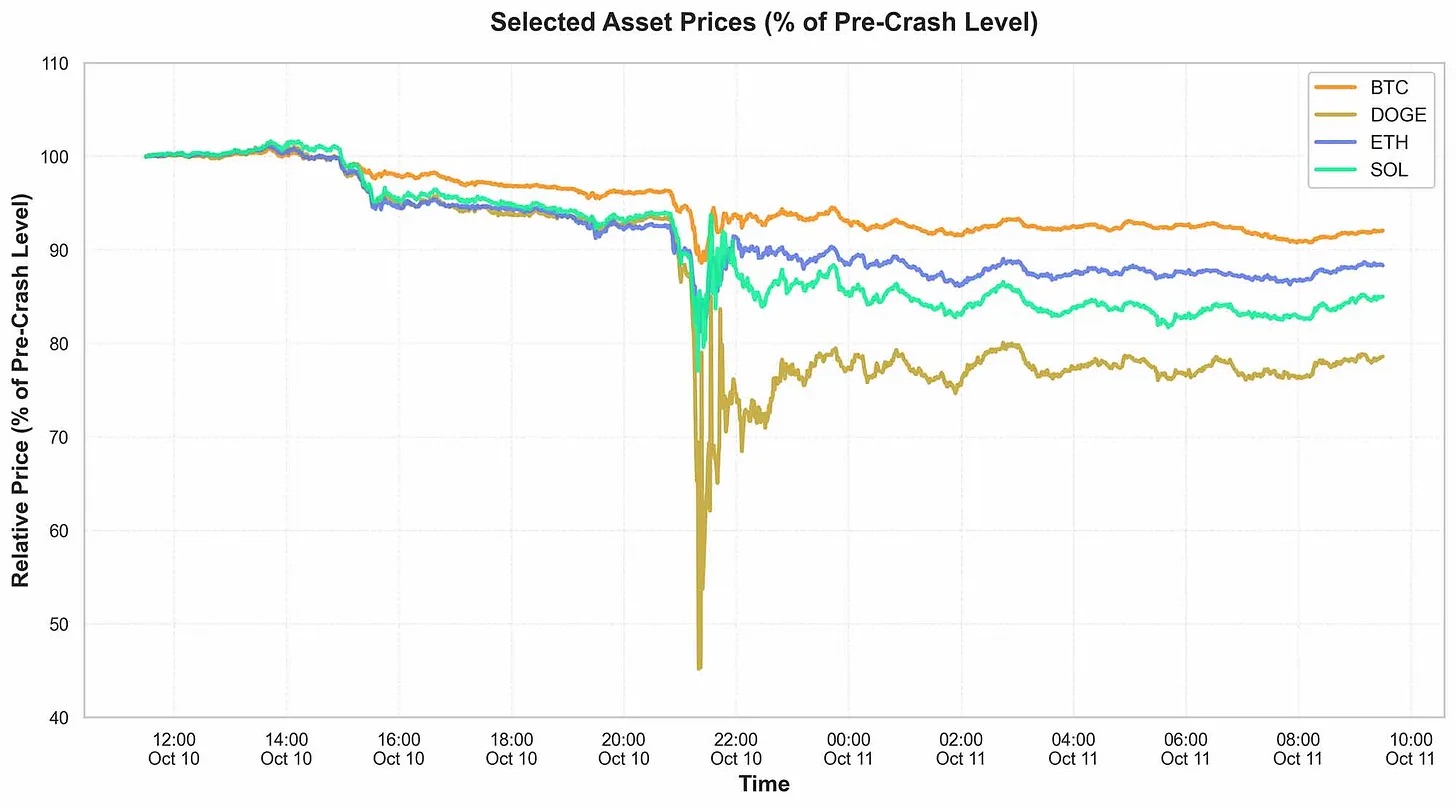
Mandloi marks Oct. 10, 2025 as the moment the discussion shifted. On that day, bitcoin on Binance fell 12.6% in 10 minutes. Liquidations reached $19.37 billion, with 87% on the long side.
The article says the trigger was a liquidation reference price that dropped below actual spot and futures execution levels during the move, causing the system to liquidate positions at prices detached from the real market. One round of liquidations pushed prices lower, which triggered more liquidations, creating a self-reinforcing negative feedback loop until the selling pressure ran out.
Hyperliquid, according to the piece, saw $2.1 billion liquidated in 12 minutes. Its auto-deleveraging system absorbed $704.6 million in asset write-downs to cover $304.5 million in realized losses, consuming eight times the capital theoretically required.
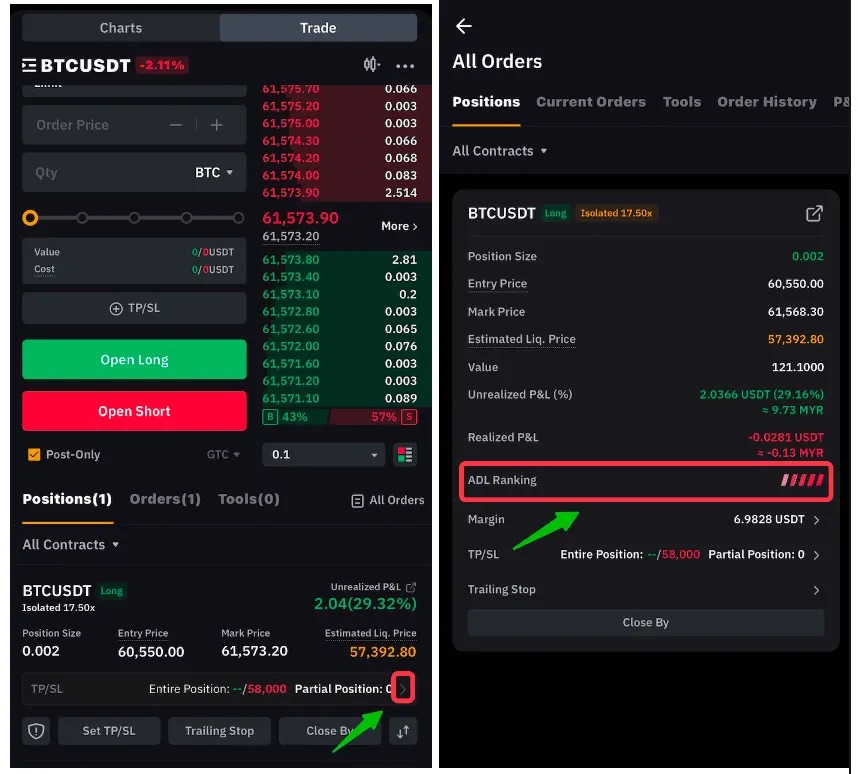
The episode also changed how institutions talked about basis trades. A common strategy is to buy spot bitcoin and short bitcoin perpetuals to collect funding while remaining market neutral. During the Oct. 10 crash, however, multiple exchanges forced the closure of the profitable perpetual short leg through auto-deleveraging. Traders who had built delta-neutral books were suddenly left holding unhedged spot longs into a falling market.
That, the article argues, exposed a built-in weakness in perpetuals: path dependency.
Why options look different after that event
Perpetual futures margin engines evaluate positions tick by tick rather than at a fixed expiry. Even if bitcoin opens and closes a week at the same price, a 15% intraperiod drop can still wipe out the position before the end point arrives.
A put option works differently. The buyer pays premium upfront, and the maximum loss is locked in from the moment the trade is entered, regardless of how violently bitcoin moves before expiry.
Mandloi treats the Oct. 10 crash as the catalyst that pushed the options market into a rebuild.
Infrastructure is being rebuilt
After the sell-off, the article says, infrastructure began moving quickly. Derive dropped the old pooled-vault model and rebuilt around a central limit order book, a request-for-quote system and portfolio margin. Traders can hold perpetuals and options in the same margin account.
That is a major change from the first generation of crypto options venues. Traders can now reuse margin tied to perpetual positions as collateral for options instead of siloing capital by product. The piece notes that this is standard practice at mature derivatives exchanges in traditional finance.
Following the rebuild, Derive posted a record $294 million in weekly trading volume and more than $1 billion in open interest.
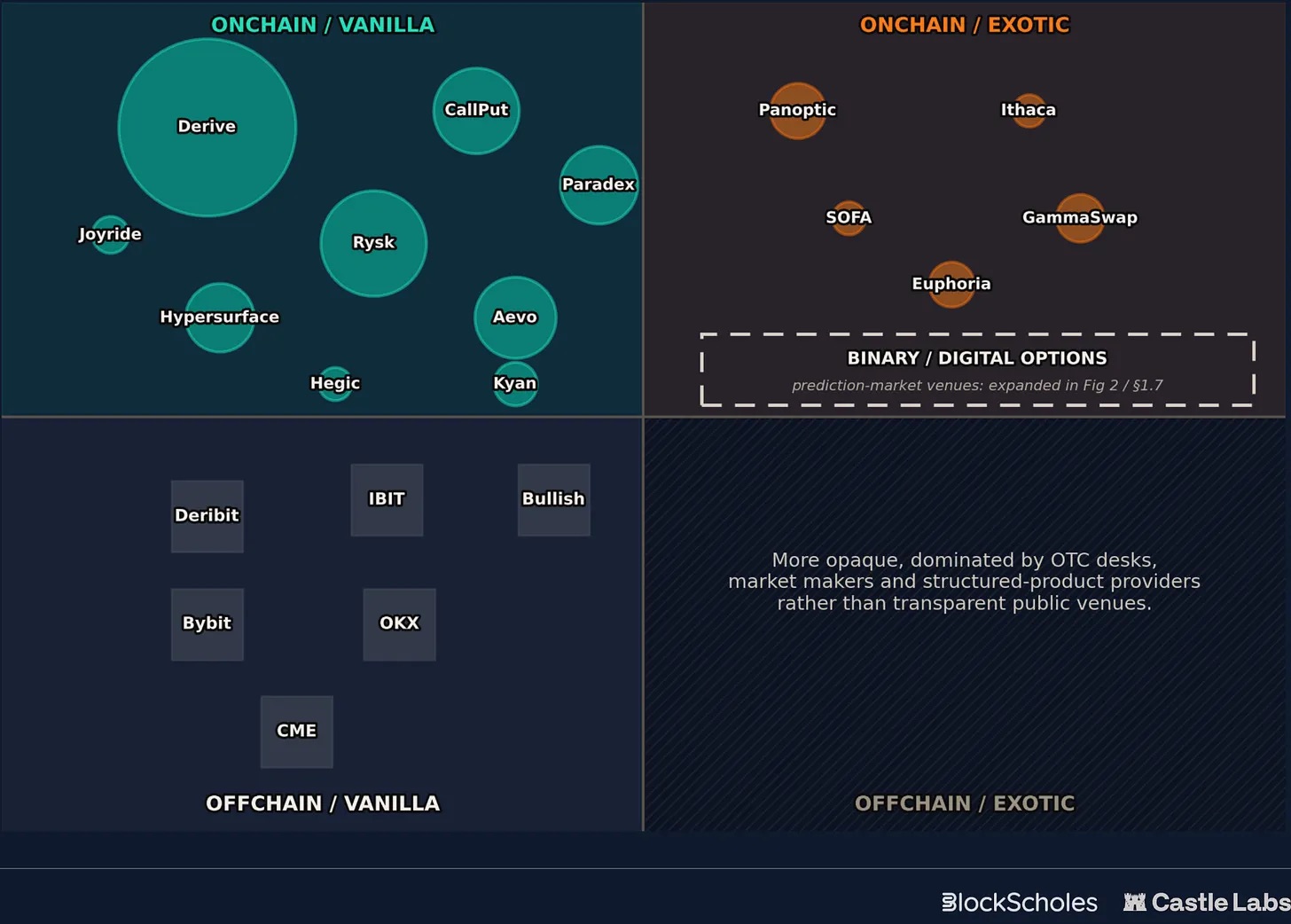
At the same time, Nasdaq listed IBIT options under a regulated central clearing setup. A central counterparty guarantees each trade, cutting counterparty performance risk. Within months, IBIT options open interest had surpassed Deribit, and Deribit’s market share dropped from above 90% to below 39%.
Mandloi compares the moment to the formation of the Chicago Board Options Exchange. In that earlier period, the Options Clearing Corporation removed bilateral counterparty risk in equity options, while the Black-Scholes model gave the market a common pricing benchmark. Equity options went from telephone-based over-the-counter dealing to a pillar of modern finance in five years. Crypto, the article says, has compressed a similar institutional buildout into a matter of months.
Coinbase’s acquisition of Deribit adds another layer. The deal places the leading crypto options venue inside a U.S. regulatory framework and gives U.S. institutions a more direct access point. Before that, Deribit had operated largely as an offshore business.
Most of the growth is still happening on regulated venues
For all the momentum, onchain options still account for less than 1% of total trading volume, according to the article. The latest surge in scale has flowed mainly to regulated, centrally cleared platforms such as Nasdaq and Deribit rather than DeFi protocols.
That means the current growth story for options is largely unfolding inside institutional market structure borrowed from traditional finance. Products aimed at ordinary users onchain have not produced open interest measured in the hundreds of billions.
Who is really on the other side of retail onchain options
Mandloi argues that most onchain options products marketed to ordinary users are still variations of covered-call strategies. Users deposit BTC or ETH, the protocol sells call options to market makers against those holdings, and users collect premium income. The pitch is simple: keep exposure to the asset and earn passive yield at the same time.
But in economic terms, depositors are selling volatility. They receive periodic premium and give up upside beyond a specified level, while professional market makers tend to benefit when volatility spikes.
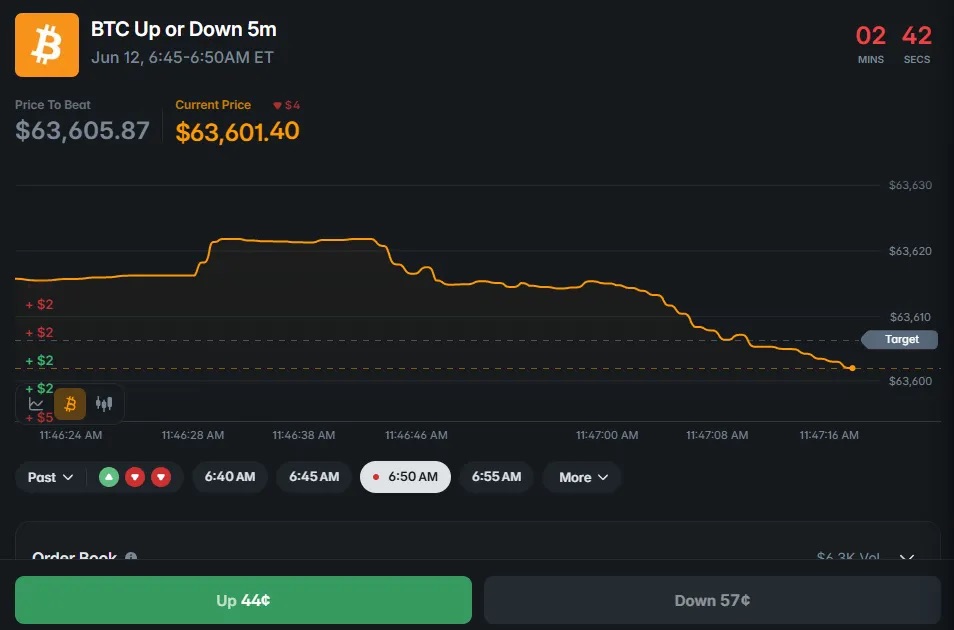
The article also points to products such as Euphoria. Users click positions on a price-time grid and receive a payout if bitcoin lands in the chosen range within five seconds. Mandloi says the structure is effectively a binary options spread.
He then places that against an existing regulatory record. The European Securities and Markets Authority banned sales of these products to retail investors in 2018. Israel’s parliament passed a ban in 2017 by a 51-0 vote. The FBI has estimated global binary options fraud at $10 billion a year. Euphoria, despite that backdrop, raised $7.5 million from more than 100 investors and moved the product onchain.
Traditional finance has seen this packaging before
The article argues that traditional finance has long known how to package short-volatility exposure as an income product for retail investors. Derivatives-income ETFs have used covered calls and puts for years in equity markets, distributing option premium as fund income. Assets under management in that segment have quietly reached $147 billion.
JPMorgan’s JEPI and JEPQ are cited as the largest products in the category. They sell options against broad equity indexes that tend to rise gradually over time. Investors give up some upside, but principal is not usually exposed to the kind of destructive outcome associated with highly volatile assets.
That changes when the underlying becomes much more volatile. Mandloi uses MSTY, a covered-call ETF tied to MicroStrategy stock, as an example. It has a trailing yield of 244%, yet net assets have fallen 62% since launch. The article says 98.54% of MSTY’s distributions are return of capital, meaning investors are effectively receiving their own money back and still paying income tax on it.
Monthly distributions can look like income while the underlying value base keeps shrinking. In the article’s view, that is exactly what can happen when short-volatility strategies are applied to assets with very high volatility. Crypto belongs in that category.
Why the article sees a turning point now
Mandloi closes by pointing to three forces behind the shift.

The first, and most important, is yield compression. In 2021, basis trades could generate 25% annualized returns by buying spot BTC and shorting perpetuals to collect funding. That figure has now fallen to 4.46%. The old high-yield backdrop that supported much of crypto’s expansion has faded. Option premium, in his view, is one of the few remaining native yield sources with a real economic basis, because one side of the market is willing to pay to transfer risk.
When basis trades returned 25%, the market had little reason to use options as a yield engine. At 4.46%, the incentive to price risk through options looks more concrete. The demand is also coming more from institutions that actually need hedging than from retail traders chasing leverage.
The second factor is the lesson of the FTX collapse. Billions of dollars in derivatives positions were trapped in bankruptcy estates. Traders could see profitable positions in their accounts but could not close them, and instead had to file claims and wait years. Onchain options settle directly to user wallets, with collateral held in smart contracts that can be checked on Etherscan rather than trusted through an exchange balance sheet. For institutional desks that lived through multibillion-dollar losses, Mandloi says that has practical appeal and can pass compliance review.
The third factor is composability, which he describes as a uniquely onchain advantage. Tokenized options positions can plug into DeFi infrastructure. Covered-call positions can serve as collateral in lending protocols. Multiple option contracts can be assembled in code into new packaged products. Portfolio margin between perpetuals and options can be calculated onchain in real time rather than waiting for overnight reconciliation at a clearinghouse.
Those capabilities did not exist in the Friday-auction vault era of 2021, and they are not available on Nasdaq or Deribit in the same open, permissionless form because those settlement systems were not designed for it. In that sense, the article says, crypto is not simply catching up to traditional finance. It is trying to build capabilities traditional derivatives infrastructure cannot easily replicate.
What it means that options open interest moved above futures
The article’s bottom line is straightforward. Combined bitcoin options open interest on Deribit and IBIT has risen about tenfold since the start of 2024 to $80 billion. For the first time in crypto derivatives history, options open interest is larger than futures open interest.
Mandloi reads that as a sign that capital allocated to options exposure has overtaken the leveraged directional trading capital that dominated the market for the past decade. In his view, that is what a turning point looks like: better infrastructure, fewer capital-efficiency bottlenecks, broader regulatory frameworks, and tens of billions of dollars backing the shift with real positions rather than theory.