
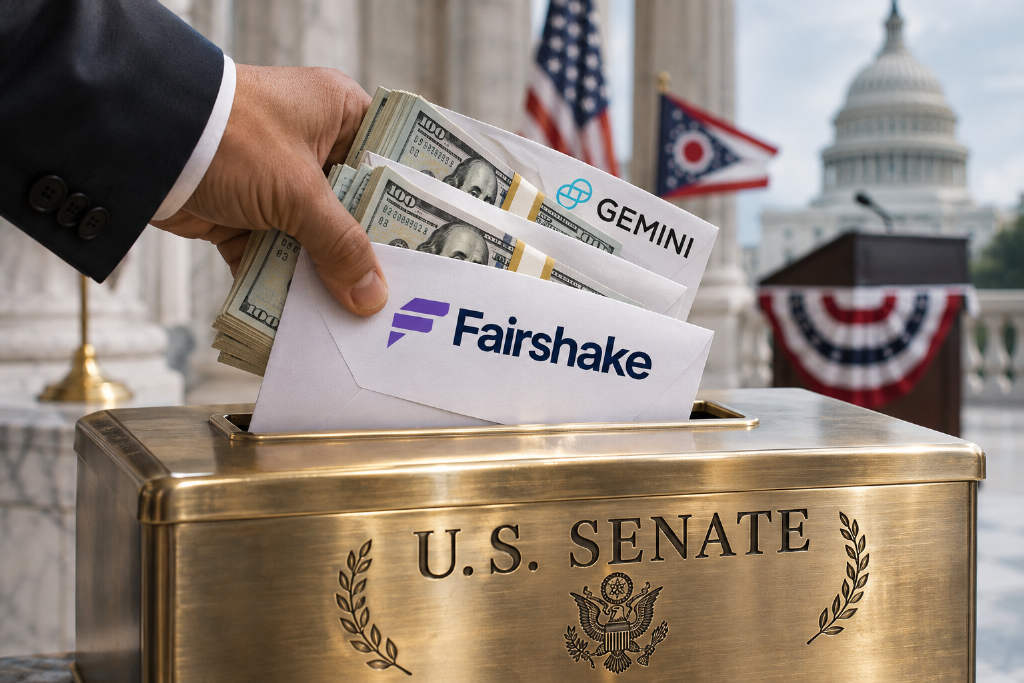
“Thank you for getting rid of Sherrod Brown.”
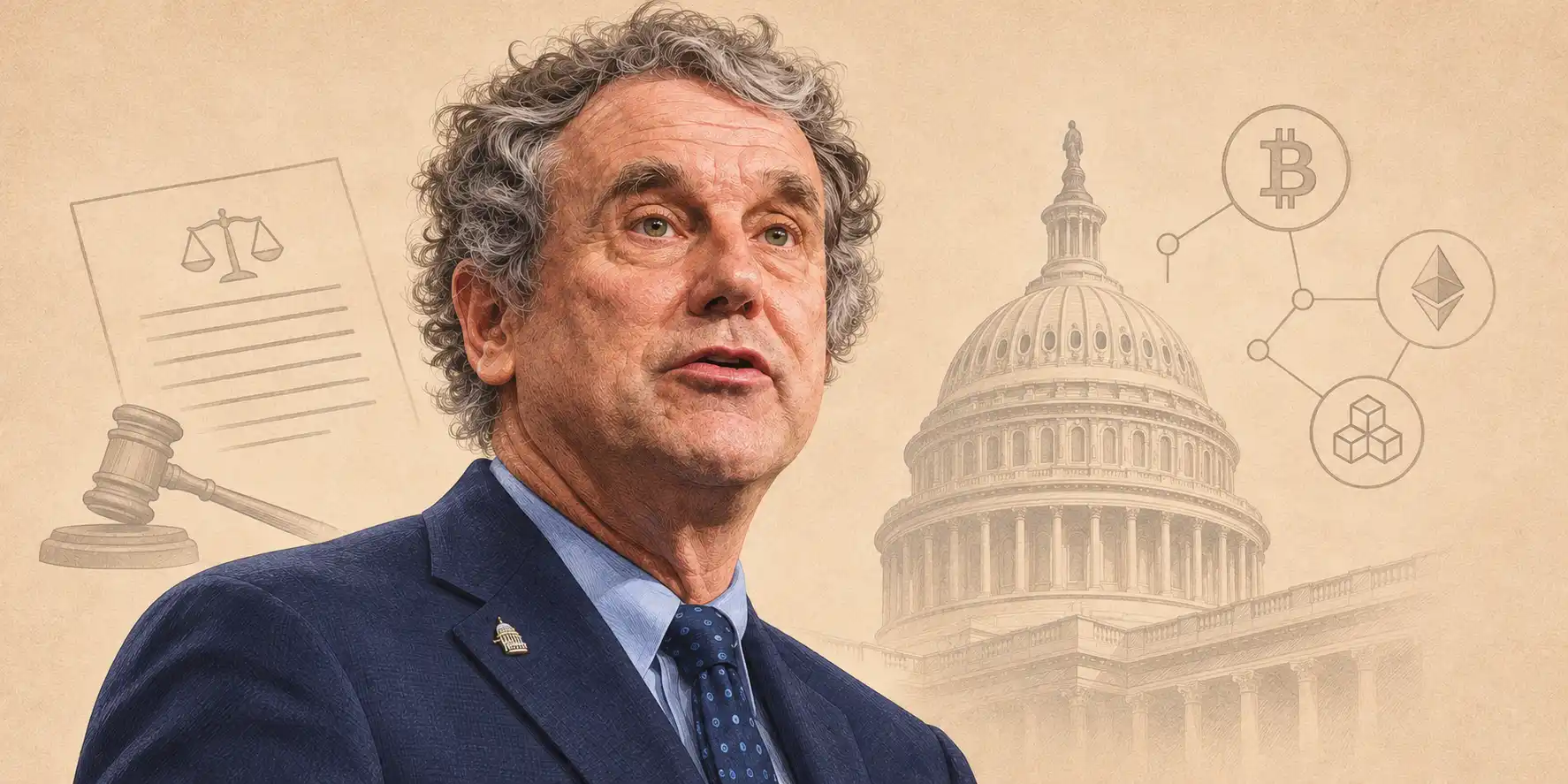
That was the line Senate Banking Committee Chairman Tim Scott delivered at a blockchain conference in Jackson Hole, Wyoming, on Aug. 19, 2025. The room laughed and applauded. Scott then added: “By the way, he’s running again.”
Brown had announced one day earlier that he would run in Ohio’s 2026 special Senate election. Fairshake and other political groups that had spent heavily to push him out of Congress in 2024 moved back in soon after. This time, the money was even larger.
In 2024, crypto industry political action committees led by Fairshake spent about $40 million backing Republican Bernie Moreno and opposing Brown. Brown, who had served 18 years in the Senate, lost that race. After Republicans retook the chamber, Scott replaced him as chair of the Senate Banking Committee.
Now Fairshake and affiliated groups have put nearly $56 million into Ohio to oppose Brown and support incumbent Republican Senator Jon Husted. Add roughly $7.2 million from a PAC backed by Gemini co-founders Cameron and Tyler Winklevoss, and spending tied to this year’s race reaches about $63 million.
Including the contest two years earlier, total crypto industry spending around Brown’s two elections has topped $100 million. The campaign stands as one of the largest political spending efforts the U.S. crypto industry has directed at a single member of Congress.
The scale is striking because Brown was not the most aggressive crypto critic in Democratic politics when compared with Elizabeth Warren. In 2024, he even sent relatively moderate signals on industry legislation. Even so, a former senator who had lost power and said he was willing to engage with the industry remained a top target.
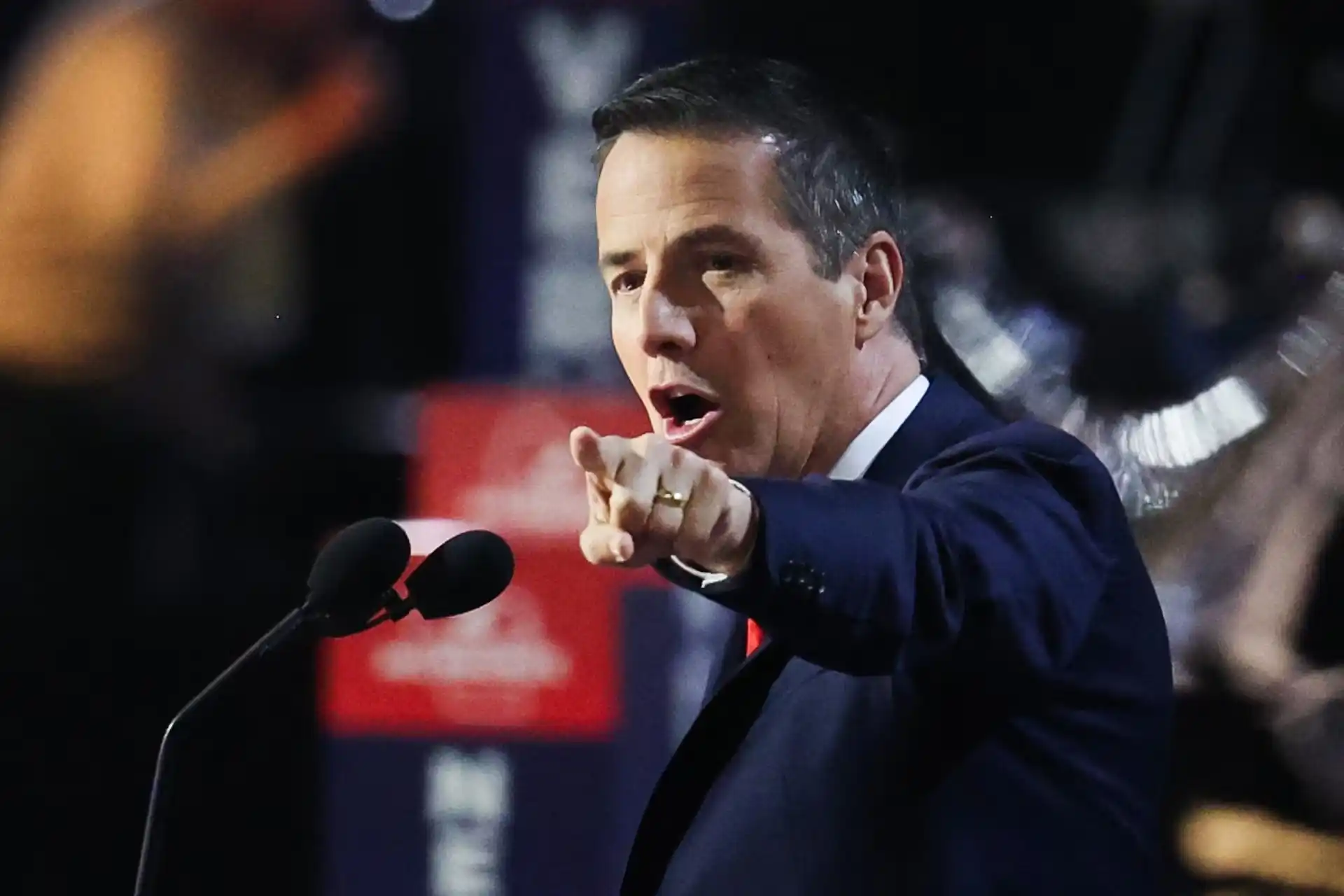
More than $100 million spent, but Brown still has a path back
Sherrod Brown’s political career began in Ohio. He was first elected to the U.S. Senate in 2006 and won reelection in 2012 and 2018.
Ohio was once one of the most important presidential swing states in the country, but it has shifted clearly toward Republicans in recent years. Brown, known for focusing on manufacturing jobs, labor unions and consumer rights, still maintained a degree of cross-party support. That helped him win again in 2018 during Donald Trump’s presidency. The gap between the state’s broader political direction and Brown’s personal base made his races unusually volatile.
In 2021, after Democrats gained control of the Senate, Brown became chair of the Senate Committee on Banking, Housing, and Urban Affairs. The post gave him major influence over U.S. financial regulation. The committee handles legislation tied to banking, securities and parts of the financial markets, and regulators including the Securities and Exchange Commission fall within its orbit. For a crypto industry pushing for dedicated digital asset legislation, Brown became impossible to ignore.
In 2024, Brown faced his fourth Senate election. His opponent was Republican Bernie Moreno, who had Donald Trump’s backing.
Moreno, who had prior experience founding a blockchain project, publicly supported crypto industry growth and promised to advance digital asset-friendly regulation in the Senate. Brown’s years of criticism toward crypto assets made him a prime target for industry PACs.
Moreno eventually defeated Brown with about 50.6% of the vote to Brown’s roughly 46%, ending Brown’s 18-year Senate run.
For the crypto industry, the race carried heavy symbolism. After Brown lost, Coinbase Chief Executive Officer Brian Armstrong called him one of the most anti-crypto members of the U.S. Senate on social media and openly praised the industry’s political spending in the race. Tim Scott, who succeeded Brown as Banking Committee chair, also publicly thanked the industry at a blockchain event in Wyoming and said crypto had played an important role in Moreno’s victory.

Brown, however, quickly got another opening to return to Congress. In 2025, then-Vice President JD Vance resigned his Ohio Senate seat, and former Ohio lieutenant governor Jon Husted took over. Under the election schedule, Ohio is set to hold a special election in 2026 to choose a senator to complete the remainder of Vance’s term.
Brown decided to run again. Early in the new campaign, he also began sending relatively softer signals to the crypto industry. In May this year, his campaign manager Patrick Eisenhauer said Brown recognized that cryptocurrency had become part of the U.S. economy and would approach future issues brought before the Senate with an open attitude.
That did not change Fairshake’s position. On Sept. 21, the group announced at least $30 million in spending in Ohio, then added more. Brown responded in his Substack newsletter by accusing crypto billionaires of trying once again to shape the election and made opposition to large corporations and special interests a central campaign theme.
By late October, Fairshake and affiliated groups had spent close to $56 million on the race, with the Winklevoss-backed PAC joining the fight as well.
There was a broader political calculation behind the continued pressure on Brown: defeat a prominent regulatory critic and show other lawmakers the political cost of opposing the crypto industry.
That strategy had surfaced before. In 2024, The New Yorker examined Fairshake’s political ads against Democratic Representative Katie Porter and cited a person familiar with the group’s operations as saying the goal was not only to beat Porter, but also to warn other politicians that opposing crypto could make them targets of massive campaign spending.
Brown’s case sharpened that message. He had chaired the Senate Banking Committee and controlled an important part of the financial legislative agenda. For Fairshake, blocking Brown served a direct political objective while also showing Congress how much money it could mobilize. The signal from this confrontation reached beyond a single Senate seat in Ohio.
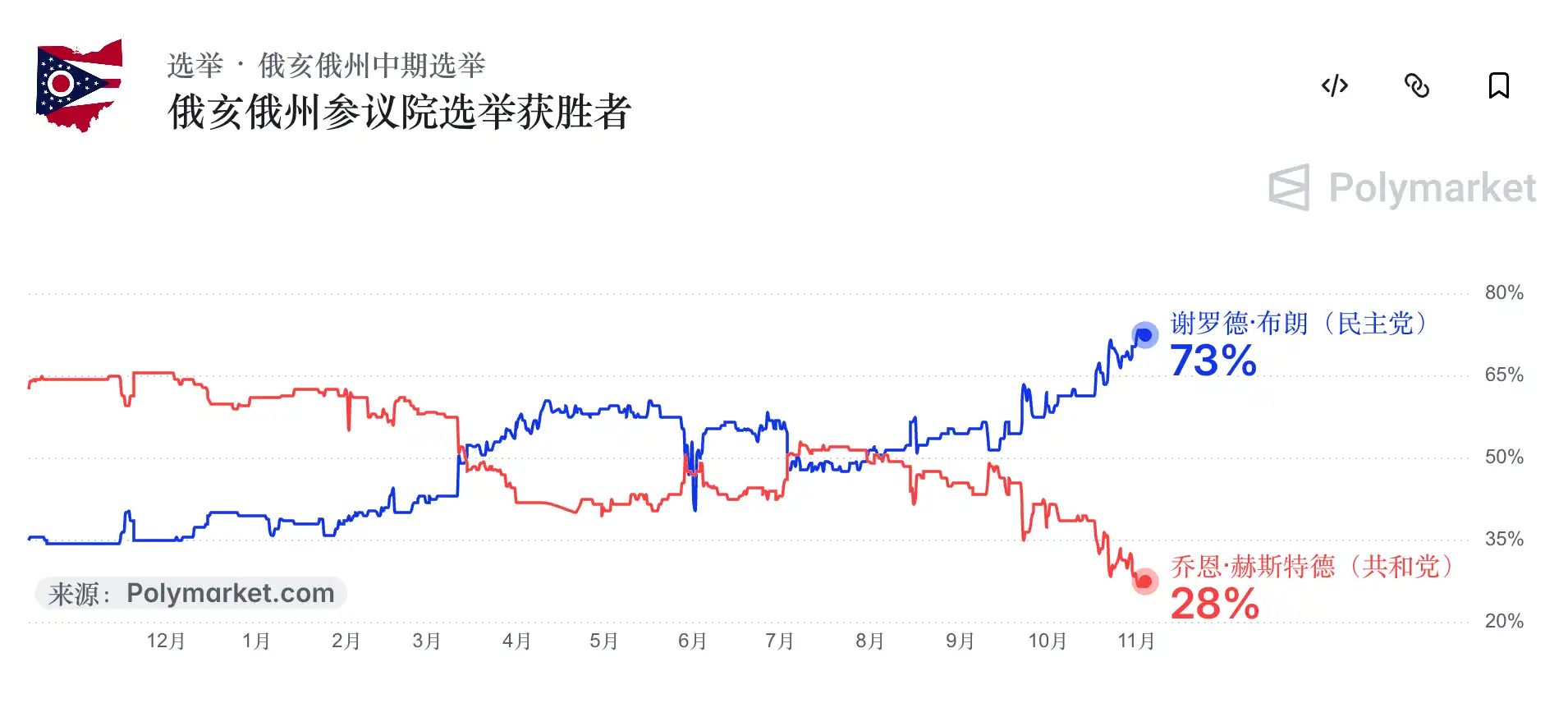
Yet even with that level of spending, Brown still held a slight edge in the race.
Most recent polls showed Brown narrowly ahead. A New York Times/Siena College survey conducted from Oct. 26 to Nov. 1 showed Brown leading 49% to 44%. As of Election Day on Nov. 3, prediction markets Polymarket and Kalshi both put Brown’s chances of winning above 70%.
That left Fairshake and other crypto political groups facing the possibility that Brown could return to Washington even after more than $100 million had been spent across two election cycles.
The clash with crypto was about more than public criticism
Brown’s conflict with the crypto industry can be traced back to his time as chair of the Senate Banking Committee.
In December 2021, Brown led a hearing on stablecoin risks. He questioned whether stablecoin issuers held enough reserve assets to guarantee redemptions at any time and raised concerns that volatility in crypto markets could spread into the traditional financial system through stablecoins. In his remarks, Brown also linked cryptocurrency to Wall Street-style financial speculation and criticized companies he said were shifting risk onto ordinary investors under the banner of innovation.
After the collapse of FTX in 2022, his regulatory stance hardened further. Brown called on the U.S. Department of Justice, the SEC and the Commodity Futures Trading Commission to investigate potential wrongdoing and argued for stricter financial consumer protections for crypto companies. In a Senate hearing in February the following year, he again criticized what he described as fraud, theft and speculation across the crypto market.
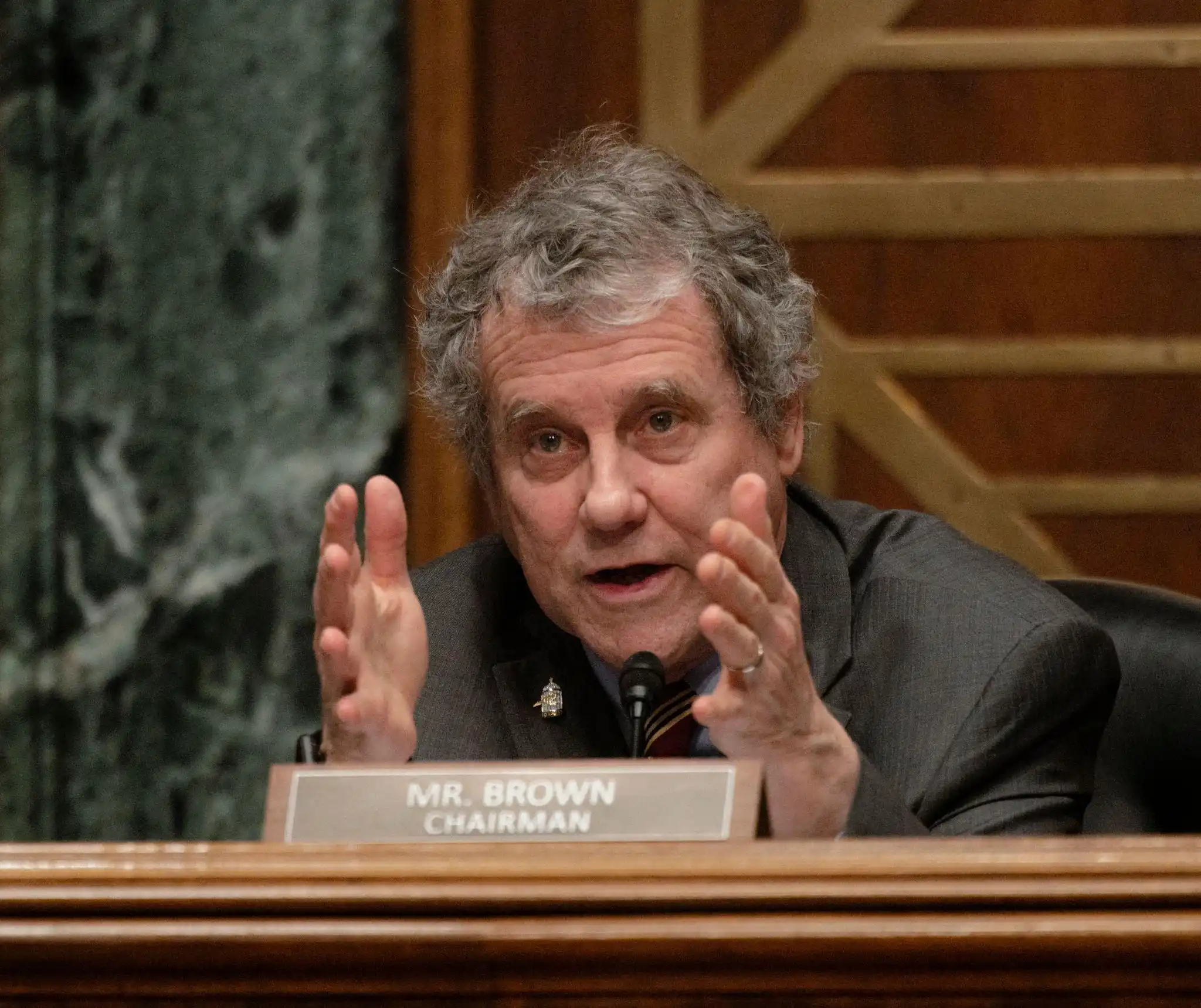
Still, the more direct issue for the industry was Brown’s control over the legislative agenda. U.S. crypto companies had long tried to push Congress to pass dedicated laws defining how digital assets should be regulated, especially the division of authority between the SEC and the CFTC.
From the industry’s perspective, existing securities laws do not fit many digital assets neatly, and the SEC’s reliance on enforcement actions had increased business uncertainty.
In May 2024, the U.S. House of Representatives passed the Financial Innovation and Technology for the 21st Century Act, an effort to create new classification standards for digital assets and expand the CFTC’s authority over digital commodity markets. But after the bill reached the Senate, it made no meaningful progress. Many in crypto therefore saw Brown, as Banking Committee chair, as their biggest obstacle.
There were, however, details in Brown’s position that were easy to miss.
In April 2024, Brown said he was willing to consider moving stablecoin legislation, though he wanted it discussed alongside other financial reform measures. In July that year, he said he was willing to work with Senate Agriculture Committee Chair Debbie Stabenow on digital asset market structure reform. At the same time, he said he would not support bills drafted under industry leadership without sufficient consumer and investor protections.
So while Brown and the crypto industry both recognized the need for clearer rules, they diverged sharply on the content of those rules, the powers of regulators and the responsibilities the industry should bear.
Those differences did not disappear after Brown lost. In 2025, Congress passed the stablecoin bill known as the GENIUS Act, but the market structure bill the industry cared more about, the CLARITY Act, was blocked in a procedural Senate vote.
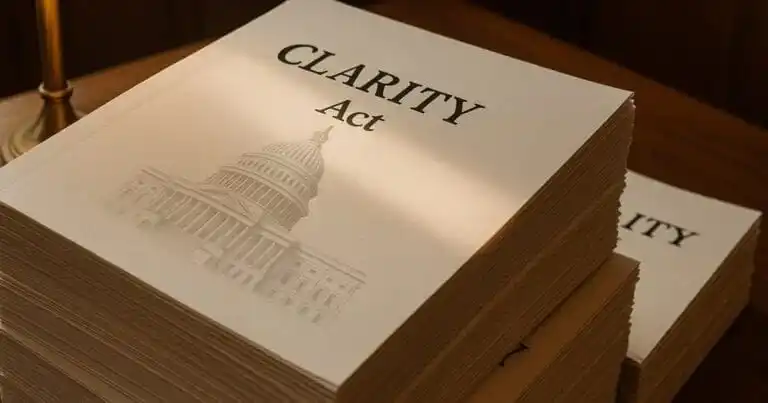
Objections did not come only from Democrats. Some Republicans also raised concerns tied to conflicts of interest involving government officials, bank deposits and financial regulation.
Fairshake’s rise has opened a debate inside crypto politics
Behind the years-long confrontation between Brown and the crypto industry sits an expanding campaign finance network.
In 2023, U.S. crypto companies began building political action committees in a more concentrated way, hoping to expand their influence in Congress by backing friendly candidates and opposing lawmakers with hardline regulatory positions. Fairshake, funded by Coinbase, Ripple and Andreessen Horowitz, or a16z, became one of the most influential groups.
Unlike direct donations to candidates, Fairshake operates as a Super PAC. It can accept unlimited contributions from companies and individuals and run independent political advertising, but by law it cannot coordinate those expenditures with a candidate’s campaign.
In 2024, Fairshake and affiliated groups spent about $196 million in total. In this year’s midterm cycle, Fairshake and affiliated groups have spent more than $150 million. Ohio, where Brown is running, has been the most concentrated battleground for that money.
Fairshake has maintained a clear anti-Brown position. In October last year, spokesperson Josh Vlasto said Ohio voters in 2024 had already sent a clear message that the regulatory path associated with Brown and Elizabeth Warren did not match what voters in the state wanted. He also said Fairshake would continue backing pro-crypto candidates and opposing anti-crypto politicians.
As crypto’s political influence has grown, criticism of Fairshake’s strategy has become more visible. The split sharpened after the CLARITY Act stalled in the Senate this year.
Democratic Senator Ruben Gallego, speaking to The Associated Press, called Fairshake’s continued targeting of Brown “bad political strategy.”
Gallego supports digital asset market structure legislation and also received campaign support from the Fairshake network in 2024. He said the crypto industry still needs enough bipartisan backing in the Senate to move a contested market structure bill to the next stage. Large-scale attacks on Democratic candidates, he argued, could make future negotiations harder.
Similar concerns have appeared inside the crypto industry. Dennis Porter, co-founder of Satoshi Action Fund, said Fairshake’s decision to spend tens of millions attacking Brown could damage the industry’s chance to build a long-term relationship with Democrats. Another advocacy group, Digital Sovereignty Alliance, said Fairshake’s political spending mainly reflects the choices of a small number of well-funded companies and investors and should not be treated as representing the entire crypto industry.
Fairshake, for its part, has consistently said it supports pro-crypto candidates in both parties rather than serving Republicans alone. The group previously spent $40 million and $31 million, respectively, to support 29 Democrats and 28 Republicans.
Ohio voters were set to decide on Nov. 3 whether Brown would return to the Senate. The political fight, spanning two election cycles and costing more than $100 million, was approaching another result.
Whatever happens to Brown, the dispute in Congress over digital asset regulation is not going away. Whether the crypto industry’s huge political spending can be converted into durable legislative outcomes remains an open question.



