From 1958 Credit Card to 1990s Debit Card: The Historical Echo for Crypto Payment Cards
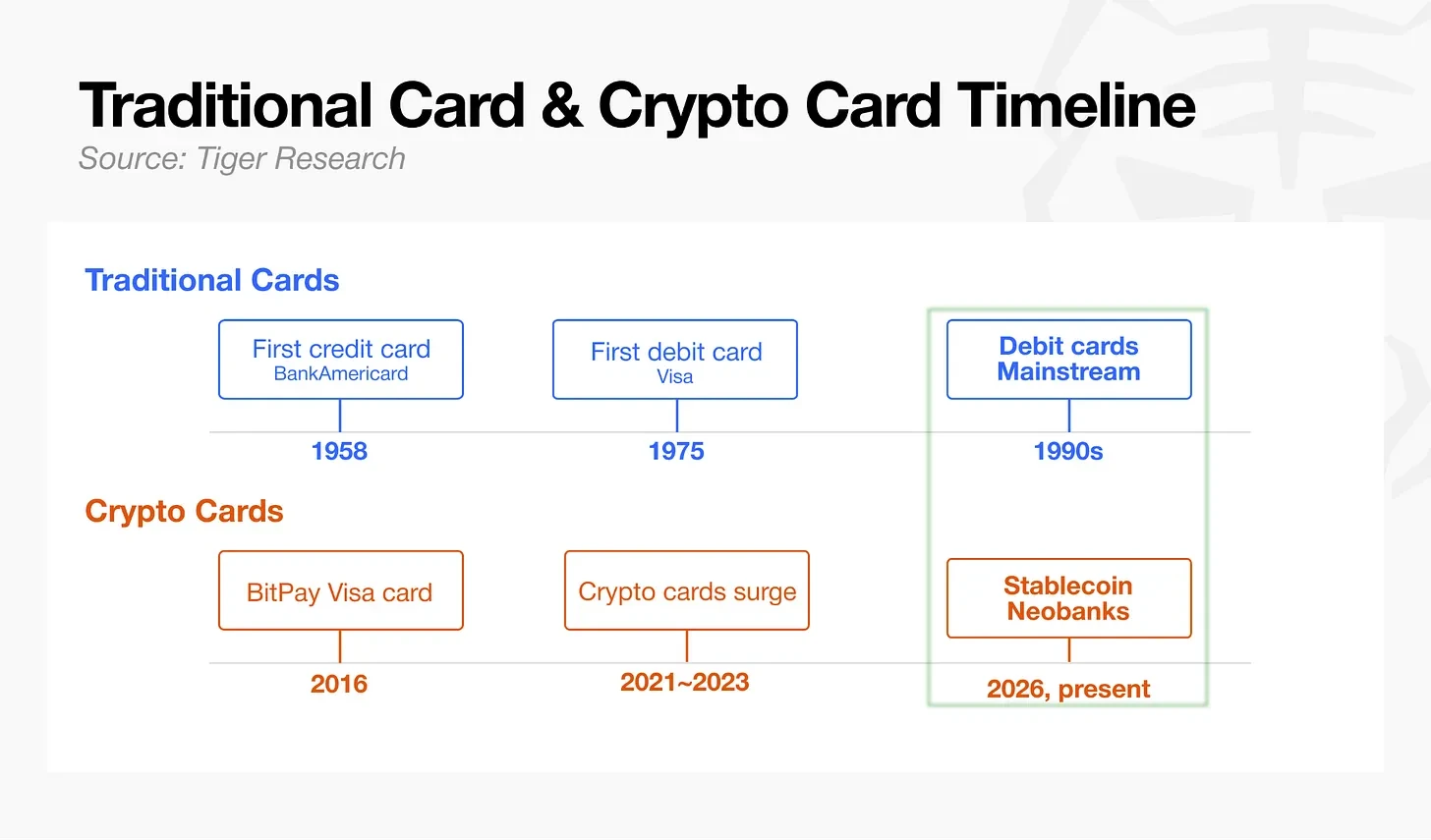
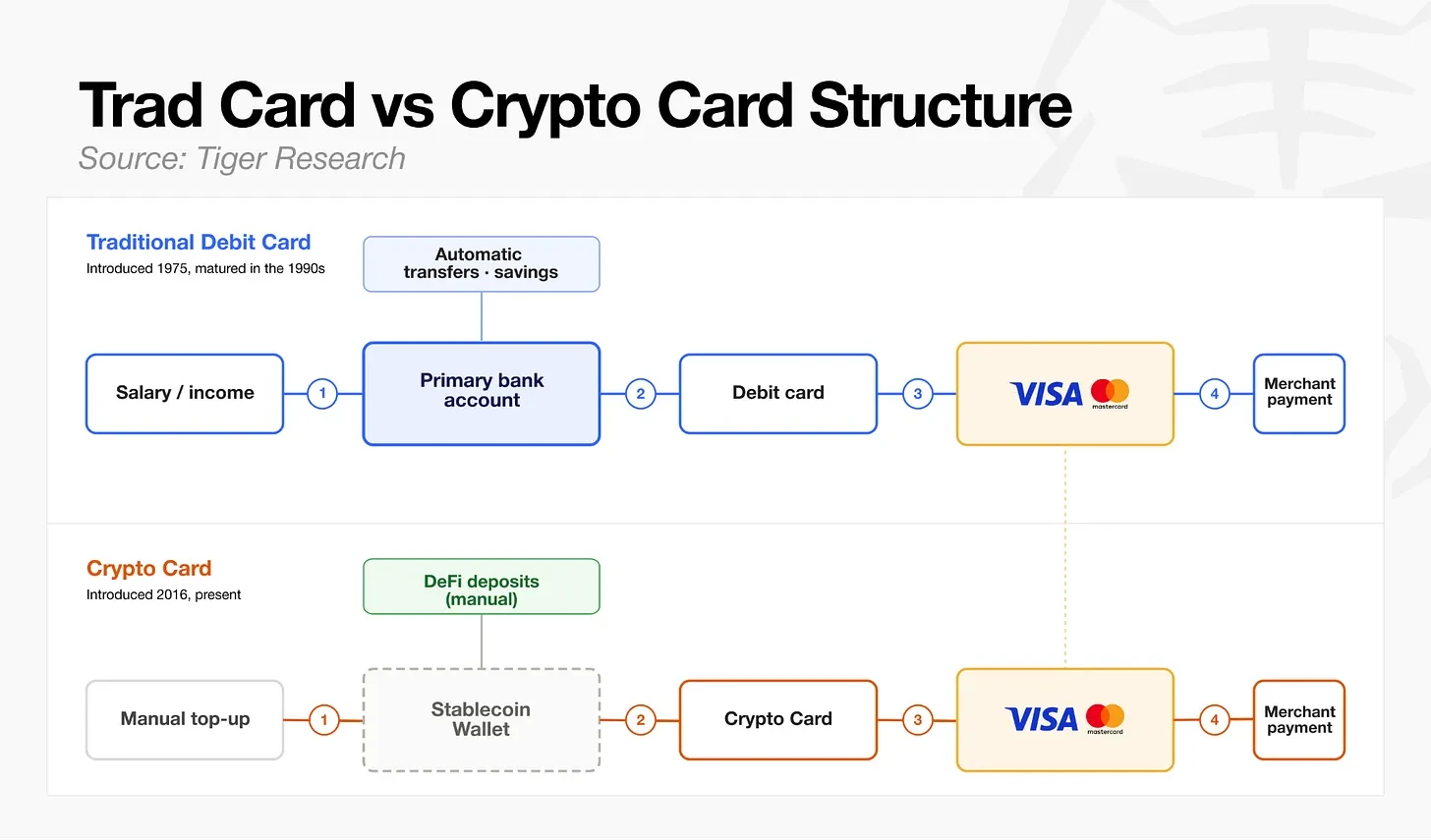
In September 1958, Bank of America mailed credit cards to 65,000 residents of Fresno, California—the first payment card without supporting infrastructure. After one year, the business was bleak with a 22% delinquency rate and $20 million in losses. It took the industry 15 years to build an electronic settlement system; debit cards only officially launched in 1975, and Visa spent 20 years establishing a global payment standard. The fundamental difference between traditional and crypto payments lies in whether they anchor users' regular financial account relationships. Debit cards only became the default core banking tool in the 1990s after payroll direct deposit became widespread. Today's crypto payment cards, by contrast, rely almost entirely on users manually depositing stablecoins; most crypto wallets cannot handle salary deposits, auto-debits, or other recurring cash flows. The industry as a whole is at roughly the same stage as debit cards in the early 1990s. The future leader in crypto payment cards will not be determined by card issuance volume, but by who first builds a true core account for daily income and expenses, or finds a growth engine that drives long-term user retention.
$1.5B Monthly Volume: The Real Demand Picture Behind the Numbers
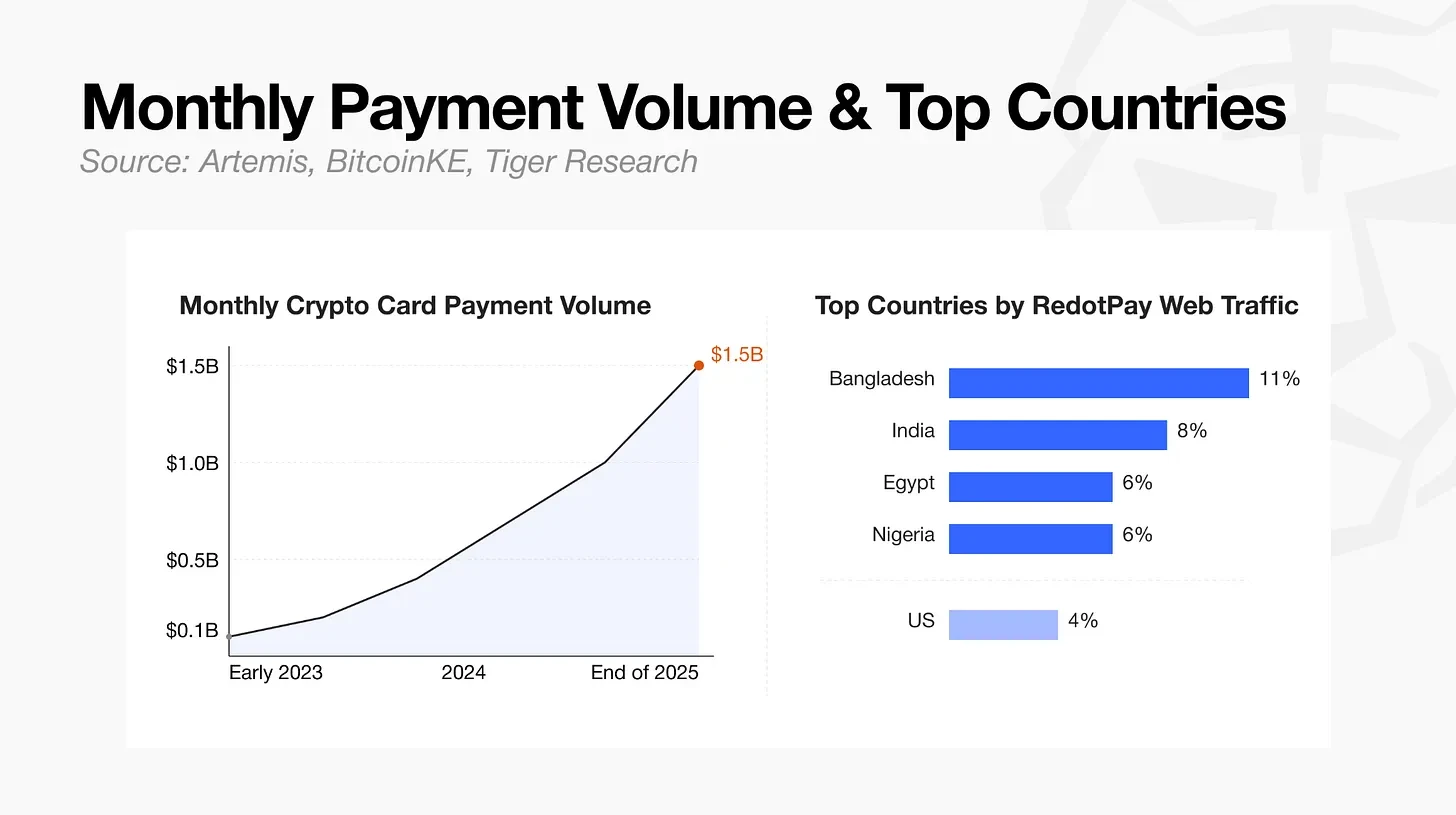
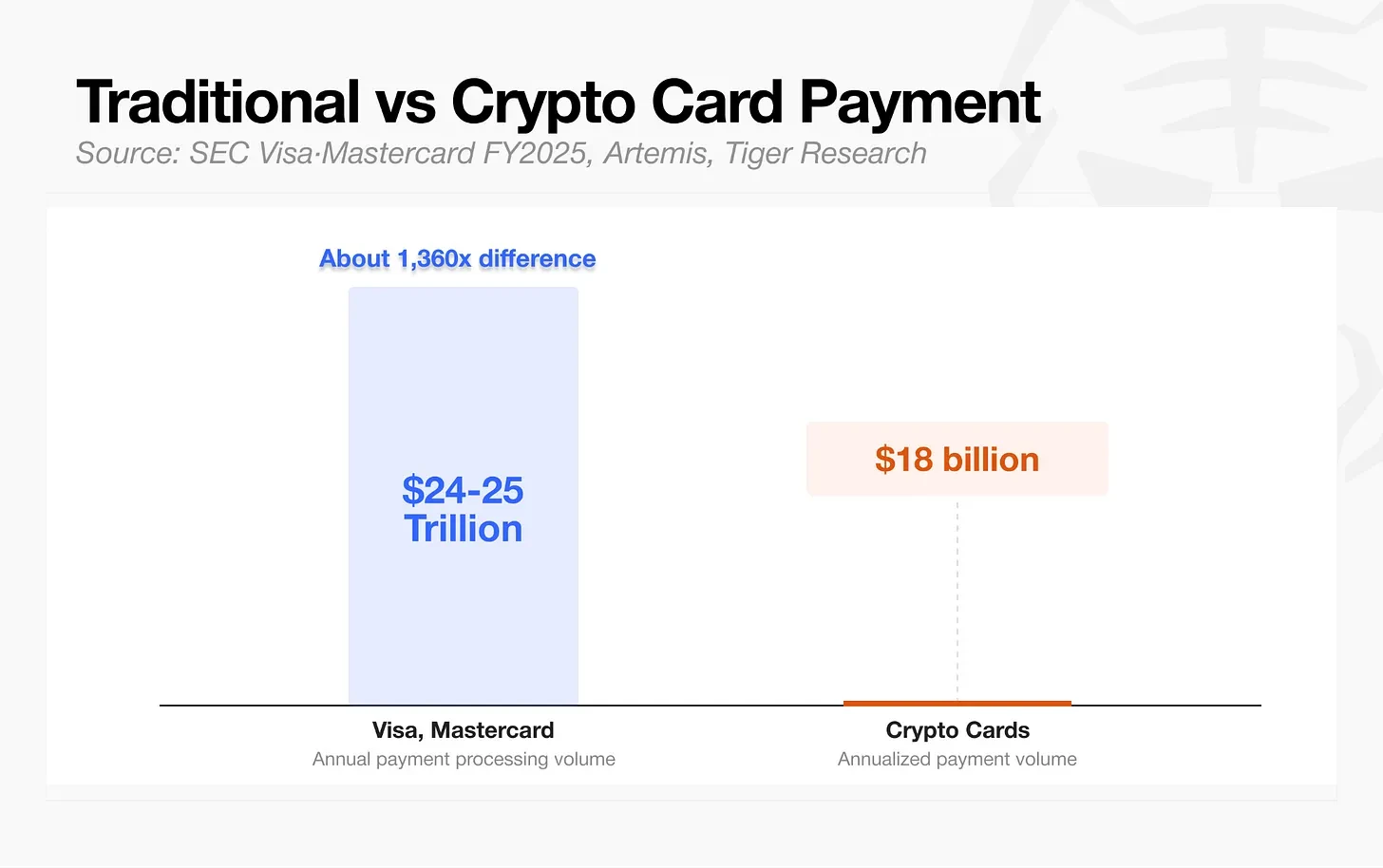
According to data firm Artemis, monthly transaction volume of crypto payment cards grew from $0.1 billion in early 2023 to $1.5 billion by end-2025, an annualized run rate of approximately $18 billion. While on-chain data methodologies cause small fluctuations, the explosive growth is indisputable. However, a closer look reveals concentrated service and geographic patterns: RedotPay alone handles over half of all transaction flow; user visits are heavily skewed toward emerging markets—Bangladesh 11%, India 8%, Egypt 6%, Nigeria 6%, while the U.S. accounts for only 4%. Real demand comes not from developed mainstream markets, but from developing regions with inadequate financial services and limited access to U.S. dollars. The scale gap with mature payment networks remains enormous: Visa and Mastercard handle $24-25 trillion annually, while crypto payment cards manage only ~$18 billion—orders of magnitude apart. Velocity metrics for daily payments are equally low: Visa reports on-chain stablecoin retail velocity at 0.08, just 1/20th of the narrow money M1 velocity of 1.65. Users' stablecoin behavior is characterized by one-time top-ups followed by sporadic card swipes, rather than the recurring pattern of salary deposit, daily spending, and recharge cycles. Growing transaction numbers do not equate to a mature universal clearing system. A large share of current crypto card transactions comes from users in emerging markets who lack easy access to U.S. bank accounts—for them, the cards offer genuine utility. But in developed markets, crypto payment cards have yet to find a stable product-market fit or build deep account-binding relationships through payroll and auto-debit. In short, today's crypto payment cards are best suited to specific country-level niches, serving as complementary tools rather than universal financial infrastructure.
Four Business Models: Infrastructure, Exchange, Self-Custody, and Stablecoin Accounts
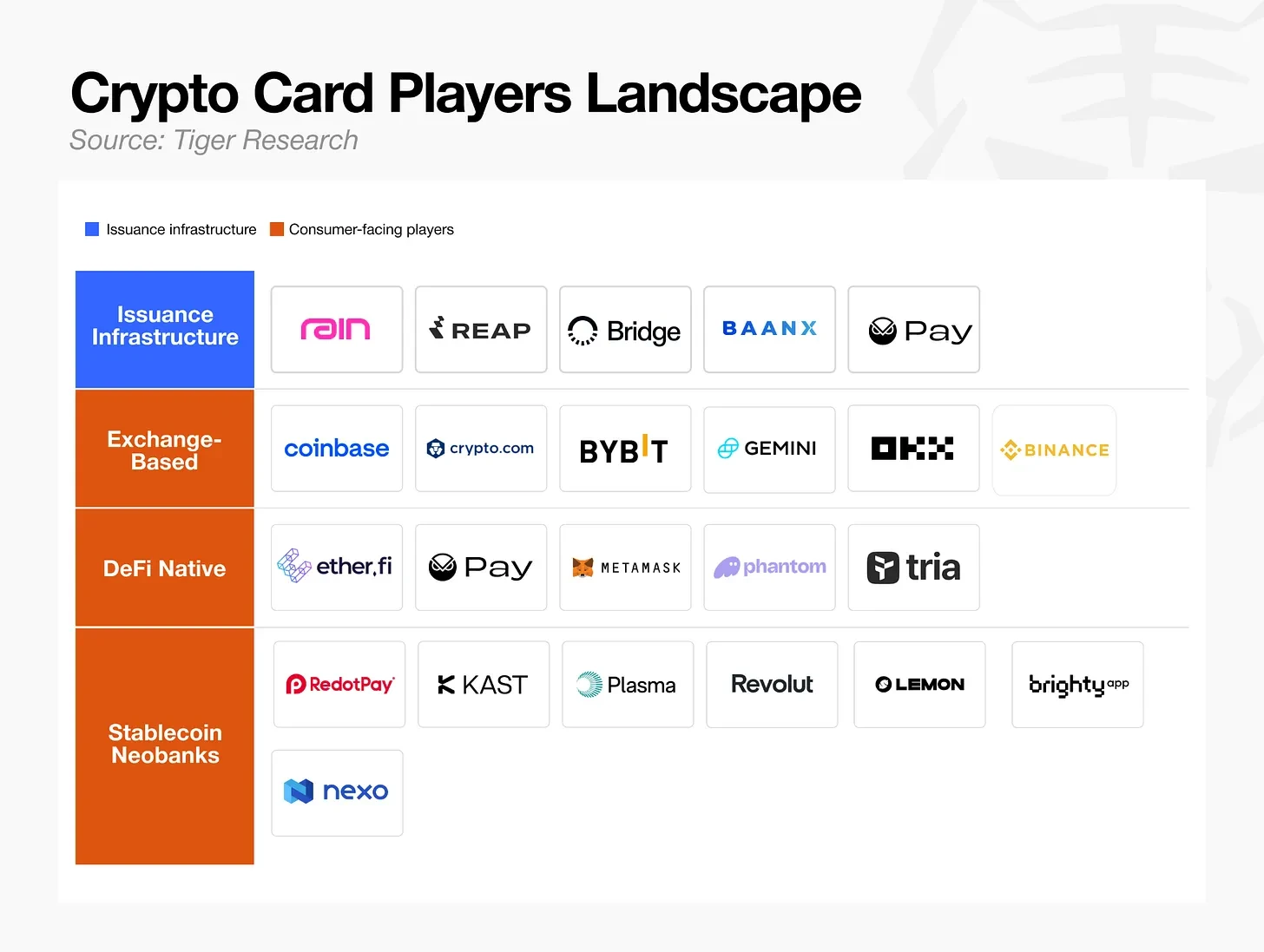
The crypto card ecosystem broadly divides into four business models, each with distinct competitive dynamics. First, the card issuance infrastructure layer includes both a traditional two-tier structure (separate program manager and issuing bank) and full-stack issuers like Rain and Reap that combine both roles. Many apparently independent card brands—Phantom Card, MetaMask Card, Gnosis Pay—share a handful of backend program managers, with Rain handling the vast majority of consumer card volumes. Second, exchange-backed cards treat the payment card as a user retention tool and gateway to a financial super-app; the real revenue comes from trading fees, lending, and custody, not card spending. Self-issued token cashback carries price volatility risk, while stablecoin cashback or interest-bearing balances are curbed by the U.S. GENIUS Stablecoin Act. Third, the self-custody wallet model allows users to hold assets on-chain and spend directly from self-custodial wallets, with credit lines secured by collateral. However, users must manage their own vaults, track collateralization, and monitor liquidation risk—a high barrier to entry. MetaMask Card uses its own L2 network Linea to lower gas fees to ~$0.01 per transaction, and Tria adopts a gas-free top-up model, but until the UX matches traditional debit cards, users remain confined to native crypto enthusiasts. Fourth, the stablecoin-account model integrates stablecoin balances with forex, cross-border remittance, and wealth management, using the card merely as a spending layer. This model is particularly competitive in emerging markets with volatile local currencies, high remittance costs, and limited dollar access. RedotPay, the current industry leader by volume, offers zero cashback, while later entrants like Kast and Plasma One aggressively promote dollar or token cashback to attract users.
Competition Intensifies: Traditional Finance Giants Enter, Differentiated Value-Add Becomes Key
The concentration of card issuance infrastructure has attracted traditional digital banking players. In March 2026, Nium launched a stablecoin card platform supporting both Visa and Mastercard networks. Other recent entrants include Bridge (acquired by Stripe for $1.1B in early 2025) and BVNK (acquired by Mastercard for up to $1.8B in March 2026). As the issuance track becomes increasingly crowded—full-stack issuers, legacy program managers, and fintech newcomers all competing—simple card issuance no longer provides a sustainable moat. Rain differentiates itself through daily stablecoin settlement: traditional card clearing cycles take days, but Rain enables T+0 settlement via Visa, dramatically improving capital turnover for partners like Ether.fi. Recently, Rain launched an AI agent control layer that supports programmatic generation of one-time virtual cards, extending functionality beyond basic issuance infrastructure. To break out, card issuers must deliver more than just payment rails; they need innovative value-added features that traditional infrastructure cannot replicate.

The Road Ahead: From Prepaid Cards to Core Accounts—Regulation and Standard-Setting
History shows that pure payment services have extremely low profit ceilings. Traditional card businesses only became profitable when they integrated core account concepts, deposit-taking, and lending spreads. The crypto payment card industry now faces the same inflection point, but global regulations such as the U.S. GENIUS Act and the EU MiCA framework restrict interest-bearing stablecoins and asset management, making the path forward difficult. Under macro regulatory constraints, players must pursue three core strategies: first, directly control the upstream flow of funds before the Visa settlement layer; second, gain early mover advantage in specific niche markets; and third, build a global consumer infrastructure standard from scratch, analogous to how bank accounts became the foundation of traditional finance. Once industry standards solidify, companies that fail to achieve these three priorities will gradually fall behind. Looking back at the rise of debit cards, the winner was not the issuer with the most cards, but the one that first controlled the user's primary bank account. Crypto payment cards face the exact same challenge today. Those that cannot execute on these fronts will remain niche prepaid instruments for small cashback rewards, rather than essential daily tools.