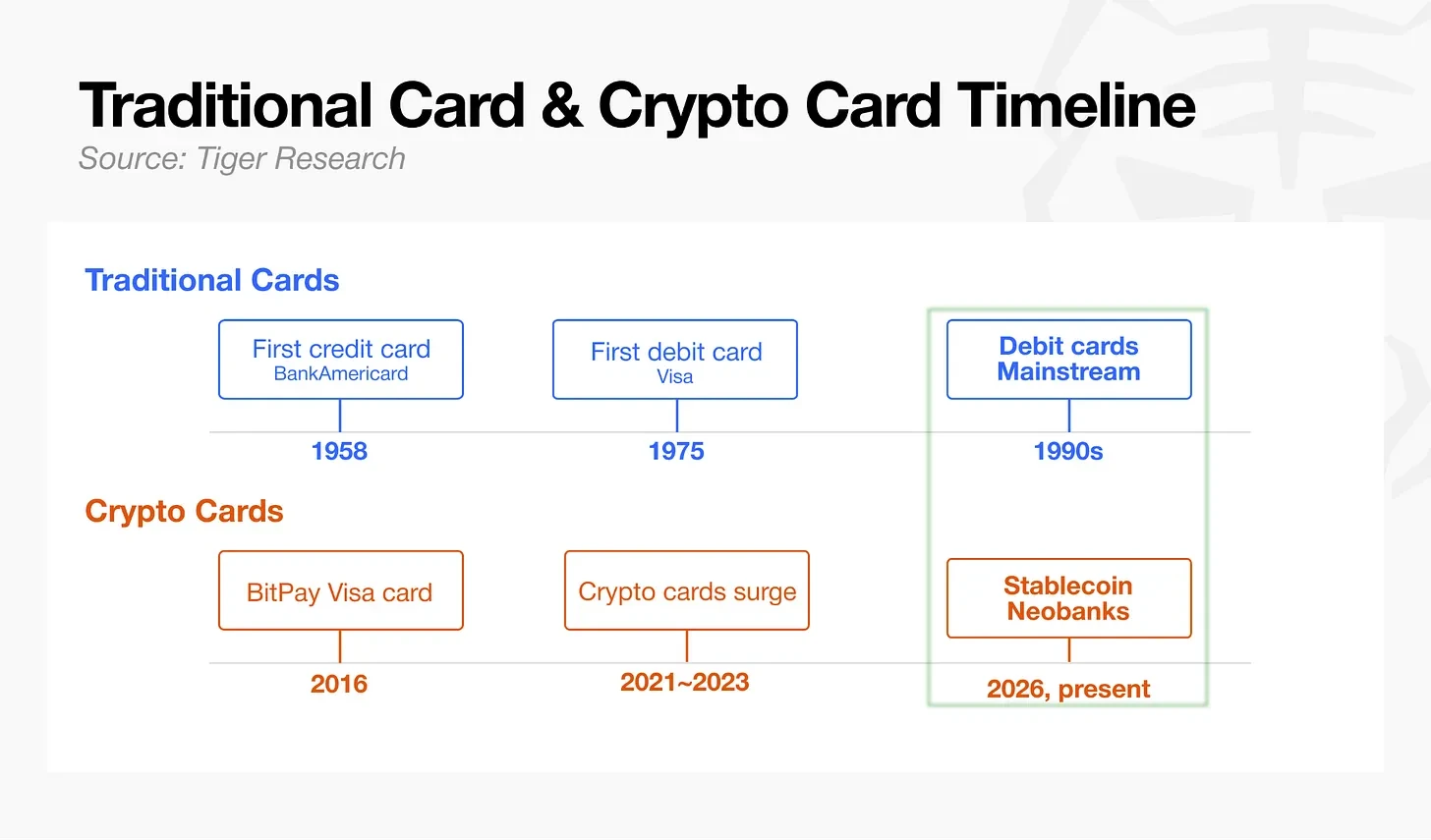
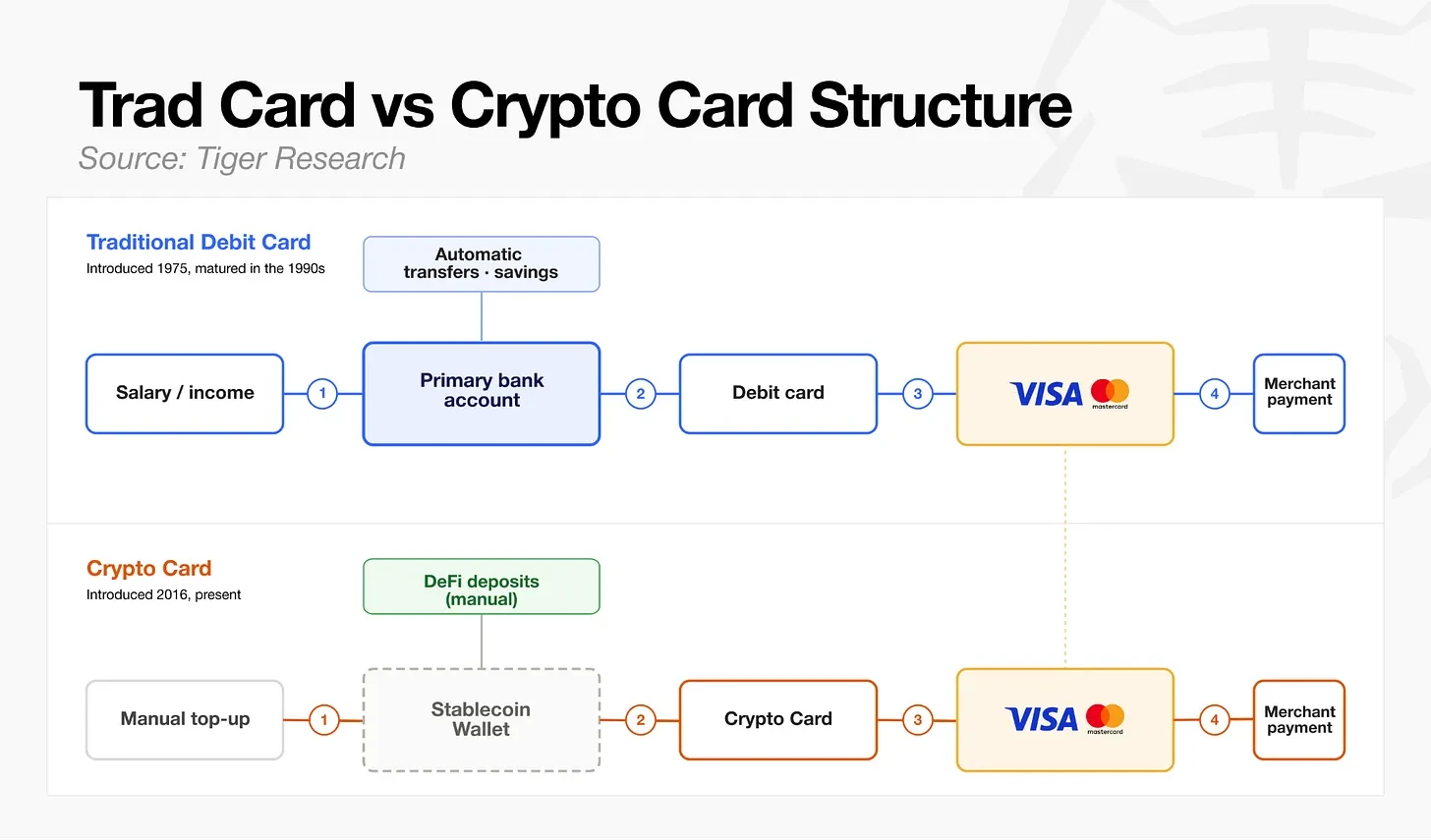
In September 1958, Bank of America mailed credit cards to 65,000 residents in Fresno, California—the first card without supporting infrastructure. One year later, the program posted a 22% delinquency rate and $20 million in losses. It took 15 years to build electronic clearing, another 17 for the debit card to launch, and 20 years for Visa to establish a global payment standard. The key differentiator between traditional payments and crypto payments is whether they anchor a user's primary financial account. Crypto payment cards today mostly rely on users self-funding with stablecoins; they cannot accommodate payroll deposits or automatic bill payments. The industry stands roughly where debit cards were in the 1990s—before they became the default for personal banking.
Market Size: $1.5B Monthly But a Fraction of Traditional Networks
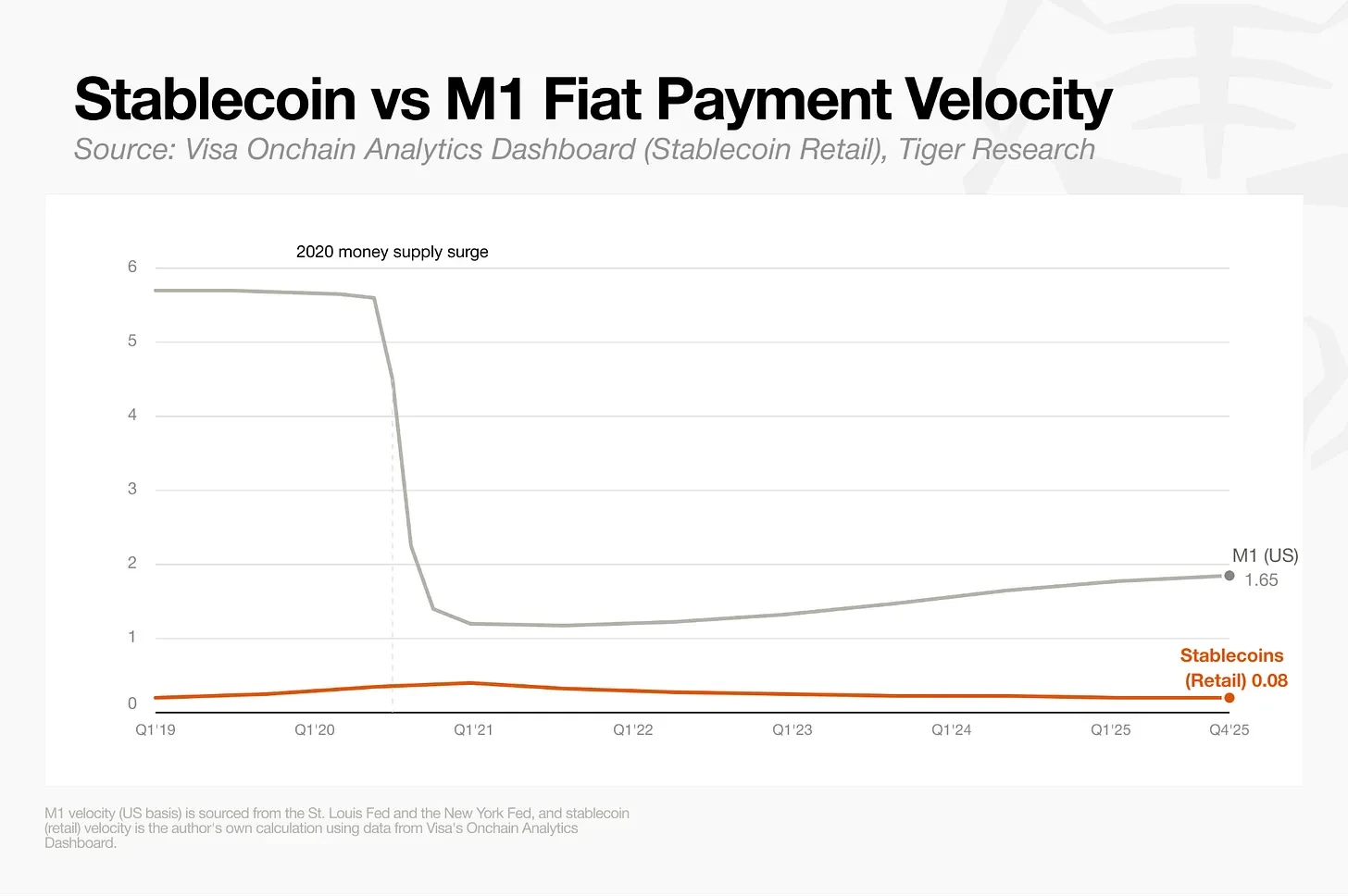
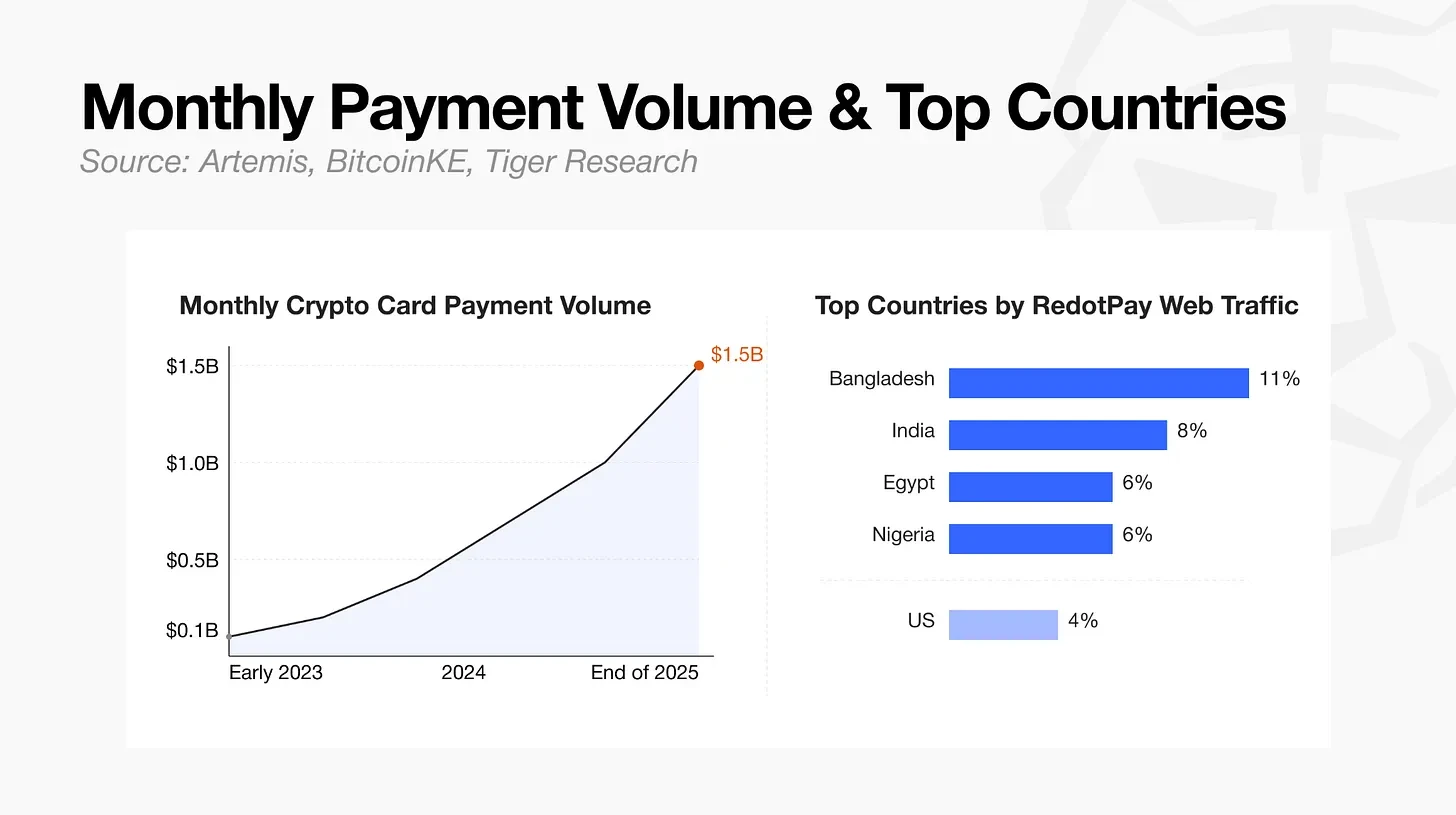
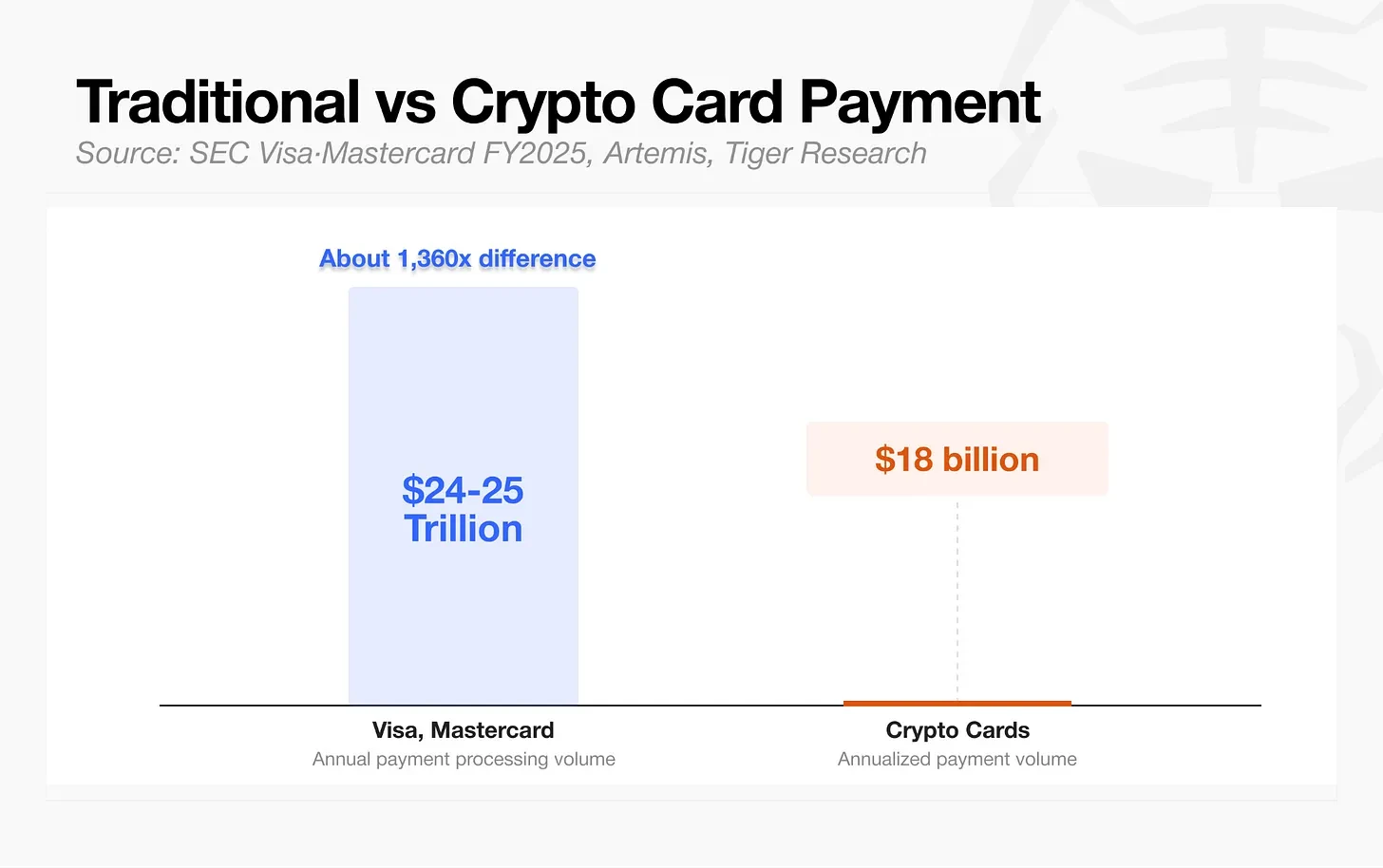
Artemis data shows monthly crypto card transaction volume rose from $100M in early 2023 to $1.5B by end 2025, an annualized $18B. Yet Visa and Mastercard each process $24-25 trillion annually—over 1,300 times larger. On-chain stablecoin retail velocity is only 0.08, one-twentieth of the M1 velocity of 1.65, indicating users top up sporadically rather than using cards for regular income and expenses. RedotPay accounts for over half of all transaction flow. User concentration is in emerging markets: Bangladesh 11%, India 8%, Egypt 6%, Nigeria 6%, while the U.S. accounts for only 4%. The real demand comes from underbanked regions where accessing U.S. dollars is difficult, not from developed markets.
Four Business Models: Infrastructure, Exchanges, Self-Custody, and Aggregators
Full-stack issuers like Rain handle both program management and issuing; Rain achieves T+0 stablecoin settlement via Visa and recently launched an AI agent layer to auto-generate virtual cards. Exchange-linked cards (e.g., RedotPay) aim to retain existing users, but token-based cashback is volatile, and the U.S. GENIUS Act prohibits yield on stablecoins. Self-custody wallet cards (MetaMask Card, Gnosis Pay) allow spending directly from on-chain assets, but face high gas fees and UX complexity; MetaMask uses Linea L2 to cut gas to ~$0.01 per transaction. Stablecoin aggregate accounts (Kast, Plasma One) bundle foreign exchange, cross-border remittances, and savings, using the card as a top-layer spending tool—highly competitive in emerging markets but still operating as a prepaid card model. Traditional fintech players like Nium, Stripe (via its $1.1B acquisition of Bridge), and Mastercard ($1.8B acquisition of BVNK) are also entering the space, intensifying competition.
Regulatory and Strategic Bottlenecks
Pure payment business has razor-thin margins. Legacy digital banks only became profitable after embedding primary checking accounts and lending/ deposit spreads. Crypto cards face the same inflection point, but regulations (U.S. GENIUS Act, EU MiCA) restrict stablecoin yield and asset management. To survive long-term, players must (1) build a primary account that handles paychecks and direct debits, (2) control the upstream of Visa settlement rather than just being a card program manager, and (3) establish standards in niche markets before incumbents do. History shows debit card winners were not those with the most cards issued, but those that captured the primary banking relationship. Crypto cards that fail to achieve these three will remain a niche prepaid tool for small cashback rewards, never becoming an essential daily utility.