

Stablecoins are showing up more often in everyday spending through payment cards, according to a report by Robert Hackett and Ryan Holloway of Andreessen Horowitz, or a16z, translated by Foresight News. The report says crypto payment cards are no longer a novelty product and that monthly spending across the sector has now moved past $750 million.
These cards let users pay with crypto at online and offline merchants that already accept traditional card networks. In the background, the crypto used for payment is converted into local fiat currency at the point of settlement. For merchants, the incoming payment looks like a standard card transaction, with no need to handle crypto directly.
The report notes that users do not necessarily need a traditional bank account to use crypto payment cards. Product structures differ. Some require users to hold stablecoins with the card issuer or service provider, while others allow funds to remain onchain in a self-custody wallet. In that setup, the card becomes a way for users around the world to access dollar-account-like services while also giving stablecoin holders a practical payment rail for daily use.
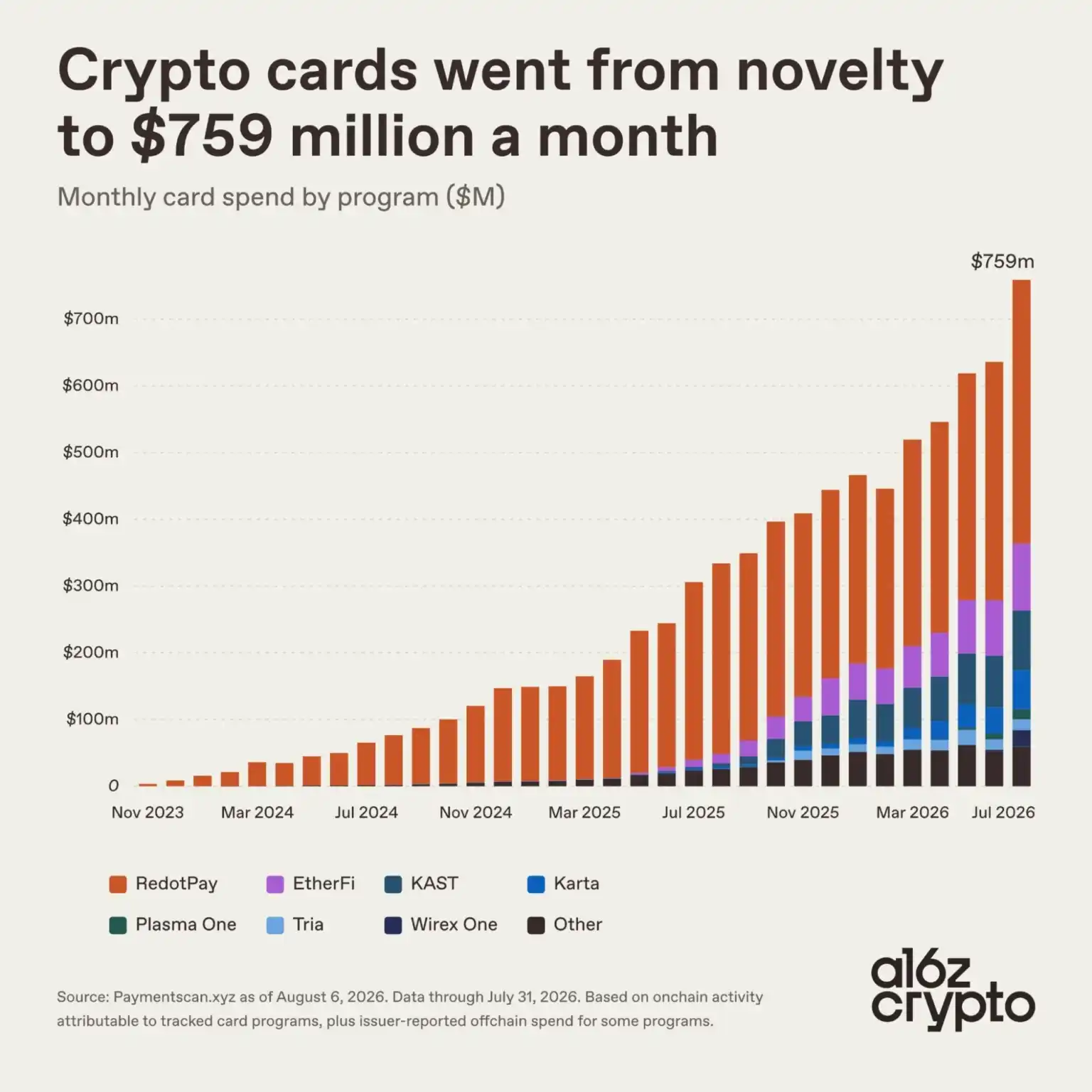
Monthly volume climbed to $759 million
Based on onchain behavior data tracked by Paymentscan, monthly transaction volume for crypto payment cards reached $759 million in July 2026. The same month a year earlier, the total stood at $306 million, which puts the market at roughly 2.5 times its prior-year level.
The report also looks back to October 2023, when Paymentscan began tracking the category. At that point, monthly transaction volume across the sector was still below $1 million. One caveat is attached to RedotPay, the top-ranked card by volume: its spending figures are disclosed by the issuer rather than derived from onchain data collection.
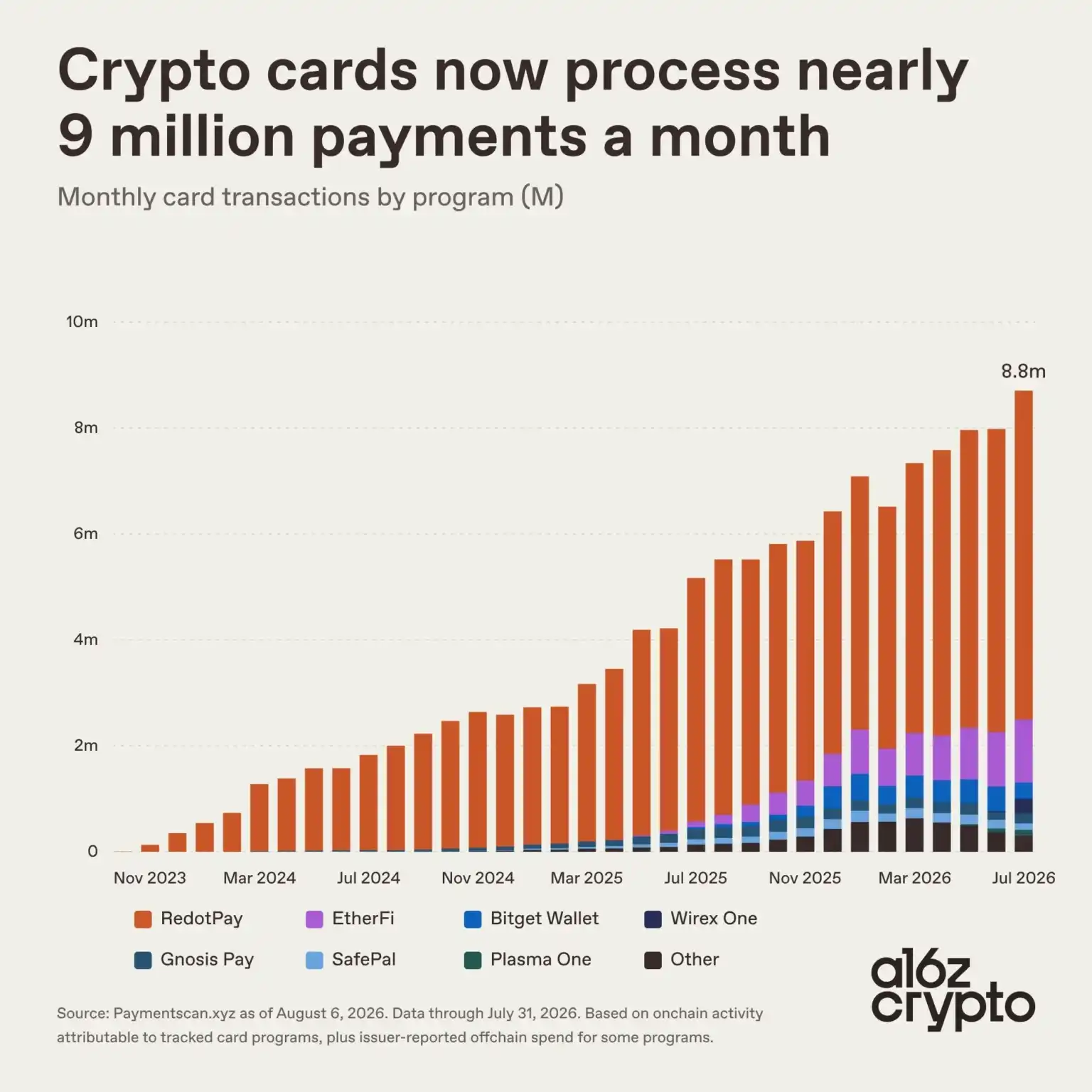
Purchase count neared 9 million in July
Transaction count has increased at a pace similar to the rise in dollar volume. In July 2026, crypto payment cards were used for nearly 9 million purchases, compared with about 5.2 million in the same month last year.
Using those figures, the average card payment comes to about $86.
Settlement activity spread beyond Gnosis
In early 2024, payment-card traffic was heavily concentrated on Gnosis. Gnosis Pay was built on that chain, and the report describes it as the first Visa co-branded payment card that could connect directly to a self-custody wallet.
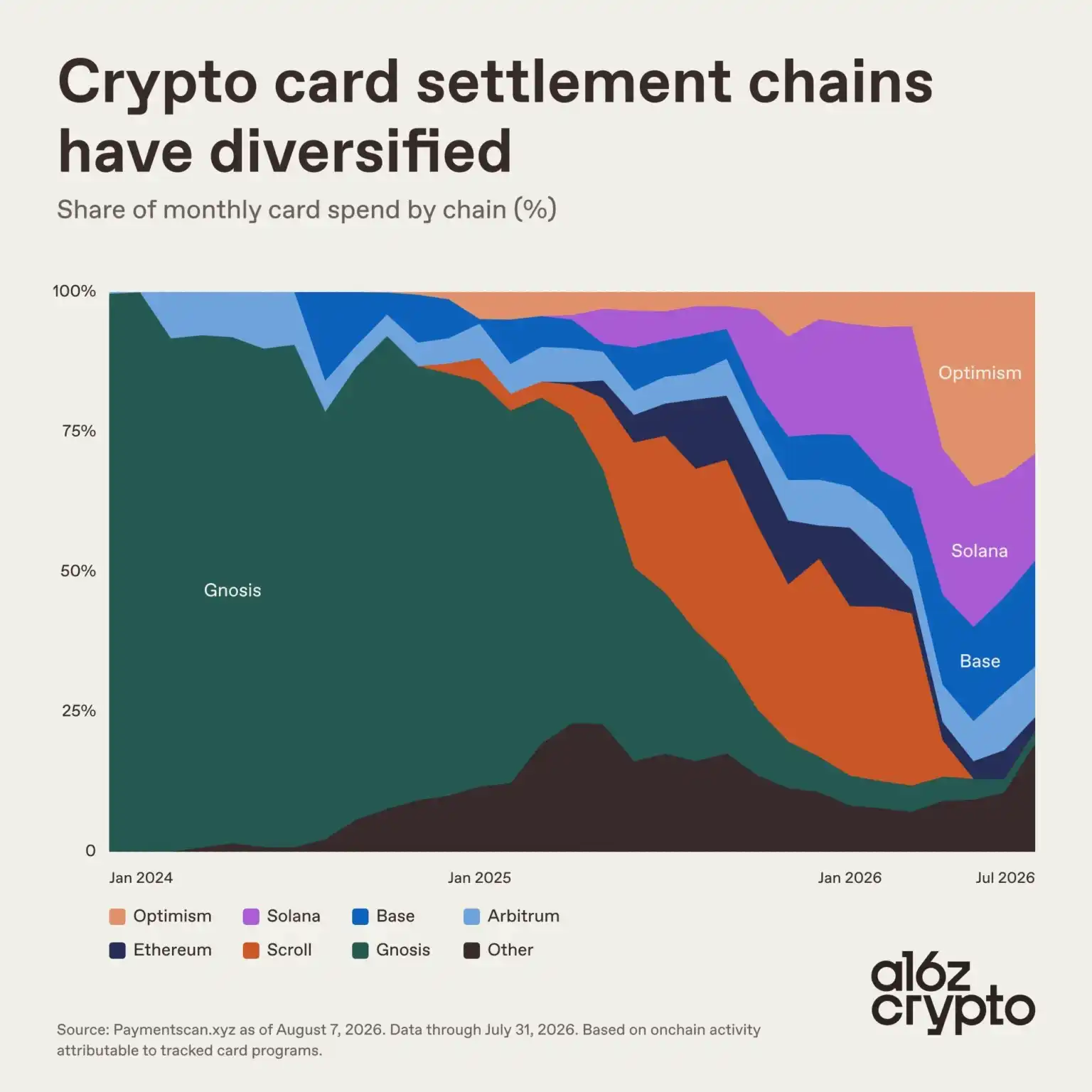
That concentration has faded as more crypto card products entered the market and settlement activity spread across more chains. Paymentscan’s July figures show Optimism carrying about 29% of crypto payment card volume. Solana and Base each accounted for 19%, while Gnosis, once the main chain for the category, had fallen to just 2%.
Dollar stablecoins replaced euro-backed tokens as the core medium
The stablecoin mix has shifted just as sharply. Euro-backed stablecoins once dominated crypto card spending. In early 2024, EURe represented 88% of all crypto payment card volume, and most of that activity ran on Gnosis.
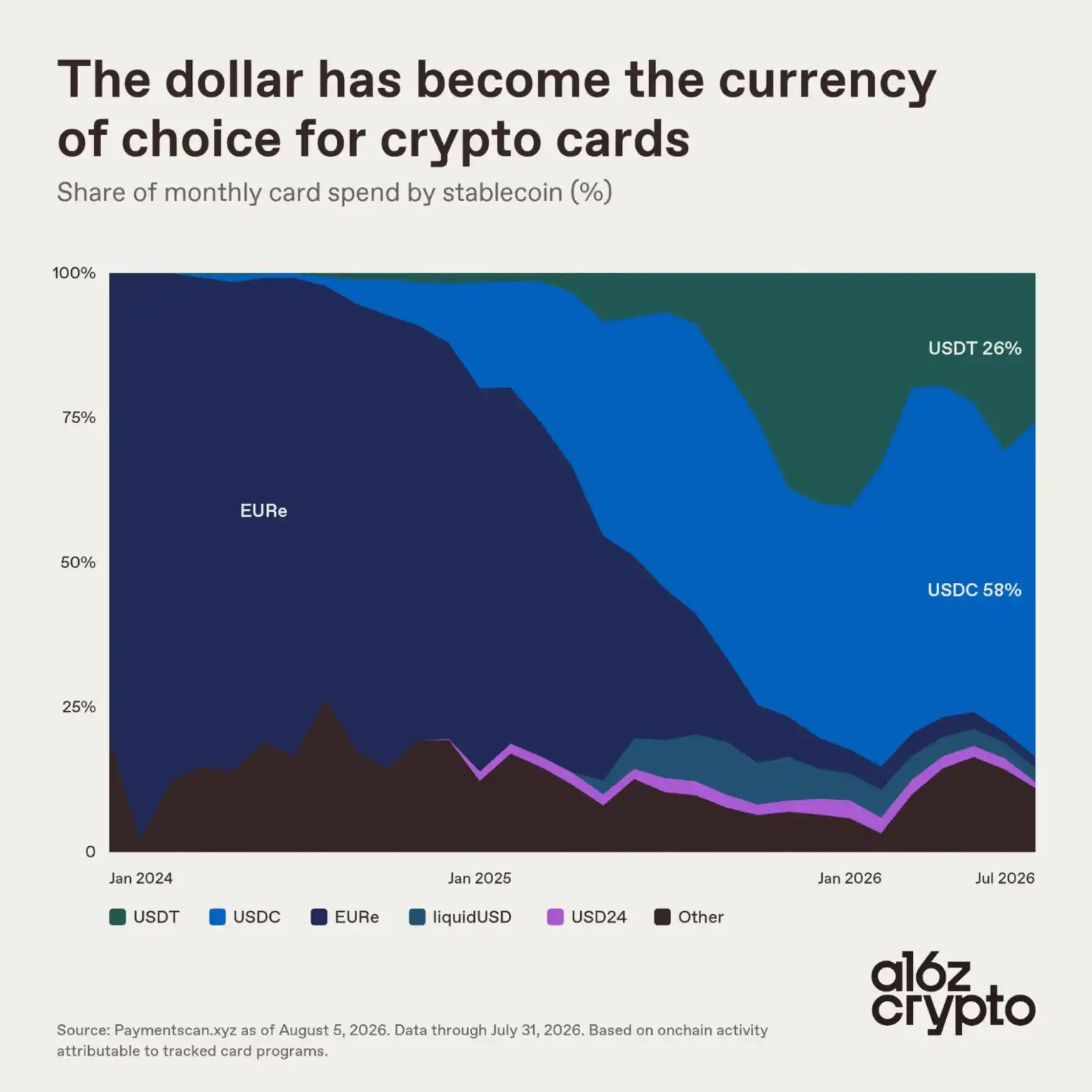
By July this year, EURe’s share had dropped to 2%. Dollar stablecoins now lead the market. USDC accounted for 58% of crypto card payment flow and USDT for 26%. A year earlier, the two stood at 48% and 7%, respectively. The report says that most spending through crypto payment cards now relies on digital dollar stablecoins.
Still small next to traditional card rails, but growing fast
Against traditional card networks, crypto payment cards remain a very small market. The report says conventional card rails process transactions in the trillions of dollars every month.
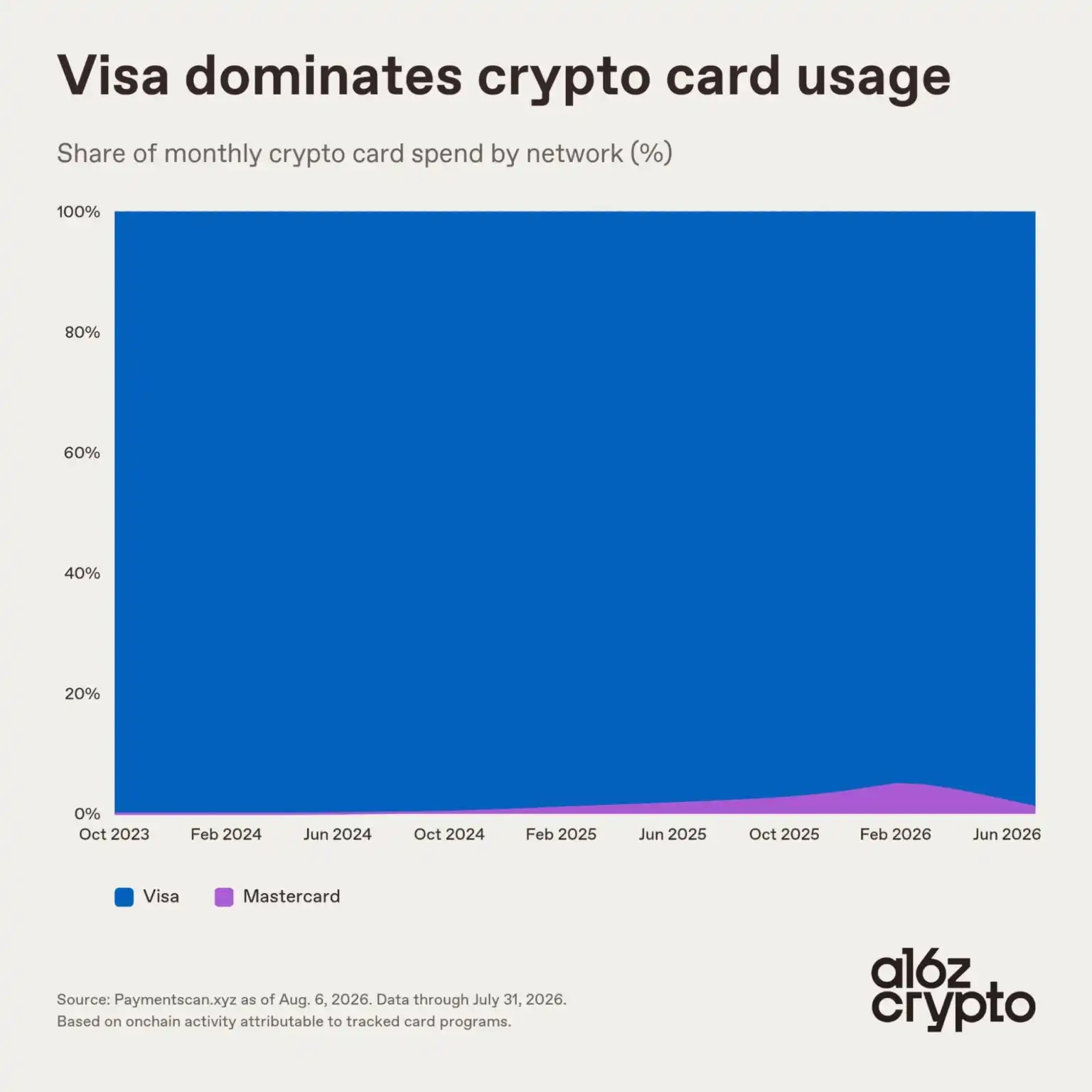
Even so, growth has been strong. The piece argues that stablecoins are continuing to penetrate the global financial system, while crypto payment cards reach consumers by using mainstream card infrastructure that is already in place. Nearly all of the products covered in this dataset operate on Visa’s network.
The report adds that after the GENIUS Act, the broader crypto industry has entered a faster phase of development, and crypto payment cards are one part of that shift.