
Crypto Payment Cards: Reliving the 1990s Debit Card Era
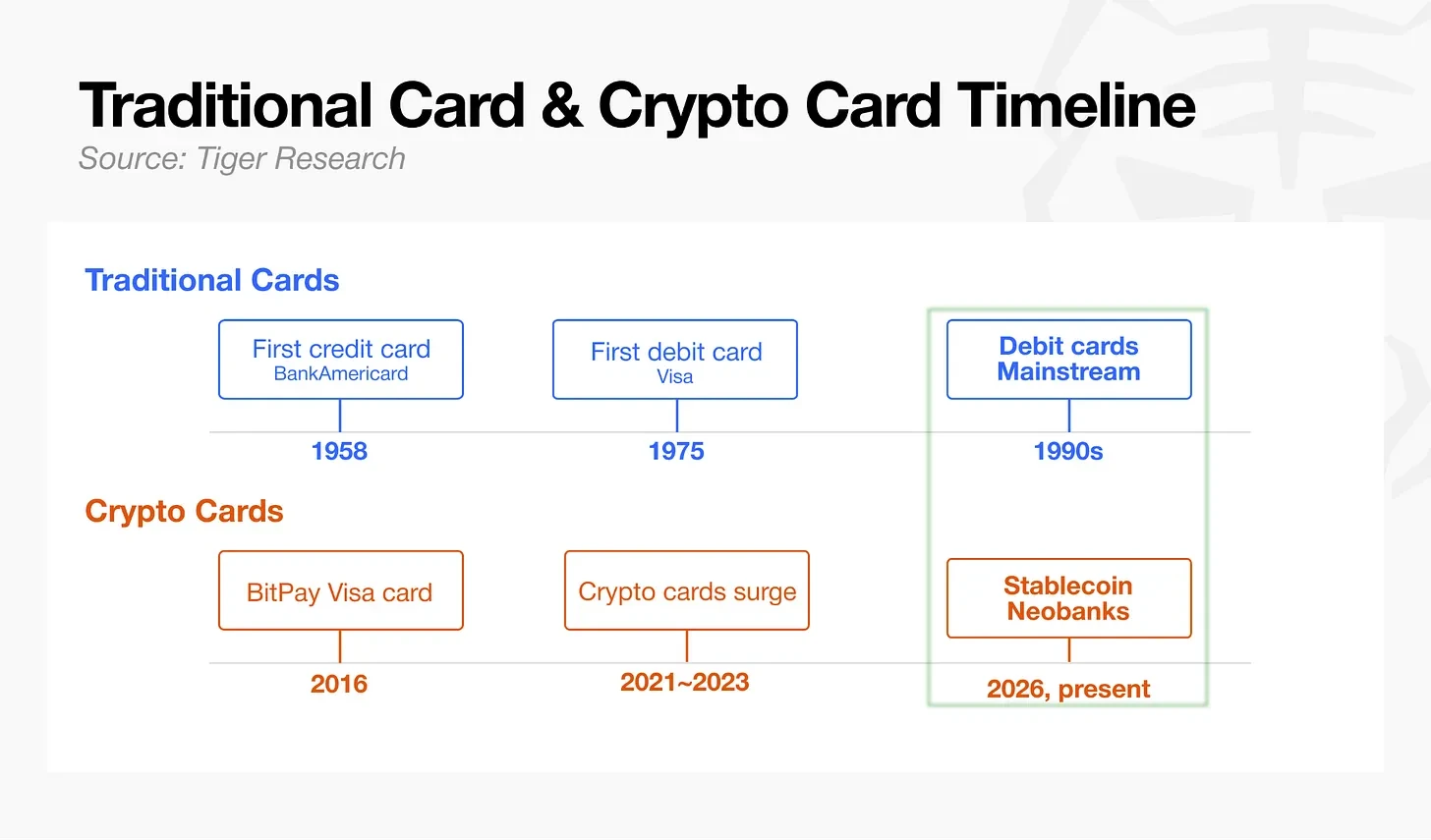
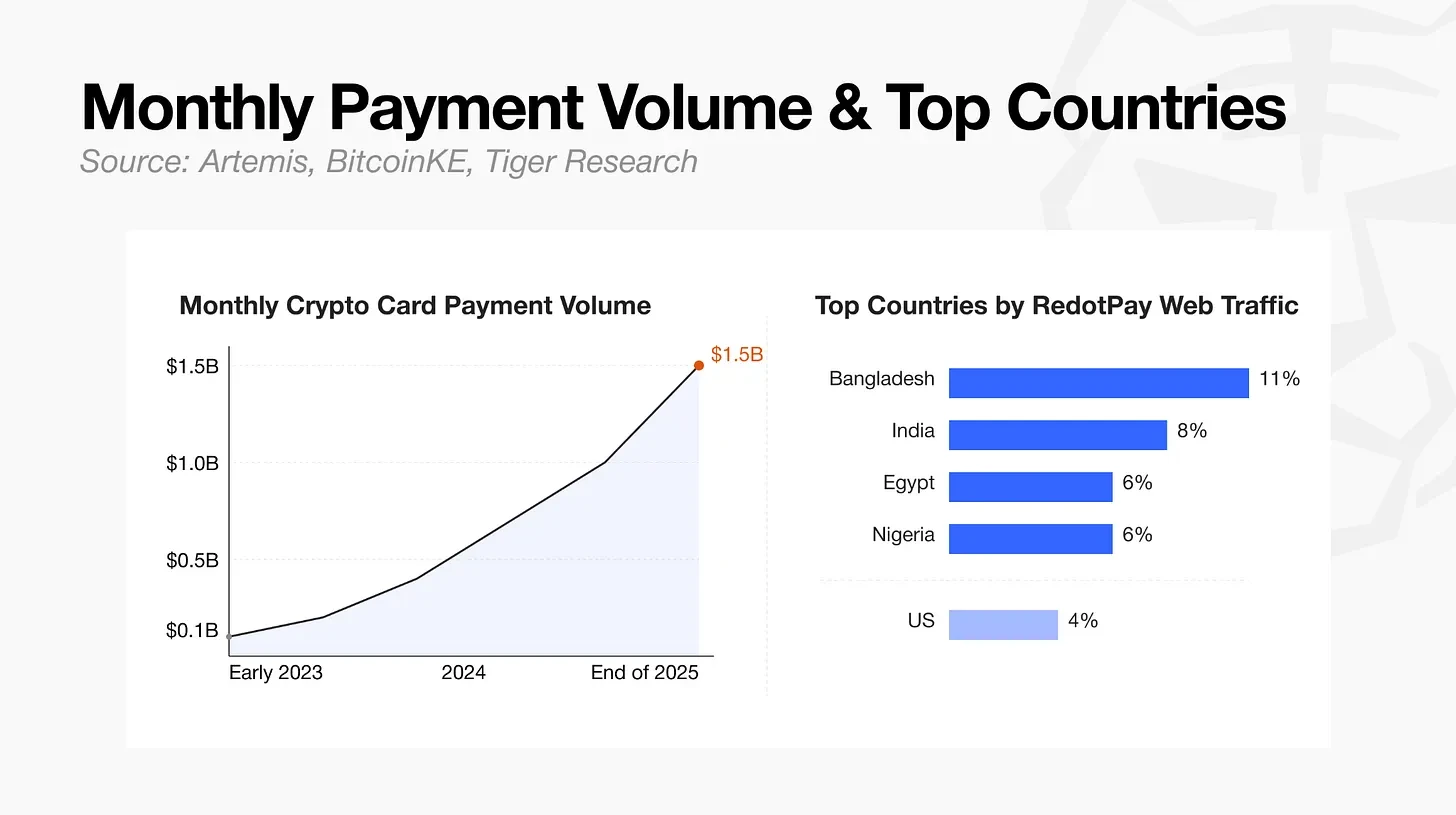
The crypto payment card industry stands at a historic inflection point. Monthly transaction volume has exploded from $100 million in early 2023 to $1.5 billion by late 2025, an annualized run rate of approximately $18 billion. Yet this rapid growth parallels the early struggles of traditional payment instruments: Bank of America's first mass-mailed credit cards in 1958 suffered 22% delinquency and $20 million losses within a year. Debit cards, introduced in 1975, only became mainstream in the 1990s when direct deposit for payroll took hold. Today's crypto payment cards remain stuck in a 'prepaid card' paradigm—most crypto wallets cannot handle regular salary deposits or recurring payments. The industry's overall development is roughly equivalent to the state of debit cards in the 1990s.
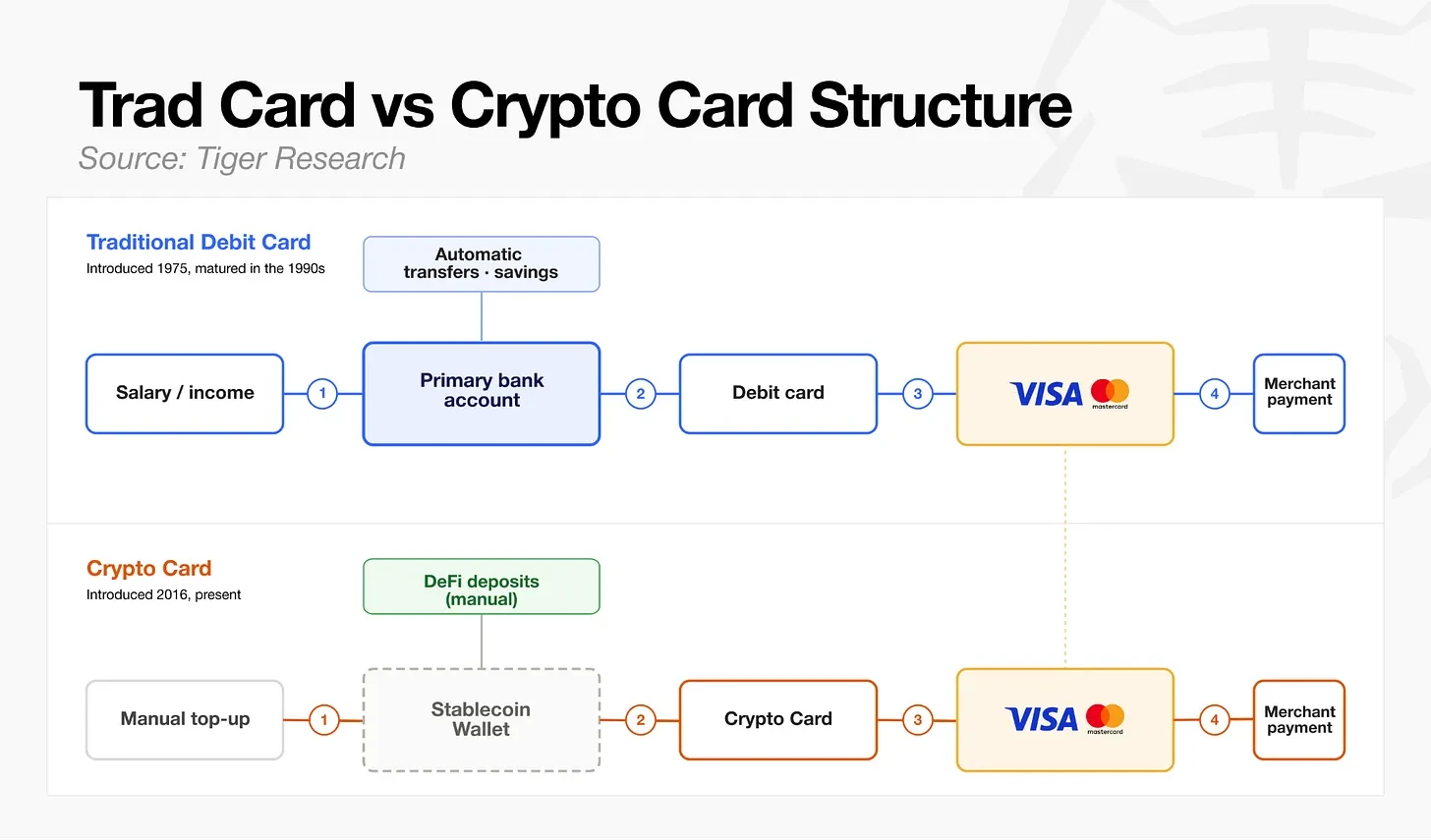
$1.5B Monthly Volume but Concentrated in Underbanked Regions
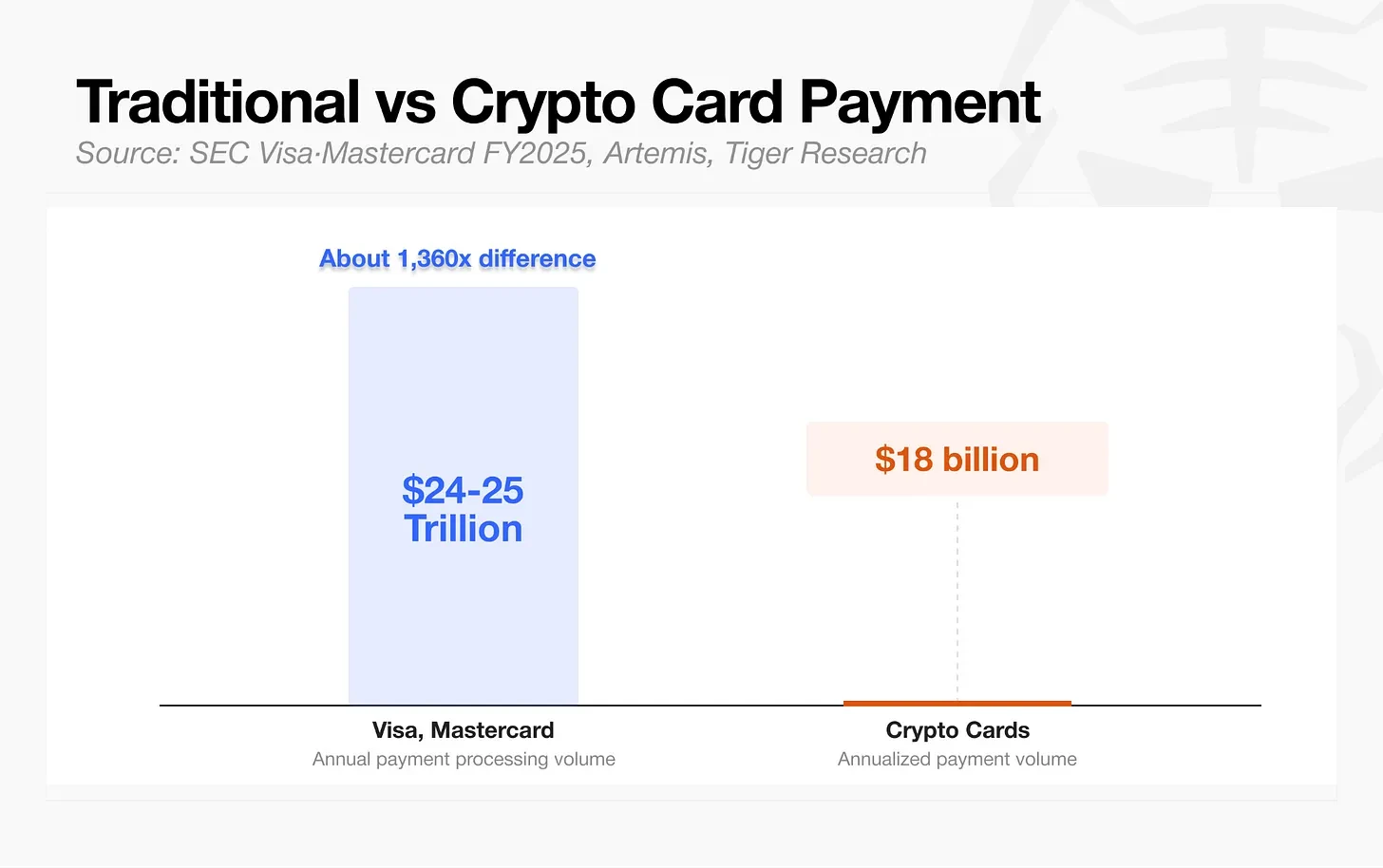
Despite the volume surge, structural disparities are evident. According to research firm Artemis, leading issuer RedotPay alone processes over half of all industry transaction traffic. User access data reveals heavy concentration in emerging markets: Bangladesh 11%, India 8%, Egypt 6%, Nigeria 6%, while the US accounts for only 4%. This underscores that real demand stems not from developed mainstream economies but from regions with limited financial services and difficult dollar access. In comparison, Visa and Mastercard each handle $24–25 trillion in annual payment volume—crypto cards' $18 billion annualized is negligible. Velocity metrics tell a similar story: stablecoin retail velocity on-chain is just 0.08, roughly one-twentieth of narrow money M1 velocity (1.65). Most users top up once and spend intermittently, rather than engaging in recurring salary deposits, daily spending, and top-up cycles.
Four Business Models: From Infrastructure to Self-Custody
The crypto card ecosystem currently features four distinct business models. 1. Card Infrastructure Providers: Traditional two-tier structure (program manager + issuing bank) under Visa/Mastercard, plus full-stack issuers like Rain and Reap that combine both functions. 2. Exchange Wallet Model: Binance, OKX and others leverage existing users, assets, and trading data to add card functionality as a retention tool and gateway to a financial super-app. 3. Wallet-as-Account Model: Assets stay self-custodied on-chain; spending settles directly from the chain (e.g., MetaMask Card). Supports credit lines with collateral but requires users to manage vaults and liquidation risk. MetaMask Card uses its own Layer 2 network Linea to reduce per-transaction gas fees to ~$0.01. 4. Stablecoin Balance Account Model: Accounts integrate FX, cross-border remittances, and savings; payment cards are just an upper-layer spending vehicle. This model is ideal for emerging markets with volatile local currencies. Infrastructure is highly concentrated: multiple seemingly independent card products (Kast, Ether.fi, Tria, Plasma One) share backend providers. Traditional fintechs like Stripe ($1.1B acquisition of Bridge in early 2025) and Mastercard ($1.8B acquisition of BVNK in March 2026) are also entering the fray, intensifying competition.
Regulatory Bottlenecks: GENIUS Act and MiCA Restrictions
The US GENIUS Stablecoin Act prohibits stablecoin interest-bearing products, while the EU's MiCA framework imposes strict rules on stablecoin-linked asset management. These constraints prevent crypto payment cards from replicating the profitable deposit-lending spread of traditional bank accounts. Reward strategies diverge: RedotPay and Revolut offer no cashback, while newcomers like Kast and Plasma One aggressively use dollar or platform token rebates to attract users. Yet subsidies alone cannot embed cards into everyday spending. Historical evidence from debit/credit cards shows that pure payment businesses have razor-thin profitability; only by integrating primary account concepts and deposit-lending margins do they become viable. Crypto cards now face the same inflection point.

Future Breakthrough: Control Upstream Fund Flows and Build Global Standards
To survive long-term, crypto card operators must pursue three strategic pillars: directly control upstream fund flows before they reach Visa/Mastercard; seize niche segments (e.g., stablecoin balance accounts in emerging markets); and establish a global standard for consumer infrastructure—without any precedent. Those that fail on these fronts will remain niche prepaid cards used only for small rebates. History shows that the dominant players in the debit card era were not those issuing the most cards but those that first secured consumers' primary banking accounts and created daily fund-flow loops. Crypto payment cards must now replicate that transformation.