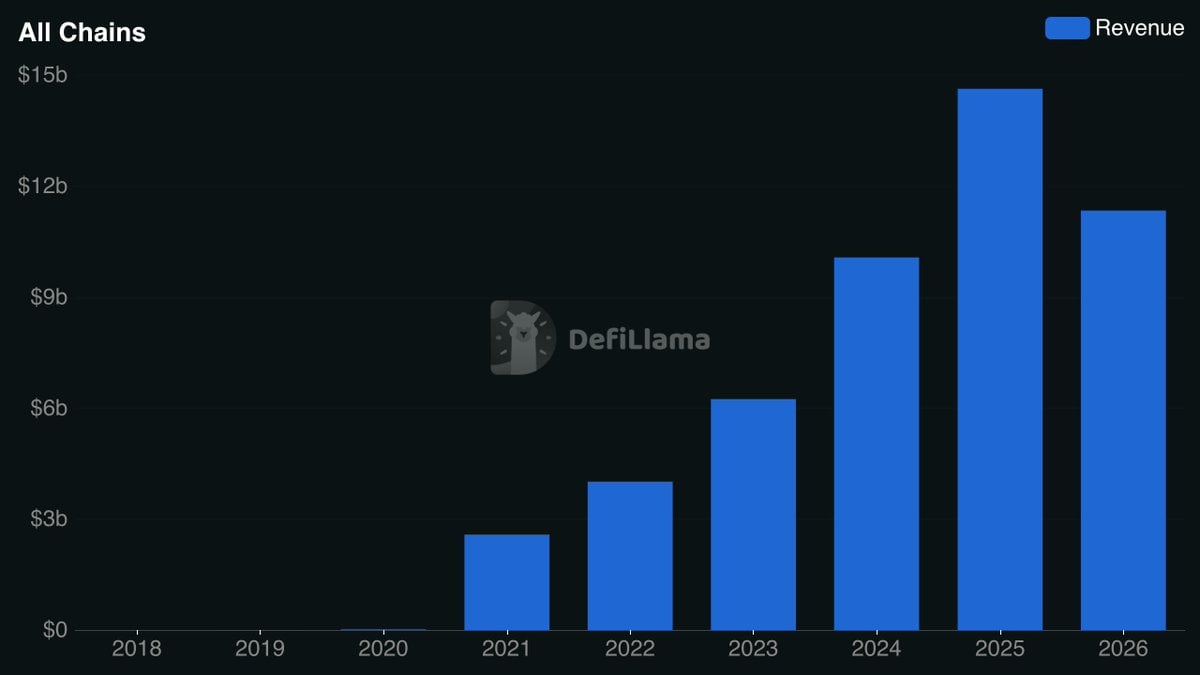
Crypto protocols generated $11.68 billion in onchain revenue year to date in 2026 and could reach approximately $13.9 billion for the full year if November and December hold near October's level, according to an analysis by WallStreetBets. That would be less than $1 billion below the 2025 total, despite a much weaker market.
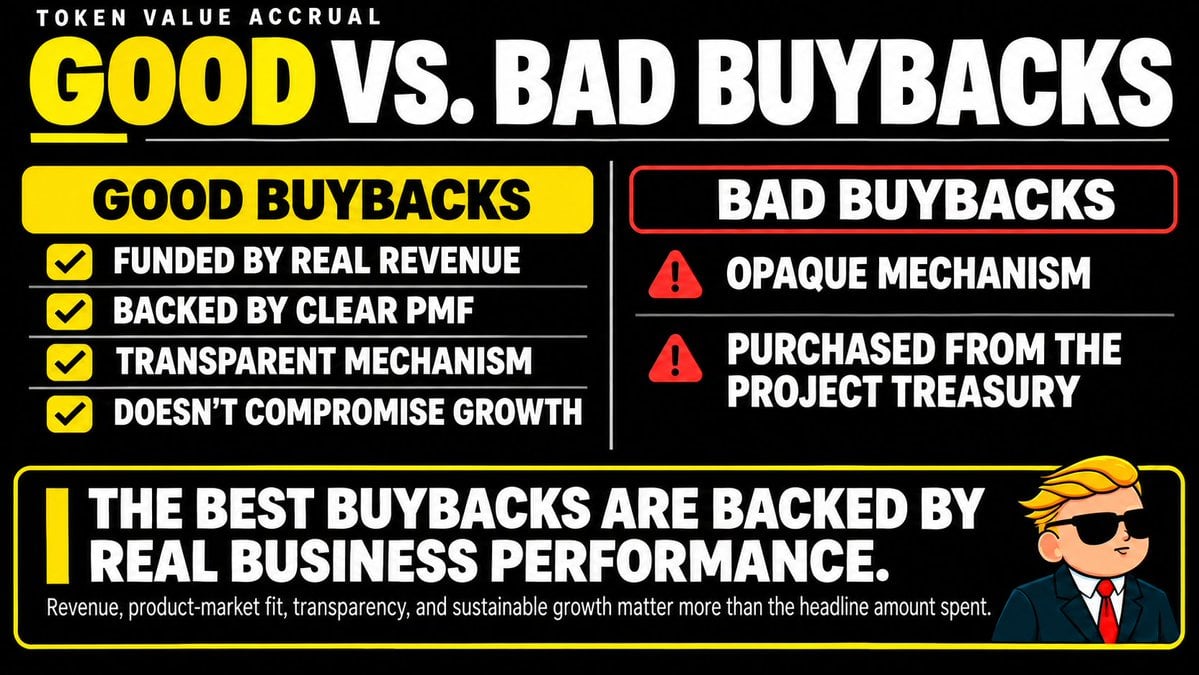
In the article compiled by TechFlow, the author reviews token buyback programs from 2025 and 2026 and argues that purchases funded by real revenue can connect business performance with token-holder value. Market conditions, new supply and the design of a buyback all affect the outcome, he says.
Why revenue is drawing attention
Some crypto companies are earning substantial profits and spending tens of millions of dollars to let token holders share in their business results, WallStreetBets writes. His research asks why fundamentals have held up while the broader market has weakened, how to assess revenue-generating businesses and why teams ranging from Hyperliquid to World Liberty Financial have adopted buybacks.
Previous investment cycles centered on non-fungible tokens (NFTs), the metaverse, SocialFi and successive public-chain ecosystems. In the author's account, those cycles often relied more on narratives and speculation than on conventional business fundamentals: capital pushed up valuations, but investors could suffer heavy losses after enthusiasm faded.
He sees a change in the industry. Trading, stablecoins and decentralized finance (DeFi) have established clearer product-market fit (PMF), while prediction markets and asset tokenization have attracted a wider audience. Institutional capital has entered through routes such as DeFi vaults that resemble traditional finance (TradFi), and regulatory work in Washington has made substantive, if slow, progress.
Venture capital firm Hack VC offered a similar assessment: 「Pure token speculation is gradually losing its appeal, and more sophisticated retail investors are getting better at identifying predatory tokens without economic backing. We see growing interest in two types of projects: those that use tokens to attract capital, liquidity and activity to strengthen product distribution, and businesses with strong revenue growth and clear paths for value to flow back to holders.」
Hack VC also said: 「As more high-volume fintech and AI businesses adopt crypto infrastructure, revenue opportunities are expanding, and investors are paying closer attention to revenue quality, profitability and long-term value capture.」
WallStreetBets argues that narratives supported by sustainable businesses may retain investor interest through market cycles, even if token prices face short-term pressure. He is adjusting his holdings toward sectors with durable demand and long-term compounding potential, an approach that previously led him to privacy and now to revenue-generating projects.
Revenue opportunities span many parts of crypto rather than a single technology or application, he writes. The businesses he wants to identify have stable customers, sustainable revenue and a way to turn commercial success into value for token holders. Traditional fundamental analysis is a starting point, but the token mechanism requires separate scrutiny.
A successful business does not guarantee a successful token
Unlike shares, most crypto tokens do not give holders legal ownership of the underlying company or its profits. A protocol can generate hundreds of millions of dollars in revenue without passing economic value to its token. Finding a profitable business is therefore only the first step, the author argues.
In conventional equity markets, companies can repurchase shares with excess cash, reducing the number outstanding and increasing remaining shareholders' ownership percentage. Crypto projects face different economic and regulatory considerations: token holders generally lack legal ownership, and directly tying their returns to a management team's efforts may raise securities-law compliance questions.
A protocol can instead use part of its revenue to buy tokens on the open market, then burn, lock or place them in its treasury. Buybacks have nevertheless been contentious over the past two years. Some projects spent hundreds of millions of dollars and still delivered disappointing token performance. WallStreetBets argues that the question is no longer simply whether buybacks work, but when, why and under what conditions they work.
Lessons from the 2025 buyback debate
In 2025, 28 major crypto projects spent more than $1.4 billion on token buybacks. Yet only three of the top 10 buyback projects—AAVE, HYPE and SKY—outperformed Bitcoin that year, and several tokens fell sharply in value. Spending millions on repurchases did not automatically produce stronger secondary-market returns.
Rather than judge a program by price alone, WallStreetBets proposes four baseline tests:
- Revenue backing: purchases should be funded by actual business revenue, not existing treasury reserves or other unsustainable sources.
- Established PMF: the business should have sufficient demand and recurring revenue to support purchases over time.
- Transparency: holders should be able to verify the source of funds, execution and destination of purchased tokens.
- Sustainable capital allocation: buybacks should not impair reinvestment in growth, financial resilience or the pursuit of higher-return opportunities.
Market conditions: Jupiter bought during an ecosystem decline
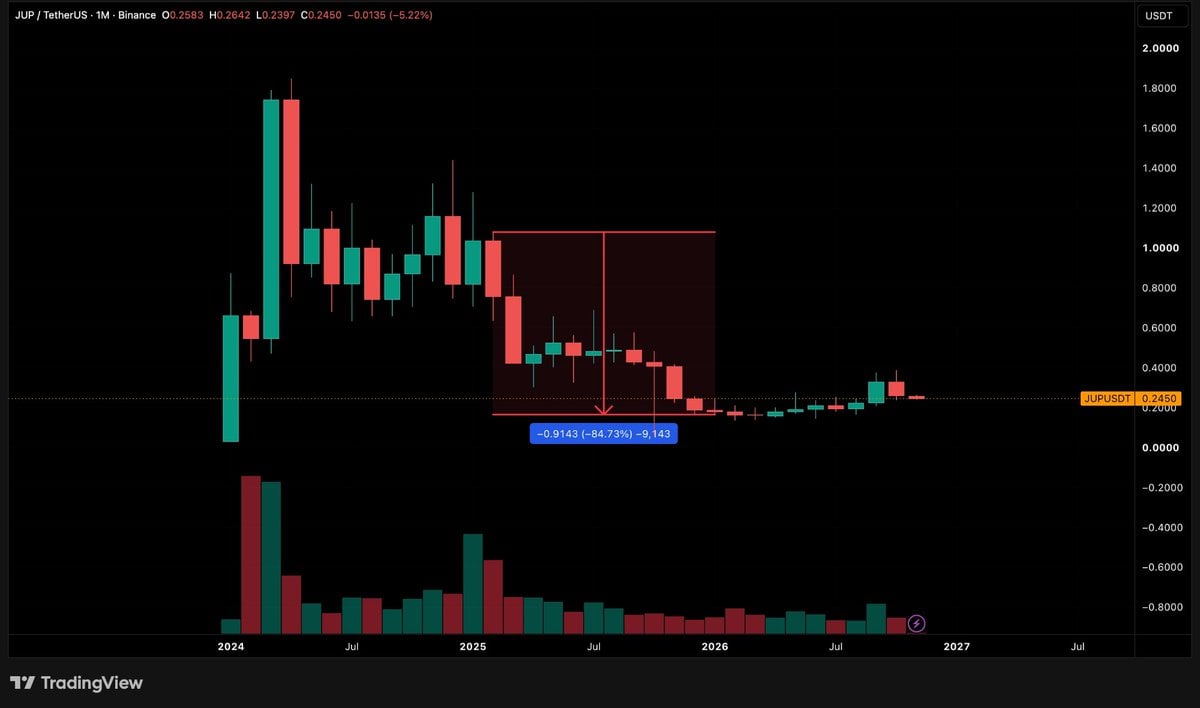
Jupiter is often cited as an example of a buyback failing to meet market expectations. In February 2025, it began allocating 50% of onchain protocol revenue to JUP purchases. By January 2026, the team had spent more than $70 million, yet JUP had fallen sharply.
Jupiter co-founder Siong Ong publicly questioned whether the program should be paused and the money redirected toward business growth. The buyback ultimately continued.
The wider Solana market matters to the assessment, WallStreetBets says. January 2025 was a local peak for the previous Solana ecosystem rally. SOL subsequently fell from $294 to $96; tokens associated with major protocols including Sanctum, Kamino and Jito dropped more than 80%, while popular meme coins Fartcoin and WIF retreated more than 90%. Against that backdrop, even more than $70 million in JUP purchases could not by itself reverse a prolonged systemic decline.
Token supply: can purchases absorb new issuance?
New tokens entering circulation are another key variable. Unlocks, inflation and other distribution mechanisms can create more selling pressure than a buyback absorbs, overwhelming its effect even when a protocol spends tens of millions of dollars.
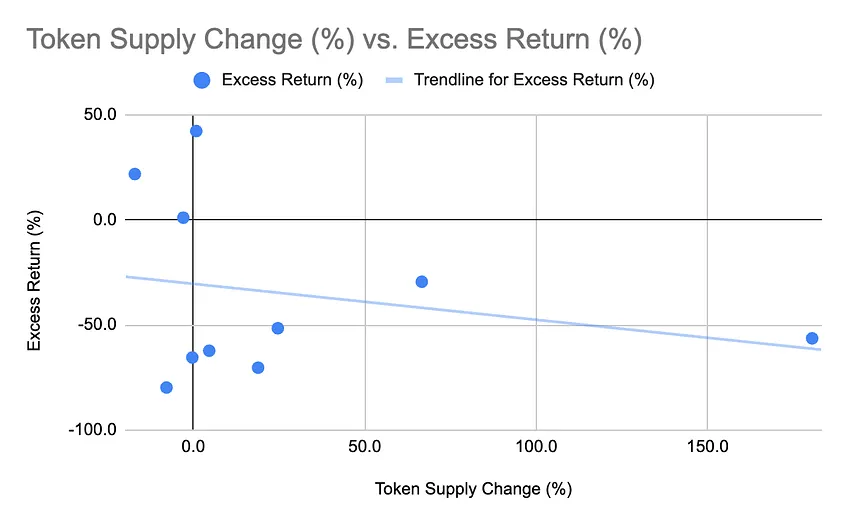
Research cited by WallStreetBets found a negative correlation between token supply growth and relative market performance among major buyback projects. The relevant question, he argues, is whether purchases improve supply and demand, not just how much a team spends.
The chart, sourced to Bill Hsu, compares supply changes and excess returns against Bitcoin for 10 major crypto buyback projects in 2025.
Execution: automatic purchases or discretion
Many protocols automatically allocate a fixed share of revenue to purchases regardless of token valuation. The approach creates predictable demand and demonstrates a commitment to holders, but it may not be the most efficient use of capital, the author says.
He contrasts it with Berkshire Hathaway under Warren Buffett. The company has historically conditioned repurchases on a share price below a conservative estimate of intrinsic value while retaining ample liquidity. The principle is to buy when undervalued and retain cash when valuations are high or better opportunities are available.
WallStreetBets sees the appeal of programmatic purchases during prolonged bear markets, when tokens tied to strong revenue-generating businesses may remain undervalued. If markets recover and valuations expand, he expects more teams to consider price, growth opportunities and capital-allocation priorities through discretionary buybacks. The objective, in his view, should be long-term holder value rather than the size of the purchase program alone.
2026 returns: a 93.8-point gap between two groups
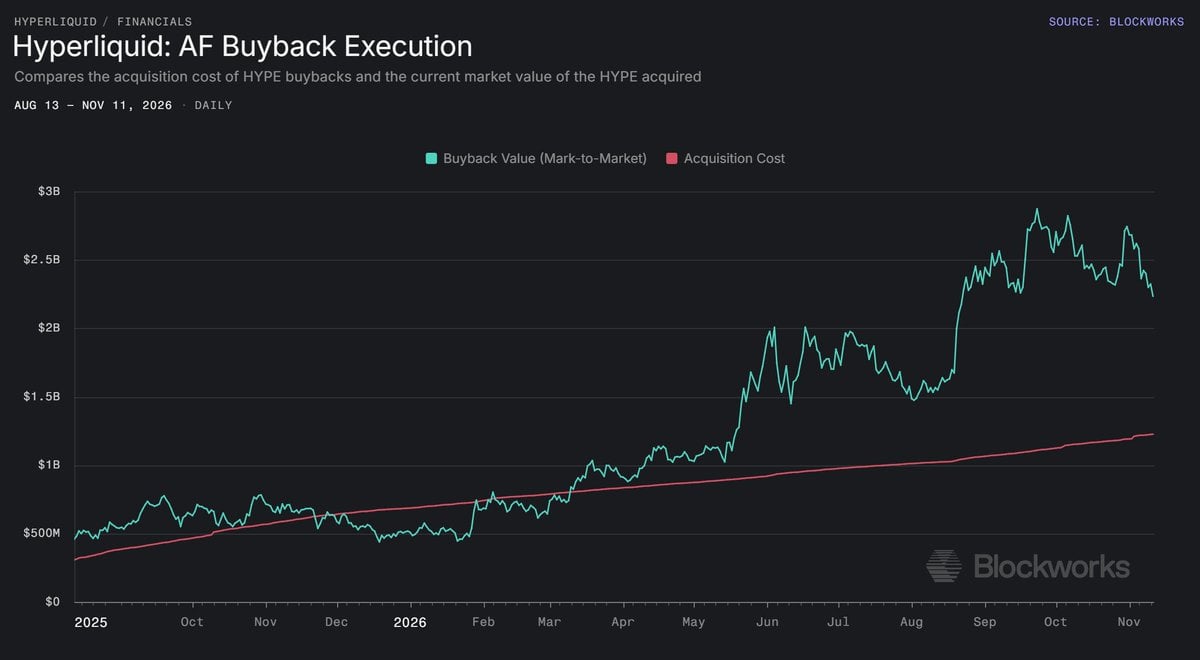
Projects spent more than $900 million on token buybacks and related burn mechanisms in 2026, the article says. Hyperliquid accounted for more than $505 million and Pump.fun for more than $269 million. Other programs included more than $56 million at Uniswap, more than $28 million at Jupiter and $34.08 million at Sky.
The accompanying chart shows a substantial unrealized gain on Hyperliquid's purchases.
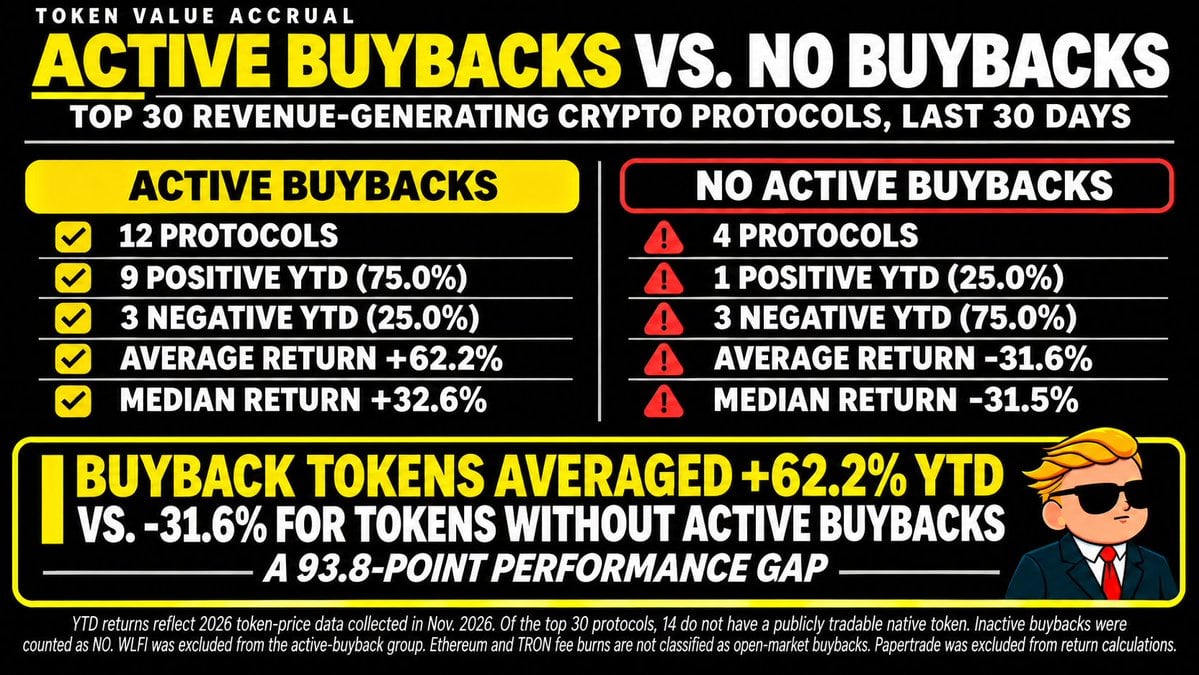
WallStreetBets examined the 30 protocols with the highest revenue over the preceding 30 days. Fourteen, or 46.7%, had no publicly tradable native token. Of the remaining 16 with investable tokens, 12 had active buyback programs.
- Among the 12 active-buyback projects, nine tokens had positive year-to-date returns and three had negative returns. The average was 62.2% and the median 32.6%.
- Among the four without active programs, one token had a positive return and three had negative returns. The average was -31.6% and the median -31.5%.
The average-return gap was 93.8 percentage points. The author notes that the positive returns came while total crypto market capitalization had fallen approximately 19% year to date.
The calculation uses token prices collected in November 2026. Projects with discontinued buybacks were assigned to the non-buyback group. World Liberty Financial was excluded because its program had only recently begun; automatic fee burns on Ethereum and Tron were not treated as open-market buybacks; and Papertrade was excluded because its token launched only in October 2026 and lacked regular spot trading.
World Liberty Financial started its WLFI buyback during the preceding week, the article says. WallStreetBets expects more teams to follow in the first quarter of the following year; that is his forecast, not an announced set of plans.
Buybacks versus direct distributions
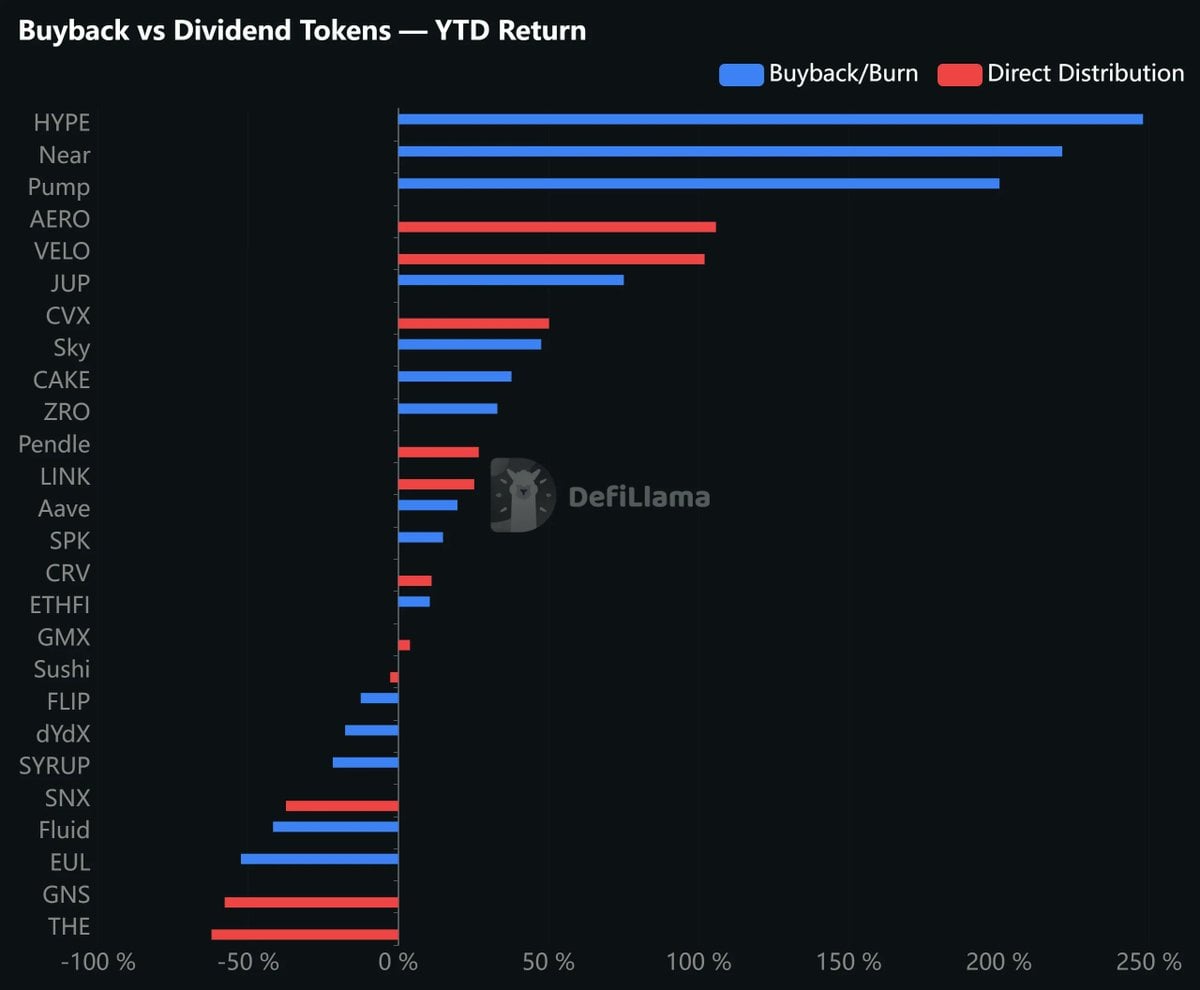
A September 2026 DefiLlama analysis compared tokens associated with buybacks with those distributing revenue directly. Median year-to-date returns were 19.7% for the buyback group and 11.1% for the direct-distribution group. Weighted by market capitalization, the respective returns were 190% and 29%.
The same research found that, through September 2026, crypto protocols had generated more than $1 billion in aggregate monthly revenue for 23 consecutive months. Roughly 5% of that revenue went to token holders two years earlier; by September 2026 the share had tripled to 15%.
WallStreetBets reads the results as three signals: buyback projects generally performed better in the secondary market in his sample, buyback tokens outperformed direct-distribution tokens in the DefiLlama analysis, and a larger share of protocol revenue was reaching holders.
Where the author is looking next
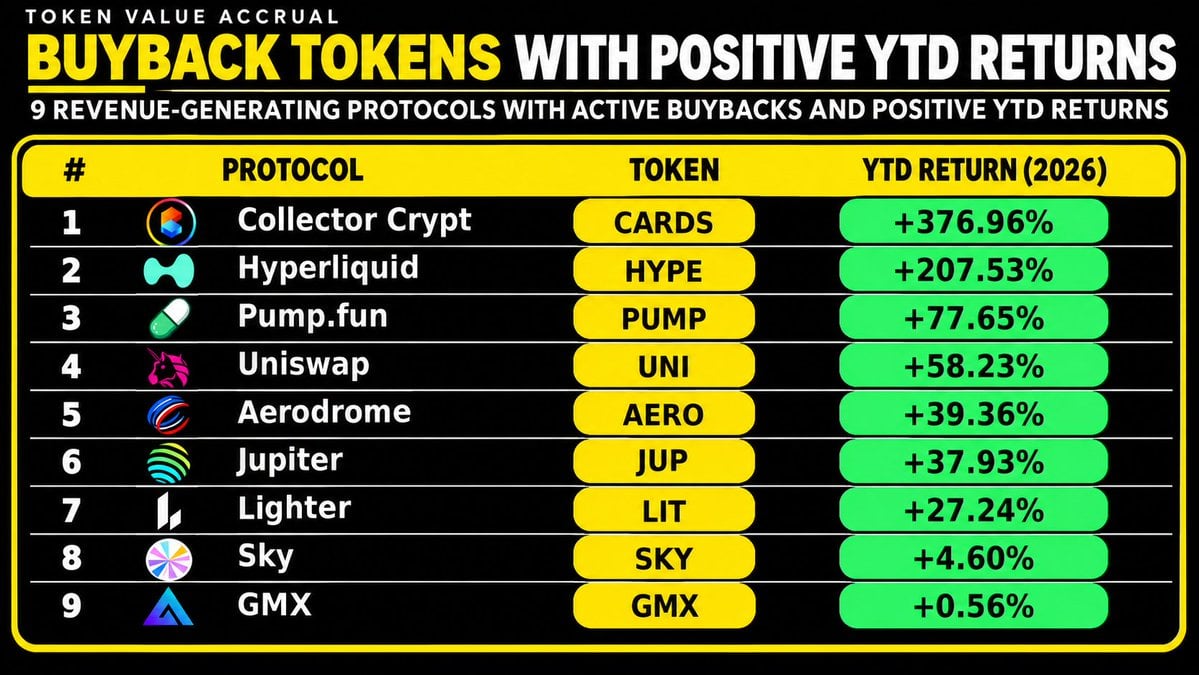
Nine of the 30 high-revenue protocols in the author's sample combined active buybacks with positive year-to-date token returns. Alongside individual projects, he examines the revenue available across sectors, seeking businesses that execute buybacks appropriately in markets with long-term growth potential.
The article estimates total crypto industry revenue at $86.4 billion in 2025 and cites an institutional forecast of $305 billion by 2030. It also cites research projecting that stablecoins and real-world asset (RWA) lending will be among the fastest-growing areas, with annual revenue of $60 billion and $15 billion respectively by 2030. The forecasting institutions are not named in the article.
World Liberty Financial: USD1 reserve income and WLFI
WallStreetBets considers stablecoins one of crypto's strongest PMF cases, but says ordinary investors have had few direct ways to capture their economic value. He cites Tether, Circle, World Liberty Financial and Ethena as examples of companies and protocols that have demonstrated the business scale of stablecoins.
The available exposures differ. Tether remains privately held. Circle offers equity exposure but shares substantial revenue with distribution partners. Coinbase receives some USDC revenue, although its share price reflects a broader business. Holding XRP or PayPal shares does not directly correspond to RLUSD or PYUSD revenue.
World Liberty Financial has allocated part of the income associated with USD1 reserves to WLFI purchases; that income exceeds $150 million on an annualized basis. WallStreetBets says the program creates a more direct link between the stablecoin business and WLFI demand. In his assessment, greater USD1 circulation would increase reserve income and the funds available for purchases. He calls it a direct attempt to connect a stablecoin issuer's economics with a publicly traded token.
Venice: subscriptions and API purchases drive burns
Privacy-focused artificial intelligence (AI) platform Venice recently passed 4 million users and exceeded $100 million in annualized revenue. On November 9, it carried out its largest monthly discretionary VVV burn to date, removing approximately $458,000 worth of tokens.
Automated burns driven by new subscriptions and application programming interface (API) credit purchases rose 40% month over month in October. Venice burned approximately $1.07 million of VVV during the month, and the article projects that November could reach a record $1.14 million.
WallStreetBets says few crypto-linked companies have achieved comparable commercial scale outside crypto. He attributes VVV's more than 1,200% year-to-date rise to market buying together with the buyback and burn mechanism.
Bittensor: subnets buy Alpha tokens with external revenue
Bittensor operates through subnets that compete for TAO emissions. WallStreetBets compares each subnet to an independent technology startup: demand for its Alpha token directly affects its share of incentives, making token performance relevant to a team's ability to keep operating.
Buybacks, burns and emissions management have consequently become central to subnet strategy. The author describes the ecosystem as a continuing token-economics experiment that other teams considering buybacks can study.
SubConnect's Bittensor revenue index showed that, as of August 2026, 14 of 24 subnets generating external revenue used that income to buy Alpha tokens. The combined annualized revenue of those 24 subnets was estimated at $28 million to $35 million.
One example is Targon, which the article identifies as Bittensor's third-largest subnet by market capitalization. On October 27, Targon announced a burn of approximately $2.1 million in Alpha tokens, including about $445,000 of newly repurchased tokens. The purchase was funded entirely by revenue from its AI computing business.
Within seven hours of the announcement, SN4's weekly gain exceeded 13%. At the time of writing, despite a broader crypto pullback, its price remained about 3% above its pre-announcement level. WallStreetBets sees the response as evidence that subnet investors watch emissions management, revenue and token demand closely; he speculates that the broader market could evolve similarly as buybacks spread.
Robinhood Chain: LONG 500 links community tokens and stocks
WallStreetBets also highlights buyback experiments involving tokenized real-world assets on Robinhood Chain. In September 2026, Long introduced LONG 500, a shared economic model connecting community tokens with tokenized equities.
- Of the stock-token fees generated by new trading pairs, 5% goes to the AI community treasury to accumulate tokenized equities in a shared reserve.
- Another 5% buys and burns the community token paired with each stock. Anyone can trigger execution.
The author says the design combines token purchases with the accumulation of real-world financial assets. As more stock communities launch and trade, he argues, it can reduce participating community-token supply, support liquidity and increase ecosystem reserves. He expects to see more comparable mechanisms on Robinhood Chain.
The author's outlook for a stronger market
WallStreetBets argues that crypto now has enough commercial activity and financial performance to support fundamentals-based investment. Despite difficult market conditions, he says, some leading revenue-generating businesses have delivered strong token returns, expanded their user bases and grown revenue.
If conditions improve, he expects greater adoption and market activity to increase revenue. Where a substantial portion is allocated to buybacks, demand for tokens could grow alongside the business. He also sees recovering sentiment and new capital as potential sources of outperformance.
Even if forecasts for hundreds of billions of dollars in annual industry revenue by 2030 are only directionally correct, the author believes substantial economic value remains to be realized. On that basis, he concludes that the crypto revenue narrative is still in its early stages.