
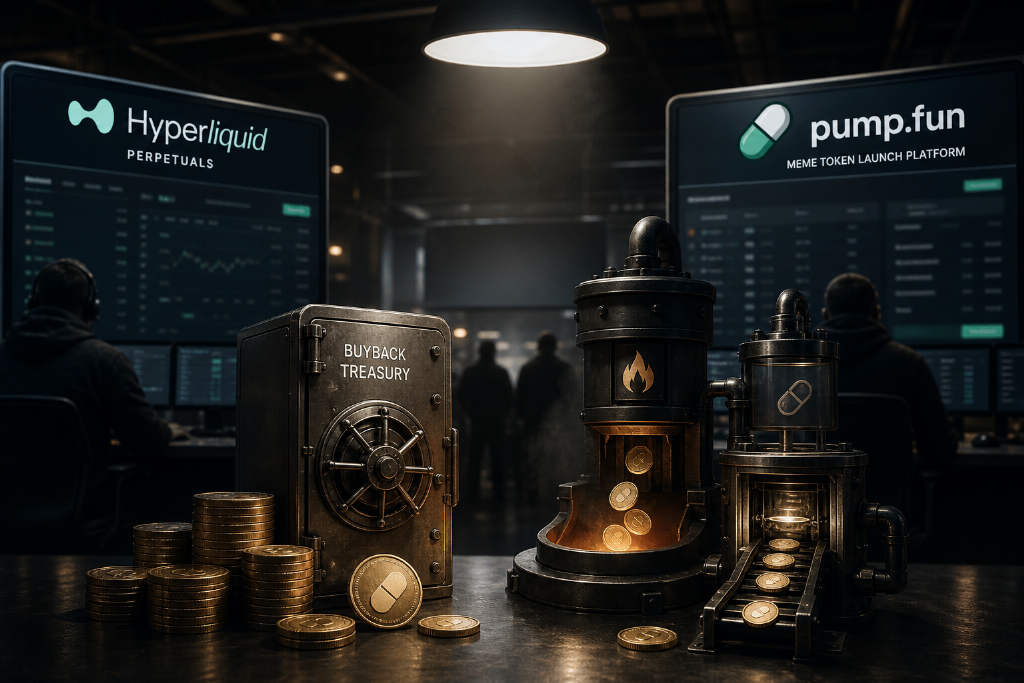
Crypto projects have spent a record $638 million on token buybacks in 2026 through Aug. 31, but the total is far less broad-based than the headline suggests. About 90% of the money came from two names alone: Hyperliquid, which earns fees from perpetual futures trading, and Pump.fun, which collects fees from memecoin launches.
That split captures the current turn in tokenomics. Projects are moving the value-capture story away from inflation and toward operating revenue, yet much of that revenue still comes straight from trading activity.
$638 million in buybacks, but most of it is concentrated in two projects
The report says crypto projects spent a combined $638 million on buybacks from the start of 2026 to Aug. 31, the highest level on record. The comparable figure was $545 million a year earlier, while full-year 2024 buybacks totaled just $366,000.
Distribution was highly uneven. Hyperliquid accounted for about $370 million and Pump.fun contributed nearly $200 million, leaving all other projects to share roughly the remaining tenth.
Looking over a longer period, research firm Tokenomist put total buybacks and burns since January 2025 at about $18.8 billion across 27 tokens. More than 80% of that came from burns, and the bulk was tied to established, revenue-generating blue chips such as BNB, ETH and OKB rather than the newer buyback programs driving the current narrative.
In other words, the noise around the buyback wave is larger than its actual scale.
Tokenomist grouped 15 tracked projects into three buckets:
- Profitable exchange and public-chain blue chips: BNB, ETH, OKB, BGB and LEO
- The most visible buyback names in this cycle: HYPE, PUMP, ASTER and JUP
- The remaining six: PENDLE, AAVE, UNI, ETHFI, KAITO and RAY
All three groups are changing the supply side. The difference is whether they can keep doing it.
Hyperliquid and Pump.fun are driving the revenue story
According to real-time data from DefiLlama cited in the report, Hyperliquid generated $68.29 million in fees over the past 30 days, or roughly $830 million annualized. Pump.fun generated $47.72 million, or about $580 million annualized. By that measure, both sit near the top of the industry in cash flow.
The market performance has also stood out. HYPE is up 145% in 2026 and PUMP has gained 109%. Over the same period, Bitcoin is down 10% and the total crypto market capitalization is down 11.9%.
The two tokens outperforming the wider market are backed by different fee streams, but both are still tied to trading. One takes a cut from perpetuals activity, the other from memecoin issuance. The report’s point is blunt: “real revenue” is real, but speculation has not disappeared from crypto. It has been turned into a fee mechanism, and that toll is then used to buy back the issuer’s own token.
Only BNB and RAY are actually shrinking on a net basis
Buybacks are meant to reduce supply. The problem is that supply often keeps growing at the same time through issuance and unlocks.
Once Tokenomist included new unlocks, only two of the 27 tracked tokens showed net deflation: BNB and RAY. The rest were still expanding in effective supply.
HYPE is still increasing annualized supply by about 47% even though buyback funds are being used for burns. ASTER is up 24% because the repurchased tokens are redistributed to stakers rather than destroyed. PUMP is rising 14%, and KAITO is close to 100%; its buybacks have already been paused.
Tokenomist’s conclusion, as quoted in the report, is that “buybacks or burns only matter if they exceed issuance.”
Ethena’s buyback vote passed, but the trigger has not been met
Ethena’s governance vote closed on Sept. 2. A total of 17.6 million ENA were cast in favor, with zero votes against. The proposal would direct 95% of protocol net revenue to buy back ENA.
For now, none of that money will be deployed. The mechanism only starts if USDe circulating supply returns to $7.5 billion. It currently stands at $4.12 billion, meaning supply would need to grow 82% before buybacks begin.
The report uses that case as a clean entry point into the 2026 tokenomics debate: a unanimous buyback decision that has passed, but is not yet active.
Solana’s governance vote exposed the supply math
Solana completed its first on-chain governance vote in August, and the three proposals produced sharply different outcomes.
- SGP-0001, the governance constitution, received 95.35% support and came close to unanimous approval.
- SGP-0002, which speeds up inflation reduction, won 68.77% support, just above the two-thirds threshold.
- SGP-0003, which would have increased transaction-fee burns, received 62.72% support and failed to pass.
SGP-0002 raises the annual decay rate of new SOL issuance from 15% to 30% and brings forward the point at which the minimum 1.5% inflation rate is reached from 2032 to 2029. Over six years, that would reduce issuance by about 18.9 million SOL.
SGP-0003 is where the arithmetic becomes clearer. The proposal would have lifted daily burns from about 650 SOL to 7,500 to 9,000 SOL. That sounds large, but the Solana network is still producing about 60,000 new SOL each day. Even if the proposal had passed, net supply would still have been rising.
It did not pass. Abstentions totaling 20.75% kept it below the required threshold.
The report also noted that Nasdaq-listed Solana Company, ticker HSDT, publicly backed the governance constitution on Aug. 21 while opposing the other two proposals. Its stated reason was that institutional investors need predictable economic rules for multi-year planning. The conflict was straightforward: token holders want scarcity, while listed companies want stability.
Even then, passage would only amount to authorization. The technical changes would still need to be developed and deployed.
Ether.fi is presented as a cleaner comparison case
If real revenue can support token prices, the report says Ether.fi may be one of the cleaner examples to watch. Spending on its Cash card rose from $54.3 million in January to $100.3 million in July, an 85% increase. Monthly active addresses climbed from 21,898 to 40,040, nearly doubling. Cash’s share of monthly revenue increased from 17% to 46%.
The source text cuts off at that point, and no further details were provided in the input.