

CryptoRank recorded 153 distinct venture firms participating in disclosed crypto financings in July as of July 31, the lowest monthly level since November 2020. The figure counts de-duplicated institutions that joined at least one disclosed crypto round during the month. It does not mean the market has been reduced to only 153 venture firms.
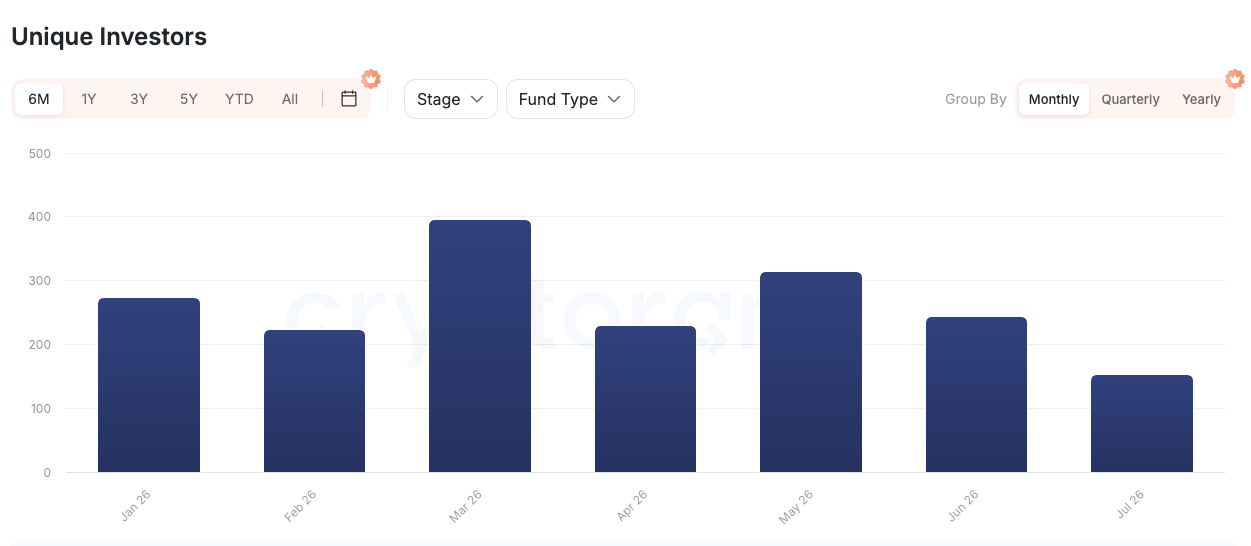
That number had reached a monthly peak of 1,177 in 2022, then fell by about 87%. On a quarterly basis, 651 firms participated in crypto financings in the second quarter of 2026, down about 75% from 2,564 in the second quarter of 2022.
CryptoRank data also shows the count hit 395 in March 2026, briefly recovered to 314 in May, slipped to 244 in June, and then dropped to 153 in July.
Global venture capital is still expanding, but crypto is losing share
The decline in crypto-focused venture participation has come during a period of expansion in global venture capital. In the second quarter of 2026, global venture investment reached $227.4 billion across 8,440 deals, the second-highest quarter on record. First-half investment totaled $560.4 billion, trailing only the same period in 2021. Large AI rounds for companies including Anthropic, Prometheus, and DeepSeek were cited as the main driver.
KPMG said global venture funds had raised about $98.8 billion across 727 funds by the end of the second quarter. Nineteen funds larger than $1 billion pulled in a combined $53.2 billion, more than half of the total. Deal volume remained soft, while large pools of capital continued to flow mainly to AI and mature companies with validated business models.
Crypto moved in the opposite direction. Galaxy Research said crypto and blockchain startups closed 355 financings worth about $4 billion in the first quarter of 2026, down 16% and about 50% quarter over quarter, respectively. Only eight new crypto venture funds closed during the quarter, raising about $1.1 billion in total, the lowest level since the third quarter of 2020.
Galaxy attributed the tougher fundraising backdrop to several factors: pressure on historical returns after the industry's turmoil in 2022 and 2023, the macro environment, AI competing for limited partner capital, and spot crypto ETFs plus digital asset treasury companies offering more liquid crypto exposure. Capital is still available globally, but both allocation priorities and the roster of managers receiving commitments are narrowing.
$11.778 billion raised in the first seven months, with May contributing one-third
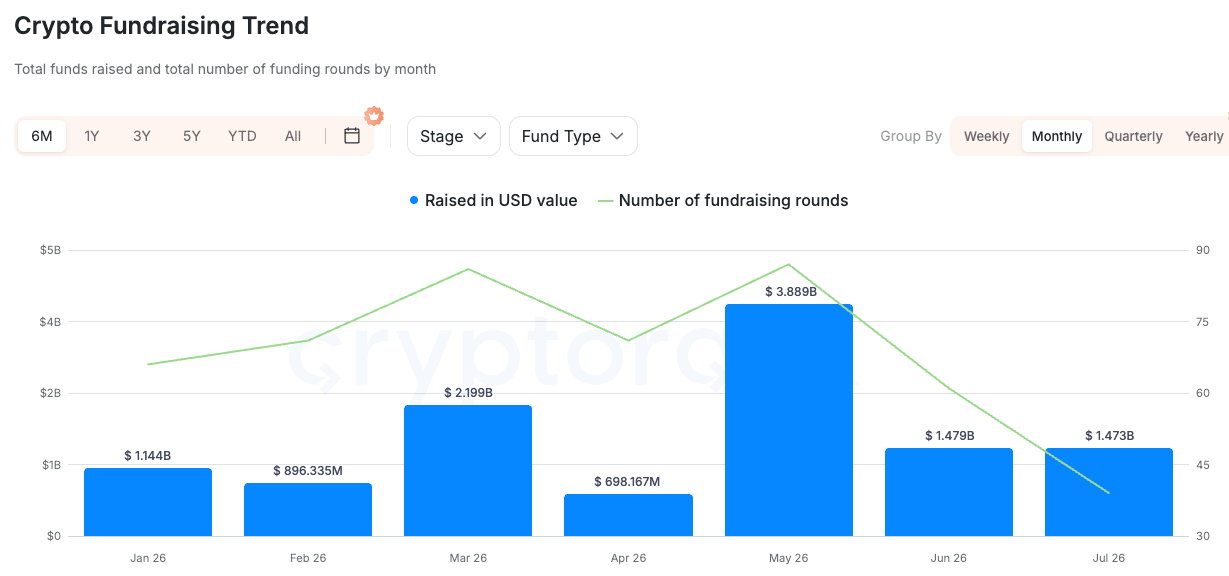
CryptoRank's public dashboard showed that crypto projects completed 481 funding rounds worth about $11.778 billion in the first seven months of 2026, as of July 31.
May marked the high point of the year with $3.889 billion raised across 87 rounds, accounting for about 33% of the seven-month total. April had posted only $698 million across 71 rounds. Funding volume in May was 5.6 times the previous month, while the number of rounds increased by only about 23%. Similar numbers of deals produced sharply different dollar totals, pointing to a monthly curve driven by a small number of outsized transactions.
March and May together absorbed about $6.088 billion, or roughly 52% of the year's total so far. Funding then fell back to $1.479 billion in June and $1.473 billion in July, while the number of publicly recorded rounds dropped from 61 to 39.
Exchanges, prediction markets, and payments took 53% of the money
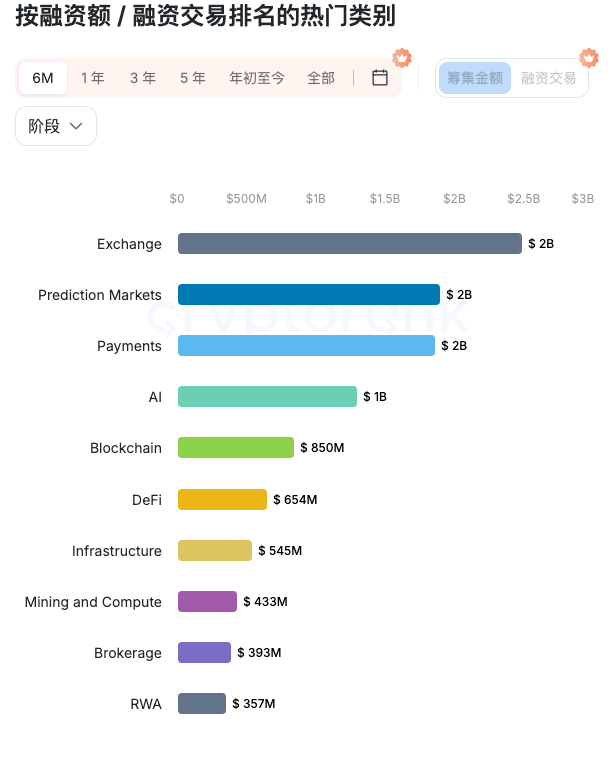
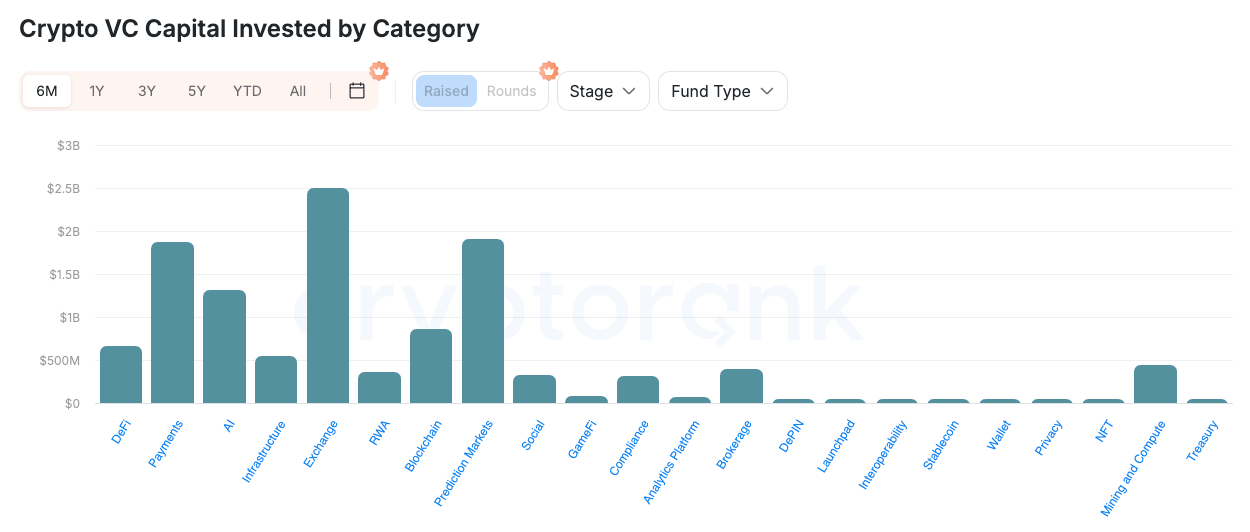
Using CryptoRank's project categories, exchanges, prediction markets, and payments ranked as the top three sectors by dollars raised this year, taking in $2.490 billion, $1.897 billion, and $1.861 billion, respectively. Together they drew about $6.247 billion, or 53% of the first seven months' total. AI ranked fourth with $1.305 billion.
Deal count and capital raised did not line up neatly. DeFi led all categories with 78 rounds, yet brought in only about $654 million. Payments and AI logged 73 and 65 rounds, respectively. Early-stage activity remained present at a fairly high frequency, but larger checks were concentrated in areas such as exchanges and prediction markets that can absorb later-stage financings.
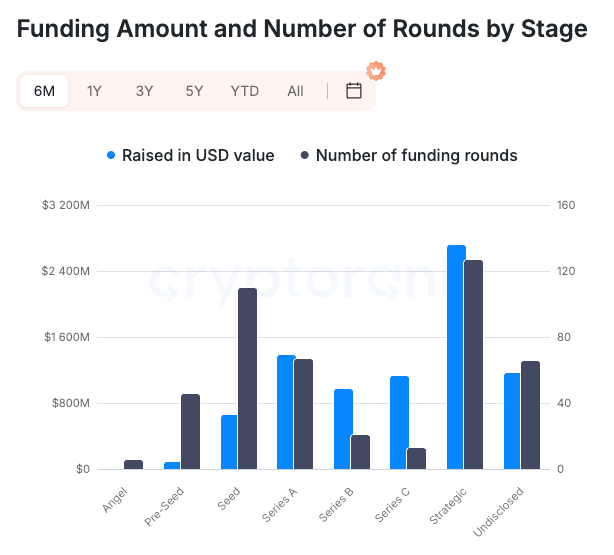
The stage breakdown made that gap even clearer. Series C and later rounds totaled only 20 deals, but they drew about $3.333 billion. Seed-stage rounds, including pre-seed and extension rounds, totaled 156 deals with about $750 million disclosed. Strategic rounds reached 127 deals worth about $2.718 billion. Most rounds were concentrated in early-stage and strategic financings, while the annual peaks in dollars were lifted by a smaller number of late-stage transactions.
M&A surged, and repeat investors became more important
Crypto industry M&A volume rose from $272 million in the fourth quarter of 2025 to $7.23 billion in the second quarter of 2026, an increase of more than 26 times over six months. That amount is not included in the $11.778 billion financing total above, but it still indicates that capital is moving into companies that already have operating businesses and assets through acquisitions.
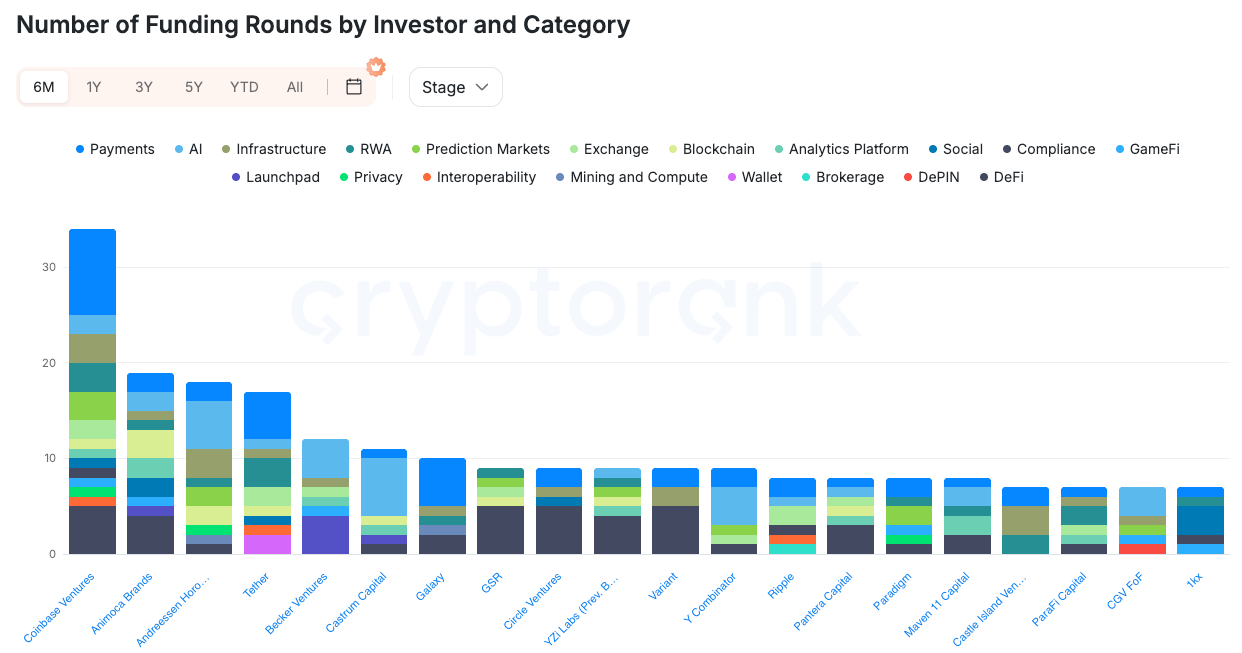
The investor league table also points to concentration. Coinbase Ventures participated in 34 rounds this year, while Animoca Brands, a16z crypto, and Tether joined 19, 18, and 17 rounds, respectively. Repeat participation by the same firms can lift deal counts without increasing the de-duplicated investor metric, which helps explain why financing activity continues even as the number of active institutions keeps falling.
Top funds are still raising money while smaller firms fade from new rounds
Large managers are still able to secure major commitments. Dragonfly closed its fourth fund at $650 million in February, and a16z crypto announced a $2.2 billion fifth fund in June. At the same time, Galaxy Research said only eight new crypto venture funds closed in the first quarter of 2026, raising about $1.1 billion in total, the fewest since the third quarter of 2020. The list of managers that can keep raising capital is getting shorter.
Dragonfly partner Rob Hadick previously described the current phase as a "mass extinction" for crypto venture capital in an interview with Fortune. The number of active firms is down by nearly 90% from its peak, even as overall global venture capital has expanded during the same period. That gap suggests the contraction is tied more to capital allocation than to a broad shortage of money. AI and secondary-market vehicles have both diverted capital that might once have gone to primary crypto deals.
Early-stage projects are still getting funded with some regularity, but ticket sizes remain limited. Larger pools of money are clustering in a handful of later-stage segments such as exchanges and prediction markets, as well as in M&A transactions. The crypto primary market has not disappeared, but risk appetite has narrowed and is now leaning more heavily toward companies with proven operations and accumulated assets.
Large funds are completing big raises, while many small and mid-sized firms are no longer showing up in new rounds. For startup teams, that changes the market in practical ways: fewer investors to approach, less room to negotiate terms, and a higher screening bar. A decline in firm count, capital raised, and deal frequency does not automatically signal something negative on its own, but it does point to a market with a higher threshold for project quality, capital efficiency, and exit visibility.