
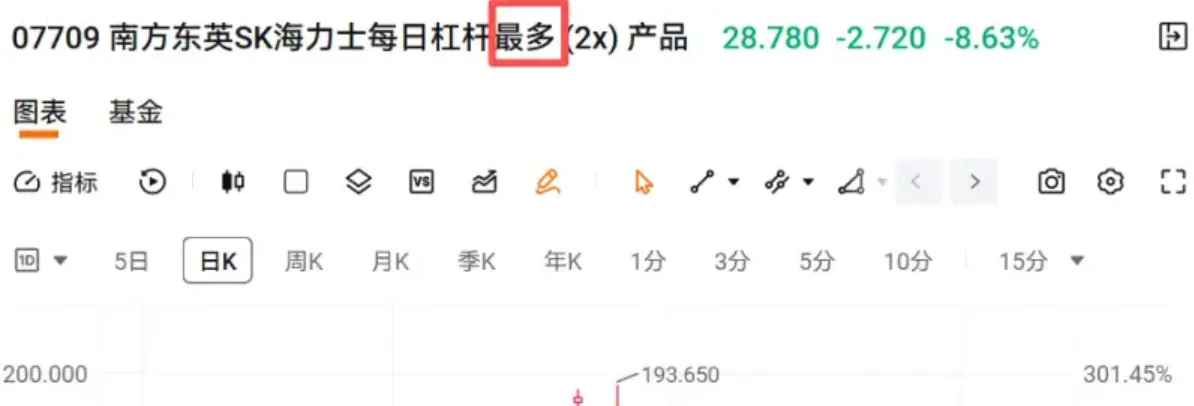
A name change is usually routine. In the case of CSOP’s 07709, the extra words matter.
What had been marketed as “2x long SK Hynix” is being reframed as “up to 2x long SK Hynix.” The source article argues that this shift does more than update branding. It changes how leverage is described and may weaken the path some holders were counting on to recover losses.
From a steep run-up to a deep drawdown
07709 is described in the article as a CSOP leveraged ETF linked to South Korean chipmaker SK Hynix.
The article says the fund listed in October 2025 at HK$7.8. As the AI trade accelerated and SK Hynix benefited as a key supplier of HBM chips, the product surged. By June 2026, its price had climbed to HK$193.65, more than 10 times the listing price, while assets under management had exceeded HK$130 billion.
The reversal was just as dramatic. In late June, after SK Hynix shares pulled back from their highs, 07709 fell sharply. The article puts the maximum drawdown at nearly 87%, with the product dropping from HK$193.65 to around HK$25. It adds that a market value once measured in the hundreds of billions of Hong Kong dollars was largely wiped out. At the time of publication, the latest price was HK$28.6.
Flexible leverage starts on Aug. 3
As holders waited for a rebound in the underlying stock, CSOP announced on July 27 that the product would move to a “flexible leverage structure” from Aug. 3.
Instead of maintaining a fixed 2x target, the ETF will be able to adjust leverage dynamically within a range of 1.1x to 2x.
The article sums it up in simple terms: keep leverage close to 2x when conditions are favorable, and cut it toward 1.1x when markets weaken.
That mechanism can reduce losses during a selloff. The article acknowledges that point. It also argues that if SK Hynix rebounds after a deep correction, lower leverage would slow any recovery in net asset value, leaving losing investors with a longer road back and a higher time and capital cost.
The piece also notes that shares of SK Hynix and Samsung Electronics have already seen sizeable pullbacks, and says Morgan Stanley had issued a report arguing that the deleveraging phase in Korean equities was nearing its end and that valuations were becoming attractive again.
New SFC rules provide the backdrop
The article ties the change to a specific regulatory development. On July 24, Hong Kong’s Securities and Futures Commission issued new rules for leveraged products, allowing them to adjust target leverage in extreme market conditions.
On that basis, the article says the fund manager may not have breached the rules procedurally. Its criticism is different. It asks whether compliance alone is enough when the risk-reward profile sold to investors is altered after a steep decline.
In the article’s framing, “2x” helped attract assets on the way up, while “up to 2x” gives the manager room to scale back exposure on the way down. The result, it says, is that the same product and the same holders face a different set of expectations depending on market direction.
Questions raised about contract-change procedures
The source article goes on to discuss what it describes as the normal process in Hong Kong for major changes to a fund contract, particularly when revisions involve the investment objective, performance benchmark, or diversification limits and could impair investors’ original expectations.
- First, the fund manager and trustee submit the proposed change to the SFC in advance and obtain preliminary regulatory feedback.
- Second, a circular is sent to all holders and a holders’ meeting is convened.
- Third, a special resolution must pass, with more than 75% of the voting units present in favor.
- Fourth, at least 30 days’ notice is required so investors have time to redeem and exit.
- Fifth, the contract revision only takes effect after final SFC approval.
Based on that framework, the article asks whether CSOP followed those steps, whether holders approved the change at a formal meeting, and whether investors who suffered losses should consider seeking compensation if there were procedural defects.
Fees and the debate over aligned interests
The article also focuses on fees. It says the fund charges a 1.60% annual management fee and has generated about HK$356 million in cumulative fee income since listing.
Its point is that fee income rose while net asset value was surging and continued to be collected after the collapse. Now, with the leverage rules adjusted, the article argues that the fund manager has reduced liquidation risk and preserved its ability to keep earning fees, while investors who bought near the highs may lose what they saw as their last chance to recover through a rebound in the underlying stock amplified by leverage.
The article characterizes the renaming and structural change as a trade-off: weaker recovery potential for holders in exchange for greater survivability for the fund itself.
The dispute is about rules and trust
It also notes that, in theory, the manager could raise leverage back to 2x if it judged that the stock had bottomed and was set to rebound. That, the article says, would require a high degree of market timing skill. It then asks why such skill did not prevent the steep drawdown seen over the past month.
The closing argument in the source piece is that the real issue goes beyond price charts. It is about rules, contractual expectations, interests, and trust.