
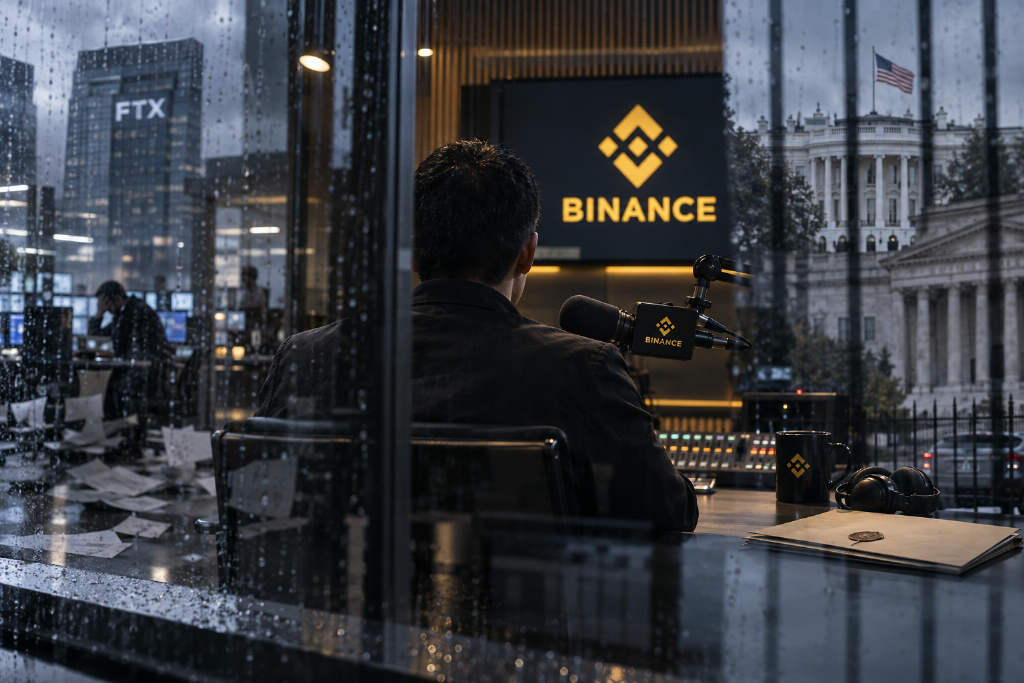
Binance founder Changpeng Zhao, or CZ, used an episode of the When Shift Happens podcast to give a broad account of Binance’s creation, the collapse of FTX, his prison term in the United States, the presidential pardon he later received, and his views on Hyperliquid, decentralized exchanges, market structure, and education.
The episode was hosted by Kevin and aired on Sept. 25, 2026. In the interview, Zhao said FTX was not brought down by his tweet and said he had no direct contact with Donald Trump at any point in the pardon process.
From immigrant family background to Binance’s launch
Asked what in his life might explain how he became one of the richest people in crypto before age 50, Zhao pushed back on the premise. He said the ranking often attached to him was not accurate and that he was probably closer to the top 100 or top 500 rather than the top 20. He added that his social circle is heavily skewed toward wealthy people in crypto, which can distort perception.
Zhao said he grew up in a relatively poor environment after his family immigrated to Canada. According to him, both of his parents earned wages close to the minimum, while many of his friends came from wealthy investment-immigrant families from Taiwan and Hong Kong. That contrast, he said, created pressure.
He also spoke about his sister, describing her as a technical professional who worked at a startup in Tokyo before becoming one of Morgan Stanley’s managing directors. Zhao said Morgan Stanley has roughly 400 managing directors and nearly 100,000 employees worldwide. He said she retired at around age 42 and now counsels people dealing with depression.
On the question of how to keep later generations from losing drive, Zhao said he does not yet have a proven answer. He said education is probably part of it, but not an easy one.
Looking back at Binance’s first day, Zhao said the company did not begin from scratch. He said the team already had 15 to 20 people and was operating a company called BG Tech that sold trading systems to other exchanges. In May 2017, he brought everyone into a meeting room and said it might be the right time to build a crypto-to-crypto exchange. That, he said, was the moment the pivot happened.
Zhao added that 80% to 90% of BG Tech’s clients were not crypto exchanges but other business-to-business customers, including collectibles markets. After the shift, Binance became the world’s largest exchange in about six months.
He defined hard work in terms of output and efficiency rather than hours. “Producing results and being efficient matters more than working long hours,” he said.
Zhao also addressed what he sees as common misconceptions about Binance. One is that Binance is a Chinese company. He said it is not, though it has many Chinese employees. Another is that centralized exchanges are inherently bad for the industry. Zhao said Binance has invested heavily in decentralization and that he believes the future is decentralized, even if most users still prefer centralized exchanges today.
On FTX: “A tweet did not destroy a real company”
Zhao rejected Sam Bankman-Fried’s claim that a Binance tweet caused FTX to collapse. “If one of your competitors can destroy your company with a tweet, then you don’t really have a company,” he said.
He said he does not believe the tweet had the kind of market impact critics later assigned to it. In his telling, it was closer to a public disclosure. As part of Binance’s exit from its FTX equity position, Binance received about $2.1 billion in cash, BUSD, and FTT. Zhao then posted that Binance would liquidate all remaining FTT on its books.
He said he did not know at the time that FTX was in trouble and did not expect the consequences that followed.
Zhao pointed to a Coindesk report published three or four days before his tweet that said FTX might be insolvent. He said the core issue was that FTX had lied to customers and misused customer funds. He also noted that Alameda’s CEO posted on X about 20 minutes after his own post, and said many people believed that message revealed more than his did.
Asked what truth about that week remains underappreciated, Zhao gave a blunt answer: FTX used billions of dollars in customer funds to buy other things, and when the market turned down, customers could not withdraw. “It’s that simple,” he said.
Prison term and the 2025 pardon
Zhao said the hardest part of going to prison was not losing a belief but worrying that the case might never end. He said he feared being kept there indefinitely or facing additional charges. “In my case, in U.S. history, nobody had ever gone to prison just for a single Bank Secrecy Act violation, and to this day nobody has,” he said. He added that most people in similar situations are not even prosecuted.
Asked whether anyone disappeared when things became difficult, Zhao said nobody inside Binance did. He said all of the co-founders from 2017 are still there and none left, which he described as a sign of strong cohesion.
On the pardon process, Zhao said he first discussed the procedure with lawyers. He noted that Trump had said during the campaign that he would pardon Ross Ulbricht, and that Arthur Hayes later also received a pardon. Zhao said Hayes’ case was more similar to his own. Through friends, he contacted the same lawyer who had handled those pardon matters and filed a petition in April 2025, after Hayes was pardoned in March 2025.
He said he never needed to meet Trump. Zhao stated that he has never met Trump in person, never spoken with him by phone, never emailed him, and does not have his number. The closest he came was in Davos, where Trump was on stage and Zhao was in the audience. They did not shake hands, and Trump did not know he was there, Zhao said.
On the argument that a pardon proves political influence matters more than anything else, Zhao said his own view is obviously biased and should be judged by others. He said many people have told him he was treated unfairly and that the situation should have been corrected. Zhao also said he was charged because Binance’s KYC program was not strong enough, but that he personally never handled any trades.
He then referred to current U.S. discussions around Polymarket. According to Zhao, Polymarket does not use KYC and instead geo-blocks international markets. He said regulators may look at perpetual DEXs in a similar way. If his case were judged by today’s standards, he said, “there would be no problem.”
The “red button” approach to security incidents
Zhao spent part of the interview explaining what he called his “red button” principle for exchange security.
The host referenced comments Zhao made after Bybit’s $1.5 billion hack, when Zhao publicly suggested pausing withdrawals while Bybit co-founder Ben Zhu chose not to do so. Zhao said there is no absolute right or wrong in that kind of situation. It is a judgment call, he said, and Ben clearly had more information about the incident than he did. Zhao added that his own style is much more conservative and that he would pause withdrawals first.
Looking back at Binance’s own 2019 breach, Zhao said the exchange lost $40 million in May of that year. The first thing he did, he said, was halt all withdrawals and effectively stop all systems. In his mind, he said, there is a large virtual red button that should be pressed first whenever a security incident happens, before the team works out what happened and how far the damage goes.
Zhao said anyone at an exchange should be able to press that red button and stop everything. Only after the facts are clearer and the risks are understood should systems be turned back on gradually.
He said Binance paused withdrawals for a week in 2019 but kept trading open because the company did not want prices on Binance to drift away from other exchanges. During that same week, Binance also moved its system from a server-based architecture to a serverless architecture.
Asked whether Bybit’s outcome would have been dramatically different if it had followed his advice, Zhao said no. The hack had already happened, he said, and pausing withdrawals would only have made a major difference if there had been a second hack. Fortunately, he said, there was not.
Hyperliquid, DEXs, and a market that is still small
Zhao rejected the idea that Binance sees Hyperliquid as its first real competitor and that his public comments were meant to slow its momentum.
He said he wants more crypto exchanges to innovate because exchanges help expand the overall market. By his estimate, only about 5% to 15% of people may hold some form of crypto. But measured against net worth and actual capital allocation, he said, the share committed to crypto is still very small. On that basis, he argued, industry penetration is still below 1%.
Zhao said he welcomes more decentralized exchanges. He argued that the first mover in a sector does not always become the biggest winner over time. Google was far from the first search engine, he said, and Binance was far from the first centralized exchange. A head start does not guarantee victory, and growing the industry matters more than growing a single platform, in his view.
Asked where Hyperliquid is stronger than Binance today, Zhao said it does not have KYC, though he described that as a small point.
On why HYPE was not yet available on Binance spot at the time even though it had been one of the best-performing assets of the past two years, up about 25x and in the top 10, Zhao said he had already stepped back from day-to-day management of Binance by the time HYPE took off. His understanding, he said, was that the token had not been circulating for a long period and that Binance had a policy requiring it to be able to hold such tokens to manage counterparty risk. He added that this may no longer be an issue today, but said he does not know the current status.
His account of the Oct. 10, 2025 market crash
Turning to the market shock of Oct. 10, 2025, Zhao said the search for a villain was amplified by a competitor that pushed the narrative that Binance caused the event.
He said the earliest price dislocations did not begin on Binance but on another specific exchange. In his timeline, Trump announced tariffs first, then stocks and crypto sold off, and only after that did Binance experience a technical issue tied to a small stablecoin. Zhao stressed that it was not USDT or USDC but Athena’s USD, with a market capitalization in the single-digit billions, and therefore not the cause of the broader 10/10 collapse.
Zhao said some Chinese-language media picked up and amplified the claim, and that a Chinese competitor operating a centralized exchange pushed it aggressively. He cited a timeline chart posted by Dragonfly’s Hasib showing that prices had already started falling after Trump’s tariff announcement, while Binance’s issue came later. Zhao also said Cathie Wood later acknowledged that she did not think Binance caused the entire crash, only that Binance had a technical issue that was one part of the episode.
He said Binance paid out about $800 million to compensate users who suffered losses on the platform even though it had no obligation to do so. Zhao added that during the period when criticism of Binance was loudest, the exchange still saw net inflows and did not lose market share. In his view, the money flow showed that users did not believe Binance caused the problem.
Asked whether he posted “4,” the symbol he uses to ignore FUD, Zhao said he did not. He said he usually posts “4” when a traditional media outlet runs a negative story. Community-level small media or a few KOLs posting on X, even if paid, are not enough on their own for him to do that.
On bullish posts and market influence
The host brought up a post Zhao made on Aug. 19, 2026, when Bitcoin was around $60,000 or $64,000. The post was read as a clear buy signal, and the market rose about 20% in the following days. Zhao rejected the idea that he can move a crypto market worth about $3 trillion.
He said the short answer is no. Zhao said he has posted many bullish messages and that all of his posts are bullish. He said he posts about five times a day. That particular post stood out only because it happened to come about five hours before Trump made positive remarks at a crypto summit, and Zhao said he had no idea that would happen.
Zhao added that whenever he feels he has information that gives him an advantage, he does not post about it. He said that post was written while he was on the road and reading a book. He saw a quote, thought he could adapt it into a positive line about crypto, and posted it. Five hours later, he said, Trump spoke positively and said they would bring Hyperliquid into the United States, but Zhao said he knew none of that in advance.
Asked whether posting five bullish messages a day makes it statistically likely that one of them will land five hours before positive news, Zhao agreed. He added that nobody is complaining today because people are making money. Crypto follows a four-year cycle, he said; he just did not wait until October to post that one.
Regulation work and Giggle Academy
Asked what contribution he would want to be remembered for if Binance disappeared tomorrow, Zhao said he is simply doing what he can. Even with Binance still operating, he said, he spends no time on the centralized exchange itself and instead uses all of his time to talk with different countries about crypto regulatory frameworks.
He said 70% to 80% of his investments are still in Web3 and that he also spends time on Giggle Academy.
When asked what he is optimizing for in life now, Zhao answered: positive impact. If you know you are contributing and helping others, he said, it makes you happy from the inside. In the short term, that means helping countries shape crypto regulation. Over a longer horizon, he said Giggle Academy may be the biggest positive contribution he can make.
Zhao said Giggle Academy offers free education to people around the world and is growing quickly. At the start of 2026, he said, it had reached about 100,000 children. By the time of the podcast recording, that number had climbed to about 1.3 million in less than seven months, and he described the growth as exponential.
On education, Zhao argued that current systems are designed to produce average, predictable people. If a student is good at math and weak in English, he said, the system pushes that student to spend less time on math and more on English, pulling the person back toward the mean. In a highly competitive future, Zhao said, people need to be in the top 1%, ideally the top 0.1%, and that means specializing in a small number of things they do especially well.
He also criticized the economics of the teaching system. Zhao said the average teacher salary in the United States is $30,000, which he described as the highest in the world, and argued that average quality is therefore low. He said he believes AI-driven, app-delivered, personalized courses will be much more effective. Robots are still clumsy today, he said, but once an app is built, the marginal cost of serving 100,000 users or 1.3 million users is close to zero.