

Dan Koe says people do not need to remember everything they read. In his essay on the subject, he argues that if an idea truly matters, it will surface when needed through repeated use, reflection and conversation rather than forced memorization.
The piece starts from a familiar frustration: people save thousands of articles, install several note-taking apps and build elaborate “second brain” systems, yet still feel unable to recall or apply what they have learned. Koe’s answer is that the problem is not memory itself. It is a distorted understanding of what learning is supposed to be.
Why “remembering everything” is the wrong goal
Koe argues that many people equate learning with stuffing information into their heads and treat accurate recall as proof of mastery. That instinct, he says, is shaped by years of school systems built around memorization and testing. Real life does not work that way. Employers do not reward someone for reproducing a passage from The Economist, and clients do not sign because a person can recite the steps from a marketing book.
His point is sharper than simple anti-memorization advice. People often fail to retain what they read not because they are careless readers, but because they make “remembering” the end point of reading. Trying to preserve every sentence can become a vanity project, a way to appear informed. Koe says that kind of learning is off course from the start.
What actually stays, in his view, is the material that gets used, tested, reconsidered and discussed until it becomes part of a person’s cognitive structure. Forgetting most of what one reads is normal. The better question is not how to keep everything, but which ideas deserve to remain and what mechanisms make them available when needed.
Learning as a feedback system
To explain that mechanism, Koe borrows from cybernetics, a term rooted in the Greek idea of a helmsman. He reframes learning as a feedback loop rather than a one-way input stream. In this model, an intelligent learning system works through four parts: goal, sense, compare and act.
| Step | Cybernetics term | Learning equivalent | What happens when it is missing |
|---|---|---|---|
| 1 | Goal | A clear picture of the state you want to reach | No direction, so every piece of information looks both relevant and irrelevant |
| 2 | Sense | An honest read of where you are now | Self-deception, such as mistaking saved material for actual learning |
| 3 | Compare | Seeing the gap between the target and the current state | No felt discrepancy, and no pressure to learn |
| 4 | Act | Specific moves that reduce the gap | Endless preparation without real progress |
Koe says most people do not fail because they lack discipline. They fail because they keep inputting information without the first step, a defined goal, that would create a usable error signal. Without that signal, the brain has no reason to distinguish what should be retained from what can be discarded. Everything goes in, and then everything falls away.
He offers a simple example. “I want to get healthier” is too vague to trigger correction. A night of drinking or staying up until 3 a.m. does not clearly register as deviation. “I want to finish a half marathon in three months” does. Every missed run becomes visible against the target. Koe says learning works the same way.
Start with output, not endless preparation
From that framework, Koe draws one of the essay’s main conclusions: do not begin by studying in the abstract. Begin by making something.
He references Naval’s idea of “Specific Knowledge,” the kind of knowledge that fits a person’s nature, creates an edge and cannot be easily replaced. Koe argues that this sort of capability is not built through broad, systematic coursework. It develops through work itself, with information gathered on demand.
He breaks the process into three stages:
- Choose a goal that actually matters to you, rather than following default tracks such as certifications, school advancement or salary progression.
- Launch a project instead of trying to fully prepare first.
- Fill skill gaps as they appear, learning only what moves the work forward.
His examples are practical. Someone who wants to learn After Effects should not start by watching an entire tutorial library from beginning to end. Koe says it is better to commit to a specific deliverable, such as a 30-second promotional video for a friend’s coffee shop, and then study keyframing, color work or any other technique only when the project demands it. Over several projects, those skills accumulate. Because each one is tied to a concrete use case, it is harder to lose.
He applies the same logic to learning guitar. Instead of disappearing into theory, start with a song you actually want to play. Learn the first chord, then the second. Tune the instrument and understand rhythm when those issues become real obstacles. The pull of wanting to make something, he says, is what drives learning. Watching lessons alone does not create the same force.
Why many “second brain” systems turn into digital graveyards
Koe then turns to knowledge management. He acknowledges the influence of Tiago Forte’s “Second Brain” concept, including PARA and the CODE process, but says most people end up using those systems as sophisticated storage lockers rather than tools for real thinking.
He traces that critique through his own experience with tools. He mentions Roam Research, which changed how he wrote, as well as Kortex, a product he built that later evolved into Eden. The problem, he says, is not the software. It is the way people use it.
Koe lists three recurring mistakes:
- The illusion that saving equals completion. A link is stored, a passage is highlighted, a note is written, and then none of it is opened again.
- Compulsive over-organization. People spend hours tagging, refining PARA categories and tuning their systems, yet never turn those notes into an article, project outline or presentation.
- No retrieval design. Most tutorials explain how to put information into a system. Few explain how to get it back out when it is needed. A system with intake but no output is not a knowledge base. It is a digital graveyard.
To make the point, Koe looks back at people who actually produced enduring work. Marcus Aurelius wrote private reflections that became Meditations. Leonardo da Vinci left behind thousands of pages filled with sketches and questions. Mark Twain, Montaigne and Rick Rubin also kept their own forms of note systems. Koe says the distinction is simple: they collected ideas in order to turn them into work. He borrows Seneca’s metaphor of gathering pollen from many flowers to make one’s own honey. In modern terms, outside material has to be digested and remade into something personal.
From a second brain to a second subconscious
Koe proposes a different term for the kind of system he thinks people should build: a “Second Subconscious.” The difference matters. A good system, in his description, is not a passive warehouse. It keeps making associations in the background and surfaces relevant material while a person is writing, building or thinking through a problem.
He outlines two broad implementation paths.
Option A: Obsidian with Claude Code
This route is aimed at people willing to tinker and determined to keep data local. The basic idea is not to manually maintain an elaborate category tree, but to let Claude act as a knowledge manager.
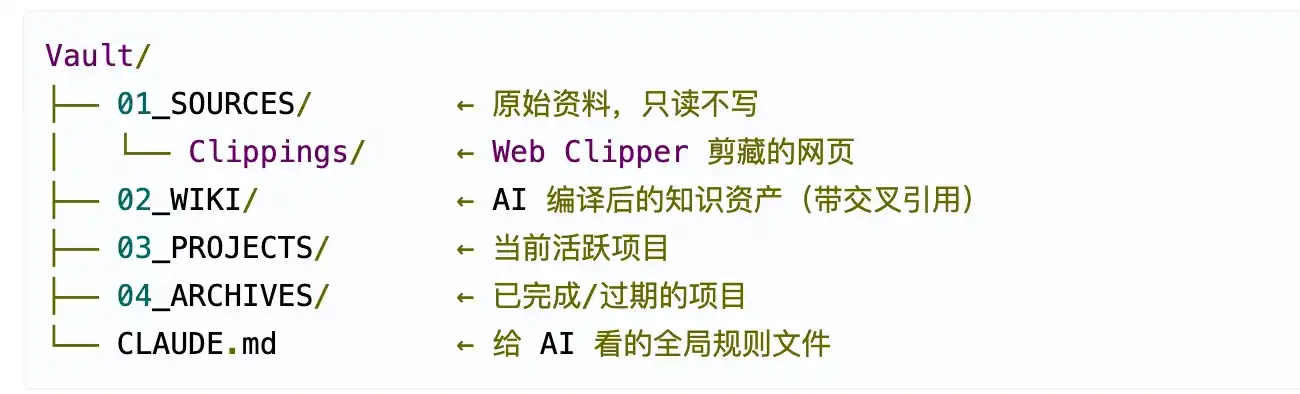
Koe describes the setup in several steps:
- Install Obsidian as the local Markdown foundation and configure Claude Code or Claude Cowork.
- Set the Obsidian Vault folder as Claude’s working directory, giving the model a controlled environment for reading and making requested edits.
- Create two Skills. One is a “save ideas” skill that turns a thought, article link or post into a new note inside the Vault’s Inbox folder with a clear title and timestamp. The second is a “process inbox” skill that reads the Inbox on a schedule, adds tags, moves notes into folders such as Projects, Areas, Resources or Archives, and creates bidirectional links using [[ ]].
- During writing or project work, ask Claude to search the Vault for anything related to the current topic and return relevant material with references.
For more advanced use, Koe suggests a layered repository structure where source files remain read-only and AI works mainly on the Wiki layer. He also recommends documenting focus areas, repository rules and import and query procedures in a CLAUDE.md file so the model has a clear map of how to handle the system.
Option B: Eden and similar tools with automatic classification and semantic search
For people who do not want to maintain vector databases, embedding APIs, indexing scripts or re-embedding logic after every change, Koe says it can make more sense to let a product handle the infrastructure. He uses Eden as the main example and notes that it grew out of Kortex, a product he helped build.
Eden, as he describes it, works in a more invisible way:
- Automatic capture. Substack essays, YouTube videos and long-form posts on X can be saved with one click, transcribed into text and highlighted.
- Automatic embeddings and semantic search. Each record is encoded as a vector of roughly 1,500 numbers, functioning like a GPS coordinate in a knowledge space. Two notes do not need shared keywords to be linked if they are semantically close.
- Readwise integration. Book highlights stored in Readwise can sync into Eden and become searchable, conversational material that can also be dragged into Boards as quote cards.
- Outlier discovery. Eden analyzes which pieces of a creator’s work perform unusually well and points to topics worth developing further.
Koe says MyMind follows a similar logic. A user drops in links and ideas, and the tool handles classification, tagging and semantic retrieval without requiring the user to maintain the process by hand.
He does not present one path as universally better. Obsidian + Claude gives more control, local data storage and deeper customization, but it also requires rule-writing and index management. Eden and MyMind reduce maintenance, offer stronger semantic linkage and provide built-in creative workflows, but they rely on cloud-based services and cloud-hosted indexes. Koe notes that Eden says it does not upload private content.
Filtering matters more than collecting
No matter which tool a person chooses, Koe says one question has to be answered first: what should go into the system at all?
His answer is shaped by the current AI environment. If machines can mass-produce content, scarcity no longer sits at the level of information volume. It sits at the level of curation, especially curation that can be absorbed into a person’s worldview. Koe’s advice is blunt: save only the ideas you are willing to be shaped by.
He argues that the thinkers, writers and creators a person returns to again and again gradually become a lens for interpreting reality. Koe says that when he thinks about the nature of reality, ideas from history, Integral Theory and Spiral Dynamics come up naturally because those frameworks now guide how he explains problems. The long-term task is to build a personal set of ideas, not to chase one hot concept after another.
He gives three practical ways to work that out:
- Read strong authors with durable ideas more than anxiety-amplifying feeds.
- Use writing and public sharing to turn borrowed material into personal understanding.
- Let projects act as filters. Knowledge that does not help move a current project forward is hard to retain even if it is briefly learned.
AI should remove friction, not speak for you
Koe also spends time drawing a boundary around AI in reading and writing. His position is not anti-AI. It is selective.
He says factual material can be delegated to AI without much trouble. If someone wants a summary of a theory’s background or an explanation of a framework, generating or citing that information through AI is not fundamentally different from searching for it elsewhere and then rewriting it. The line appears at the level of opinion and structure. A person who hands off argument, wording and judgment to a model is no longer producing a personal worldview. The output starts to drift toward statistical average.
That is why Koe places AI in a support role. It can suggest ways to organize an essay when the structure is unclear. It can offer directions for the next section when momentum stalls. It can accelerate entry into an unfamiliar topic. But the person deciding what is true, what matters and what should be published has to remain the author.
In Koe’s framing, the warning hidden inside phrases like “don’t use AI to write” is not about avoiding tools altogether. It is about not letting a model express one’s values. As AI makes generic answers cheaper and easier to obtain, the harder-to-copy asset becomes the worldview built through deep reading and direct reflection.
A practical loop for writing and creating
Near the end of the essay, Koe outlines a process for people who want to write, whether for Substack, WeChat, long-form posts on X or YouTube scripts.
- Pick a topic at the intersection of “validated” and “personally interesting.” “Validated” means the topic has already attracted real attention, which can be tracked through high-performing social posts or through Eden’s outlier discovery feature. “Interesting” means it is a question worth pursuing even without traffic.
- Dump ideas first, then build structure. Rather than staring at a blank page, gather thoughts and pull in whatever material from the note library is relevant. After that, fit the material into a simple narrative frame such as problem, insight and solution.
- Use the outline, rough notes and knowledge base together to produce a first draft.
- Keep revising until the piece says what you actually believe, rather than stopping at information assembly.
Memory is a byproduct, not the finish line
Koe closes where he began. The goal is not to remember everything. The things that remain and prove useful over time usually fall into four categories:
- What you learned in pursuit of a goal that is genuinely your own.
- What you used repeatedly inside a real project.
- What you processed through writing, sharing and discussion.
- What you placed into a second subconscious so it could surface on its own later.
Tools such as Obsidian, Claude, Eden and Readwise can make that process smoother, he says, but they cannot build a worldview for anyone, and they cannot answer the more basic question of where a person is trying to go.
His final recommendation is not a memory hack. It is a sequence: make the goal specific, start a project, and let knowledge come to you through the act of doing. At that point, whether you can deliberately recall every line you once read matters far less than people think.