



A blockchain company backed by a16z and funded with $140 million has decided to shut down the public chain it built and move onto a rival network.
That decision reflects a broader change in crypto. A few years ago, teams rushed to launch their own chains. Now some are walking away from them, while trading activity and capital keep concentrating in a small number of leading ecosystems.
DATA will gradually shut down its own Layer 1
DATA, formerly known as Story Protocol, said it will gradually wind down its Layer 1 blockchain and migrate its business to Sui after receiving a $30 million investment from the Sui Foundation.
Story had been one of the better-known projects focused on putting intellectual property on-chain. It raised a total of $140 million and aimed to bring assets such as music rights, patents and trademarks onto blockchain rails for automated licensing and trading.
That plan proved harder in practice. Traditional intellectual property markets already have established licensing systems, and large rights holders have had little reason to change how they operate. DATA CEO Andrea Muttoni said the company had tried to solve too many problems at once.
In June this year, Story rebranded as DATA and shifted toward the market for AI training data. Its core product, Trace, records data provenance, licensing and usage rights. As of October, the company said it had logged more than 250 million data contribution records.
As the business narrowed its focus, the team concluded that its core product was a data verification tool, not a blockchain that needed constant maintenance. DATA has chosen to use Sui’s computing and storage infrastructure and direct more of its resources to product development. The migration is not complete, and the original chain will continue to run during the transition.
The move points to a change in how projects view infrastructure. Owning a public chain no longer automatically creates an edge.
More projects are stepping back from self-built chains
Similar cases have appeared over the past few years.
In April 2023, decentralized wireless network Helium abandoned its own L1 and moved to Solana, shifting its attention back to building the wireless network itself.
In March 2025, mobile payments-focused Celo moved from an independent L1 to an Ethereum Layer 2, using Ethereum’s security and developer base to keep expanding.
By 2026, the reshuffle had become more visible.
Lisk said in August that it would shut down its L2 on Oct. 31 and turn into a financial management platform for enterprises. Polygon stopped block production on Polygon zkEVM on July 3. Polygon had previously said that while the product was technically complex, it had not established clear enough market differentiation.
These cases are not identical. Helium and DATA are moving onto existing public chains. Celo is keeping its own L2. Lisk is leaving blockchain infrastructure behind, while Polygon is cutting back one technical path inside a broader network strategy.
The common thread is straightforward: building blockchain infrastructure is getting easier, but attracting enough users is getting harder.
In earlier cycles, a public chain could win attention with faster throughput and lower fees. With Ethereum L2s and modular architectures maturing, raw technical performance is no longer scarce. Users, capital, applications and recurring revenue are.
343 of 588 public chains have less than $1 million in TVL
The latest figures suggest the market is no longer just top-heavy. It is splitting into two very different tiers.
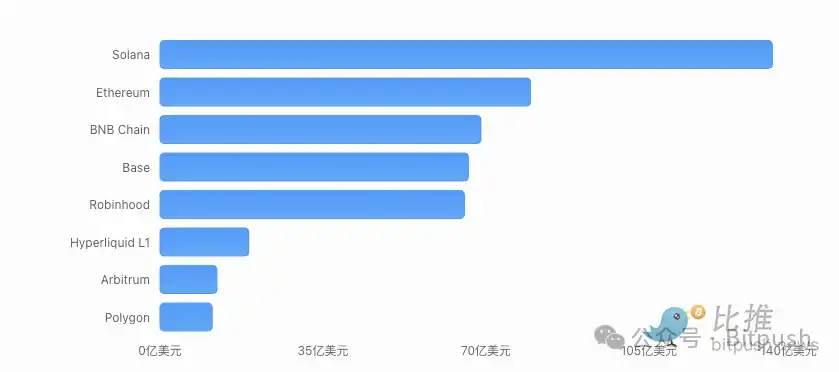
According to DeFiLlama data as of Oct. 21, 2026, the top five chains by DEX spot volume over the past seven days were:
- Solana: about $14.3 billion
- Ethereum: about $8 billion
- BNB Chain: about $7 billion
- Base: about $6.6 billion
- Robinhood Chain: about $6.6 billion
Solana remained the leader in on-chain spot trading. Ethereum and BNB Chain stayed strong, while Base and Robinhood Chain moved into the top tier.

By total value locked, a common measure of DeFi capital, Ethereum stood at about $51.1 billion, well above Base at $6.4 billion, Solana at $6 billion and BNB Chain at $5.8 billion.
DeFiLlama tracks 588 public blockchains. Among them, 343 had TVL below $1 million, equal to 58.33% of the total. That means nearly six in ten chains globally are in a state of technical death or have little to no capital actually being used on them.
Stablecoins are even more concentrated. DeFiLlama data showed the global stablecoin market at about $301.2 billion, with Ethereum at about $143.6 billion and Tron at about $94.7 billion. Together, those two chains accounted for about 79%.
Different sectors are also settling around different network strengths. Solana has become a center for high-frequency spot trading. Ethereum holds a large share of DeFi capital. Tron has a large USDT ecosystem. Hyperliquid has stood out in perpetual futures, with about $58.1 billion in on-chain perpetual volume over the past seven days.
Real-world asset tokenization is also growing. DeFiLlama’s RWA data put on-chain RWA assets under management at about $34.9 billion, with about $4.3 billion deployed into DeFi applications.
High volume does not automatically mean durable demand
Heavy trading alone does not prove that demand will last.
Robinhood Chain, which launched in July this year, is one example. The chain was initially aimed at stock-related and other RWA assets, but CoinGecko data showed that 79.2% of its July DEX volume came from meme coins.
After meme speculation cooled, average daily transaction count from Oct. 2 to Oct. 8 fell 42% from mid-September levels, while active addresses dropped 31%.
A chain can use meme activity to pull in traffic quickly. It cannot rely on meme activity alone to prove long-term value.
Openings for new chains may lie in specific use cases
Given the current market structure, it has become much harder for a new general-purpose chain to challenge Ethereum or Solana simply by offering faster speed and lower fees.
Leading ecosystems have already built strong network effects. Developers tend to go where users already are, and new financial applications grow more easily where capital is already concentrated. Better technical metrics on another chain are not enough to erase those advantages.
That does not mean latecomers have no path in.
Base has Coinbase’s users and distribution. Robinhood Chain has a customer base from a traditional brokerage platform. Hyperliquid built its position through a perpetuals trading product. These newer entrants are not competing on technology alone. They are entering with a defined product or a clear traffic source.
From the current examples, future openings may be more likely in stablecoin payments, RWA, on-chain derivatives and AI data verification than in building another chain that tries to do everything.
DATA’s move to Sui fits that pattern. For DATA, building AI data products matters more than maintaining a chain. For Sui, bringing in a project with an operating business may matter more than adding a few extra transactions.
The value of a public chain is no longer captured by trading volume, address count or fundraising alone. The harder questions are whether it has real users, whether capital keeps coming in, whether applications generate revenue, and what remains after subsidies fade.
The industry does not need more chains. It needs products users cannot do without.