

Google DeepMind co-founder and chief AGI scientist Shane Legg has published a new essay, The Economics of Intelligence, with AGI economics director Alex Imas and research scientist Andrew Koh. The team also released a working paper, Organizing Intelligence, through the DeepMind Institute.

Imas said on X that he joined DeepMind to build an AGI economics research program. The paper asks a broad question: as AI moves from AGI toward ASI, when does the economy begin to change in a fundamental way, and what form does that change take?
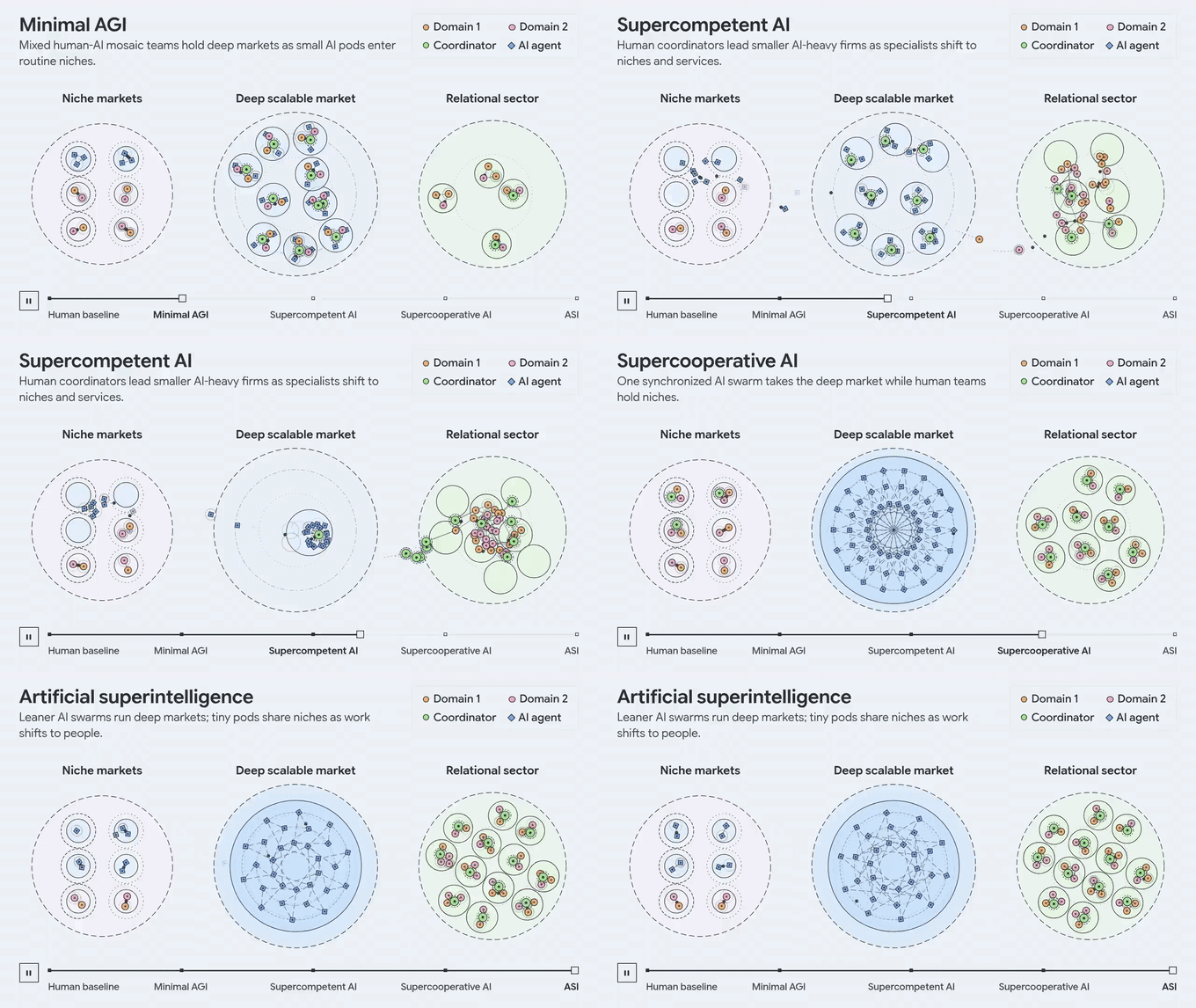
The authors divide that path into four stages: Minimal AGI, Supercompetent AI, Supercooperative AI, and ASI. Their argument is that each stage reshapes market structure, the division of labor, and wage formation in a different way.
From benchmark scores to organizational competition
A central shift in the paper is its focus on organizations rather than isolated model performance. The question, in the authors’ framing, is no longer whether AI can pass a bar exam. It is whether AI can run a law firm.
They argue that most benchmarks still compare one AI system with one human. Real markets do not work that way. Firms and teams compete, and those teams are built from people with uneven skill profiles.
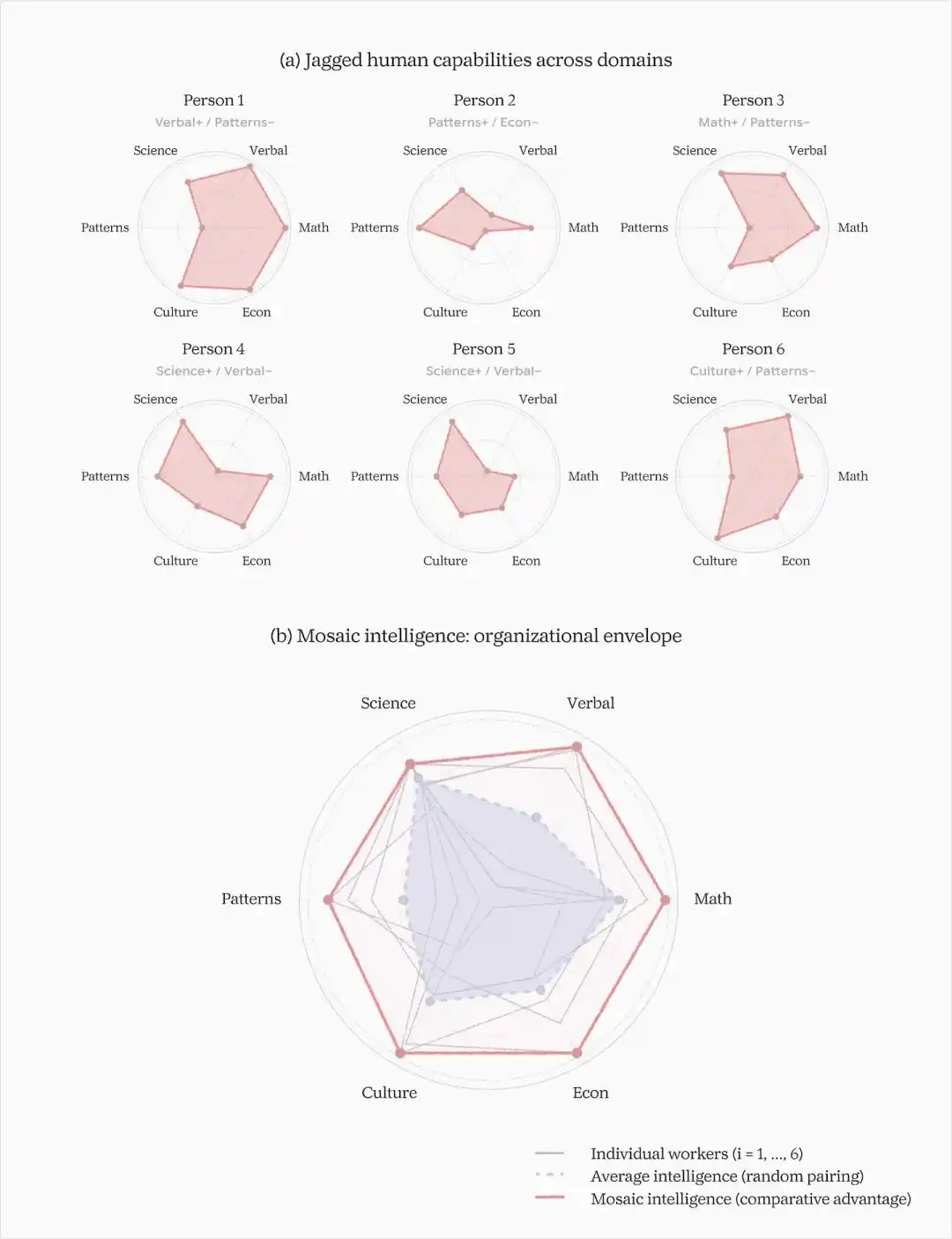
To show this, the researchers tested 100 participants across six domains: math, verbal reasoning, science, pattern recognition, culture, and economics. Performance in one domain, they found, did little to predict performance in another. In other words, the “average smart person” is not a realistic economic unit. People are specialists with jagged strengths and weaknesses.
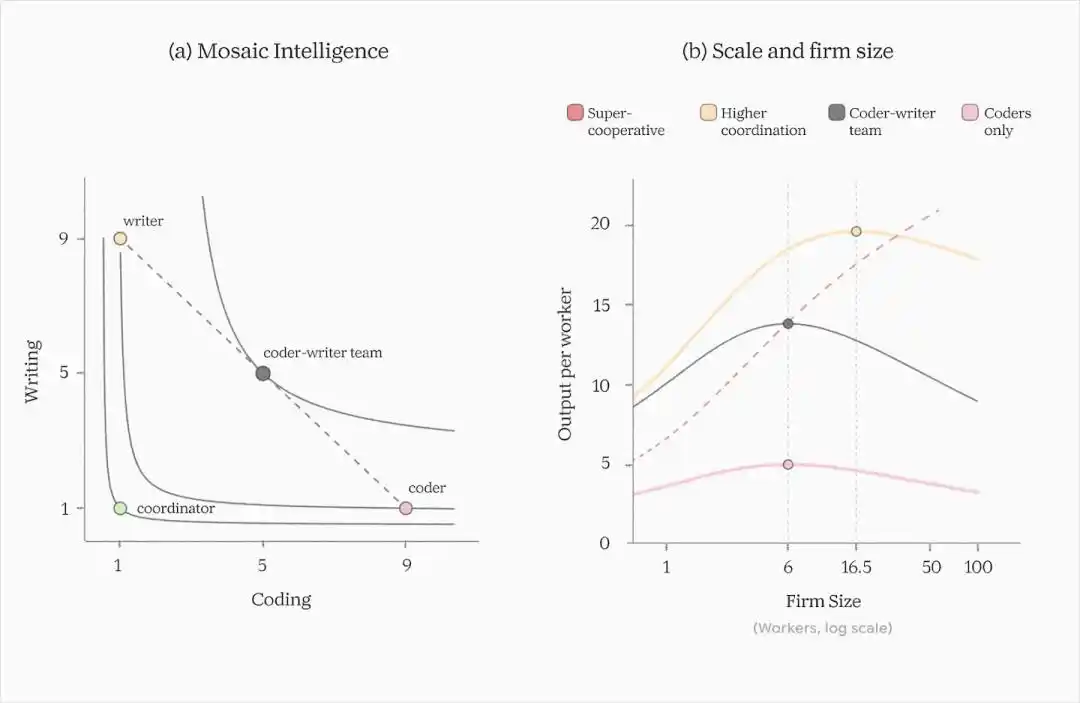
The paper calls the resulting team advantage “mosaic intelligence.” Firms create value by combining people with complementary abilities and assigning work according to comparative advantage. In the team’s tests, pairs matched for complementary strengths outperformed randomly matched pairs by 32%.
Large models, the authors say, lack that kind of complementarity. Copying the same model many times reproduces the same strengths and the same blind spots. More copies raise capacity, but they do not fill gaps. That is why a single AI system can beat the average human and still lose to a human team built around complementary specialization.
Minimal AGI: no layoffs, but wages fall first
The paper then builds a 14-person toy economy made up of six programmers, six writers, and two coordinators.
Programmers score 9 in coding and 1 in writing. Writers show the reverse pattern. Coordinators score only 1 in both tasks, making them the weakest performers in solo tests, but they are good at helping others work together.
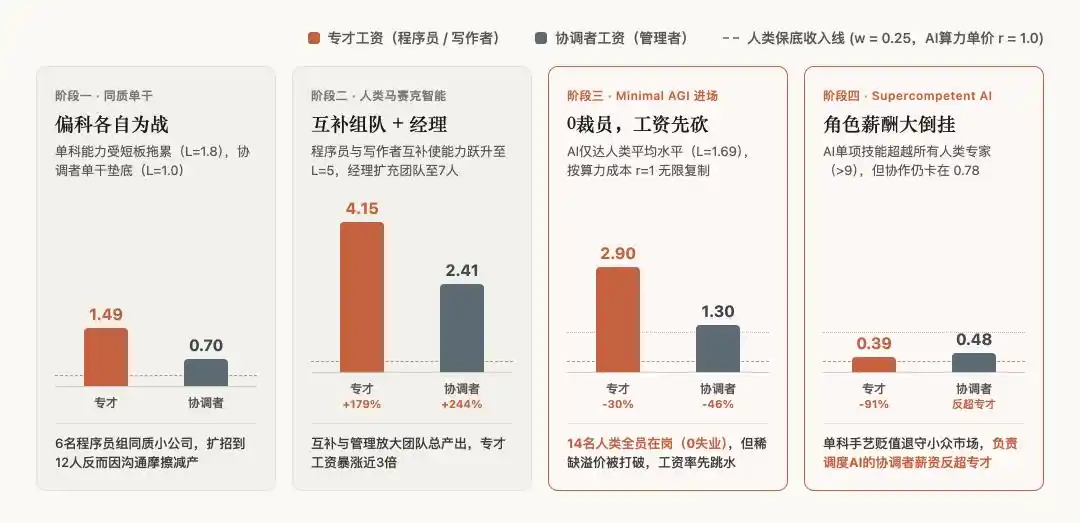
Without AI, programmers and writers pair off one-to-one. Specialist wages rise to 4.15, nearly three times the solo level. Coordinators, who reduce handoff friction, earn 2.41.
The researchers then introduce a “Minimal AGI” into this economy. It has task capability of 1.69 and coordination capability of 0.78, roughly matching the average human working alone.
Employment does not move. All 14 people remain active in the market, and unemployment stays at zero.
Wages do move. Specialist pay falls from 4.15 to 2.90, a 30% drop. Coordinator pay falls from 2.41 to 1.30, down 46%.
The mechanism is scarcity. Human experts command higher pay in part because they cannot be copied. Once AI reaches average human capability, even at that modest level, it can be replicated at compute cost and pushed into specialized markets. That changes pricing before it changes headcount.
The paper states the rule plainly: once a model matches humans in a given capability, wages tied to that capability begin to anchor to compute costs. The authors also warn that wage compression can arrive before any visible reorganization of firms, which means stable employment alone is not enough to conclude that AI has had little economic impact.
Supercompetent AI: specialists lose pricing power, coordinators move up
In the next stage, the researchers raise AI’s task capability above every human specialist while leaving coordination capability unchanged. They call this stage “Supercompetent AI.”
That flips the ranking inside the market. Programmers and writers lose their price advantage in the main market and are pushed into smaller niches. Their wages fall from 2.90 to 0.39, more than 90% below the peak.
The two coordinators, by contrast, become more valuable to AI firms. The reason is simple: a room full of highly capable AI workers that cannot coordinate still needs direction and task allocation. Coordinator wages settle at 0.48, above all specialists in this stage.
The paper points to several real-world data points in the same direction. AI-native startups employ 25% fewer people than comparable peers. Entry-level employment in exposed occupations is down 7.7% to 19%, and starting pay is down 4.2%. Senior workers, by contrast, have seen jobs and pay remain stable or improve.
Why pure AI firms have not displaced traditional firms yet
The paper then turns to a harder question. If AI is already strong in narrow tasks and compute can be rented, why has a pure AI firm not swept traditional firms aside?
The answer is framed through Ronald Coase’s 1937 question: if internal specialization lowers costs, why does the world not collapse into one giant firm? The standard answer in economics is that coordination breaks down as organizations grow. Attention is limited, messages degrade, incentives diverge, and internal friction eats the gains from specialization. The paper labels that limit the “Coase ceiling.”
The authors argue that frontier AI systems face a similar ceiling in multi-agent settings, and in some cases the coordination failures are severe.
They cite a range of multi-agent breakdown data. In mainstream workflow benchmarks, task failure rates reach 41% to 87% because agents misalign on goals, lose context during handoffs, or break verification chains. In sequential planning tasks, adding more agents cuts performance by 39% to 70%. Poorly coordinated agent swarms can amplify upstream errors by as much as 17.2 times.
OpenAI researcher Noam Brown is also cited in the paper. He said that when many agents work in parallel on hard math problems, effective coordination is difficult, and he would attribute less than 10% of the gains to multi-agent collaboration.
To quantify the constraint, the team proposes an “organizational scaling law” for firms, modeled after scaling laws in AI. Task capability determines how much each member can do. Coordination capability determines how large the organization can become.
If coordination capability stays below 1, output per person rises at first and then falls as the team expands. In the model, the optimal size of a pure AI firm is only about seven copies. Once coordination capability moves above 1, each additional member raises output per person instead of dragging it down. That is the point where the Coase ceiling breaks.
The paper says real-world AI teams still fall short. Their output scaling exponent is only 0.48 to 0.68, well below 1. Sol Messing, an evaluation scholar at Google DeepMind, said frontier model weights are frozen and cannot keep learning on the job. Stuffing in more context can leave agents more confused, not less. That limitation, in the paper’s view, is one reason human firms still retain their boundaries.

Crossing the coordination threshold changes the replacement pattern
The paper presents two unemployment curves to show two different replacement paths.
The first is gradual substitution inside firms. With AI coordination fixed at 0.96 and task capability rising from 3 to 3.4, the number of human specialists in mixed teams declines smoothly from 4.58 to zero.
The second is abrupt substitution across firms. With AI task capability fixed at 4 and coordination rising from 0.80 upward, all 12 human specialists initially remain fully employed in all-human firms. When coordination reaches 0.8521, the cost structure of a pure AI firm undercuts the human firm. The all-human firm exits, and employment for those 12 workers drops from 12 to zero.
The larger break comes after coordination moves above 1. The paper calls this the “Supercooperative” threshold. At that point, returns to organizational scale shift from decreasing to increasing, and production in the main market can concentrate rapidly into a giant pure AI firm.
On one side of the threshold, the economy still supports many small and mid-sized firms. On the other side, it reorganizes quickly around a small number of pure AI giants.
Even coordinators lose their edge there. Once AI learns to coordinate on its own, coordination is no longer scarce. In the supercooperative scenario, about half of coordinators lose their jobs. By the ASI stage, both coordinators in the model are unemployed.
The paper leaves room for real-world constraints
The authors do not present the “supercooperative” outcome as inevitable. They describe it as a highly simplified mathematical property. Regulation, competition among AI firms, and compute constraints could all block or slow the arrival of what the paper calls a corporate singularity.
Still, their framework is clear. Once AI crosses both the supercompetent and supercooperative thresholds, it enters the ASI range. At that point, most goods and services become extremely cheap, and wages in reproducible production tasks are pushed toward compute costs.
Where does value go then? One possibility raised in the paper is “relational industries” such as healthcare, education, and in-person experiences, where human participation is itself part of the product.
Imas reduced the paper to two points in his X post. First, if you want to understand how AI will reshape the economy, watch coordination among agents. Second, the first shock is more likely to show up in wages, then in market structure and employment.
That leaves the paper with a direct conclusion: the final gate on the road to ASI may not be higher benchmark scores alone. It may be coordination. When thousands of agents can divide work and hand it off with little loss, the boundary of the firm changes with them.



