
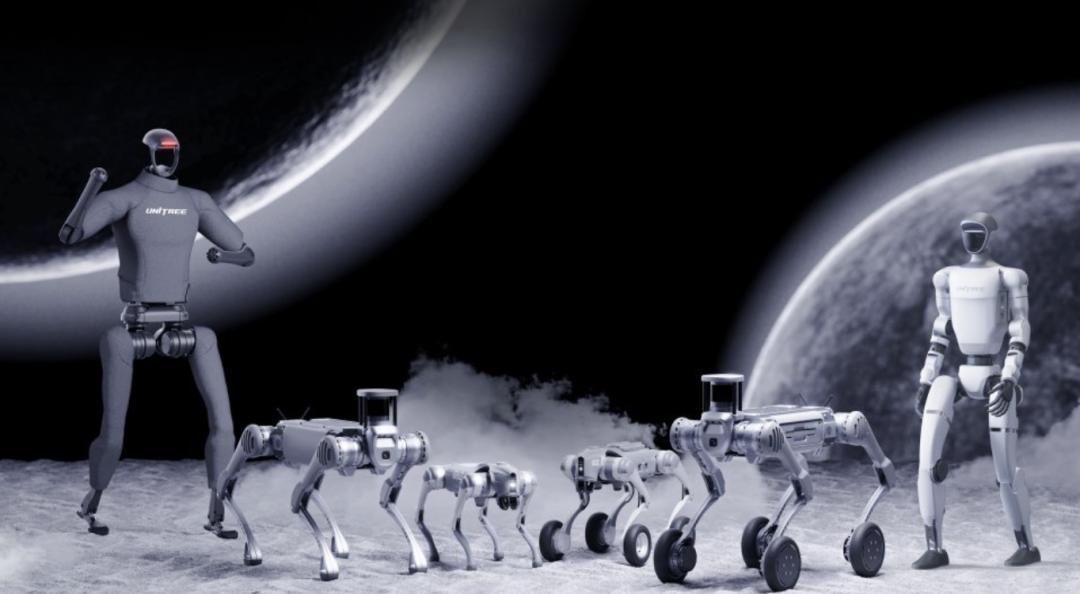
Unitree Robotics opened online subscriptions for its STAR Market IPO on Aug. 10 at RMB 150.8 a share, for an implied offering valuation of about RMB 60.9 billion. Before the subscription window opened, attention had already shifted to the company’s strategic placement roster.
On the evening of Aug. 6, Unitree disclosed its list of strategic placement investors. DeepSeek, the parent company behind the DeepSeek model family, appeared on that list with an allocation of 933,390 shares worth about RMB 141 million.
A day later, Unitree chairman Wang Xingxing said this was not an ordinary financial investment. He said the two companies had signed a strategic cooperation memorandum and would work closely in three areas: artificial general intelligence, robot hardware, and AI large models. Tencent and PetroChina were also listed among the strategic placement investors, but the DeepSeek name drew particular attention.
The money was only part of the story
Measured against Unitree’s roughly RMB 60.9 billion offering valuation, the RMB 141 million commitment was relatively small. The article says the more important element was the strategic cooperation memorandum that accompanied the investment.
The disclosed areas of cooperation include joint research aimed at artificial general intelligence, deeper work on high-performance general-purpose robots, and collaboration on AI large models. At this stage, though, those points remain statements of intent. No detailed execution plan has been made public.
A busy window for robotics funding and listings
The report places the deal in a broader market backdrop. In the first eight months of 2026, primary-market financing in China’s robotics sector exceeded RMB 46 billion. In Hong Kong, 51 embodied-AI-related companies were also said to be waiting in the IPO pipeline.
Against that backdrop, the article argues that who a company binds itself to is starting to matter as much as, or more than, exactly when it reaches the public market. DeepSeek and Unitree are both described as members of Hangzhou’s so-called "six little dragons," with one providing the "brain" and the other the "body." In that framing, this was not a case of a large incumbent writing a support check to a startup, but two companies of similar profile tying themselves more directly to each other’s product paths.
From digital competition to physical-world tests
The article says large-model competition over the past several years has been concentrated in the digital world. Capability was usually judged through parameter counts, reasoning performance, benchmark rankings, and developer ecosystems, while common products remained chatbots, coding assistants, and office software.
Robotics changes that. Once AI is placed inside a machine that can walk and grasp objects, the question is no longer only whether the model can produce the right answer. It becomes whether the system can understand a real environment, decide on a specific action, and complete a task in the physical world.
The piece compares that shift with the path of smartphones. Early on, markets tended to focus on hardware: sharper screens, stronger chips, better device specs. Later, the industry found that operating systems and ecosystems had more influence on long-term market structure, while hardware became the gateway. By that logic, the key issue in robotics may not be who can build a robot first, but who defines its intelligence and controls the ecosystem that forms after deployment.
The Figure AI and OpenAI precedent
Before drawing conclusions about the DeepSeek-Unitree tie-up, the article revisits a case from the United States.
In February 2024, humanoid robotics company Figure AI raised $675 million from investors including Microsoft, OpenAI, Nvidia, and Amazon founder Jeff Bezos, at a post-money valuation of $2.6 billion. Around the same time, Figure AI said it would work with OpenAI to develop next-generation humanoid robot AI models. At the time, that pairing was widely watched as a leading "brain plus body" model in embodied AI, and both Figure 01 and Figure 02 used OpenAI model capabilities.
That relationship lasted less than a year. In February 2025, Figure AI said it was ending its partnership with OpenAI and moving to an in-house end-to-end model strategy. Figure AI founder Brett Adcock said the priorities and resources of a general-purpose large-model company might not fully match the specific needs of a robotics company. In his view, the "body" wanted a dedicated "brain," not a general one shared across multiple embodied-AI companies. At nearly the same time, OpenAI was also reported to be restarting a robotics team it had disbanded years earlier.
For the Foresight article, that episode is a reminder that model-company and robotics-company tie-ups may start with complementary resources but can still run into differences over who leads the technical roadmap. Whether DeepSeek and Unitree will face a similar split remains unknown.
Unitree’s gains are easier to identify
The report says the clearest beneficiary in this arrangement is Unitree.
DeepSeek’s models are already open-source and free to use. The article names UBTECH, Inspur Robot, JEGP Intelligent, and Pudu Robotics as peers that had already connected to DeepSeek-R1 for embodied-AI adaptation without paying for access and without signing a cooperation memorandum.
What Unitree appears to have secured is not an exclusive technical asset, but something more immediate: a strategic placement list carrying the DeepSeek name and a public cooperation memorandum released just days before IPO pricing. In the context of an offering document, the article says, a statement that a top AI company has committed real capital can be more persuasive than the issuer’s own description of its prospects.
Financial data adds context
Unitree’s own financial figures also made the timing more notable. According to the article, Unitree’s year-on-year revenue growth in the first quarter of 2026 slowed to 68.49% from 332.64% in the prior year, while net profit excluding non-recurring items fell 52.55% from a year earlier.
That, the report argues, suggests the industry story is shifting from an explosive growth phase to a verification phase. In that setting, linking up with DeepSeek gave Unitree another anchor for the story it could tell investors in its prospectus.
What DeepSeek gets is still unclear
What DeepSeek has secured in return is harder to pin down. The three cooperation areas listed in the memorandum remain broad statements of intent, and no public detail has been provided on whether Unitree robots will actually run DeepSeek models or how any deployment would be structured.
The article closes without drawing a firm conclusion. It says the Figure AI-OpenAI example shows that embodied-AI partnerships between a "brain" and a "body" are not permanent answers but relationships that may need to be renegotiated over time. DeepSeek’s RMB 141 million commitment may yet lead to real technical deployment, or it may stop at a public show of support. For now, there is no disclosed answer.
With 51 companies still lined up for IPOs, Unitree is presented as one of the first cases to write a model-company strategic placement directly into the prospectus narrative. As more robotics companies look for their own model partners, the question of who will control that entry point remains open.