

Foresight reported that DePIN’s role in AI compute is moving in 2026 from token-funded growth to a test of protocol revenue and engineering reliability. The article says the shift in AI demand from training to inference has opened a structural window for decentralized compute networks, even as the sector remains caught between proof of concept and large-scale commercial deployment.
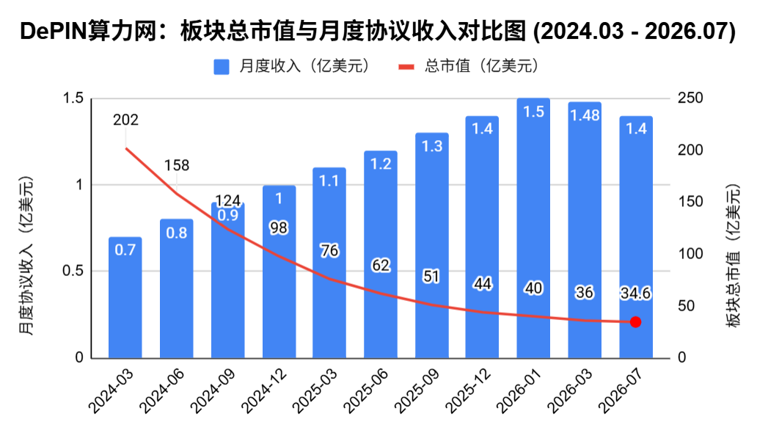
Market value has dropped sharply, but protocol revenue has held up
According to the article, the sector is going through a valuation reset: token prices have fallen hard, while real revenue has risen.
As of mid-July 2026, total market capitalization for the DePIN sector stood at about $3.46 billion, down roughly 83% from its March 2024 peak of $20.2 billion. The sector was also down 23% on the year. The article contrasts that market decline with protocol income, which it says did not shrink in parallel. In January 2026, monthly on-chain revenue across DePIN projects reached $150 million, generated by actual payments from enterprises for compute, storage and connectivity rather than token emissions or speculative incentives.
Aethir, a GPU infrastructure provider, led that revenue tally at $55 million. Render Network contributed $38 million, and Helium added $24 million. In the article’s framing, the sector’s market-cap drawdown does not mean the thesis has failed. It reflects a shift from expectation-driven pricing to revenue-driven valuation.
Inference workloads are emerging as a better fit for distributed networks
The demand-side case rests on a change in AI compute mix. The article says AI infrastructure is moving away from a training-dominated model toward one centered more on inference, and that this lines up more naturally with the distributed structure of DePIN networks.
At a May 2026 earnings briefing, Lenovo Chairman and CEO Yang Yuanqing said around 70% to 80% of AI compute is currently used for training, while 20% to 30% goes to inference. He added that the trend would reverse, with inference eventually accounting for more than 70% of AI compute. The article uses that point to draw a distinction between the two workload types. Training still depends on ultra-low latency and tightly concentrated compute clusters, where traditional cloud providers retain a strong position. Inference, by contrast, is described as geographically sensitive, highly concurrent and more distributed in nature, which makes it a closer match for decentralized node networks.
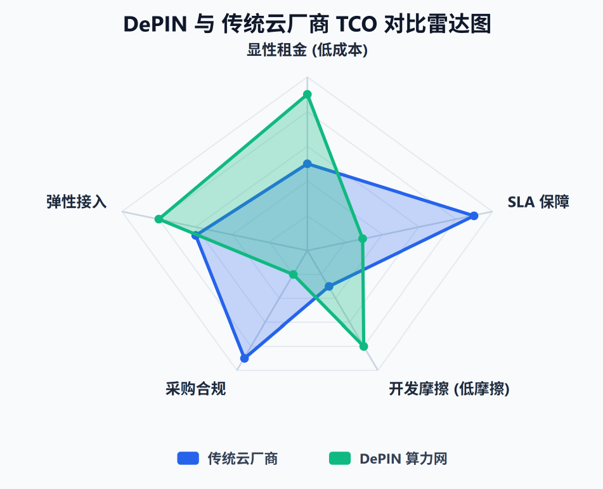
The article says smaller AI studios, game-rendering teams and agent service providers can access compute on demand and by the second, without signing annual commitment contracts. Still, the piece stresses that stronger demand does not automatically become commercial traction. Stable delivery on the supply side remains the core question.
Enterprise buyers care less about list price than deliverability
The article argues that a lower nominal price does not equal a lower real cost. It identifies three engineering hurdles: service-level guarantees, development friction and procurement barriers.
By mid-2026, listed hourly H100 rates on DePIN platforms were broadly below those of traditional cloud vendors. Akash Network was priced at about $2.30 to $3.68 per hour, io.net at about $1.85 to $2.69 per hour, and Aethir at about $1.90 to $3.10 per hour. By comparison, AWS H100 instances in the P5 series were priced at about $5.19 per hour in U.S. regions and $4.72 per hour outside the U.S. Google Cloud’s H100 price was about $11.06 per hour. The article puts the broader traditional-cloud range at roughly $3.93 to $11.06 per hour.
But procurement decisions are not based on sticker price alone. First, service-level guarantees remain uneven. The article says leading projects have started to emphasize enterprise-grade service targets, yet many distributed nodes still face instability tied to residential bandwidth or power supply. That leaves interruption risk meaningfully above the 99.99% level associated with traditional cloud providers, and developers may need to reserve redundant nodes, offsetting part of the savings.
Second, scheduling and engineering friction has not disappeared. Tasks such as balancing heterogeneous GPU loads and handling cross-region data transfer still require extra work by users, adding to development time. Third, institutional friction in procurement remains clear. Enterprises are accustomed to fiat settlement, standard contracts and auditable invoices, while crypto-native networks are still building those capabilities. The article therefore places DePIN today as a supplement to cloud infrastructure rather than a replacement, especially for edge computing and burst inference demand.
Token models are being tied more closely to revenue capture
On token economics, the article says leading protocols are moving away from high-emission supply incentives and toward models built around revenue-funded token burns. It adds that whether those systems truly capture value still needs to be tested.
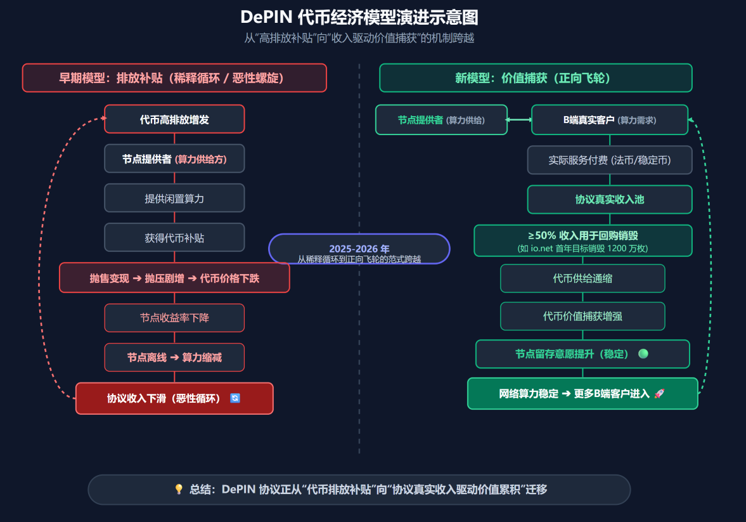
In June 2026, io.net launched its Incentive Dynamic Engine, or IDE, and said at least half of network revenue, after provider revenue sharing, would be used to permanently burn IO tokens. The article says the project expects to burn at least 12 million tokens over the next year. It also notes that io.net has signed $8 million in enterprise contracts, contributing about $650,000 in monthly on-chain revenue, while processing more than 4 billion AI inference tokens a day through OpenRouter.
Aethir has disclosed annualized revenue above $100 million, though figures cited from different sources range from $113 million to $147 million. Its network spans 93 countries. The article also says a $260 million B300 cluster contract signed by Nasdaq-listed Axe Compute is being delivered through the Aethir network.
In the article’s view, tokens are shifting from subsidy instruments to interfaces for value capture. Revenue-driven burns, rather than fresh emissions, are meant to change the supply-demand loop from dilution to deflation. The piece still flags a key risk: whether tokens actually capture value will depend on the durability of revenue and customer retention.
The sector is past the earliest stage, but not yet mature
The article concludes that DePIN is neither a dead bubble nor a mature layer of enterprise infrastructure. The fall in sector market capitalization from $20.2 billion to $3.46 billion is presented as a correction in valuations that lacked revenue support. At the same time, $150 million in monthly on-chain revenue, annualized revenue above $100 million at leading projects and enterprise contracts in the tens or hundreds of millions of dollars suggest decentralized compute is becoming a real supply layer in the AI stack.
That reality, the article argues, is still conditional. DePIN appears to have found a more suitable use case in inference, but crossing into enterprise-scale deployment will still require work on SLA standardization, developer tooling and procurement compliance. The next phase is not just about who is cheaper. It is about whether these networks can get closer to enterprise standards for stability and sustainability. The article says DePIN’s transformation will only be complete when developers care mainly about whether compute is cheap, stable and easy to use, rather than whether it comes from a centralized or decentralized network. In its view, that process in 2026 is only halfway done.