DRV has rerated fast. At current levels, buyers are paying less for Derive’s present revenue base than for a future in which the protocol keeps its lead in on-chain options and turns that position into much larger cash flow.
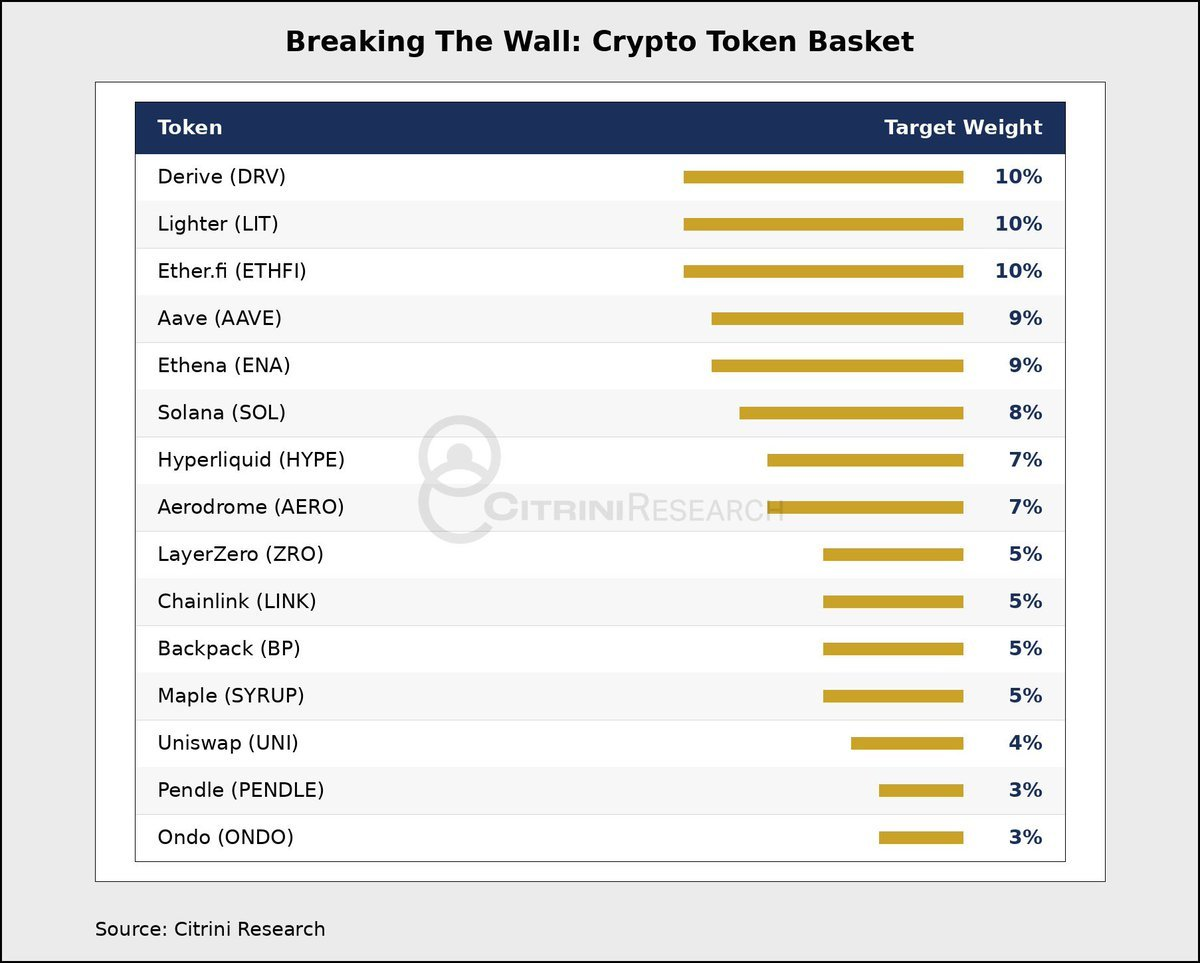
On Oct. 8, macro research firm Citrini Research, which the article describes as previously skeptical of crypto assets, published a report titled Breaking The Wall. After testing and studying a range of crypto products, the firm disclosed a public crypto portfolio. In that basket, Derive’s token DRV received a 10% allocation, tied for the highest weight with Lighter and Ether.fi.
That public positioning helped pull more attention toward Derive’s options business. As of Oct. 10, DRV was stabilizing near $0.55, up 44% over the previous seven days and about 260% over the past month. The token was also sitting just below its all-time high of $0.5693.
The move has changed the debate. With institutional attention, visible buybacks and a coming protocol upgrade already in the price, the question is no longer whether Derive has been discovered. It is whether DRV still offers value here.
Static valuation looks stretched
The article’s core argument is straightforward: if DRV is measured against current on-chain cash flow, it no longer looks cheap.
Based on DeFiLlama data for the latest 30 days, Derive users paid about $714,800 in trading fees. After market-maker rebates, protocol net revenue came to roughly $574,900. Against that, DRV’s circulating market capitalization stood near $551 million, while fully diluted valuation was about $827 million.
Annualizing that one-month snapshot produces the following multiples:
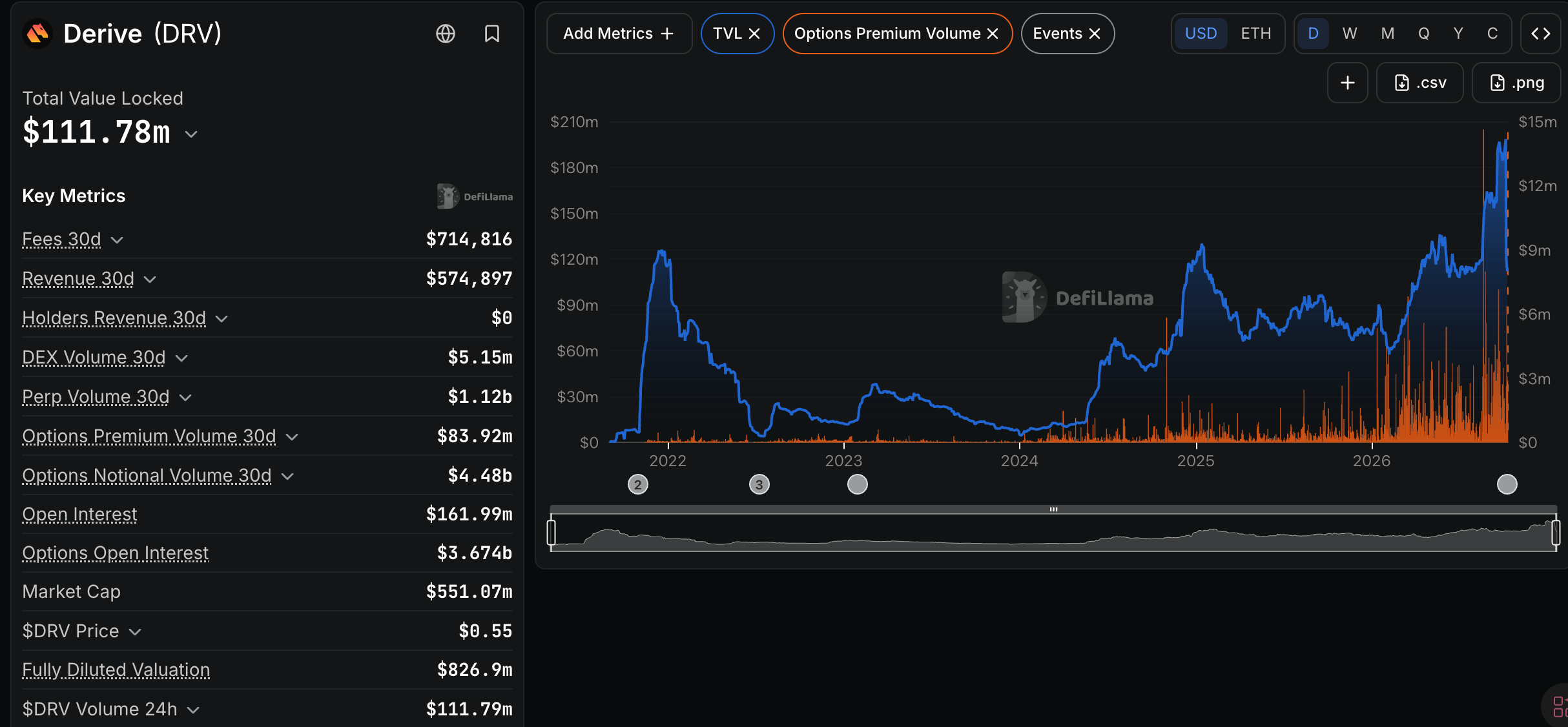
- Circulating market cap / annualized fees = 64x
- Circulating market cap / annualized protocol revenue = 79.5x
- FDV / annualized fees = 96x
On that basis, the article says buying DRV now is roughly equivalent, from an income perspective, to paying nearly $80 for $1 of annual profit. That is not a cheap entry point.
This is why much of the discussion around DRV has shifted toward future growth rather than current earnings. At today’s valuation, the bullish case needs a meaningful expansion in usage and revenue.
The piece uses Hyperliquid as a reference point. After building initial trading volume, Hyperliquid saw fee revenue rise nonlinearly: a 10x increase in volume translated into an 88x jump in fee income. Derive, the article argues, has only completed the first step of that path. Over the past year, nominal trading volume rose from $660 million to $5 billion.
That leaves current buyers effectively betting on a transition from volume growth to fee acceleration. In the bullish framework laid out in the article, if Derive can expand profit by another 5x, the valuation burden at the current market cap would fall from paying 80 for 1 to paying 16 for 1.
Derive dominates on-chain options, but the bigger bet is migration from centralized venues
The article also addresses a common question from derivatives traders: if decentralized perpetual futures are already mature, with simpler interfaces and deeper liquidity, why does on-chain options infrastructure matter?
Its answer is that perpetuals and options serve different needs. In perpetual markets, a wick or extreme move can wipe out a position quickly. For an options buyer, the maximum loss is fixed at entry because the cost is limited to the premium paid upfront.
Professional traders also rarely run isolated naked positions. More often, they hold spot or perpetual exposure and buy options as a hedge. Derive’s edge, according to the article, is not mainly a cleaner interface. It is the ability to bundle options and hedging positions into a single margin framework, reducing duplicated capital requirements for larger traders. Large clients can also submit a full hedging package and have market makers quote it on-chain as one bundled strategy.
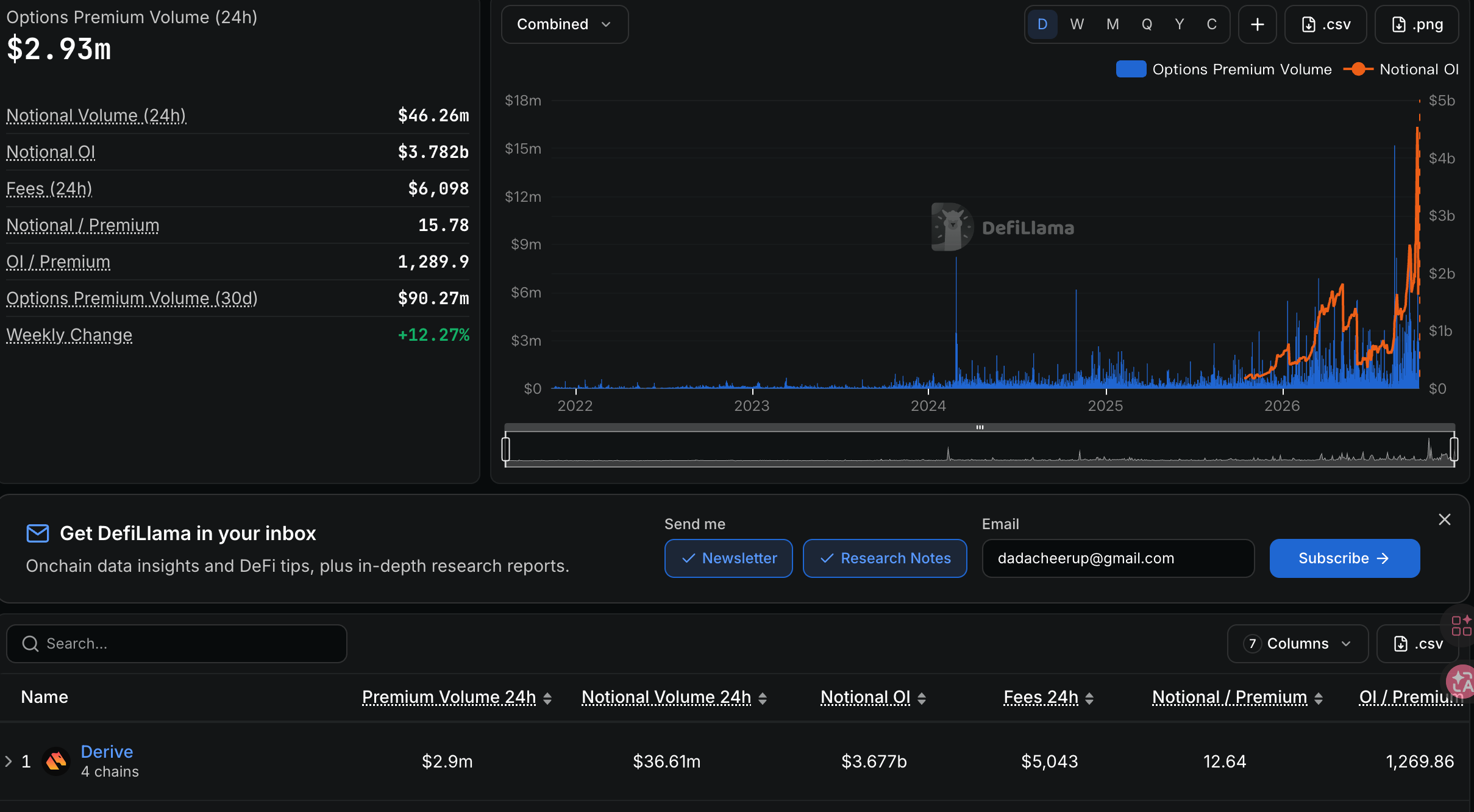
DeFiLlama data cited in the article shows that on-chain options premium volume in September was about $77.67 million. Derive accounted for roughly 91.7% of that total.
The article then widens the lens. Data disclosed in Derive’s V3 proposal shows that in early September, Derive’s own options open interest was around $2 billion, while the global crypto options market, led mainly by centralized exchanges such as Deribit, was around $40 billion in open interest.
That leads to two conclusions in the piece. First, Derive has already filled most of the existing on-chain options pool. Second, the real logic behind the richer valuation is the possibility that even 10% to 20% of the $40 billion centralized market could eventually move on-chain.
That is the larger narrative investors are paying for. The article compares it to an earlier period when centralized exchanges still looked dominant and many market participants did not believe Hyperliquid could carve out meaningful share in on-chain perpetuals.
A competitive window remains open
One obvious concern is whether Hyperliquid, the leading Perp DEX player, could move into options and overwhelm Derive.
The article argues that this is not the immediate setup. Under Hyperliquid’s public HIP-4 specification, the focus is on binary options, described here as capped-payout event contracts. Founder Jeff has also, according to the article, largely confirmed that standard vanilla options are not a near-term priority. Vanilla options are the core of DRV’s current business.
Binary options are framed as closer to event prediction and not suitable for the kind of complex volatility trading and delta hedging used by professional institutions. In other words, the strongest on-chain competitor is, for now, avoiding the most traditional slice of the options market.
Lighter is the other name to watch. The article says the project has said it plans to launch vanilla options by year-end, but the earliest delivery would likely come in late Q4 or later.
That leaves Derive with what the piece describes as a monopoly-like vacuum window: the largest incumbent is not directly competing in vanilla options, and the next challenger has not shipped yet. Derive is trying to use that period to roll out V3, move custody and settlement back to Ethereum mainnet, and open cross-asset margin and underlying vault integrations in an effort to turn its settlement layer into protocol infrastructure.
If that works, the article argues, future teams could still build lighter or more user-friendly front ends while routing trading and fee flows through Derive underneath.
Buybacks rise on Oct. 14, but that does not settle the price question
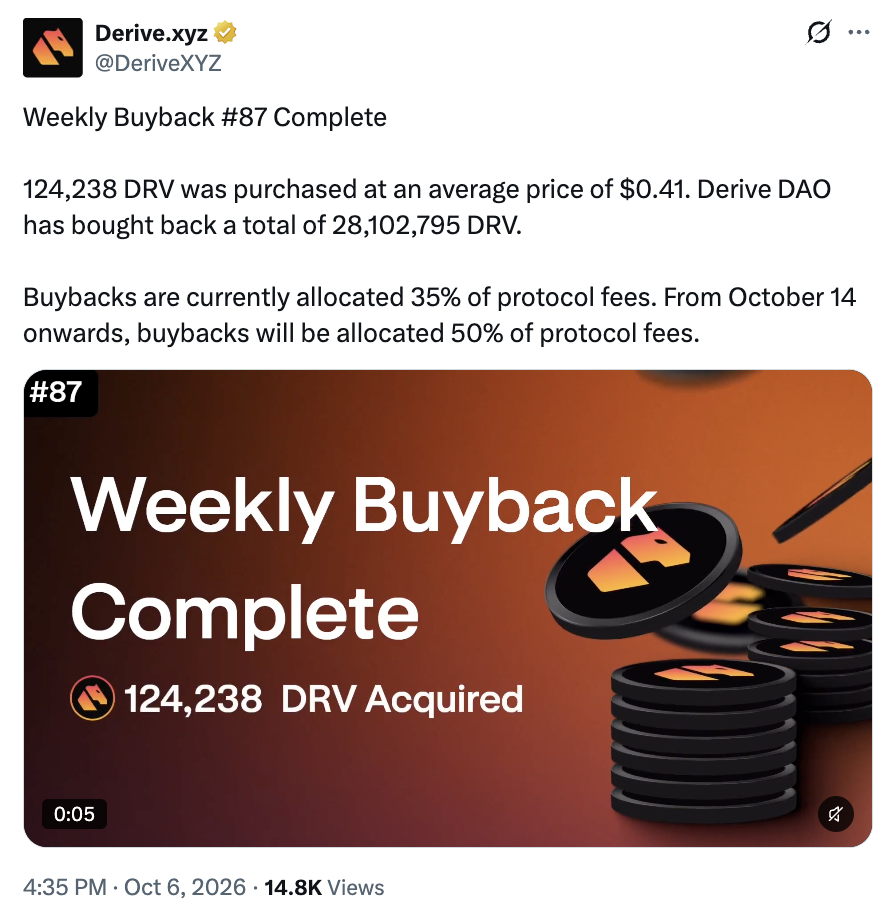
A major part of the bull case in the secondary market is DRV’s token utility. The protocol has been using 35% of fees to buy DRV in the open market, and the article says cumulative buybacks have already exceeded 28 million tokens. With V3, the community has approved a change that will raise that buyback share to 50% starting Oct. 14.
At first glance, that looks like a clean demand tailwind. The article, though, stresses that traders need to run the math on token price as well as fee flow. Once DRV has already rallied sharply, the same dollar amount of buybacks absorbs much less supply.
DRV has climbed nearly 260% over the past month. Using the article’s example, if the protocol spends $350,000 per month on buybacks, that amount can absorb more than 2.3 million tokens when DRV trades at $0.15. At $0.55, the same $350,000 only absorbs a little more than 600,000 tokens.
That is why the article says the real test begins after the new rule takes effect on Oct. 14. The market will have to see whether buybacks equal to 50% of fees can offset profit-taking at elevated prices and routine token unlock-related selling pressure.
What to watch in Q4
The article concludes that DRV has already completed its first round of sentiment-driven rerating after the Citrini callout. On its numbers, part of the upside has been pulled forward, and the margin of safety is no longer obvious.
Rather than chasing size at current levels, the piece argues for a more measured approach: build a base position first, then watch a few hard indicators.
The first is real Q4 revenue. After V3 goes live, the article suggests tracking monthly fee data on DeFiLlama. It treats roughly $700,000 in September fees as the line to hold. If November and December move higher and break above $1 million, that would support the thesis that a fee-growth flywheel is starting. If the data turns lower instead, the article says it would suggest Derive failed to convert the attention from institutional endorsement into stronger options activity, leaving an almost 80x valuation looking more like sentiment than fundamentals.
The second is Lighter’s progress. Derive is benefiting from a temporary gap in competition, and Lighter is not a marginal name in this discussion. Citrini gave both DRV and LIT 10% weights, tying them for the top slot in its portfolio. If Lighter delivers vanilla options on schedule in late Q4, the competitive picture in a still-limited options market could change quickly.
On that basis, the article mentions a more conservative trade expression: holding both DRV and LIT.
The piece ends with a broader caution. Crypto tokens remain heavily narrative-driven. A revenue-based narrative may be closer to traditional valuation frameworks than pure storytelling, but prices are still highly sensitive to market sentiment and the broader crypto tape. The final advice is simple: DYOR.