
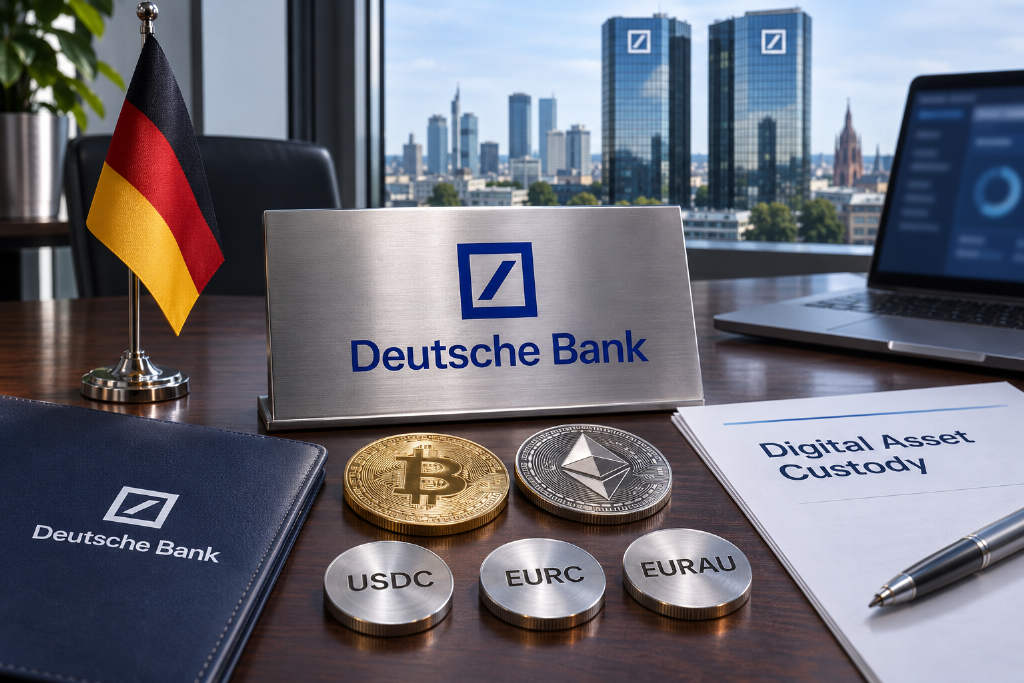
Deutsche Bank has formally entered the institutional digital-asset custody market after receiving approval from Germany’s Federal Financial Supervisory Authority, known as BaFin. The bank announced on Nov. 11 that it had activated its Digital Asset Custody, or DAC, service for European corporate and institutional clients.
Bitcoin, Ether and three digital-dollar or euro assets
The initial asset list includes Bitcoin (BTC), Ether (ETH), the dollar stablecoin USDC, and the euro-denominated stablecoin and electronic-money tokens EURC and EURAU. The service is not currently available to ordinary retail customers.
Deutsche Bank is targeting corporations, asset management firms, hedge funds, brokers, custodians and sovereign institutions. It will manage digital wallets and private keys on behalf of clients, while supporting asset safekeeping and transfers to external destinations.
The custody setup includes hardware protection for private keys, multi-person transaction authorization, and separation between hot and cold wallets. These measures are intended to reduce the operational burden for institutions that would otherwise need to build their own blockchain custody infrastructure.
Gerald Podobnik, co-head of Deutsche Bank’s Corporate Bank, said digital assets were “not a replacement for the traditional financial system, but an important complement.” He described them as a new financial rail that can coexist with existing market infrastructure. Podobnik said the bank wanted to offer clients a secure and regulated entry point to the digital-asset market.
Deutsche Bank and asset-management unit explore tokenized products
The custody launch is paired with a memorandum of understanding between Deutsche Bank and its asset-management business, Deutsche Asset Management. The two sides plan to explore tokenized money-market funds, crypto asset exchange-traded products, or ETCs, and stablecoin-related applications.
The cooperation covers digital-asset custody, settlement, liquidity management and treasury management. The stated aim is to integrate blockchain-based financial services into the traditional institutional banking system.
Paul Maley, Deutsche Bank’s head of Global Trust and Securities Services, said the bank’s medium-term objective was to build “a fully integrated, regulated ecosystem” supporting digital-asset custody, tokenization and settlement.
Deutsche Asset Management had €1.22 trillion in assets under management, equivalent to about $1.36 trillion, at the end of September 2026. Its product range already includes crypto-asset ETCs, and the business is involved in the stablecoin joint venture AllUnity. Tokenized funds and related products remain areas for cooperation, exploration and development rather than fully launched offerings.
From regulatory application to live commercial operations
Deutsche Bank first applied to BaFin for a digital-asset custody license in June 2023. In September of that year, it partnered with Swiss fintech company Taurus to develop institutional-grade crypto custody and tokenization technology.
In September 2026, Deutsche Bank published another update on the planned service launch, confirming that BTC, ETH and selected stablecoins would be supported. The service was still awaiting completion of the regulatory process at that point.
With the service now live, the bank’s digital-asset strategy has moved from technical cooperation and regulatory applications into commercial operations.
Deutsche Bank research shows that the global tokenized-asset market, excluding stablecoins, grew from about $10 billion in January 2025 to about $39 billion in September 2026.
Market prices and initial custody scale remain undisclosed
Traditional banks are expanding their crypto businesses while the broader cryptocurrency market remains under pressure from inflation and interest-rate expectations. CoinGecko data checked on Nov. 12 put Bitcoin at about $73,349 and Ether at about $2,043. Neither asset had moved clear of recent market volatility.
Deutsche Bank’s regulated custody service could reduce operational and compliance barriers for institutions holding digital assets and establish infrastructure for future tokenized financial products. The bank has not disclosed the number of initial clients, the amount of assets under custody or revenue tied to the service.
The prices in this article are market snapshots checked on Nov. 12, 2026, and may change at any time. This article is not investment advice.



