

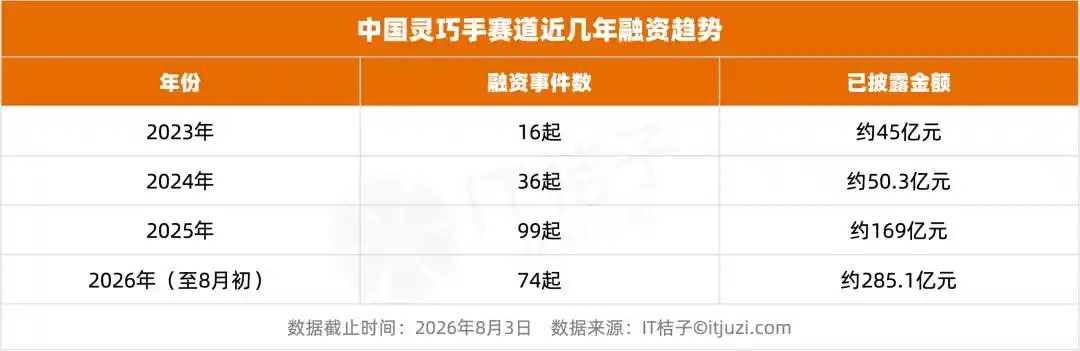
China’s dexterous hand sector recorded 74 financing events involving 47 independent companies between January and early August 2026, with disclosed funding totaling about RMB 28.51 billion, according to an ITjuzi report republished by MarsBit. The data was counted through Aug. 3.

The report separates the market into two camps: 15 humanoid robot makers that develop dexterous hands as in-house core modules, and 32 third-party suppliers that sell complete dexterous hands or critical parts independently. Its central argument is straightforward. Building dexterous hands internally is becoming a de facto requirement for humanoid robot manufacturers, while key underlying components are still mostly sourced from outside vendors.
That distinction matters because the two groups are raising money under very different assumptions, moving at different financing stages, and competing with different kinds of moats.
Funding has accelerated sharply in 2026
ITjuzi said the financing curve for the dexterous hand segment has steepened over the past three years. By deal count, 2024 more than doubled year over year, and 2025 was close to three times 2024. By capital raised, the jump was even more striking: the RMB 28.51 billion disclosed in the first eight months of 2026 already exceeded the RMB 16.9 billion raised in all of 2025.
The report added that nearly five months of 2026 were still outside the sample window, and said total funding for the year was likely to exceed RMB 40 billion.
Average deal size also changed. In 2025, the number of deals surged but the average ticket declined to roughly RMB 170 million per deal, based on the report’s own calculation of RMB 16.9 billion across 99 events. In the first eight months of 2026, the average climbed back to RMB 385 million. The report interpreted that as a shift away from expansion by count and toward concentration in larger, better-funded names.
15 humanoid OEMs versus 32 independent suppliers
The report said it is not useful to pool humanoid robot makers that happen to develop dexterous hands with companies whose main business is selling hands or parts into the supply chain. It therefore split 2026-funded companies into two groups. It also noted that the list covers only companies with financing records in 2026, not every company in the segment.
Humanoid robot makers
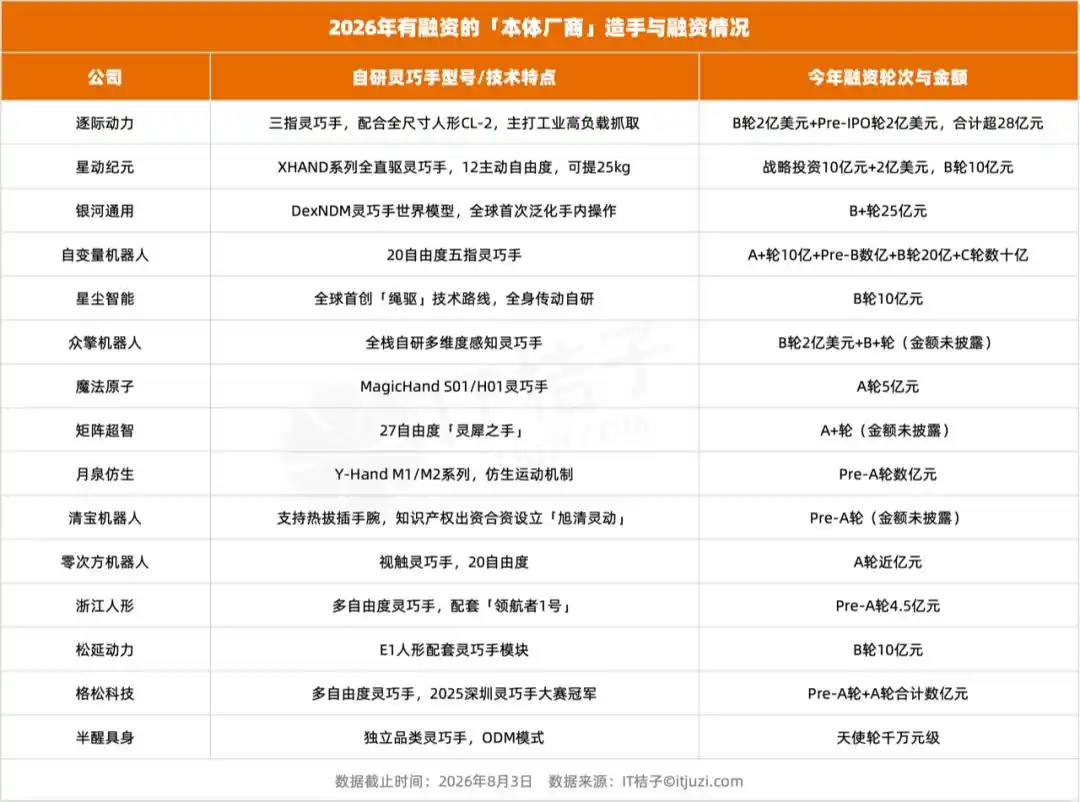
The first group includes 15 companies whose primary business is full humanoid robots, with dexterous hands developed as internal core modules and generally not sold as standalone products. The companies named are LimX Dynamics, Xingdong Jiyuan, Galbot, Zi Variable Robot, Stardust Intelligence, Zhongqing Robot, MagicLab, Matrix Super Intelligence, Yuequan Bionic, Qingbao Robot, Lingcifang Robot, Zhejiang Humanoid, Songyan Dynamics, Gesong Technology, and Banxing Jushen.
Those 15 companies completed 23 financing events in the first seven months of 2026, with disclosed funding of about RMB 18 billion to RMB 20 billion.
Third-party suppliers
The second group includes 32 companies that independently develop and sell complete dexterous hands, tactile sensors, micro motors, precision screws, and other core parts. Their customers include humanoid robot companies, research institutions, and industrial automation manufacturers.
Those 32 suppliers completed 51 financing events in the first seven months of 2026, with disclosed funding of about RMB 8.51 billion.

The report highlighted three takeaways from that split.
- First, humanoid OEMs are raising much larger rounds. On the report’s numbers, 23 deals brought in about RMB 20 billion, or more than RMB 800 million per deal on average. Suppliers raised about RMB 8.5 billion across 51 deals, or less than RMB 200 million each on average.
- Second, there are far more suppliers than robot body makers, roughly double by company count. The report said that points to lower startup barriers for standalone dexterous hand businesses, but also to much more intense competition.
- Third, the funding stages are different. More than 56% of financing events for humanoid OEMs were at Series B or later, with some companies already at Series C or pre-IPO. Suppliers were much more concentrated between angel and Series A, with angel through pre-A accounting for more than 45%.
In-house hand development has become standard for robot makers
The report said all 15 funded humanoid OEMs in 2026 had clearly moved to self-developed dexterous hands. What used to be a differentiator for a handful of leading players is now treated as a standard move for robot manufacturers.
Its reasoning is that dexterous hands are the core organ that allows a robot to work. Outsourcing that piece means handing the most important differentiating capability to someone else. At a stage when the industry is still early and technical approaches have not converged, more robot makers are unwilling to accept that tradeoff.
Even so, their internal development is mostly concentrated in the hand body itself, meaning mechanical structure and drive control. For tactile sensors, micro motors, precision screws, and other deeper components, most OEMs still rely on outside procurement. The report said the technical barriers and capital intensity in those areas remain difficult for full-stack robot makers to cross in the near term.
Three humanoid OEM case studies
LimX Dynamics
LimX Dynamics was presented as an example of a high-load route built around industrial use cases. Its self-developed three-finger dexterous hand is paired with the full-size humanoid robot CL-2 and targets high-load grasping in industrial settings. The report said the three-finger design strikes a balance that leans toward payload rather than maximum dexterity, making it suitable for heavy-duty handling and assembly tasks on factory lines.
The company completed a $200 million Series B and a $200 million pre-IPO round this year, for a combined total of more than RMB 2.8 billion. The report said the pre-IPO financing shows the company is already preparing for a listing and has clearly entered a later financing phase.
Xingdong Jiyuan
Xingdong Jiyuan follows a fully direct-drive route and develops the XHAND series in-house. According to the report, XHAND1 has 12 active degrees of freedom, can lift 25 kilograms, and can perform more than 100 complex operations. Direct drive offers fast response and high control precision, but the report described cost and form factor as the hardest engineering challenges among the three routes it examined.
This year, the company completed a strategic investment round worth RMB 1 billion plus $200 million, as well as a RMB 1 billion Series B. The report placed it in the top funding tier and said it is moving quickly to convert technical leadership into a commercial barrier.
Stardust Intelligence
Stardust Intelligence uses a tendon-driven route and develops everything from whole-body transmission systems to dexterous hands itself. The report said tendon drive replaces rigid transmission with tendon-like cables, making the structure closer to a human hand in biomechanics and improving flexibility and anthropomorphism, though long-term reliability and control precision remain difficult engineering problems.
Its S1 has already achieved deliveries in the thousands, the report said, while the T1 has a starting price of RMB 89,900. Among the three routes discussed, it was described as the first to bring pricing down into a range ordinary consumers can recognize. The company completed a RMB 1 billion Series B this year.
Suppliers fall into three distinct categories
The report divided the 32 funded suppliers into three commercial categories: complete dexterous hand vendors, tactile sensing solution providers, and core drive and transmission component makers. Each one serves different buyers and competes on different strengths.
1. Complete dexterous hand vendors
These companies sell a full dexterous hand module, from fingers and joints to drive control, as a plug-and-play product for humanoid robot makers, research institutes, and industrial automation integrators. Their moat, the report said, lies in systems engineering: hardware design, mass production, cost control, and integration with the customer’s robot “brain.”
The report highlighted three names.
AGILINK, formally Shanghai Linjiedian Innovation Intelligent Technology Co., Ltd., was founded in January 2026 and is based in Shanghai. Founder Xiong Kun holds a master’s degree from the Hong Kong University of Science and Technology’s robotics research institute in electronic and information engineering. He joined Tencent Robotics X in 2018, took part in building the lab from scratch, and was responsible for robot body and software architecture. He later worked at the IDEA Research Institute and Inovance before joining AgiBot in November 2024 to lead dexterous hand operations. Co-founder Deng Taihua is chairman of AgiBot, and Wang Chuang previously served as president of AgiBot’s general business unit.
AGILINK completed an angel round in January 2026, an A round in February, an A+ round worth several hundred million yuan in May, and a RMB 1 billion Series B in June. Its valuation topped RMB 10 billion. The report said it became a unicorn just five months after registration. It also said the company was profitable from inception, delivered more than 8,000 OmniHand dexterous hands in less than half a year, and shipped more than 10,000 grippers. Xiong was quoted as saying, 「灵巧手的竞争不在实验室,在生产线上。」
Lingxin Qiaoshou, formally Lingxin Qiaoshou (Beijing) Technology Co., Ltd., was founded in July 2023 and is based in Beijing. Founder, CEO, and CTO Zhou Yong came through the gifted youth program at Huazhong University of Science and Technology and has more than 15 years of experience spanning the internet industry and robotics. Co-founder Zuo Jiaping previously worked at CloudMinds and Segway Robotics and is responsible for hardware mass production and supply chain operations. Chief AI architect Su Yang leads cloud large-model and data system development. The report said the R&D team has more than 100 members and that more than 90% of core components are developed and produced in-house.
Its financing history includes a seed round in April 2025, an angel round in August, Series A in October, A+ in November, A++ in December, a RMB 1.5 billion Series B in February 2026, and a B+ in April. The valuation reached RMB 15 billion. The report said the company has started preparing for a Hong Kong IPO. It also said Lingxin Qiaoshou holds more than 80% share in the global high-degree-of-freedom dexterous hand market, has monthly production capacity above 4,000 units, and covers linkage, direct-drive, and tendon-cable routes.
Xynova, formally Hangzhou Xynova Technology Co., Ltd., was founded in December 2024 and is based in Hangzhou. Founder and CEO Xia Yuxuan holds a master’s degree from Columbia University and previously worked at CDH Investments, Morgan Stanley, and Warburg Pincus. The team includes talent from Tsinghua University, Zhejiang University, Shanghai Jiao Tong University, Columbia University, the University of Pennsylvania, DJI, Schaeffler, KUKA, Apple, and CATL.
The company completed an angel round in December 2025, a pre-A in March 2026, an A round worth several hundred million yuan in May backed by Xiaomi, Li Auto, and CSC Capital, and an A+ round in July. Its valuation surpassed $1 billion. The report said Xynova created the world’s first hybrid “tendon drive + direct drive” dexterous hand, Flex 2. It also cited Xia’s account of visiting a charger factory and watching a worker spend the whole day peeling labels off products, an experience he described as the origin of the business. The report expects the company to reach annual capacity in the tens of thousands by the end of 2026.
2. Tactile sensing solution providers
The report argued that flexible fingers alone are not enough. Without tactile feedback, a robot cannot reliably judge grip force on fragile or slippery objects. Tactile sensors were long dominated by overseas companies, it said, with single-unit prices starting at RMB 100,000, but domestic suppliers are now moving quickly into the space.
These companies tend to have high technical barriers and strong lock-in with downstream customers. Once a dexterous hand is adapted to a specific tactile system, switching costs become high.
Percipio, formally Percipio AI Technology (Beijing) Co., Ltd., was founded in June 2021 and is based in Beijing. Founder and CEO Xu Jincheng holds a doctorate from Waseda University and studied under robotics scholar Shigeki Sugano. The report also noted that Sugano’s mentor, Ichiro Kato, invented WABOT-1, the world’s first humanoid robot, in 1973. Luo Xiaoheng serves as chief strategy officer.
Percipio completed an angel round in November 2021, a pre-A in December 2022, A and A+ financings in 2024, two A+ rounds in 2025, a RMB 1 billion Series B in March 2026, and a RMB 1 billion strategic investment in August. Its valuation reached RMB 15 billion. The report said its self-developed ITPU multidimensional tactile sensing technology is globally leading and that some modules are now priced in the three-digit yuan range, down two orders of magnitude from comparable overseas products priced around RMB 100,000. It also said BYD and JD.com both moved from customers to shareholders. Xu was quoted as saying, 「不是大脑指挥手,而是手塑造了大脑。」
Daimon Robotics, formally Daimon (Shenzhen) Robotics Technology Co., Ltd., was founded in December 2021 and is headquartered in Shenzhen. It was co-founded by Professor Wang Yu, founding dean of the Hong Kong University of Science and Technology’s robotics institute, and his student Dr. Duan Jianghua. The report said the team has close technical roots with MIT professor Edward Adelson, inventor of the GelSight visuotactile technology.
The company completed angel rounds in September 2023 and November 2024, an angel+ round in August 2025, a RMB 100 million strategic investment in December 2025, and an A round worth nearly RMB 100 million in June 2026 backed by Inovance Industrial Investment and China Telecom. Its valuation was reported at RMB 3 billion.
The report described Daimon as the first domestic company to mass produce visuotactile sensors independently. It said the product reaches 40,000 sensing units per square centimeter, denser than a human fingertip. In April 2026, the company open-sourced 10,000 hours of tactile data on a platform. The report said downloads exceeded 1 million in the first month, topping rankings for physical-world embodied datasets.
Qianjue Robotics, formally Qianjue Robotics Technology (Shanghai) Co., Ltd., was founded in May 2024 and is headquartered in Shanghai. Founder Ma Daolin earned both his bachelor’s and doctorate in mechanics from Peking University, completed postdoctoral research at MIT’s Mcube Lab, and now serves as an associate professor and doctoral supervisor at Shanghai Jiao Tong University. Co-founder Liu Jin handles operations, while Zhao Haonan leads low-level sensor hardware R&D.
Its financing record includes an angel round in October 2024, an angel+ in May 2025, a pre-A in October 2025, and a Series A in July 2026. The report said the company has completed four rounds in two years and already serves more than 300 customers. It also credited the company with launching the world’s first miniature multimodal tactile sensing system and building a full technical loop spanning tactile sensors, data acquisition, simulation, a VTLA model, and scenario solutions.
3. Core drive and transmission component makers
The final category consists of companies that do not sell complete dexterous hands, but do supply the parts inside them, including motors, reducers, and screws. The report said this category may be the most stable over the long run because all technical routes still need those components. In its view, these companies benefit both from domestic substitution and from manufacturing advances that can drive costs down to a fraction of previous levels.
Wuji Technology, formally Shanghai Wuji Technology Co., Ltd., was founded in March 2019 and is based in Shanghai. Founder Pan Yunzhe graduated in 2018 from the University of Illinois Urbana-Champaign with dual majors in computer science and chemistry. The report said he started the company out of frustration with motors that were heavy but underpowered and spent three years developing the F-series motor from scratch.
The company raised an angel round in August 2023, a pre-A in November 2023, a Series A in November 2025, an A+ in February 2026, and multiple additional A+ rounds between March and July 2026. According to the report, its F-series motor delivers 8 Nm of peak torque at a weight of 200 grams. The cluster of A+ rounds this year was interpreted as a sign that downstream orders are rising fast enough to require ongoing capacity expansion.
Zhijian Zhiqing, formally Suzhou Zhijian Zhiqing Technology Co., Ltd., was founded in August 2024 and is based in Suzhou. Founder and CEO Zhang Yang graduated from Central South University in electrical engineering and automation, with a focus on motors, and has 12 years of industry experience at Midea Group, Weifu High-Technology, and Innovusion. CTO Han Jie has 10 years of motor R&D experience and previously led production of multiple traction and precision motors at Geely and Innovusion.
The company raised an angel round in August 2025 and a pre-A in June 2026. The report said it developed the world’s first mass-production process for PCB axial-flux stator windings, applying semiconductor manufacturing thinking to electric motors. Its 48-layer PCB stator is only 4.2 millimeters thick, and product diameters start at 4 millimeters. The report also said mass-production yield is close to 100% and cost is more than 30% lower than traditional solutions.
Nuoshi Robotics, formally Shenzhen Nuoshi Robotics Co., Ltd., was founded in July 2023 and is based in Shenzhen. Founder Xu Yang holds a master’s degree in mechanical manufacturing from Tongji University and previously led R&D at Valeo’s Asia-Pacific R&D center. Co-founder Wang Xiaobin previously served as deputy general manager at a Valeo subsidiary. Core technical adviser Xu Genlin is a retired professor from Shanghai University. The report described the company as a two-generation relay, combining decades of family manufacturing expertise with modern industrial organization.
Nuoshi raised an angel round in December 2024, an angel+ round in April 2025, and a Series A worth several hundred million yuan in March 2026. The report said it has built the world’s smallest planetary roller screw, with a diameter of 1.5 millimeters and a 5.5-millimeter nut. It can stably output 10 kilograms of load force, lasts for more than 3 million cycles, and is priced below RMB 100 per unit. The report also said the company improved production efficiency by 10 times through its own high-precision metal forming process and currently splits its business evenly between humanoid robots and steer-by-wire automotive chassis systems.
The report’s broader conclusion
The report argues that the dexterous hand market is now going through structural differentiation.
Its first conclusion is that a mixed model of in-house development plus external procurement is likely to become the standard industry setup. All 15 funded humanoid OEMs have clearly committed to self-developed dexterous hands, and together they raised about RMB 20 billion. But that does not amount to a simple negative for suppliers, the report said, because most OEMs still buy tactile sensors, micro motors, and precision screws from specialized vendors.
Second, it said the market structure is unlikely to mirror power batteries, where large OEMs can internalize much of the value chain. A more likely analogy is automotive electronics, with tiered competition between Tier 1 dexterous hand module vendors and Tier 2 core component suppliers.
Third, the report said valuation logic differs sharply across the two camps. Of the 74 financing events in 2026, humanoid OEMs accounted for 23 and roughly RMB 20 billion, while suppliers accounted for 51 and about RMB 8.5 billion. The more than fourfold gap in average deal size does not, in the report’s view, prove lower investment value for suppliers. Rather, OEMs are priced against the broader embodied intelligence thesis, while suppliers are priced against product share and revenue growth.
Fourth, it said supplier consolidation is likely to be harsh, with complete dexterous hand vendors under the most pressure. Nearly 20 of the 32 suppliers claim to be building complete dexterous hands. The report singled out AGILINK, Lingxin Qiaoshou, and Xynova as companies that have already built advantages in capacity, pricing, or order visibility, and said the number of effective players in the complete-hand category could shrink sharply by the end of 2027.
Finally, the report said “hidden champions” in tactile sensing and core components may enjoy the longest period of upside. It specifically cited Percipio, Daimon Robotics, Wuji Technology, and Nuoshi Robotics as companies that have built early technical barriers in tactile sensing, data assets, motor power density, and miniature screw manufacturing. The report’s view is that these businesses may not all become platform companies valued at tens of billions of yuan, but that many of them have a relatively high probability of becoming durable vertical specialists in the billion- to multi-billion-yuan range.
The original article was published on the ITjuzi WeChat account, ID itjuzi521, and credited to author Wu Meimei. MarsBit republished the piece.