
DFINITY founder Dominic Williams publicly challenged NEAR’s Confidential Intents design on Oct. 22, saying its privacy model appeared to depend too much on trust in permissioned nodes and lacked sufficient technical backing. Instead of putting pressure on NEAR, the criticism drew a sharp response from the market and from the NEAR community, where many framed the move as an attempt to grab attention.
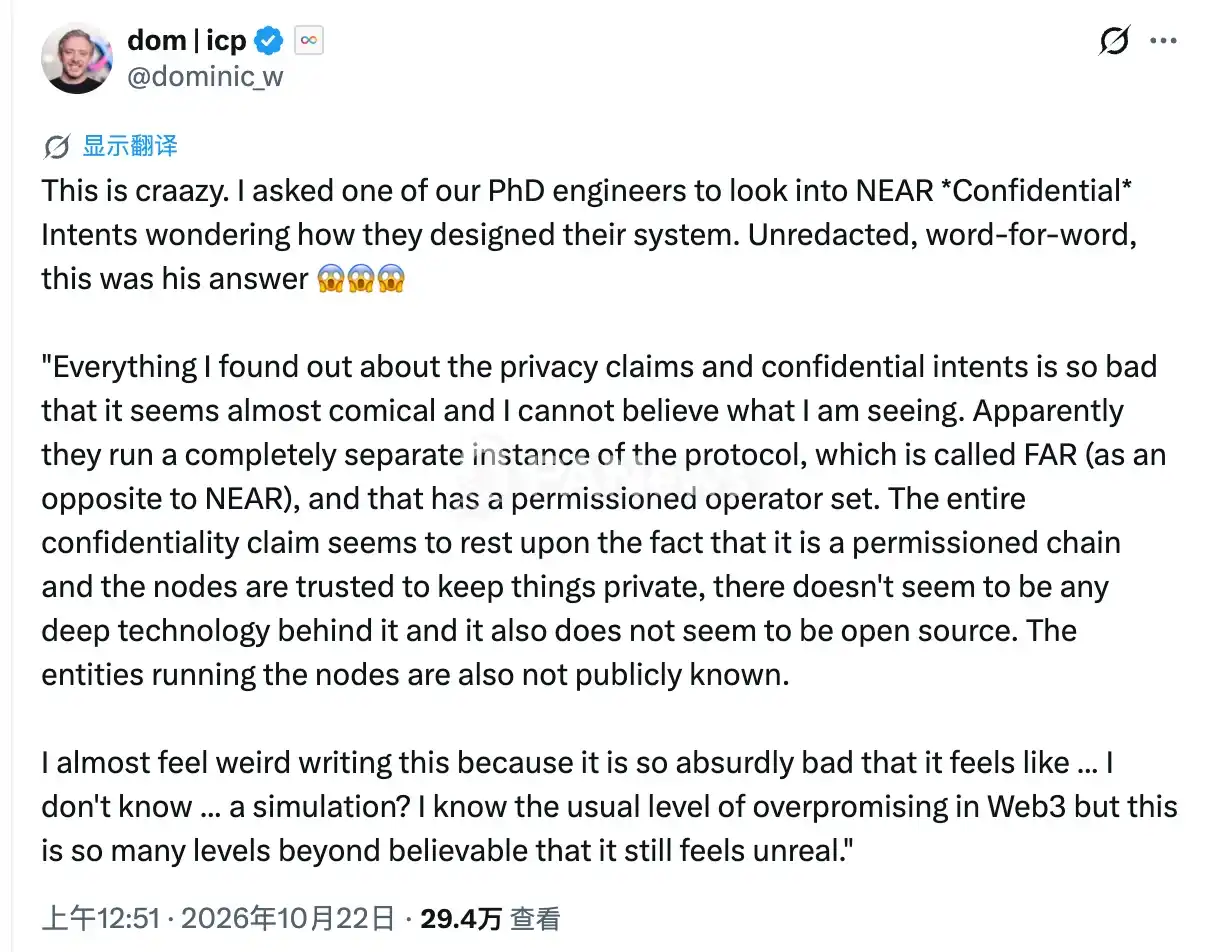
Williams questions NEAR’s privacy architecture
The dispute began with a post from Williams that drew heavy attention within hours and briefly pushed DFINITY back into the center of crypto discussion. The attention, though, was not tied to a product launch or a technical milestone. It came from the founder directly taking aim at NEAR, which has recently seen stronger momentum.
In the post, Williams focused on NEAR’s Confidential Intents privacy mechanism. He said he had asked a PhD engineer to study the system’s underlying design and that the feedback he received was hard to believe.
According to that engineer’s assessment as described in the report, NEAR appeared to run a separate protocol instance called FAR and used permissioned nodes. The privacy guarantees, in that view, seemed to rest mainly on the credibility of node operators rather than on deeper technical protections. The engineer also raised questions about whether the system was open source and whether the identities of node operators had been disclosed.
Williams said the situation went well beyond the kind of exaggeration commonly seen in Web3. He described it as something that felt 「like something happening in a simulated world」 and cast strong doubt on the real privacy guarantees offered by NEAR’s mechanism.
NEAR and outside founders push back
NEAR AI lead Cameron Dennis responded by calling the episode a sad FUD stunt. Dennis said the supposed “discovery” had already been disclosed in the original announcement for NEAR Intents. He also took a shot at Williams, saying the time would be better spent building products that actually create value.
Polygon founder Sandeep Nailwal also backed the NEAR team. He said NEAR was building a practical solution aimed at real user needs and argued that winning users comes from solving real problems, not from chasing technical perfection for its own sake.
Nailwal added another jab of his own, saying people obsessed with idealized technical purity may support so-called perfect solutions, but that support rarely lasts because they are never satisfied.
Community mockery spreads and a meme coin appears
The argument quickly moved beyond the principals involved. Some community users mocked the episode by saying a PhD had spent significant time researching only to arrive at information already clearly stated in NEAR’s public documentation. One comparison in the report likened it to a Michelin chef spending hours in study before finally realizing that an oven gets hot.
Other voices said DFINITY had long since become a fading Layer 1 and described the public criticism of NEAR as a textbook marketing attack. The backlash even produced a meme coin. According to the report, members of the NEAR community launched IKP based on Williams’ post. The name, “INDERNED KEPUTER,” was a parody of Internet Computer, or ICP. The report added that the fees generated by the token exceeded DFINITY’s revenue over the same period.
Market data sharpens the contrast between the two ecosystems
The intensity of the response was tied not only to the privacy debate itself, but also to the very different market positions of the two networks. On one side is NEAR, which the report described as seeing a recovery in price action, capital flows and ecosystem attention. On the other is DFINITY, whose market presence has continued to fade.
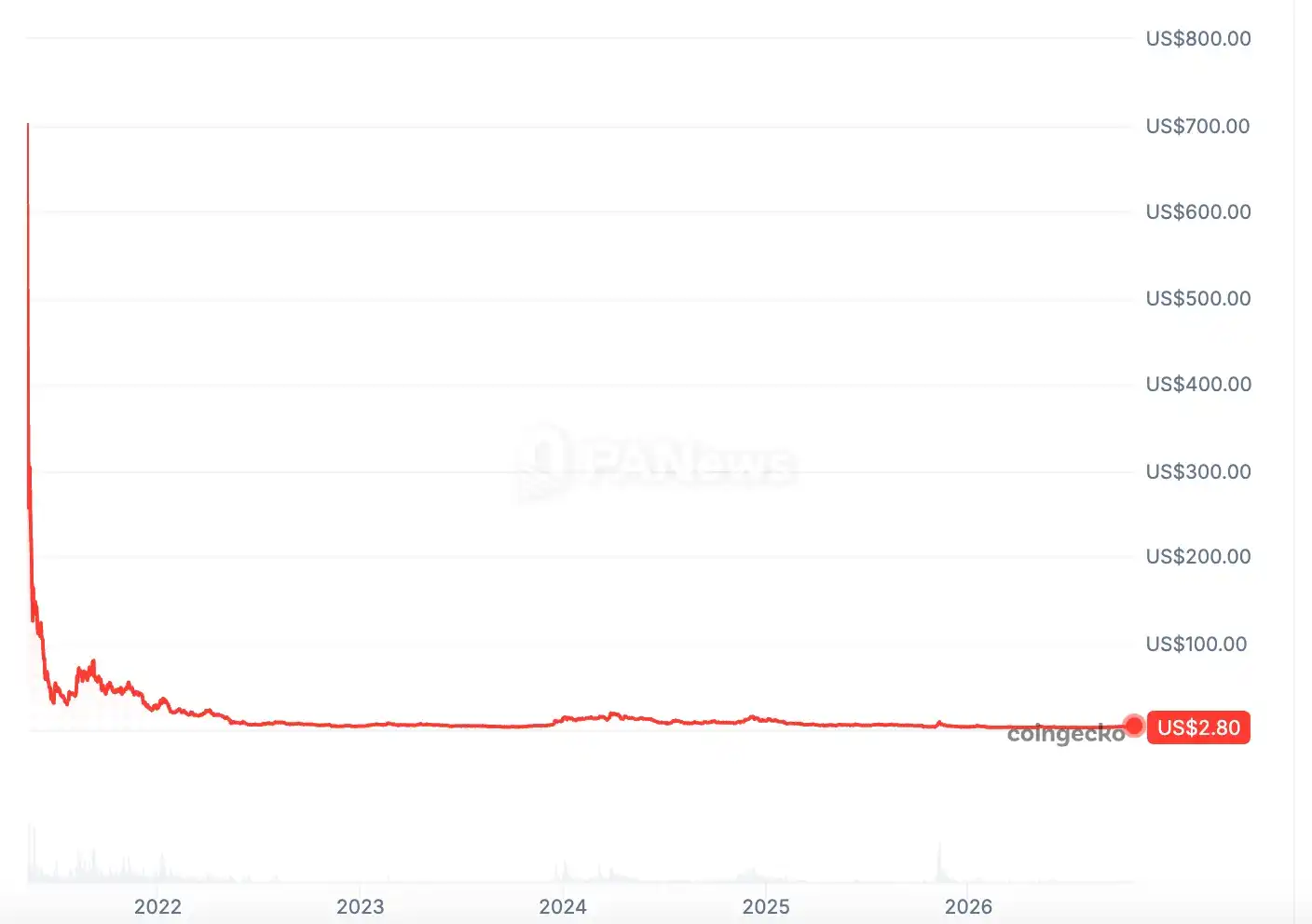
CoinGecko data cited in the report showed ICP trading at about $2.8 as of Oct. 22, down 99.6% from its all-time high and down about 7.6% over the past year. Earlier this year, the DFINITY Foundation released a new tokenomics white paper that aimed to cut ICP’s annual nominal inflation rate by more than 70% in an effort to improve the token model. Based on current market performance, the report said, that reform has yet to produce a clear lift in price.
NEAR, while also still far below its own peak, was up 126.2% over the past year, giving it a much stronger market profile over the same stretch.
On-chain figures point to a wide gap in traction
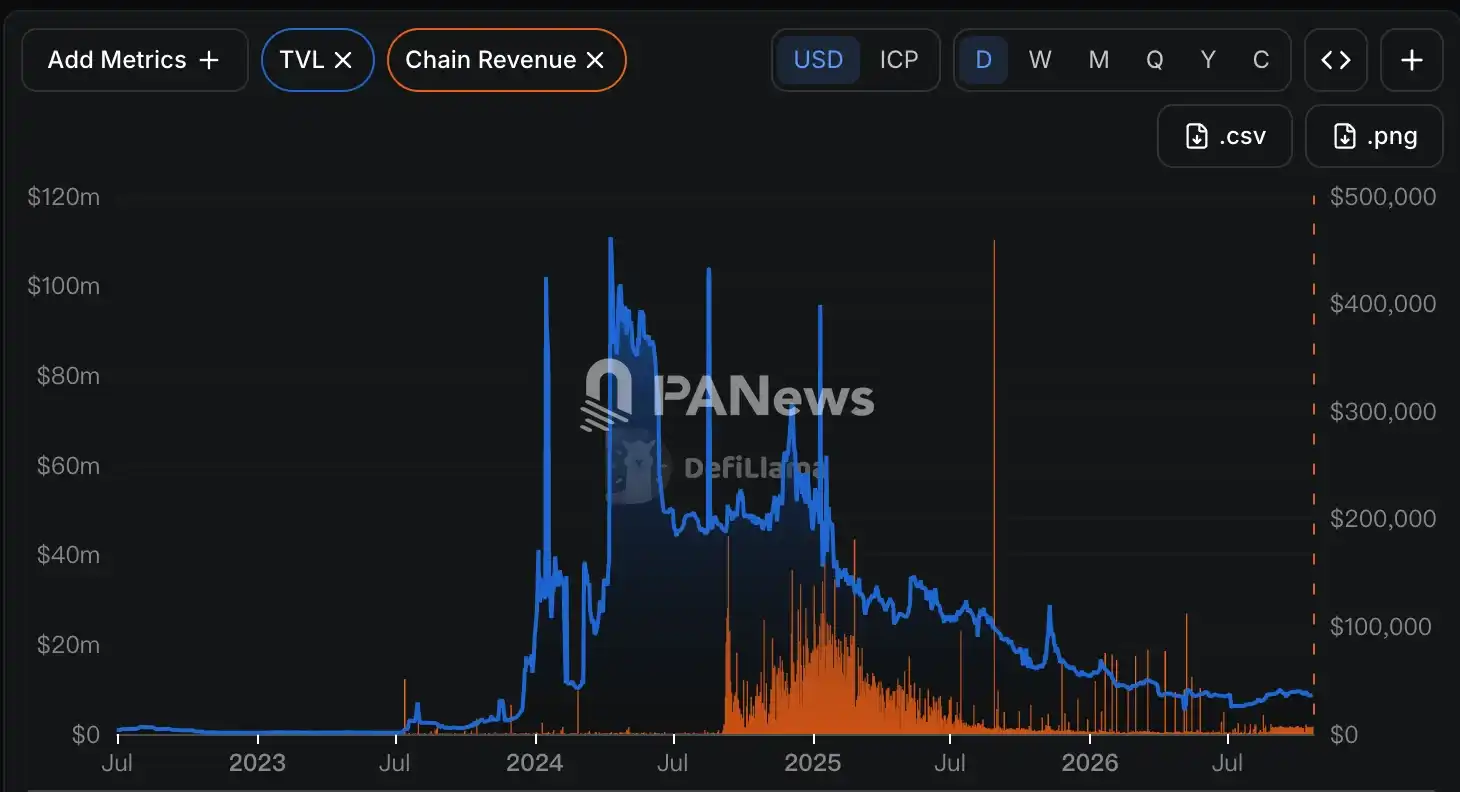
DeFiLlama data cited in the report showed ICP with total value locked of about $8.62 million as of Oct. 22, down more than 70% from its historical peak and still trending lower overall. Its chain revenue over the previous 24 hours was under $6,900.
NEAR’s TVL, by contrast, was above $230 million. That figure was also well below its historical high, but it had risen more than 5.6 times from this year’s low, a sign of much stronger capital returning to the ecosystem.
DFINITY is still pushing a strategic shift
Even with market pressure building, DFINITY has continued to reposition itself. The report said the project has spent recent months accelerating a shift away from the broad public-chain narrative and toward decentralized sovereign cloud and AI infrastructure.
Among the products mentioned was Utopia, a private cloud infrastructure offering designed for government agencies and enterprises, with a focus on securely running AI, managing digital assets and supporting data sovereignty for governments. Cloud Engines was described as a system that lets enterprises choose nodes, configure subnets and control the physical location of their data while keeping tamper resistance, uptime and interoperability with the mainnet. The report said 20% of revenue from that business would be used to buy back and burn ICP.
The report also listed Open SaaS, an open-source enterprise software suite described as deployable as easily as installing a mobile app and built with deep AI agent integration. Another product, Caffeine AI, targets natural-language application development and allows users, together with AI tools such as Claude Code and Codex, to generate, update and run production-grade applications directly.
DFINITY is also exploring ways to connect ICP ecosystem applications through conversational interfaces such as ChatGPT, allowing users to read or operate related data and functions directly, including schedules, to-do items and coordination across multiple applications.
A public spat that reflects a deeper loss of momentum
The report argued that the exchange cannot be separated from DFINITY’s broader slide in the Layer 1 race. Early governance and token distribution controversies, combined with a long period of weak token performance, have continued to erode market trust in the project.
At the same time, user activity, developer scale and enterprise adoption still need to improve, while token inflation pressure has not been fundamentally resolved.
With capital and attention increasingly concentrating around leading public chains, the argument sparked by Williams did little to change the central question hanging over DFINITY: whether its technical vision can be turned into real applications and measurable ecosystem growth.



