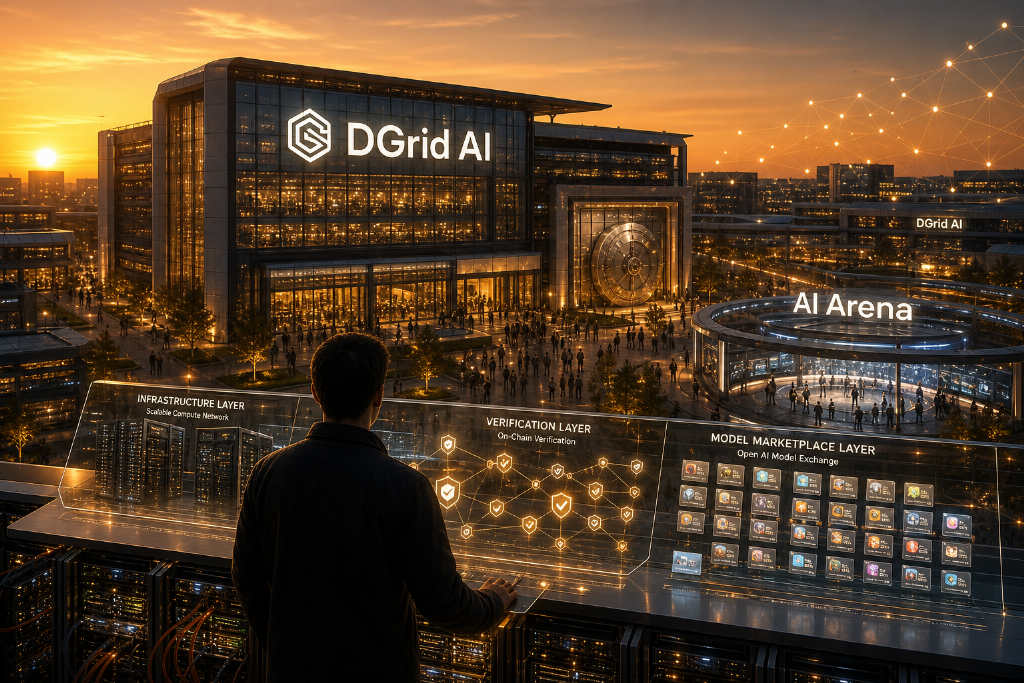
DGrid AI is framing its pitch around a simple claim: AI models may already be strong, but the infrastructure used to access them still is not trustworthy.
In a market analysis published by Foresight, DGrid is presented as an effort to rebuild AI infrastructure with on-chain quality verification, an open model marketplace, and token-based coordination. The article says the project wants AI services to become callable, verifiable, and settleable, rather than dependent on opaque centralized platforms.
As of the first half of 2026, DGrid had served more than 15,000 paying users and generated $23 million in verification revenue, according to the article. Its AI Arena had also attracted more than 500,000 users to participate in model evaluation. With the $DGAI token model now public and a token generation event set to begin, the project is described as moving from an AI service product toward a decentralized AI infrastructure protocol.
Three structural problems DGrid says still define AI services
The article breaks the current market into three core issues.
The first is what it calls a quality black box. If a company pays top-tier pricing through an aggregation platform to use Claude Opus 5 for sensitive documents, it may have no way to confirm whether the platform actually called that model, swapped in a cheaper version during peak periods, or altered the original output before returning it. In that setup, the platform controls the service flow and also acts as the judge of service quality.
That has different consequences for different users. Developers cannot reliably verify service quality or fine-tune product experience. Enterprises face a high trust cost when sensitive data or core business processes are involved. At the industry level, the absence of common quality standards can favor low-cost cheating over higher-quality service.
The second problem is vendor lock-in. The report describes a SaaS product that deeply integrates one model provider’s API into its business logic. If that provider later raises prices or changes service terms, switching is expensive. Code must be rebuilt, systems retested, and deployments repeated. Because each provider has its own API specification, authentication method, billing logic, and rate-limit policy, the switching cost climbs as integration deepens.
The third problem is closed value distribution. The article uses a medical AI team as an example, saying a model fine-tuned for clinical diagnosis may outperform general-purpose large models in its niche, yet still struggle to reach users without listing through a centralized platform. In that arrangement, the platform determines revenue sharing and traffic allocation, while suppliers, developers, and users remain outside the core value flow.
DGrid’s answer, as laid out in the article, is to use decentralized mechanisms to make quality verifiable, supply open, and value traceable.
A three-layer stack built around access, verification, and markets
DGrid AI is not described as a project that simply puts AI on-chain. Instead, the report presents it as a protocol stack built around three layers.
AI Gateway
The unified access layer is AI Gateway, which is meant to address vendor lock-in. DGrid says the gateway offers an OpenAI-compatible API, allowing developers to reach more than 200 models with a single API key. The list in the article includes Claude Opus 5, GPT-5.6, Gemini Pro, MiniMax, DeepSeek, Kimi, and GLM.
The gateway is built around intelligent routing, load balancing, standardized billing, and what the article calls zero migration cost. Routing is based on task type, cost budget, and latency requirements. If an upstream provider fails, traffic can move to a backup node. Billing is normalized through a Compute Unit mechanism, and developers only need to change the base_url parameter rather than rebuild their codebase.
The piece argues that this gives developers room to switch models, compare performance, and manage cost without being trapped by one provider.
Proof of Quality
The middle layer is Proof of Quality, or PoQ, which the article describes as DGrid’s core technical innovation. It says PoQ is DGrid’s proprietary on-chain quality verification mechanism and calls it the only quality verification protocol already deployed in AI infrastructure. The report adds that the system is backed by five technical papers.
PoQ is designed around random blind testing, multi-dimensional scoring, on-chain records, and slashing. DGrid maintains a question bank and randomly selects prompts to test model services offered by nodes. Outputs are then scored across quality, response speed, stability, and format compliance. Those results are written on-chain and used for both reputation and incentive allocation. If a node claims to offer GPT-5.6 but actually routes requests to a lower-tier model, the report says PoQ is meant to detect that behavior and slash the node’s stake.
The article stresses one design choice repeatedly: PoQ verifies the service a node claims to provide, but does not use real user call data in the verification flow.
Model Marketplace
The bottom layer is an open market. DGrid’s Model Marketplace allows model providers to list services, set prices, and receive call revenue directly through on-chain smart contract settlement.
According to the report, anyone with model resources or compute capacity can become a supplier. Providers set their own prices based on cost, performance, and demand. Listed models receive PoQ verification, and their quality signals are made public. Revenue from usage is distributed automatically through smart contracts rather than held by a platform operator.
The article says that structure is meant to help fine-tuned vertical models in areas such as healthcare, law, and finance reach paying users directly. It is also meant to give institutions with idle GPUs a way to deploy inference services and monetize them.
How PoQ works in practice
The report spends extra time on PoQ because it treats the mechanism as the hinge that makes an open AI market possible.
Without verification, the article argues, open listing quickly degrades. A node can claim to provide Claude Opus 5 while routing traffic to a cheaper model. Another can let reliability fall during high-demand windows. Others can return outputs that do not comply with API format requirements, increasing downstream handling cost.
PoQ is designed to check service quality without touching user privacy. The process has four steps.
First, DGrid builds a question bank that covers several task types, including code generation, text comprehension, reasoning and analysis, format conversion, and multilingual translation. Each question comes with a standard answer or a scoring framework.
Second, the system performs random spot checks. It periodically draws prompts from the bank and sends blind test requests to nodes. Nodes do not know whether a request is a test or a real user call.
Third, results are evaluated across multiple dimensions. The article lists answer accuracy, completeness, and logic under quality scoring; response delay and time to first byte under speed; success rate and error rate under stability; and output format compliance under standards checking.
Fourth, the scores are recorded on-chain to form a reputation profile for each node. Those records are public, tamper-resistant, and persistent. They also affect incentive weights, with stronger nodes receiving more $DGAI rewards, while fraudulent nodes face stake confiscation.
The article highlights three design points in that system. One is privacy protection, because only node behavior is tested and user data is not used. Another is anti-cheating, because randomness and blind testing prevent nodes from identifying audits in advance. The third is incentive compatibility, since PoQ is not a binary pass-or-fail system but one that feeds directly into rewards.
DGrid uses that framework to distinguish itself from projects such as OpenRouter and Infura. In the article’s wording, those systems depend on platform trust, while DGrid is trying to rely on verifiable mechanisms.
A product set aimed at four user groups
The report describes DGrid as an ecosystem rather than a single tool, with products built for four types of participants.
For developers, AI Gateway offers access to more than 200 models through one API, with intelligent routing and no major migration burden.
For model providers, Model Marketplace offers open listing, self-directed pricing, on-chain settlement, and PoQ-backed quality signals. The article points to vertical model teams in healthcare, law, and finance, along with suppliers that own exclusive models or lower-cost compute.
For ordinary users, AI Arena is positioned around anonymous model battles, human preference data, and rewards for participation. The report says it can be used by enterprises comparing models before procurement, by users contributing evaluation data, and by DGrid itself to refine routing and quality standards.
Current figures in the article put AI Arena participation above 500,000 users.
For agent developers, DClaw is presented as a one-click deployment product with on-chain identity and autonomous service access. The report says DClaw integrates BNB Chain’s ERC-8004 Agent Identity standard, giving agents on-chain identity, discoverability, and a path to reputation accumulation. It also says DClaw is part of the BNB Chain AI Landscape.
In the article’s own structure, AI Gateway addresses access, Model Marketplace addresses supply and revenue distribution, AI Arena feeds quality assessment and user data back into the network, and DClaw connects deployment with on-chain agent identity.
$DGAI as staking, payment, incentive, and governance infrastructure
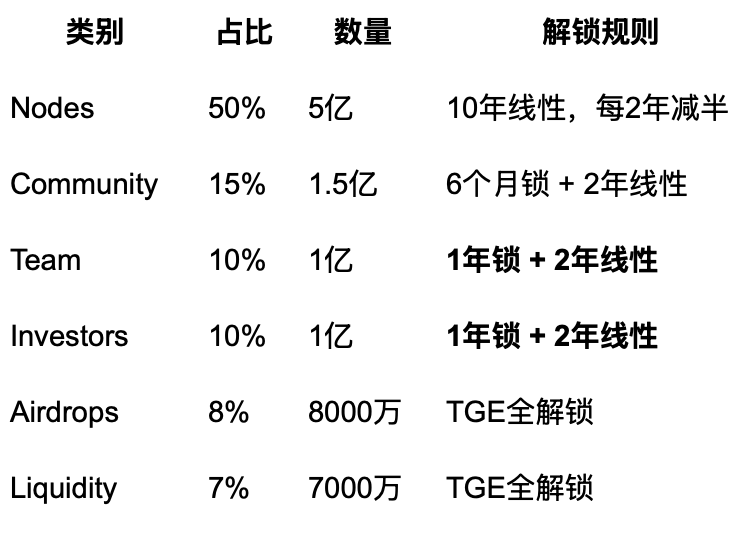
$DGAI is the native token of the DGrid AI network, with a total supply of 1 billion.
At the token generation event, only 15% will be unlocked, allocated to airdrops and liquidity, according to the report. Team and investor allocations remain fully locked for one year.
The article gives $DGAI four functions.
First, node operators stake the token as service collateral, with PoQ scores affecting incentive weights. Users can also delegate $DGAI to higher-quality nodes and share revenue.
Second, the token can be used to pay for AI services, with discounts available when payments are made in $DGAI.
Third, it acts as the reward asset for participants across the network, including nodes, model providers, agent developers, and AI Arena users. The article says these rewards are not distributed evenly, but vary according to quality and call volume.
Fourth, it serves as the governance token. Holders can vote on fee structures, PoQ rules, new model support, ecosystem incentive programs, and treasury use.
The report also sketches a value loop: users call services and pay in $DGAI, nodes provide inference and earn the token, PoQ verifies quality and changes reward weights, better-performing nodes collect more incentives, and that encourages more nodes, better services, and more users. The open question raised in the article is whether $DGAI can become a usage asset instead of remaining only an incentive asset.
Commercial traction and the transition to a decentralized network
The article lists several figures it treats as evidence of validation: $23 million in revenue in the first half of 2026, more than 15,000 paying users, more than 500,000 AI Arena participants, and a $5 million seed round.
It draws three conclusions from those numbers. One, product demand has already been tested by real revenue, with AI Gateway and premium services used by actual customers and enterprises. Two, capital efficiency appears strong, with $5 million in funding linked to $23 million in revenue. Three, community participation is meaningful, given the scale of AI Arena usage and the amount of human preference data generated through it.
The report places DGrid at what it calls a turning point between a centralized product and a decentralized network. On the product side, AI Gateway, Arena, and DClaw are already live and have real users. On the commercial side, the revenue line suggests paying demand exists. On the technical side, PoQ has already been deployed and is supported by five papers. On the token side, the $DGAI model is public and TGE is approaching.
The next test, as framed in the piece, is whether current revenue and user activity can be converted into ongoing decentralized call volume, a functioning supply-demand flow in the marketplace, and real usage for $DGAI.
How the article positions DGrid against rivals
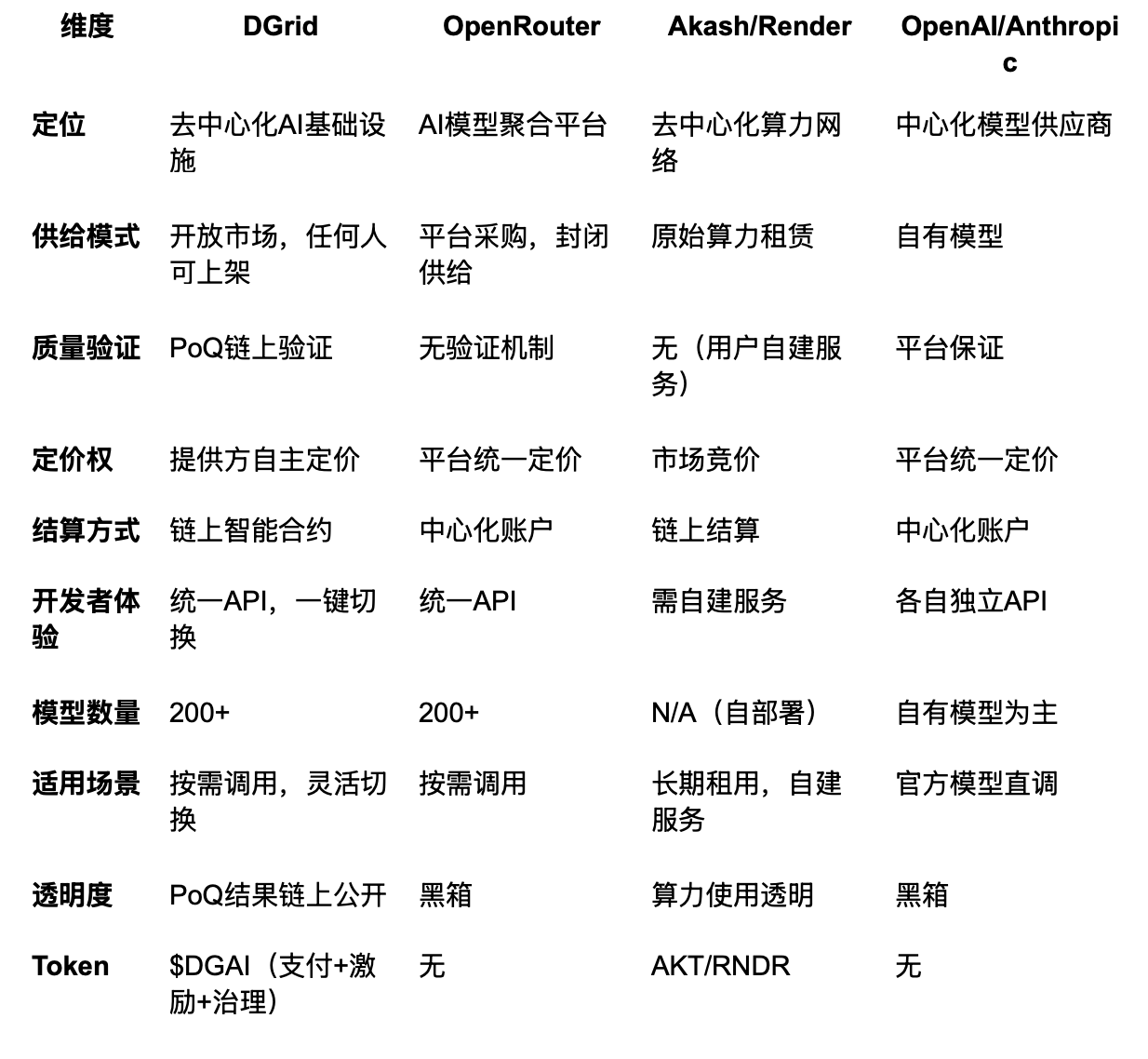
The comparison section puts DGrid alongside OpenRouter, Akash, Render, OpenAI, and Anthropic.
Against OpenRouter, the report notes that Stripe acquired the company for $7 billion, which it says validates the market value of AI aggregation. But it distinguishes the two by saying OpenRouter is a closed relay layer, while DGrid aims to be an open market. It also says OpenRouter lacks quality verification, while DGrid has PoQ on-chain verification.
Against Akash and Render, the article says Akash provides raw compute, while DGrid packages AI services for direct integration. In that view, Akash fits teams that want to build and operate their own services, whereas DGrid is aimed at developers who want faster integration. Akash is framed as a general-purpose compute network; DGrid as specialized AI infrastructure.
Against centralized platforms such as OpenAI and Anthropic, the report argues that pricing power and quality interpretation remain in the hands of the platform. DGrid’s counterproposal is verifiable quality through PoQ and market-driven pricing through Marketplace. The article adds that as model supply expands and vertical models become more important, an open market could support a much larger supply ceiling than a single-provider system.
What to watch next
The article lists three next steps for the project: launching the node network with staking and inference services, expanding Model Marketplace to attract more providers, and gradually opening governance rights to the community.
It also points to three indicators for judging progress.
- Network call volume: whether real AI service usage keeps growing, which would indicate whether $DGAI payment demand is real. The report suggests following monthly or quarterly call figures published by the project.
- Marketplace-side supply diversity: how many providers list, how many models go live, and what share belongs to vertical categories. The article treats this as a measure of whether the open market is actually functioning.
- Token utilization: whether $DGAI is genuinely being used for payments, staking, and governance rather than only trading. Suggested indicators include on-chain payment count, staking rate, and governance participation.
The report closes by arguing that AI infrastructure is shifting from centralized platforms toward open protocols. In DGrid’s version of that transition, AI Gateway handles access, PoQ handles service verification, Model Marketplace handles supply and value distribution, and $DGAI acts as the coordination layer linking participants across the system.
Its central question is direct: can DGrid turn callable, verifiable, and settleable AI services from product features into network rules? The article says that question is about to be tested as $DGAI goes live and the node network starts up.