
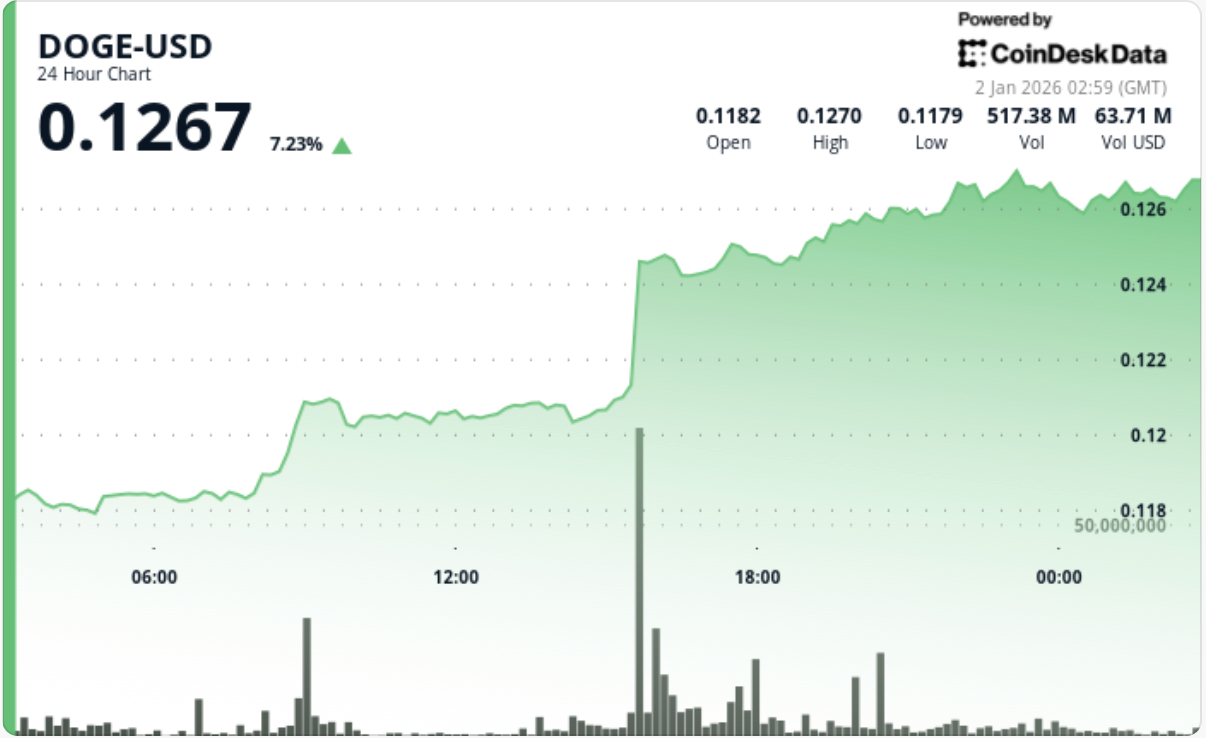
Dogecoin climbed from $0.1185 to $0.1263 over 24 hours, posting a 6.6% gain and briefly reaching near $0.127. The key shift was not just the size of the move. DOGE broke above the $0.121 resistance band that had capped several earlier recovery attempts, putting the market’s attention on whether the token can stay above the reclaimed area.
Breakout came with strong volume
The move was backed by a sharp jump in activity. Trading volume reached 1.23 billion DOGE, about 183% above the daily average. The main impulse came at 15:00 on Jan. 1, when price pushed to session highs. In a market that has recently seen thinner liquidity and more abrupt reactions to concentrated flows, a volume-led breakout carries more weight than a slow price drift higher.
The former ceiling around $0.120 to $0.121 is now being watched as a possible retest zone. That shift matters because resistance turning into support is often the first test after a clean breakout.
Double-bottom structure changed the short-term setup
According to the price structure described in the report, DOGE appears to have completed a double-bottom style base around $0.120-$0.121 before pushing higher. That changes the setup from a simple bounce to a breakout-and-hold trade, which is a different question for short-term participants.
Late in the session, DOGE held above $0.1245 and consolidated tightly around $0.1264. Volatility eased and volume faded after the spike, suggesting sellers did not immediately take control back. The rally also kept a higher-low sequence into the close, which is usually seen as a cleaner breakout profile than a fast move that reverses right away.
$0.1245 is the first line traders are watching
If $0.1245 to $0.125 continues to hold, the next area in focus is $0.132 to $0.134, the supply zone identified after the double-bottom break. A push through $0.132 could bring price toward $0.136 quickly.
If DOGE loses $0.1245, the breakout starts to look vulnerable and price could slide back toward the prior base near $0.121. If that level also fails on a retest, the report points to renewed downside risk toward $0.118 to $0.109.