
By Zen, PANews
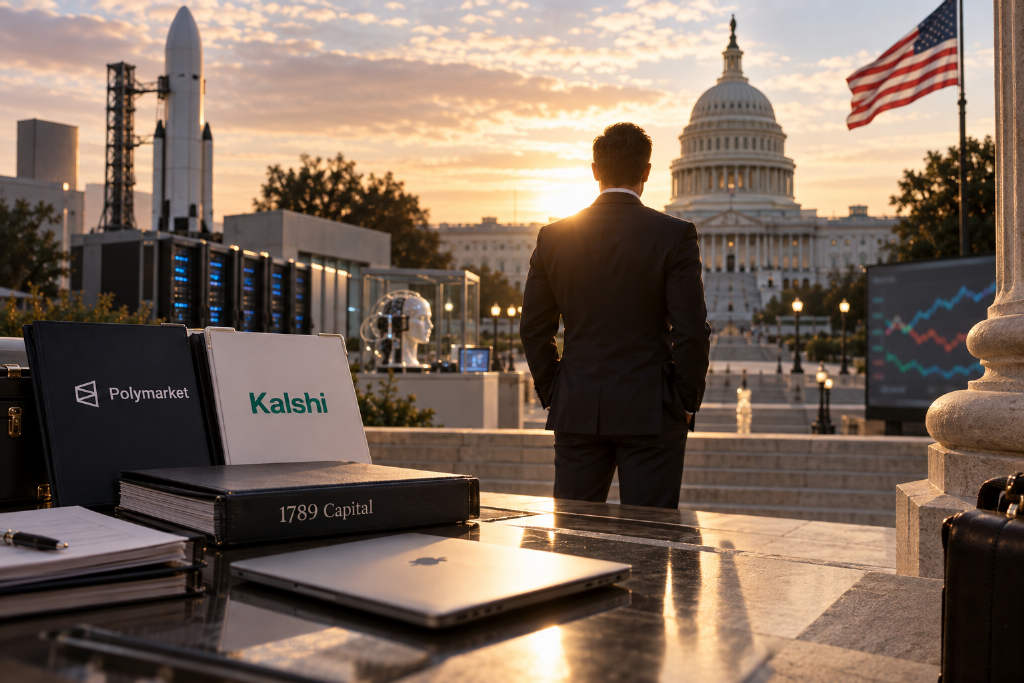
Venture firm 1789 Capital had about $150 million under management in 2024. By the summer of 2026, that figure had climbed to more than $3 billion, expanding by over 20 times in less than two years.
The firm is now in talks to raise $3 billion for a second growth fund and has already secured about $2 billion from existing investors. That pace stands out on its own. It draws even more attention because one of the firm’s partners is Donald Trump Jr.
From campaign surrogate to venture partner
In the summer of 2018, at a barbecue in the Hamptons in New York, Donald Trump Jr. was introduced by his then-girlfriend Kimberly Guilfoyle to banker Omeed Malik. At the time, Donald Trump was serving his first term in the White House, while Trump Jr. and his brother Eric were running the family real estate business their father had handed to them.
As Trump moved into presidential politics, Trump Jr. took on a larger political role of his own. During the 2016 election, the then-39-year-old was sent to towns and rural areas to win support for his father. In 2018 alone, he appeared at more than 70 events for Republican candidates and state party organizations. Through speeches, campaigning and fundraising, he built his own political network and developed a base among conservative supporters.
Malik became part of that orbit. The two men also shared a political message. In October 2020, they co-authored an article on the conservative website The Daily Caller criticizing U.S. corporate dependence on the Chinese market and arguing that companies should align with government national security goals and regain control of supply chains.
On the eve of the Capitol riot in early 2021, Trump Jr. and his father hosted the “Save America” rally. Trump Jr. took a hard line there, threatening to back primary challenges against Republican lawmakers who would not support his father. He went so far as to say, “This is no longer their Republican Party. This is Donald Trump’s Republican Party!”
By 2024, Trump Jr. was deeply involved in his father’s campaign to return to the White House. When Trump himself was tied up elsewhere, his son filled in. While Trump attended proceedings in his civil fraud case in New York, Trump Jr. campaigned for him at the Machine Shed restaurant in Urbandale, Iowa.
He also lobbied his father to choose his friend, Ohio Senator J.D. Vance, as vice president. On election night, Trump Jr. described his own effort in a half-joking way: “I used 10000% of my political capital.”
U.S. Vice President J.D. Vance, left, and Donald Trump Jr., right.
In November 2024, Trump won the presidential election and returned to the White House. On the evening of Nov. 10, the first weekend after that victory, Trump Jr. appeared at a Rockbridge donor event in Las Vegas. The gathering brought together aides and financial backers from Trump’s political camp. In front of hundreds of political donors, Trump Jr. announced that he would join 1789 Capital.
As his father moved back to the center of power, Trump Jr. chose a new title for himself: venture partner.
At 1789, he was tasked with sourcing investment opportunities, raising capital and shaping strategy. The firm’s website highlighted his broad relationships across companies and investors and said those ties could expand the firm’s network.
What 1789 Capital says it stands for
1789 Capital was founded in 2022 by Malik, Christopher Buskirk and major Republican donor Rebekah Mercer, and it was publicly launched in 2023. Its name comes from 1789, the year the Bill of Rights was proposed. The firm focuses on products and companies tied to conservative values and describes itself as anti-ESG, referring to environmental, social and governance investing.
Its investment thesis has been described as “patriotic capitalism.” Reshoring manufacturing, supply-chain security and businesses serving conservative consumers are all part of its target universe.
Before Trump Jr. joined, the firm had little public profile and limited access to capital and deals. In 2023 and 2024, it invested in five companies. One of its earlier better-known deals was participation in a $15 million financing round for a new media company launched by conservative host Tucker Carlson.
After Trump returned to the White House and Trump Jr. joined the firm, 1789 moved into a wider and more contested arena, backed by a network where politics and business overlapped.
A private club and a shared network
On the night of June 13, 2025, a private club called The Executive Branch, co-founded by Trump Jr. and Malik, held its opening party in Georgetown, Washington. The name is a direct reference to the executive branch of government.
According to the New York Post, founding members paid as much as $500,000 to join. Treasury Secretary Bessent, Commerce Secretary Lutnick and Nvidia founder Jensen Huang were among the guests. Photography was banned inside, and phone cameras had to be covered with stickers.
The club was offering more than a place to socialize. When government officials, technology entrepreneurs and political donors can meet in the same room, a hard-to-price form of access becomes a premium commercial service. The club is organizationally separate from 1789, but it draws on the same top-tier network.
The overlap did not stop there. During Trump’s campaign, Malik got to know Elon Musk, and 1789 later invested in SpaceX, xAI and Neuralink. In March 2025, the Financial Times reported that 1789 had invested more than $50 million in xAI and SpaceX.
In less than two years, 1789 posted what the PANews report described as rocket-like growth. Assets under management rose from about $150 million in 2024 to more than $3 billion by the summer of 2026, more than 20 times the earlier level.
According to a person familiar with the matter, the firm’s main investment fund had returned about 200% as of June 30 this year. Even though the investment cycle is still at an early stage, that figure was far above the roughly 21% average return for venture firms founded in 2023, based on data from financial data provider PitchBook.
The firm’s success also drew attention from House Democrats. In August this year, Representative Jamie Raskin sent a letter to 1789’s leadership seeking the firm’s investment list, records of communications with the government and information related to the decision to hire Trump Jr.
Trump Jr. and Malik acknowledged their ties to the president’s broader circle of donors, influential supporters and senior officials, but they rejected the idea that 1789’s success came from direct access to the president and brushed off the criticism.
Omeed Malik, left, and Donald Trump Jr., right.
Trump Jr. argued that, as a private citizen, he is free to invest and has done nothing illegal. He said he speaks with his father every few weeks but never discusses business with him, and that he holds no policy role or government position. Malik stressed his physical distance from the center of power, saying he had never set foot in the White House.
Still, even without direct contact with the president, Trump Jr.’s proximity to policymakers has drawn criticism when business and politics appear to overlap. In March this year, he spoke up for prediction markets at an event held by the Republican Attorneys General Association and argued that regulation should sit at the federal level.
Whether states can restrict those platforms under gambling laws has been a central dispute for the industry over the past year.
And Trump Jr.’s support for prediction markets was not detached from his own business interests.
Close to both Polymarket and Kalshi
In July 2024, during the Republican National Convention, Polymarket founder Shayne Coplan stood in a rooftop bar in Milwaukee wearing a black T-shirt, surrounded by Republicans in suits. Among the people at his table, Trump Jr. and Malik were among the most memorable.
Trump Jr. told Coplan that he liked what he saw on Polymarket and believed the platform’s election signals matched what he was hearing directly from voters.
Not long after that, 1789 made its first investment in Polymarket before the 2024 election. After Trump won and Trump Jr. joined 1789 as a partner, the firm invested in Polymarket again.
Polymarket, which drew broad attention during the U.S. election, was still restricted from entering the U.S. market at the time. Back in 2022, it settled with the Commodity Futures Trading Commission, or CFTC, over registration-related issues and paid a $1.4 million fine.
For Polymarket, the election brought traffic and visibility. Turning that into a larger business still required a regulatory solution.
Kalshi was moving on a separate track. In 2024, it won room through litigation to offer election contracts. The CFTC-regulated platform also came into the Trump family’s orbit.
By Trump Jr.’s own account, on election night at Mar-a-Lago, he and his relatives used Kalshi to track the race and became convinced of his father’s victory before television networks did. That story later appeared in Kalshi’s announcement that it had hired him, serving as a personal endorsement from the president’s son.
Two months later, on Jan. 13, 2025, one week before Trump’s inauguration, Kalshi announced that Trump Jr. would join as a strategic adviser. The company said it wanted to use his business experience and influence to reach more partners and users and bring prediction markets into the mainstream.
As part of that advisory role, Trump Jr. received Kalshi shares worth about $300,000. At the time, Kalshi’s valuation was still below $2 billion. As the company expanded, a financing round in May 2026 valued it at $22 billion.
Polymarket also hit a turning point in the summer of 2025. After criminal and civil investigations into the company ended, it bought QCEX, which held relevant CFTC licenses, for $112 million, laying out a compliance path back into the U.S. market.
On Aug. 26, Polymarket said it had received a strategic investment from 1789 and had appointed Trump Jr. to its advisory board. In November 2025, Polymarket received an amended designated order from the CFTC and began actively expanding in the U.S. market.
The two prediction-market rivals have long competed head-on for users and market share. On one point, though, they made the same choice: both brought in the president’s son. In February 2026, Kalshi founder Tarek Mansour told the Financial Times of Trump Jr., “He’s been very helpful.”
Trump Jr. and 1789 kept deepening their work with prediction markets. At the end of June this year, Coplan visited Malik’s home in the Hamptons to discuss how to improve Polymarket’s operations and prepare for a possible listing.
At the end of August, the Wall Street Journal reported that 1789 was leading a planned $1 billion financing round for Polymarket and was expected to invest about $300 million. The plan would value Polymarket at $21 billion.
From a shared table during the campaign to advisory roles, equity awards and follow-on investments, Trump Jr. has tied his own business interests closely to the future of prediction markets.
That brings the story back to 1789’s ongoing $3 billion fundraising effort. Investors are not only weighing products, orders and valuations at portfolio companies. They are also judging how much commercial advantage can come from a fund’s position near the center of power.
For Trump Jr., no matter how extensive the résumé or title, one fact remains impossible to separate from the rest: he is the president’s eldest son.