
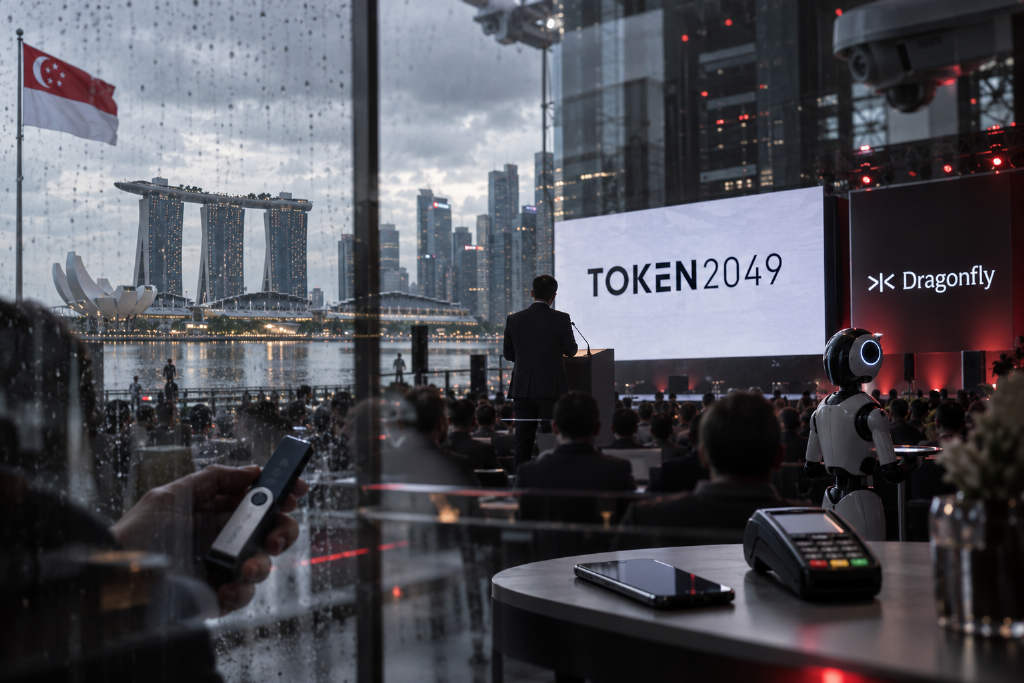
At TOKEN2049 in Singapore on Oct. 7, Dragonfly managing partner Haseeb Qureshi used his talk, titled Agents + Crypto: What's Real & What's Cope, to publicly revise his earlier view on how AI agents and crypto would intersect.
His updated thesis was direct: your agent does not need crypto; you do.
Qureshi says the agent payment thesis did not play out as expected
Qureshi opened by saying he had been wrong. He had previously argued that agents would end up using crypto and that traditional financial rails would not be ready before agents arrived at scale. He said that is not what happened.
He looked back at the market narrative from earlier this year, when agentic payments were widely pitched as an obvious breakout theme and many people argued that AI, not ordinary humans, would become crypto’s real end user. That story later reversed. Qureshi said agents did not adopt x402, Coinbase’s agent payment protocol, at scale, and added that 90% of payment volume on x402 came from farming activity.
Meanwhile, consumer-facing agents are already here. Qureshi said products in that category are growing quickly, with OpenAI also building in the space, but the payment method they use is mostly familiar: cards and credit cards.
He named Rain, Visa, Ramp and Stripe as companies that have already launched agentic card products. Those products can generate sub-cards under a user’s main card, set spending limits and restrict where the card can be used. In his telling, those companies recognized early that agentic commerce would matter and prepared for it.
Qureshi also used his own setup as an example. He said he gave his agent a crypto wallet and also gave it a card. In practice, most of the things the agent bought for him were paid for with the card.
He did not argue that cards solve every payment problem. In developed markets such as the United States, cards are widely accepted, but that is not true everywhere, and agents will not be limited to those markets. So cards are not the only answer. Still, he said the early-year claim that agents would use crypto because traditional rails would not be ready has been disproved. In his view, the rails are already ready.
That is the part he described as cope. Outside standard use cases such as international payments and large transfers, he said the overlap between agents and crypto is smaller than the market narrative suggested. The things agents will use crypto for are, in broad terms, similar to the things people already use crypto for today.
Agents could change crypto by making it easier and more dependable
For Qureshi, the more important point about agents is that they make hard things easy.
He first applied that idea to public services. Governments, he said, have long relied on complicated bureaucratic systems that ordinary people struggle to use. Filing court claims, submitting complaints to the Consumer Financial Protection Bureau, applying for benefits and making housing complaints all come with layers of friction. Now that AI agents can carry out those tasks on behalf of users, application volumes across many such services are surging and governments are getting flooded by agents.
His argument was that these systems were never designed for a world where everyone could submit complaints or applications with ease. They functioned as a kind of hidden rationing system, where difficulty and inconvenience acted as the throttle. In the agent era, that throttle breaks.
The same logic, he said, applies to crypto. Crypto remains hard for ordinary users because wallets are difficult, gas fees are confusing and cross-chain bridges are not intuitive. On top of that, users make costly mistakes all the time. He cited hacks, phishing and honeypots as examples and said a meaningful share of assets has been permanently lost because of those errors.
That is why he sees one of the biggest effects of agents on crypto not in payments, but in reliability. Agents can protect users from their own mistakes.
Qureshi compared that role to what banks do today. He said that even after more than a decade in crypto, he still feels uneasy when sending a large amount from a wallet because of the risk of making a serious mistake. He does not feel the same way when moving money through a bank account, because the bank acts as an intelligence layer between him and his money and can stop obvious errors.
Once AI becomes the API for crypto, he said, a similar layer can emerge in crypto itself. Agents could screen for phishing, keep users away from fake interfaces created through DNS poisoning, check contracts before users interact with them and verify addresses before funds are sent. His point was simple: agents do not get lazy, skip steps or get tired in the way people do. Five years from now, he said, people will not use crypto the same way they do today, and the trust relationship between users and crypto will be reshaped.
Privacy, in his view, was never really a right but a function of friction
Qureshi then turned to privacy. He said privacy has never truly been a right in practice and that what people historically experienced as privacy was closer to a rationing system created by real-world friction.
He cited a U.S. Supreme Court justice in a GPS tracking case, saying that in the pre-computer era the strongest protection for privacy was not constitutional or statutory. It was practical. Privacy existed in part because police did not have the time or resources to follow every suspect around the clock.
He said technology has changed that balance. Qureshi also referred to Anthropic founder Dario Amodei’s clash with the U.S. Department of Defense, saying Amodei made a similar point: powerful AI makes it possible to automatically and at scale assemble a full picture of any person’s life. Personal data is already scattered across leaks, he said, and the dark web is full of fragments about everyone. In the past, cost was what stopped others from putting the whole picture together.
He pointed to the recent controversy around U.S. camera company Flock as a clear example. Cameras on street corners are not new and are not necessarily illegal. The difference is scale. When every corner has a camera and AI can search all footage instantly, quantity becomes a qualitative shift, and governments can move much closer to always knowing where everyone is. The only real change, he said, is the technology.
Qureshi argued that crypto is seeing a parallel trend. Physical attacks against crypto holders rose sharply in 2025 and 2026, with reported incidents reaching an all-time high. For people whose holdings are publicly visible, the old comfort was that no one would spend the effort to target them personally. As the cost of finding and profiling targets falls, that comfort weakens.
AI strengthens the state, while crypto can push power back to the individual
From there, Qureshi framed AI and crypto as moving in opposite directions on power. AI, he said, fundamentally empowers the state by removing old constraints: governments no longer have to be slow, clumsy or unable to interpret data. Crypto does the reverse. It shifts power away from governments and back toward individuals.
In a world where governments are becoming stronger and more capable of seeing everything, he said, crypto is the only hedge available to individuals.
He also acknowledged a long-running problem with privacy: people say they care about it, but in practice they hand over chats and data to Meta, ChatGPT and Google. Privacy wins only when it is easy, he argued, not simply because it matters.
He used the history of internet security to make that case. HTTPS became the default only after Let’s Encrypt made certificates close to free. Before that, SSL was slow and expensive and was often limited to checkout pages. Messaging followed the same pattern. Billions of people only ended up using encrypted communication after Signal became easy to use and WhatsApp rolled out end-to-end encryption broadly. He said Zcash is now showing the same dynamic, with better user experience directly helping drive growth in shielded address usage.
That led to his central privacy claim: AI will push privacy through the same kind of transition. A user’s AI agent could become a defensive layer against privacy violations. If the agent is strong enough, he said, a user should be able to say something like, “make me invisible,” and have the system erase public traces, improve operational security, remove personal information from the dark web and model how an attacker might find or target them.
He added that privacy protocols such as Zcash are still hard to use today, but if agents become the interface through which people access crypto, much of that complexity can disappear for the user. In that setup, the agent could decide when not to use Bitcoin, when to use Zcash instead and when plaintext should be replaced with encrypted text.
Private AI is the final piece, Qureshi says
Qureshi closed by saying the final piece of the picture is private AI.
He cited Venice, a privacy-focused AI platform in Dragonfly’s portfolio, as an example. He described it as a private version of ChatGPT that runs on crypto rails underneath. According to Qureshi, users can even access it anonymously by registering with an Ethereum address and paying with stablecoins.
He said this will be one of the most important civil-liberties battles of the next decade. The first question is how individuals protect themselves as state power keeps expanding. The second is how people retain control over AI, which he called the most politicized technology of the coming decade.
His conclusion returned to the point he started with. The story that agents will use crypto for everything they do does not hold up, he said. For most consumers, agents will use the same tools people already use. But in his final formulation, the real need for crypto belongs not to the agent, but to the person behind it.