
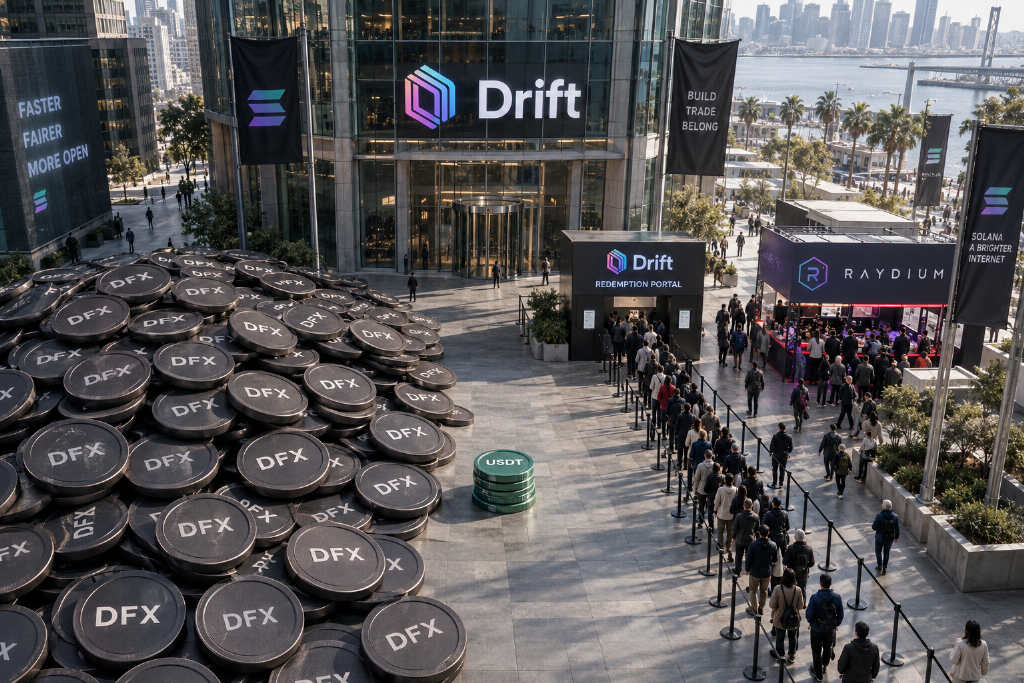
Drift Foundation opened claims and redemptions on Oct. 2 for the April 1 security incident.
Affected users can receive newly issued DFX compensation tokens at a rate of 1 token for every $1 of verified loss. DFX is a standard SPL asset on Solana with a fixed supply of about 299.5 million tokens, matching roughly $295.4 million in verified losses, and the supply will not increase.
Users can burn DFX through the official portal and redeem it for USDT at the prevailing redemption price, or move the token to secondary markets including Raydium for trading. The redemption price is calculated by dividing the balance of the recovery pool by the amount of DFX that has not yet been burned.
Current pool balance implies a redemption price near $0.0104
The recovery pool currently holds about 3.11 million USDT, implying a redemption price of around $0.0104 per DFX. At that level, users can recover only about $1 for every $100 in losses at the moment.
The ratio quickly drew heavy criticism from the community. Some users said the nominal "full-value certificate" now covers only about 1% of losses in practice, leaving claims effectively marked down by 99% compared with earlier expectations of full compensation.
Future funding sources were not in the pool on launch day
The plan also lists several potential future sources of value, including up to $127.5 million in support from Tether, up to $20 million from partners, fee-sharing from the new trading platform Velocity, and any funds that may be recovered from the exploit.
But most of those amounts are caps or phased arrangements, and they had not entered the recovery pool when claims opened. As a result, they were not reflected in the initial redemption value.
DFX market price climbed to about $0.03
Even with redemption value still around $0.0104, DFX has risen sharply since trading opened. Secondary-market trades moved from about $0.01 to roughly $0.03, a 24-hour gain of around 210%.
That move reflects expectations for future inflows rather than an increase in the recovery pool balance. Because DFX is freely transferable, its trading price does not have to match redemption value. Current liquidity is only about $200,000, meaning relatively small buy orders can move the market.
Buyers are mainly betting on future inflows and token burns
Based on views circulating in the community, buyers appear to be pricing in two main possibilities.
- If Tether funding, partner support, protocol revenue, and recovered assets arrive over time, the redemption price could in theory rise well above the current level of about $0.01.
- If users redeem early and unclaimed tokens are burned after the claim window closes on Jan. 1, 2028, then any later inflows would be shared across a smaller amount of outstanding DFX.